
On this page
Start here
Quick answer
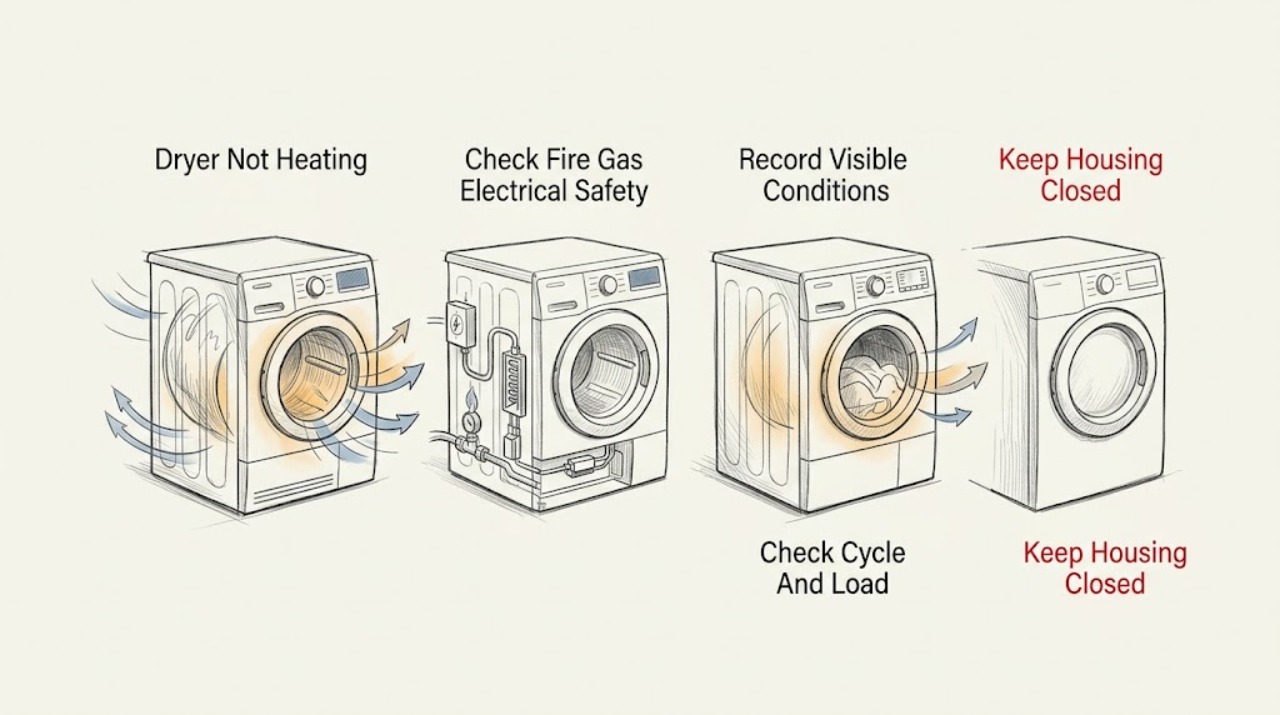
First determine whether the Frigidaire dryer is electric or gas and whether the drum runs but stays cold, heats weakly, or never starts. Stop for gas odor, smoke, sparks, scorching, a hot or damaged cord or receptacle, a blocked or damaged lint filter, or an exhaust that overheats. For a gas odor, leave the building and call the gas supplier or emergency services from outside; do not use switches or the dryer. If there is no hazard, check the cycle and temperature setting, the accessible breaker or fuse condition, the lint filter and visible exhaust path, and for gas models the supply status only as the installation guide permits. Frigidaire's official support notes that electric dryers can tumble without heat when part of their supply is lost, while gas models need gas supply, air, and ventilation. Use the exact model guide for a single reset or test. If the dryer still does not heat, the issue returns, airflow is restricted, or diagnosis requires opening the cabinet or measuring live circuits, stop and arrange qualified appliance or electrical service.
Before you begin
Safety first
- This article supports ordinary-access observation and model-approved controls only. Do not move a gas dryer, open panels, measure live circuits, inspect or alter gas components, bypass protective devices, or operate with unsafe airflow.
Work through in order
Diagnostic checks
Use only checks that match the exact appliance or system and its official guide.
-
Check 1
Stop the dryer and inspect only from a safe distance for gas odor, smoke, sparks, arcing, scorching, an unusually hot or damaged cord or receptacle, or a blocked, damaged, or missing lint filter; if no hazard is present, turn the controls off normally.
Expected result: Record whether the odor is gas-like or scorched, whether smoke or sparks are visible, whether the cord or receptacle shows heat damage, and whether the filter or exhaust path is visibly obstructed without touching a hot or damaged area.
Next step: For gas odor, leave immediately and call the gas supplier or emergency services from outside; for smoke, sparks, scorching, or electrical damage, keep the dryer off and arrange qualified service.
Stop if: Do not restart a gas-smelling, smoking, sparking, scorched, overheated, or electrically damaged dryer.
Why this matters
Why: A gas, fire, electrical, or lint hazard overrides heating diagnosis. A normal exterior permits the non-invasive checks below but does not make cabinet access or live testing safe.
-
Check 2
Record the Frigidaire model and serial information, identify electric or gas operation from the model guide, and note the selected cycle, temperature, drum movement, display, and whether the dryer is cold from the start or loses heat later.
Expected result: Classify the event as no start, tumbles with no heat, brief heat then shutdown, weak or intermittent heat, or normal heat with unusually long drying; note whether one cycle or all heat cycles are affected.
Next step: Use the exact Frigidaire owner or installation guide for the recorded model before changing settings or performing a reset.
Stop if: Stop if the model, fuel type, or display cannot be established without removing a panel or disturbing the installation.
Why this matters
Why: An Air Fluff or no-heat setting can tumble normally, while a type-specific supply or thermal symptom needs a different path. The model identity controls the safe procedure and prevents transferring gas, electric, or code guidance between products.
-
Check 3
With no hazard present, confirm that the selected cycle and temperature call for heat, then use a reasonable load or the model guide's permitted test load; leave room for items to tumble and do not use a cycle intended to run without heat.
Expected result: Record whether the dryer heats on a documented heated cycle, whether it remains cold on every cycle, and whether a tightly packed or very small load changes the drying result.
Next step: Correct only the documented cycle or load condition and run one supervised model-approved test; if it remains cold, continue with the type-specific external checks.
Stop if: Do not keep running a dryer that smells scorched, overheats, shuts down, or has restricted exhaust while testing load size.
Why this matters
Why: A no-heat setting or unsuitable load can mimic a heater failure. A cold drum on every appropriate cycle suggests a supply, heating, control, or safety-device problem that cannot be identified from the load alone.
-
Check 4
For an electric Frigidaire dryer only, inspect the accessible breaker or fuse condition and the plug and receptacle from the outside without opening the electrical enclosure; follow the model guide for any permitted reset.
Expected result: Record whether the drum runs while heat is absent, whether a breaker is visibly tripped or a fuse condition is indicated, and whether the plug or receptacle is loose, hot, scorched, or damaged.
Next step: Use only the model and household electrical instructions for a single accessible reset; if heat does not return, the breaker trips again, or the receptacle is damaged, keep the dryer off and arrange qualified service.
Stop if: Do not remove the outlet cover or dryer panel, measure live voltage, replace a fuse with a different type, or repeatedly reset a tripping breaker.
Why this matters
Why: Frigidaire notes that an electric dryer can tumble when part of its household supply is unavailable, but a normal-looking breaker does not prove that the supply or heating circuit is healthy. Heat damage or a repeat trip needs qualified electrical assessment.
-
Check 5
For a gas Frigidaire dryer only and only when there is no gas odor, confirm from ordinary access that the supply status matches the installation guide, the fuel supply has not been interrupted, and the area around the dryer is not blocked by laundry, rugs, or stored items; do not move the appliance.
Expected result: Record whether the supply status is normal, whether the dryer is connected to the intended fuel source, whether ignition attempts are normal or absent, and whether combustion-air clearance is obstructed.
Next step: Correct only an obvious external clearance or supply condition that the installation guide permits, then perform one supervised model-approved test; if heat does not return, stop using the dryer and request gas-appliance service.
Stop if: If gas odor appears, leave immediately; do not move the dryer, inspect or flex its connector, relight repeatedly, open panels, or perform a gas leak test.
Why this matters
Why: Frigidaire identifies gas supply, fuel availability, air supply, and ventilation as possible reasons a gas dryer does not heat. A normal external supply with no heat points toward ignition, burner, thermal, control, or wiring diagnosis by a qualified technician.
-
Check 6
With the dryer off and cool, clean or restore the lint filter only as the Frigidaire guide permits and inspect the visible exhaust outlet and duct entrance for lint, crushing, disconnection, or a blocked hood without dismantling the duct or opening the cabinet.
Expected result: Record whether the filter is present and clear, whether exhaust air is weak or absent during a permitted test, whether the duct is visibly restricted, and whether the dryer becomes unusually hot or shuts down.
Next step: Restore only the documented filter and external vent condition, then run one supervised model-approved test; arrange service or qualified vent cleaning when airflow remains weak or heat behavior is abnormal.
Stop if: Do not operate without the lint filter, use the dryer with a blocked or damaged exhaust, insert tools into the duct, or continue after overheating or a scorched odor.
Why this matters
Why: Frigidaire says a blocked, damaged, or missing lint filter and a restricted exhaust can impair drying and create an unsafe condition. A clear external path with persistent no heat or overheating points to an internal or installation fault.
-
Check 7
After the applicable checks are complete and the exact model guide permits it, run one supervised heated test and stop at the first abnormal odor, smoke, excessive heat, shutdown, or repeated no-heat result.
Expected result: Record whether heat returns and remains stable, whether the dryer completes the cycle, and whether any alert, odor, weak exhaust, or breaker or fuse problem recurs.
Next step: Keep the dryer off and provide the technician with the model, type, cycle, load, supply, airflow, sound, odor, display, and test notes; use Frigidaire support or qualified appliance service.
Stop if: Do not repeat failed tests, bypass a thermal or door safety device, open panels, or replace a heater, igniter, fuse, thermostat, gas valve, control, or sensor by symptom alone.
Why this matters
Why: A stable result after a documented setting, supply, filter, or vent correction supports that external condition as a contributor. Recurrence or no heat after a clear path requires diagnosis of the heating, ignition, thermal, control, or wiring system.
Use your observations
Decision map
Find the observation that best matches what you see, then follow the next safe action.
-
PATH 01Safety boundary
What you see
Gas odor, smoke, sparks, arcing, scorching, a hot or damaged cord or receptacle, or severe overheating is present.
Do this next
For gas odor, leave immediately and call the gas supplier or emergency services from outside; for fire or electrical signs, keep the dryer off and arrange qualified service.
Why this path and its safety boundary
Why it matters: This is a safety stop, not a no-heat troubleshooting path.
Safety stop: Do not restart, operate switches inside a gas-smelling space, move the dryer, or open a panel.
-
PATH 02Safety boundary
What you see
The dryer is using a no-heat setting, or the load is obviously outside the model's loading guidance, while the dryer has no hazard.
Do this next
Correct only the documented cycle or load condition and run one supervised heated test.
Why this path and its safety boundary
Why it matters: The selected cycle or load can explain a cold or slow-drying result without proving a failed heater.
Safety stop: If the drum remains cold on an appropriate cycle, stop repeated tests and continue to service escalation.
-
PATH 03Safety boundary
What you see
An electric dryer tumbles but does not heat, and an accessible breaker or fuse condition or damaged receptacle is found.
Do this next
Follow the model and household electrical instructions for one accessible reset only, or arrange qualified electrical service for heat damage or a repeat trip.
Why this path and its safety boundary
Why it matters: Frigidaire notes that partial household supply can allow drum movement without heater operation; the supply still requires safe confirmation.
Safety stop: Do not open an enclosure, measure live voltage, or repeatedly reset a tripping breaker.
-
PATH 04Safety boundary
What you see
A gas dryer has no odor, but its permitted external supply status, fuel availability, or combustion-air clearance is abnormal.
Do this next
Correct only the external condition the installation guide permits, do not move the appliance, and request service if heat does not return.
Why this path and its safety boundary
Why it matters: Gas supply or ventilation may contribute to no heat, but the fuel system and connector are not owner-repair targets.
Safety stop: For any gas odor, leave immediately; do not relight repeatedly or investigate the connector.
-
PATH 05Safety boundary
What you see
The lint filter or visible exhaust path is blocked, damaged, disconnected, or produces weak exhaust, or the dryer overheats or shuts down.
Do this next
Keep the dryer off, restore only the documented filter or external vent condition, and arrange qualified vent or appliance service when airflow remains weak.
Why this path and its safety boundary
Why it matters: Restricted airflow can impair drying and create a fire or thermal-protection concern.
Safety stop: Do not operate without the filter, continue through overheating, or dismantle the duct as an ordinary-user repair.
-
PATH 06Safety boundary
What you see
The correct cycle, external power or gas status, airflow, and one permitted test are normal, but heat remains absent or returns intermittently.
Do this next
Keep the dryer off and arrange qualified appliance service with the model, fuel type, cycle, display, supply, airflow, and test notes.
Why this path and its safety boundary
Why it matters: An internal heater, igniter, gas valve, thermal device, sensor, motor switch, control, wiring, or installation issue remains possible; the symptom does not identify a part.
Safety stop: Do not open panels, perform live measurements, bypass protective devices, or substitute parts by symptom alone.
Helpful context
Understand the symptom
Start with the symptom and dryer type
A drum that tumbles with no heat, a dryer that stops before heat begins, and a dryer that heats but dries slowly do not point to the same check. Read the normal model label or guide to identify electric or gas operation, then note the cycle, temperature, drum movement, heat, display, and any odor. Do not assume that another Frigidaire model uses the same controls or fault meanings.
Frigidaire's user checks are external and model-specific
Frigidaire's heating guidance says an electric dryer may tumble without heat if part of its household supply is interrupted. For gas models it identifies the gas supply valve, fuel supply, air supply, and ventilation as installation considerations. Those checks do not authorize opening the cabinet, measuring live voltage, disturbing the gas connector, or replacing a heater or burner by guesswork.
Airflow is part of both heating and fire safety
Check the lint filter and visible exhaust path from ordinary access. Frigidaire advises not to use a dryer when the lint filter is blocked, damaged, or missing and says the exhaust duct should not be restricted. A dryer that overheats, shuts down, smells scorched, or has weak exhaust needs to remain off until the airflow and appliance are assessed.
Use one documented test, then escalate
After correcting only a clearly documented setting, external supply, filter, or vent condition, perform one model-approved test while staying nearby. Record whether heat returns, whether the cycle completes, and whether the problem recurs. A persistent no-heat symptom may involve a thermal fuse, thermostat, heater, igniter, gas valve, motor switch, sensor, control, wiring, or installation; the symptom alone does not identify a safe part.
Safety boundary
Stop conditions
- Stop for gas odor, smoke, sparks, arcing, scorching, a hot or damaged cord or receptacle, severe overheating, or a blocked, damaged, or missing lint filter.
- For gas odor, leave immediately and call the gas supplier or emergency services from outside; do not use switches, phones, matches, or the dryer inside.
- Do not move a gas dryer, inspect or flex its connector, open panels, perform live electrical or gas testing, or bypass a thermal or door safety device.
- Do not operate without the lint filter or with a blocked, damaged, or disconnected exhaust, and do not keep running the dryer after a scorched odor or abnormal shutdown.
- Stop repeating resets or test cycles when heat remains absent, an alert returns, a breaker trips again, or the exact model guide does not explain the result.
When checks do not resolve it
Need a professional?
Arrange qualified Frigidaire appliance service when the correct cycle, model-approved external supply check, lint filter and exhaust inspection, and one permitted test do not restore heat; when the dryer overheats, shuts down, trips protection, produces an odor, or has an alert; or when diagnosis requires cabinet access, gas-system work, or electrical testing. For gas odor, leave immediately and contact the gas supplier or emergency services from outside. Provide the model and serial information, fuel type, cycle, load, heat behavior, supply observations, airflow result, and any odor or display details.
Safety scope: This article supports ordinary-access observation and model-approved controls only. Do not move a gas dryer, open panels, measure live circuits, inspect or alter gas components, bypass protective devices, or operate with unsafe airflow.
Read the exact guide
Official sources
- My dryer is running, but does not seem to be heating. What should I do?Frigidaire · Frigidaire's official dryer support page provides general electric and gas heating guidance; exact installation instructions and the complete owner guide control a particular model.
- Certain Older Gas Connectors May Be DangerousU.S. Consumer Product Safety Commission · CPSC consumer gas-appliance safety bulletin; its evacuation and no-ignition-source instructions apply when gas is smelled or suspected, while connector inspection belongs to qualified professionals.
Community feedback
Share a repair observation
Share a plain-text repair observation. Accepted observations are published automatically; this page may take a moment to update.