
On this page
Start here
Quick answer
If a Frigidaire dryer starts empty but will not start or keep running with clothes inside, first confirm the load is not oversized and that the start control, cycle selector, door, cord, outlet, and breaker are correct. Frigidaire says an overloaded dryer can overheat the motor, recommends an average wet load around one-third to one-half of the drum, and says to let an overheated motor cool for 30 minutes before reducing the load. A load-dependent failure that returns after cooling is not proof of a bad belt, motor, switch, or thermal limiter; stop repeated attempts and arrange service. Keep the lint screen installed, check the accessible exhaust path and hood, and never operate a gas dryer without an exhaust duct venting outdoors. Do not open the cabinet or bypass a thermal or door safety device.
Before you begin
Safety first
- Do not open the cabinet, bypass a thermal limiter or door switch, run without the lint screen, run a gas dryer without outdoor exhaust, or keep retrying a load-dependent failure.
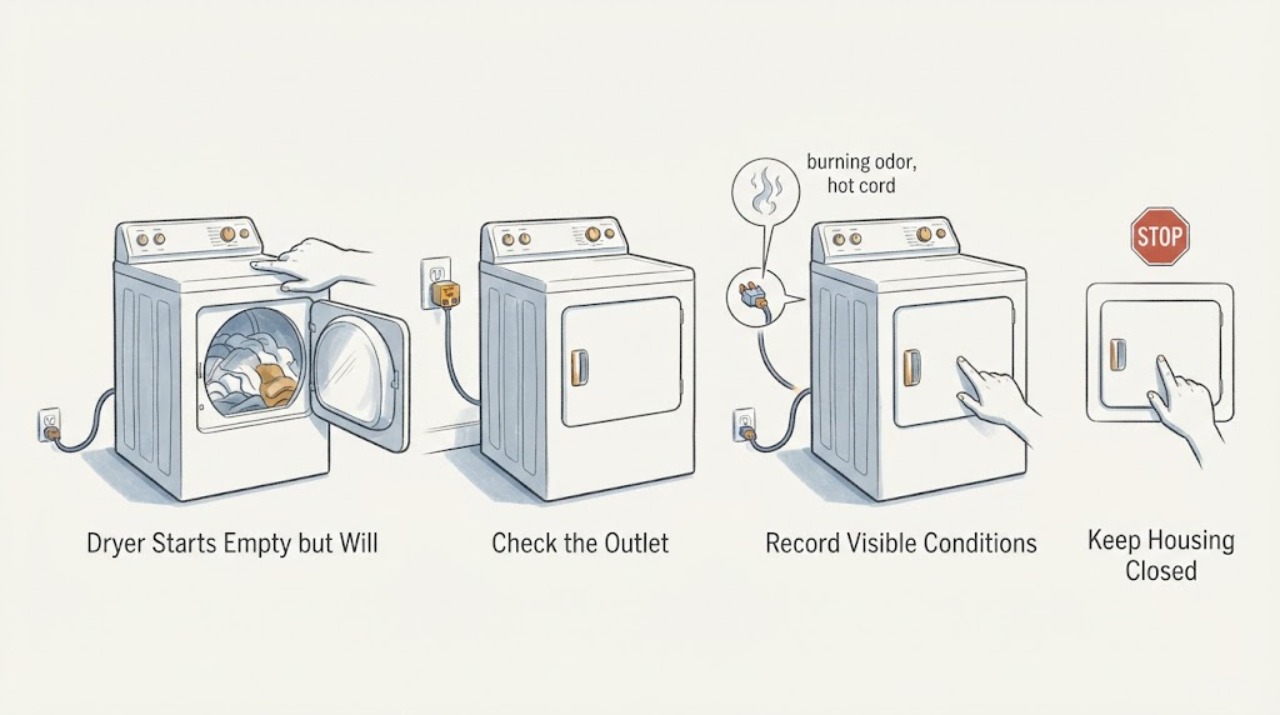
Work through in order
Diagnostic checks
Use only checks that match the exact appliance or system and its official guide.
-
Check 1
With the drum empty, select a documented cycle, hold or turn Start as required, close the door fully, and confirm the cord is firmly in the wall outlet; do not use an extension cord.
Expected result: The empty dryer starts, the selector or door prevents starting, the outlet/breaker has a power issue, or the empty dryer also fails.
Next step: Correct only an obvious selector, door-closure, or loose-plug condition. Keep the dryer off for a circuit fault or repeated failure and arrange service/electrical assessment.
Why this matters
Why: A control, door, power, or circuit condition can prevent starting before load size is considered. Empty starting only establishes a comparison point.
-
Check 2
Compare the failure with a normal loose load and with a heavy, wet, bulky, or tightly packed load; record whether the motor never starts, starts then stops, or only hums.
Expected result: Only a heavy or wet load causes the failure, every ordinary load causes it, or the drum will not turn even empty.
Next step: Do not repeatedly retry a heavy load. Use the load result as service evidence and stop if the motor hums, the drum binds, or the symptom recurs.
Why this matters
Why: Frigidaire identifies overload-related motor overheating and recommends a one-third-to-one-half drum load; failure with ordinary or empty conditions needs a technical assessment rather than a load adjustment alone.
-
Check 3
If the dryer stopped after an oversized load and there is no smoke, burning odor, hot cord, or other hazard, leave it off for the 30-minute motor-cooling period Frigidaire describes before one reduced-load observation.
Expected result: The dryer restarts after cooling and a reduced load, or it fails again after cooling/with a normal load.
Next step: Arrange authorized service for any recurrence; do not bypass a thermal limiter or continue restarting until it “catches.”
Why this matters
Why: A single overload-related thermal event is possible, but a recurring load-dependent stop keeps motor, thermal limiter, drive, or airflow causes in scope.
-
Check 4
With the dryer off, keep the lint screen in place and inspect only the accessible exhaust duct, hood, and surrounding clearance for visible blockage, crushing, or inadequate ventilation.
Expected result: The lint screen is missing/blocked, the exhaust path or hood is visibly restricted, the dryer is gas without an outdoor duct, or the visible path is clear.
Next step: Restore only safe external airflow conditions and arrange service for a damaged/restricted path or any gas-dryer exhaust concern. Do not dismantle the dryer or run it without the lint screen/required duct.
Why this matters
Why: Frigidaire links safe drying to the lint screen, exhaust path, hood, and ventilation; a gas dryer without outdoor exhaust has a carbon-monoxide risk. A clear exterior still does not diagnose a load-start failure.
-
Check 5
Give service the exact model/serial, gas or electric type, load size, empty-versus-loaded result, motor sound, cooling period, breaker behavior, vent observations, and any heat, odor, smoke, or noise.
Expected result: The dryer repeatedly fails with an ordinary load, stops after starting, or has any safety symptom.
Next step: Keep the dryer out of service until qualified service checks the exact model and installation. Do not open the cabinet or bypass a safety device.
Why this matters
Why: Frigidaire directs recurring stops after cooling and load reduction to an authorized service provider; the symptom alone cannot select a motor, limiter, belt, or switch.
Use your observations
Decision map
Find the observation that best matches what you see, then follow the next safe action.
-
PATH 01Next step
What you see
The dryer starts empty but fails only with a very heavy, wet, or packed load, and no smoke or electrical warning occurred.
Do this next
Let it cool once, reduce the load, and stop using it if the symptom returns with a normal load.
Why this path and its safety boundary
Why it matters: The load may be overloading or overheating the motor; Frigidaire recommends a one-third-to-one-half drum load and cooling after an overheat.
-
PATH 02Next step
What you see
The dryer refuses to start with an ordinary load, stops again after cooling, or also fails with an empty drum.
Do this next
Keep the dryer off and arrange authorized service; do not infer or replace a part from the loaded-versus-empty comparison.
Why this path and its safety boundary
Why it matters: Load size alone no longer explains the symptom; motor, drive, thermal, door, power, or control causes remain unresolved.
-
PATH 03Next step
What you see
The lint screen is missing or blocked, the exhaust duct/hood is visibly restricted, or a gas dryer lacks an outdoor exhaust duct.
Do this next
Keep the dryer off, restore the required external exhaust arrangement, and use qualified service for persistent restriction; never run the gas dryer without outdoor venting.
Why this path and its safety boundary
Why it matters: The installation has an airflow or carbon-monoxide safety problem that must be corrected before operation.
-
PATH 04Next step
What you see
There is a burning smell, smoke, hot plug/cord, repeated breaker trip, grinding/binding, or a drum that will not turn.
Do this next
Stop immediately, disconnect power only if safe, and arrange qualified dryer/electrical service. Do not run another load or open the cabinet.
Why this path and its safety boundary
Why it matters: The symptom is a safety or mechanical service boundary, not a load-sizing problem.
Helpful context
Understand the symptom
“Not starting with a load” can mean the motor never starts under drum resistance, the dryer starts and stops, or a control/door/power condition is being noticed only when the load is present. The loaded-versus-empty comparison is useful evidence, but it does not identify a belt, motor, thermal limiter, door switch, or control-board failure.
Confirm the basic start conditions
With the drum empty, confirm the cycle selector is at a valid start position, hold or turn Start as the control requires, close the door fully, and check that the power cord fits tightly in the wall outlet. Frigidaire says not to use an extension cord and directs attention to a blown fuse, tripped breaker, or overloaded circuit. Do not increase fuse capacity.
Compare a normal load with an overloaded drum
Record whether the dryer fails with every load or only a heavy, wet, bulky, or tightly packed load. Frigidaire says an average washer load fills the dryer about one-third to one-half full and that overloading can overheat the motor. A small or free-tumbling load that starts does not prove the appliance is safe for continued use if the same failure returns with ordinary loads.
Allow cooling once, then stop repeated attempts
If the dryer stopped after a heavy load and there is no smoke, burning smell, or other electrical warning, leave it off and allow the motor to cool for the 30 minutes Frigidaire specifies. Reduce the load for the next documented observation only if the drum, cord, and area are safe. If the dryer again refuses to start or stops under a normal load, do not keep cycling it or assume the thermal limiter or motor is the failed part; arrange service.
Check lint and vent conditions from outside
Keep the lint screen installed and clean. From the outside, check that the exhaust duct and hood are not visibly blocked or crushed and that the dryer has the required ventilation. Do not dismantle the duct, reach into the cabinet, or operate a gas dryer without an outdoor exhaust duct. A restricted vent can contribute to heat and drying problems, but it is not proof of the reason a loaded drum will not start.
Give service the load-dependent history
Provide the model and serial, electric or gas type, load size and wetness, whether the drum turns empty, whether the motor hums or stops, time allowed for cooling, breaker behavior, lint/vent observations, and any smoke, odor, heat, or noise. A service provider can then assess the motor, thermal limiter, drive, door circuit, and installation using the exact manual; do not order a part from the load symptom alone.
When checks do not resolve it
Need a professional?
Arrange service if the dryer fails with a normal load, fails again after the documented cooling/load check, stops with a hot or burning symptom, trips a breaker, binds, or has unresolved airflow or gas-exhaust concerns.
Safety scope: Do not open the cabinet, bypass a thermal limiter or door switch, run without the lint screen, run a gas dryer without outdoor exhaust, or keep retrying a load-dependent failure.
Have this ready
- Exact model and serial, gas/electric type, load size and wetness, empty-versus-loaded behavior, motor sound, cooling period, breaker behavior, lint/vent condition, and any heat, odor, smoke, or noise.
Common questions
FAQ
Why does the dryer start empty but not with clothes?
A heavy or wet load can overheat the motor, and Frigidaire recommends an average load of about one-third to one-half of the drum. If a normal load still fails after cooling, the comparison does not identify a part and service is needed.
How long should I let the dryer cool?
Frigidaire says to allow an overheated motor to cool for 30 minutes. This is a single safety observation, not permission to keep restarting a recurring failure.
Can I run the dryer without the lint screen to see if it starts?
No. Frigidaire says not to operate without the lint screen because damage can occur. Keep the screen installed and clean while arranging service for a recurring start problem.
What if it is a gas dryer?
Do not operate a gas dryer without an exhaust duct venting outdoors. Keep the unit off for an exhaust or carbon-monoxide concern and arrange qualified service.
Read the exact guide
Official sources
- What should I do if my dryer does not start?Frigidaire · Official Frigidaire support applies to dryers generally; model-specific control behavior and circuit requirements remain subject to the exact manual.
- What should I do if my dryer stops operating?Frigidaire · Official Frigidaire dryer support supports the load-dependent motor-overheat observation and service boundary; it does not diagnose a specific motor, belt, or limiter for an unspecified model.
- Dryer - Not Drying and Extended Drying TimeFrigidaire · Official dryer support is used for external lint/vent/load safety checks and the gas exhaust boundary; it does not prove a vent fault caused the no-start symptom.
- My dryer is running, but does not seem to be heating. What should I do?Frigidaire · Official dryer support is used only for the separate electrical/gas and ventilation boundaries; it does not convert a no-start symptom into a heating diagnosis.
Community feedback
Share a repair observation
Share a plain-text repair observation. Accepted observations are published automatically; this page may take a moment to update.