
On this page
Start here
Quick answer
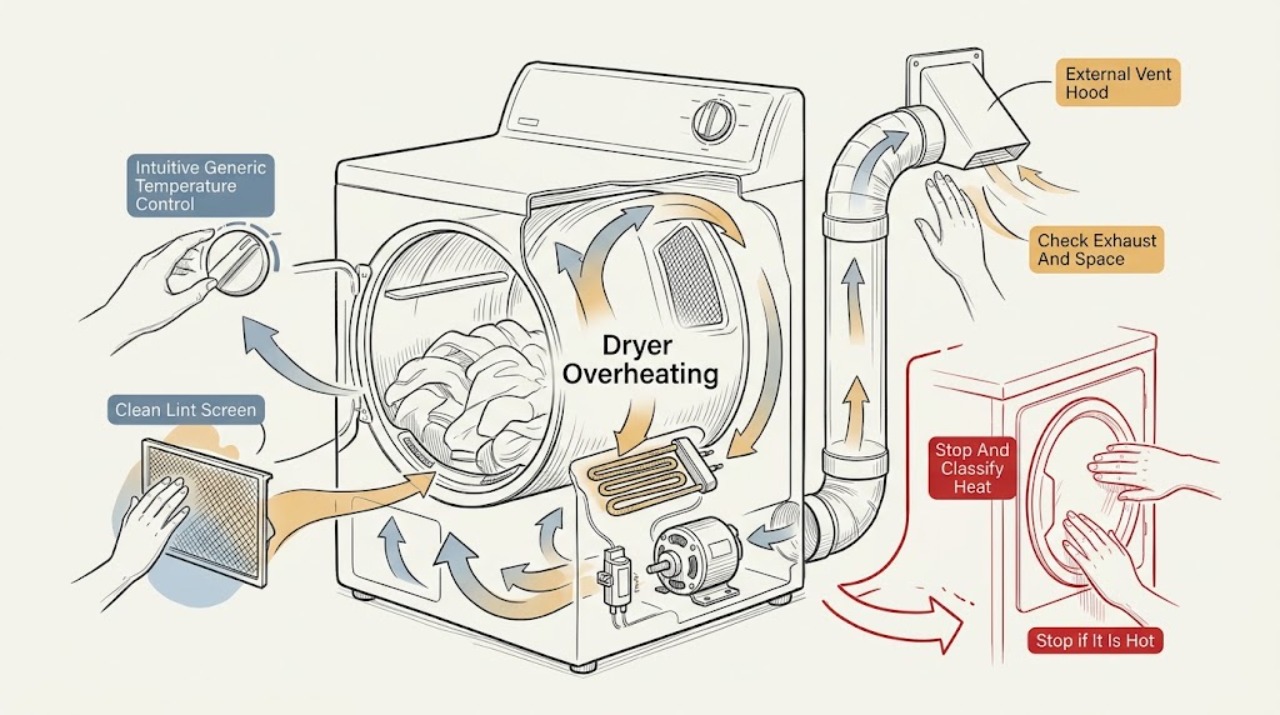
If a Frigidaire dryer overheats, stop the cycle and let the appliance cool before touching it. Clean the lint screen, check visible airflow and exhaust routing for restriction, and use a load size and temperature setting suited to the fabric and model. Frigidaire warns that lint buildup can block airflow and says not to operate a laundry-center dryer with a blocked, damaged, or missing lint filter; its guidance also says an overloaded dryer can overheat the motor and an electric dryer may shut the motor off with a thermal limiter. Do not bypass that limiter, remove cabinet panels, probe live wiring, or keep running a dryer that smells burnt, smokes, scorches clothes, trips power, has a hot cord or outlet, or has a blocked exhaust. If cooling, reducing the load, and restoring only visible permitted airflow do not resolve the heat, keep it out of service and arrange qualified repair or vent service.
Before you begin
Safety first
- This article supports safe cooling, lint-screen care, visible airflow checks, and load review only. Do not open the cabinet, access the heater or wiring, bypass a thermal limiter, adjust gas components, or operate with a blocked, damaged, or missing lint screen.
Work through in order
Diagnostic checks
Use only checks that match the exact appliance or system and its official guide.
-
Check 1
Stop the dryer and record what is hot or abnormal: clothes, drum, cabinet, exhaust outlet, cord, or nearby materials. Note the cycle and temperature, load size, drying time, whether the drum stops, and any smoke, scorch, smell, error, or power trip.
Expected result: A long dry time with weak airflow differs from a hot load, a dryer that stops, a burnt smell, heat at the outlet, or heat damage outside the drum.
Next step: Let the dryer cool fully. For smoke, sparks, burning or melting odor, a hot cord or outlet, repeated trips, or fire, isolate power only when safe and arrange emergency or qualified help; otherwise continue with lint and airflow checks.
Stop if: Do not restart an overheated or smoking dryer to reproduce the symptom.
Why this matters
Why: The symptom pattern separates a possible load or airflow issue from a thermal safety, electrical, heater, or fire hazard.
-
Check 2
After the dryer is cool and power is off, remove and inspect the lint screen. Clear lint and residue, wash the screen only as the Frigidaire instructions permit, dry it completely, and reinstall it before any future cycle.
Expected result: A screen covered in lint or coated with residue can restrict airflow; a screen that is torn, warped, missing, or still blocked after cleaning is not safe to treat as normal.
Next step: Keep the dryer out of service if the screen is damaged or missing. If it is intact and clean, continue with the visible exhaust and space check without opening the cabinet.
Stop if: Do not operate without the screen or scrape lint into the heater area.
Why this matters
Why: Frigidaire says excessive lint can block airflow and specifically warns against using a laundry-center dryer with a blocked, damaged, or missing lint filter, but screen cleaning cannot clear a hidden duct or heater-area obstruction.
-
Check 3
With the appliance cool, inspect only the visible exhaust outlet, duct connection, and clearance around the dryer. Look for a crushed or disconnected duct, lint at the outlet, a blocked vent cover, laundry or rugs pressed against the dryer, or other restriction; do not pull out a gas or built-in dryer.
Expected result: Weak exhaust flow, lint accumulation, a crushed duct, or blocked room airflow supports an exhaust or installation issue; normal visible routing with continued overheating leaves an internal fault possible.
Next step: Restore only visible routing and clearance permitted by the installation instructions. Arrange qualified vent cleaning or appliance service when the duct is concealed, damaged, inaccessible, or the dryer remains hot.
Stop if: Stop for lint packed into the duct, a disconnected gas or exhaust connection, heat-damaged materials, or any need to move the appliance without suitable help.
Why this matters
Why: Frigidaire says the exhaust duct must not be restricted and that gas dryers need enough air supply to support the burner; visible clearance is not proof that the full duct is clean.
-
Check 4
After cooling and restoring only safe airflow, compare the load and cycle with the fabric labels and the Frigidaire model instructions. Remove excess items so clothes can tumble freely, and do not use a high-heat setting for a fabric or load that requires lower temperature.
Expected result: An overloaded drum, a load that cannot tumble, or an inappropriate temperature can extend the cycle and retain heat; an empty or small permitted load that overheats points away from load size.
Next step: Use one normal permitted cycle only when the dryer is intact, cool, and free of hazard. Stop at the first sign of excessive heat, smell, noise, smoke, or poor airflow.
Stop if: Do not use repeated cycles as a stress test or run a dryer that has a damaged screen, blocked duct, or scorched load.
Why this matters
Why: Frigidaire links overload to motor overheating and says load size and temperature affect drying, but a correct load does not clear a restricted vent or failed temperature control.
-
Check 5
If the dryer stopped after a large load but there was no smoke, electrical smell, or visible damage, leave it off until the motor and cabinet are fully cool. Do not reach into the cabinet or attempt to reset a thermal limiter.
Expected result: A dryer that resumes only after cooling and a reduced load may have responded to motor overheat; a dryer that stops again, will not restart, or has an activated thermal limiter needs service.
Next step: Reduce the load and restore only permitted airflow before one supervised normal use. If the motor does not restart, stops again, or the limiter appears involved, keep the dryer out of service and call an authorized service provider.
Stop if: Do not bypass, bridge, or replace a thermal limiter, and do not restart after a burning smell or heat damage.
Why this matters
Why: Frigidaire says overloading can overheat the motor and that an electric dryer thermal limiter automatically turns off the motor in an overheat situation; the limiter is not an owner repair.
-
Check 6
Only when the lint screen is intact, the visible exhaust is clear, the dryer is stable and cool, and no hazard is present, run one short supervised cycle with a small permitted load. Observe from outside and stop if heat or odor rises unusually.
Expected result: Record whether airflow is strong, the cycle regulates heat, the drum stops, clothes scorch, an error appears, or the smell or temperature returns.
Next step: Stop immediately for excessive heat, smoke, burning odor, a hot cord or outlet, repeated stopping, or a trip. Keep the dryer off and arrange qualified repair or vent service.
Stop if: Do not run this test when the duct is restricted, the lint screen is damaged or missing, or any electrical or fire symptom has occurred.
Why this matters
Why: A normal cycle after a load or visible-airflow correction supports that external condition, while repeated overheating after a small load indicates a vent, thermal, heater, sensor, motor, or control issue.
-
Check 7
Record the exact Frigidaire model, gas or electric configuration, cycle and temperature, load size, lint-screen condition, exhaust observations, stopping behavior, and any smell, scorch, error, power, or installation symptom. Use Frigidaire's manuals and service route for model-specific help.
Expected result: A record can distinguish a load or screen issue, restricted exhaust, motor overheat, thermal limiter stop, and persistent temperature-control or heater fault.
Next step: Keep the dryer out of service and arrange qualified repair or vent cleaning for recurrent overheating, an activated limiter, persistent hot running, poor airflow, heat damage, or any electrical or gas symptom.
Stop if: Stop all troubleshooting if the appliance cannot be safely isolated or the fire or electrical risk is worsening.
Why this matters
Why: The information helps a technician assess the vent, blower, heater, motor, thermal protection, sensor, wiring, or control, but does not identify a safe replacement part from heat alone.
Use your observations
Decision map
Find the observation that best matches what you see, then follow the next safe action.
-
PATH 01Safety boundary
What you see
The lint screen, visible duct, exhaust outlet, or room airflow is blocked or restricted, with no smoke or electrical hazard.
Do this next
Clean and restore only the accessible screen and installation-approved airflow. Arrange qualified vent cleaning if the duct is concealed or the heat remains abnormal.
Why this path and its safety boundary
Why it matters: Restricted airflow can retain heat and reduce drying performance, but visible cleaning does not prove the concealed duct or dryer interior is clear.
Safety stop: Do not operate with a blocked, damaged, or missing lint screen or a heat-damaged duct.
-
PATH 02Safety boundary
What you see
The dryer stopped after an unusually large or dense load, then becomes available again after cooling, with no smoke or damage.
Do this next
Reduce the load, confirm safe airflow, and use one supervised normal cycle. Call service if it stops again, will not restart, or the limiter is suspected.
Why this path and its safety boundary
Why it matters: Frigidaire identifies overload as a cause of motor overheating and says a thermal limiter can shut off an electric-dryer motor during an overheat situation.
Safety stop: Do not bypass or replace the thermal limiter yourself.
-
PATH 03Safety boundary
What you see
The dryer is gas-fired and airflow around the appliance is restricted or the burner area behaves abnormally.
Do this next
Stop the dryer, do not adjust gas components, and arrange qualified gas-appliance service or installation review.
Why this path and its safety boundary
Why it matters: Frigidaire says gas models need sufficient air supply to support the burner; a gas or combustion issue is not a lint-screen repair.
Safety stop: For gas odor, flame outside the burner area, smoke, or suspected combustion fault, leave the area as appropriate and use the local emergency gas route.
-
PATH 04Safety boundary
What you see
The dryer overheats again with an intact screen, safe load, and restored visible airflow, or it continues heating abnormally after the controls are off.
Do this next
Keep the dryer out of service, isolate power only when safe, and arrange qualified Frigidaire or appliance repair and vent assessment.
Why this path and its safety boundary
Why it matters: A thermal limiter, heater, sensor, blower, motor, wiring, or control fault remains possible; the symptom does not identify one part.
Safety stop: Do not open the cabinet, test live wiring, defeat a safety switch, or keep running cycles.
-
PATH 05Safety boundary
What you see
Smoke, sparks, a burning or melting-plastic odor, a hot cord or outlet, scorched clothes, repeated power trips, or active fire is present.
Do this next
Stop, leave the area as appropriate, use the local emergency route for fire, and isolate power only when safe without touching hot or damaged electrical parts. Arrange qualified service before any further use.
Why this path and its safety boundary
Why it matters: This is an immediate fire or electrical hazard, not an airflow adjustment.
Safety stop: Do not restart, open the cabinet, or attempt to clear a heater-area fire or wiring fault.
Helpful context
Understand the symptom
Overheating is usually an airflow or safety-stop question first
A hot cabinet after a normal cycle is not the same as a dryer that makes clothes unusually hot, shuts down, smells burnt, or takes much longer while heat continues building. Lint, a restricted exhaust duct, a blocked screen, an overloaded drum, or restricted air around a gas dryer can change how heat leaves the appliance. A thermal limiter or other safety control may stop the motor when an overheat condition is detected. Record when the heat appears and whether the drum stops before assuming a heater or motor has failed.
Keep lint and fire hazards outside the DIY boundary
Turn the dryer off and let it cool before cleaning the screen or inspecting visible duct and vent areas. Do not operate without the lint screen, bypass a thermal limiter, open the cabinet, test live wiring, or use a flammable cleaner. For smoke, a sharp electrical or melting-plastic smell, a hot cord or outlet, sparks, or an active fire, leave the area as appropriate and use the local emergency route; do not restart the dryer.
Safety boundary
Stop conditions
- Stop for smoke, sparks, active fire, burning or melting-plastic odor, a hot cord or outlet, scorched clothes, repeated power trips, or gas odor.
- Stop for a blocked, damaged, or missing lint screen, restricted exhaust duct, heat-damaged materials, or abnormal airflow that cannot be safely corrected.
- Do not open the cabinet, test live wiring, bypass or replace a thermal limiter, adjust gas components, or use the dryer as a repeated stress test.
- If overheating returns after safe lint, airflow, load, and cooling checks, keep the dryer out of service and arrange qualified repair or vent service.
When checks do not resolve it
Need a professional?
Arrange qualified repair or vent service when overheating returns after a clean lint screen, safe load, and restored visible airflow; when the dryer stops repeatedly or will not restart after cooling; when a thermal limiter is suspected; or when there is smoke, burning or gas odor, scorching, heat damage, a hot cord or outlet, abnormal airflow, or a repeated power trip. Gas-air-supply and installation concerns require qualified help.
Safety scope: This article supports safe cooling, lint-screen care, visible airflow checks, and load review only. Do not open the cabinet, access the heater or wiring, bypass a thermal limiter, adjust gas components, or operate with a blocked, damaged, or missing lint screen.
Common questions
FAQ
Can a full load make a Frigidaire dryer overheat?
Yes. Frigidaire links overload to motor overheating and recommends cooling the dryer and reducing the load. Confirm the lint screen and exhaust are clear, but call service if it stops again, will not restart, or remains too hot with a smaller permitted load.
Can a blocked dryer vent cause overheating?
A restricted exhaust can retain heat and reduce airflow. Frigidaire says the exhaust duct should not be restricted and recommends regular lint-screen and vent maintenance. Do not operate with a blocked duct; arrange qualified vent cleaning when the path is concealed or damaged.
Can I run a Frigidaire dryer without the lint screen?
No. Frigidaire warns against operating a laundry-center dryer with a blocked, damaged, or missing lint filter. Keep the dryer off until the correct screen is intact and installed.
What does it mean if my Frigidaire dryer stops when hot?
An overloaded motor can overheat, and an electric dryer may activate a thermal limiter that turns the motor off. Let the dryer cool without opening the cabinet, reduce the load, and call qualified service if it stops again or the limiter is suspected.
When should I call for Frigidaire dryer overheating repair?
Call for repair or vent service if overheating returns after safe lint, load, and visible-airflow checks, or if there is smoke, burning or gas odor, scorching, heat damage, a hot cord or outlet, repeated stopping, abnormal airflow, or a power trip. Do not bypass safety protection.
Read the exact guide
Official sources
- What should I do if my dryer stops operating?Frigidaire · Official Frigidaire support article for dryers used for motor-overheat and thermal-limiter boundaries; exact model instructions and qualified service apply.
- What should I do if my Frigidaire Laundry Center is not properly heating or drying?Frigidaire · Official Frigidaire support article for laundry centers; model-specific installation instructions control gas, circuit, duct, and clearance details.
- Dryers - How often do I need to clean my dryer or the lint screen/filter to optimize my drying performance?Frigidaire · Official Frigidaire support article for dryers used for lint and exhaust maintenance; exact installation and vent configuration apply.
Community feedback
Share a repair observation
Share a plain-text repair observation. Accepted observations are published automatically; this page may take a moment to update.