
On this page
Start here
Quick answer
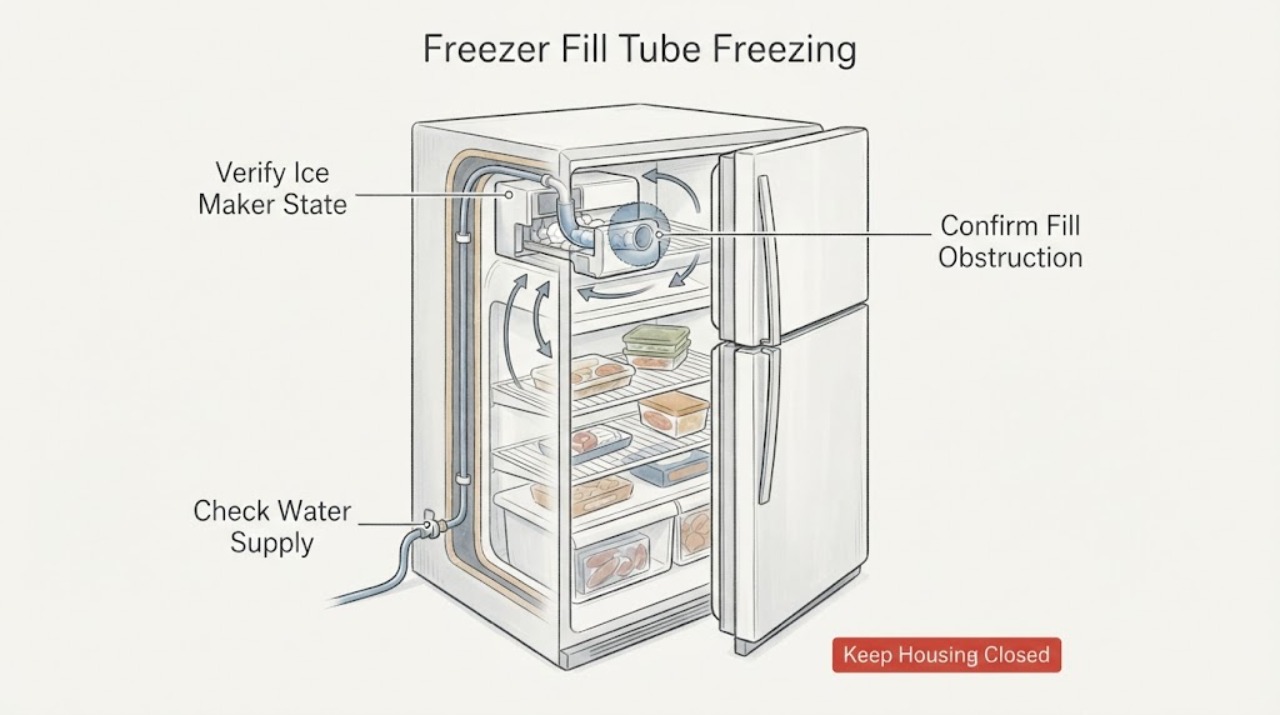
A frozen ice-maker fill tube means water is not reaching the ice tray, but it does not identify why the tube froze. With the appliance stopped, identify the exact model and document whether ice is visibly blocking the fill opening, whether the ice maker is on, and whether the freezer is otherwise frosting or running too cold. Frigidaire says ice production depends on an open water supply, a correctly positioned bin or signal arm, an unblocked water line and filter, and a stable freezer setting; its frost guidance also calls for checking the door seal, ice chute and vents. Do not pry at ice, apply a heat source, open the cabinet or order a fill tube or valve from a generic listing. If the tube freezes again, water leaks, the ice maker stays silent, or frost covers a large area, keep the unit out of service as needed and arrange model-matched service.
Before you begin
Safety first
- Limit owner checks to the stopped appliance, visible water line/filter area, model-specific ice-maker controls, door/gasket/chute/vent observations and the documented temperature setting. Do not pry ice, use a hair dryer or heat gun, apply an open flame, pierce the tube, open the cabinet/liner, disconnect a pressurized water line or perform energized tests.
Work through in order
Diagnostic checks
Use only checks that match the exact appliance or system and its official guide.
-
Check 1
With the appliance stopped, inspect only the visible ice-maker fill opening and record whether ice blocks it, whether the tray is dry and whether the water dispenser or other water function is also affected.
Expected result: The opening is visibly iced, the tray is dry without visible ice, or water delivery is slow/absent.
Next step: Photograph the accessible area and continue with the external supply and setting checks. Do not chip, puncture, pry or heat the ice.
Why this matters
Why: A visible plug is an obstruction at the fill point; slow or absent water delivery also points to a broader supply, filter or line condition. None of these observations proves a particular internal part.
-
Check 2
Using the exact model instructions, inspect the accessible water filter indicator/condition and supply line for an overdue filter, kink or compression where the refrigerator sits near the wall.
Expected result: The filter is overdue or water flow is slow, the line is kinked/compressed, or the accessible path appears clear.
Next step: Correct only an accessible placement or model-documented filter condition. Do not disconnect a pressurized line or select an unverified filter or tube.
Why this matters
Why: Frigidaire lists a clogged or overdue filter and a kinked line or refrigerator pushed too far back as reasons for reduced ice production; a clear visible path does not rule out an internal restriction.
-
Check 3
Check the model-specific ice-maker on/off indication, confirm the water supply valve is open, and for a supported top-freezer wire-arm design confirm the bin is fully back and the arm is in the on position.
Expected result: The ice maker is off, the valve is closed, the bin/arm is not in the required position, or those conditions are correct.
Next step: Restore only the model-documented external setting. If the tube freezes again or the valve chatters without water, turn the ice maker off and arrange service or correct the water connection safely.
Why this matters
Why: Frigidaire says these conditions can prevent normal filling; controls and signal mechanisms vary by configuration, so a correct-looking setting on one model cannot be assumed for another.
-
Check 4
Record the freezer temperature setting and inspect from outside for a door/gasket gap, an ice chute that does not close, or food blocking vents; after any documented setting correction, allow the manufacturer's stabilization period before judging ice production.
Expected result: The setting is outside the model guidance, the seal/chute/vents show a problem, or the visible environment is normal.
Next step: Correct only accessible loading, seal, chute or setting issues described by the model guide. Do not make repeated colder adjustments or open the liner.
Why this matters
Why: Frigidaire recommends checking the freezer setting and allowing 24 hours to stabilize, and identifies door-seal, ice-chute and airflow problems as frost contributors. This narrows environmental clues but does not diagnose a fill-tube heater.
-
Check 5
Record the complete model, ice-maker configuration, location of the visible ice, water-flow result, freezer setting, frost pattern and whether the condition returns after the external checks.
Expected result: The fill tube re-freezes, water leaks, frost is widespread, the ice maker remains inactive, or the next check would require cabinet/liner access.
Next step: Keep the ice maker off when it is calling for water without a connected supply, avoid running repeated fill cycles, and request model-matched qualified service.
Why this matters
Why: The public Frigidaire pages do not establish a universal model-independent fill-tube thaw, heater, valve or replacement procedure.
Use your observations
Decision map
Find the observation that best matches what you see, then follow the next safe action.
-
PATH 01Next step
What you see
The fill opening is visibly iced, but water delivery is otherwise normal and the freezer has no broad frost or seal problem.
Do this next
Do not pry or heat the obstruction. Record the exact model and arrange model-matched service if it recurs or cannot be cleared by the model manual.
Why this path and its safety boundary
Why it matters: The immediate symptom is a localized fill obstruction; the available Frigidaire guidance does not identify whether the cause is a model-specific heater, valve, tube position or another internal condition.
-
PATH 02Next step
What you see
The filter is overdue, water is slow, or the supply line is kinked/compressed behind the refrigerator.
Do this next
Correct only the accessible, model-documented condition and observe the next normal ice cycle; stop and service if water leaks or the line cannot be safely handled.
Why this path and its safety boundary
Why it matters: Frigidaire lists these external water-path conditions as causes of reduced ice production, so a fill-tube complaint may be downstream of restricted water delivery.
-
PATH 03Next step
What you see
The ice maker is off, the water valve is closed, or the bin/signal arm is not in the required position for that configuration.
Do this next
Restore the model-specific external setting. If the water supply is not connected, leave the ice maker off to avoid valve chattering and obtain service for the installation.
Why this path and its safety boundary
Why it matters: The ice maker may not be calling for or accepting water, so the visible freeze symptom cannot be interpreted as a failed component.
-
PATH 04Next step
What you see
The freezer has a poor door seal, blocked vent, stuck ice chute or unusually broad frost pattern.
Do this next
Correct only the listed external obstruction or loading issue and allow the documented stabilization period. Contact service if frost or leakage remains.
Why this path and its safety boundary
Why it matters: Frigidaire identifies seal, chute and airflow problems as frost contributors; the condition is broader than a proven fill-tube fault.
-
PATH 05Next step
What you see
The tube freezes repeatedly after the water path, ice-maker state and freezer-environment checks, or inspection would require cabinet or liner access.
Do this next
Keep the ice maker off as needed, avoid sharp tools and heat, and request model-matched qualified service with the recurrence record.
Why this path and its safety boundary
Why it matters: The public family-level guidance cannot safely distinguish a model-specific fill-tube, heater, valve, ice-maker or control issue.
Helpful context
Understand the symptom
Confirm what is actually frozen
With the appliance stopped, look only at the accessible ice-maker area. Record whether ice blocks the fill opening, whether the tray is dry, whether water is dispensing normally, and whether the ice maker is on. A visible blockage confirms an obstruction at that point; it does not prove a bad valve, heater, control or water pressure. Do not probe the opening or chip ice with a tool.
Check the water path from outside
Frigidaire says a clogged or overdue filter, a kinked water-supply line, or pushing the refrigerator too far against the wall can reduce ice production. Inspect only the accessible line and filter area using the exact model instructions. Do not disconnect a pressurized line or assume a generic filter or tube fits the appliance.
Verify the ice maker is enabled
For supported configurations, check the ice-maker on/off indication, the open water valve and the bin position. Frigidaire's top-freezer guidance says the bin should be pushed back and the wire signal arm lowered for the on position; other configurations may use different controls, so do not copy a button combination from another model.
Check temperature, seal and airflow clues
Record the freezer temperature setting and look for a door or gasket that does not seal, an ice chute that cannot close, or food blocking vents. Frigidaire recommends allowing 24 hours after a temperature adjustment to stabilize and identifies door-seal, ice-chute and airflow problems as frost contributors. These observations can explain repeated ice buildup without identifying an internal fill-tube assembly.
Do not force a recurring obstruction
If the fill opening freezes again after the external water, setting, seal and airflow checks, record the full model and the recurrence pattern. The public Frigidaire guidance does not authorize a universal hair-dryer, heat-gun, sharp-tool, heater or cabinet-removal procedure. Keep the ice maker off if it is calling for water without a connected supply, and use model-matched service for a recurring freeze, leak or inaccessible ice.
Escalate leaks or widespread frost
Arrange service when water leaks, the freezer has broad frost, the door cannot seal, the ice maker remains inactive after documented external checks, or the tube repeatedly freezes. Frigidaire directs service when frost cannot be resolved by the listed door, chute and vent checks; the missing model prevents a safe conclusion about a fill-tube heater, inlet valve or ice-maker assembly.
When checks do not resolve it
Need a professional?
Use Frigidaire support or a qualified appliance servicer for a repeated freeze, leak, inaccessible fill tube, widespread frost, uncertain model-specific controls or any suspected internal heater, valve, tube or ice-maker fault.
Safety scope: Limit owner checks to the stopped appliance, visible water line/filter area, model-specific ice-maker controls, door/gasket/chute/vent observations and the documented temperature setting. Do not pry ice, use a hair dryer or heat gun, apply an open flame, pierce the tube, open the cabinet/liner, disconnect a pressurized water line or perform energized tests.
Common questions
FAQ
Does a frozen Frigidaire ice-maker fill tube prove the water valve is bad?
No. A visible ice plug shows an obstruction at the fill point, but Frigidaire also directs checks of the filter, supply line, ice-maker state, freezer setting, door seal, ice chute and vents. The exact model is needed before identifying an internal part.
Should I keep the ice maker on when the water supply is not connected?
No. Frigidaire says to turn the ice maker off if a water supply cannot be connected because the fill valve may chatter when it tries to operate without water.
Can I use a hair dryer or sharp tool to clear a frozen fill tube?
Do not use a heat source, open flame or sharp tool in this model-unspecified article. Frigidaire's public family guidance does not provide one universal thawing or fill-tube replacement procedure; use the exact manual or qualified service.
Read the exact guide
Official sources
- Refrigerators - How do I use my ice maker in my Top-Freezer refrigerator?Frigidaire · Configuration-specific guidance used only for water valve, bin placement, wire signal arm and expected operation when that design is present.
- Refrigerators / Freezer - Frost Build UpFrigidaire · Used for external door-seal, ice-chute and vent checks and the service boundary when frost persists.
- My refrigerator was just installed and the ice maker is not working, how do I fix it?Frigidaire · Used for on/off state, priming context, no-water valve-chatter warning and model-family boundary.
- Freezer Too ColdFrigidaire · Used for recording the freezer setting, allowing stabilization and keeping vents clear; not used to diagnose a fill-tube part.
- What should I do if my ice maker is not making enough ice in my refrigerator?Frigidaire · Family-level ice-production guidance used for filter, water-line, freezer-setting and service checks; it does not define a universal fill-tube repair.
Community feedback
Share a repair observation
Share a plain-text repair observation. Accepted observations are published automatically; this page may take a moment to update.