
On this page
Start here
Quick answer
First confirm that the complaint is no ice production, not a dispenser jam. Read the exact refrigerator model and use its manual to verify that the ice maker is enabled; do not assume every Frigidaire uses the same switch, signal arm, display, bin, or ice-maker location. Then confirm the freezer is cold enough according to the model setting and allow temperature to stabilize after installation, a power event, or a setting change. Check only visible water conditions: the supply line is connected and not kinked, the filter is correctly installed and not overdue, and a new line or filter has been primed as the official guide describes. Make sure the correct ice bin and any required door are fully positioned and closed, but do not force the arm or reach into the mechanism. Frigidaire says ice production can take up to 24 hours to stabilize and that warm freezer temperature, restricted water, filter problems, and frequent door opening can slow production. If the enable state, temperature, bin/door, and water checks are normal but no cycle starts, the internal sensor, valve, motor, heater, or control needs model-specific service; do not bypass or live-test it.
Before you begin
Safety first
- This article covers model identification, normal controls, visible bin/door placement, freezer setting, visible supply/filter conditions, and model-authorized priming. Qualified service must handle the ice-maker module, sensors, motor/ejector, heater, fill valve, wiring, controls, cooling system, and live diagnosis.
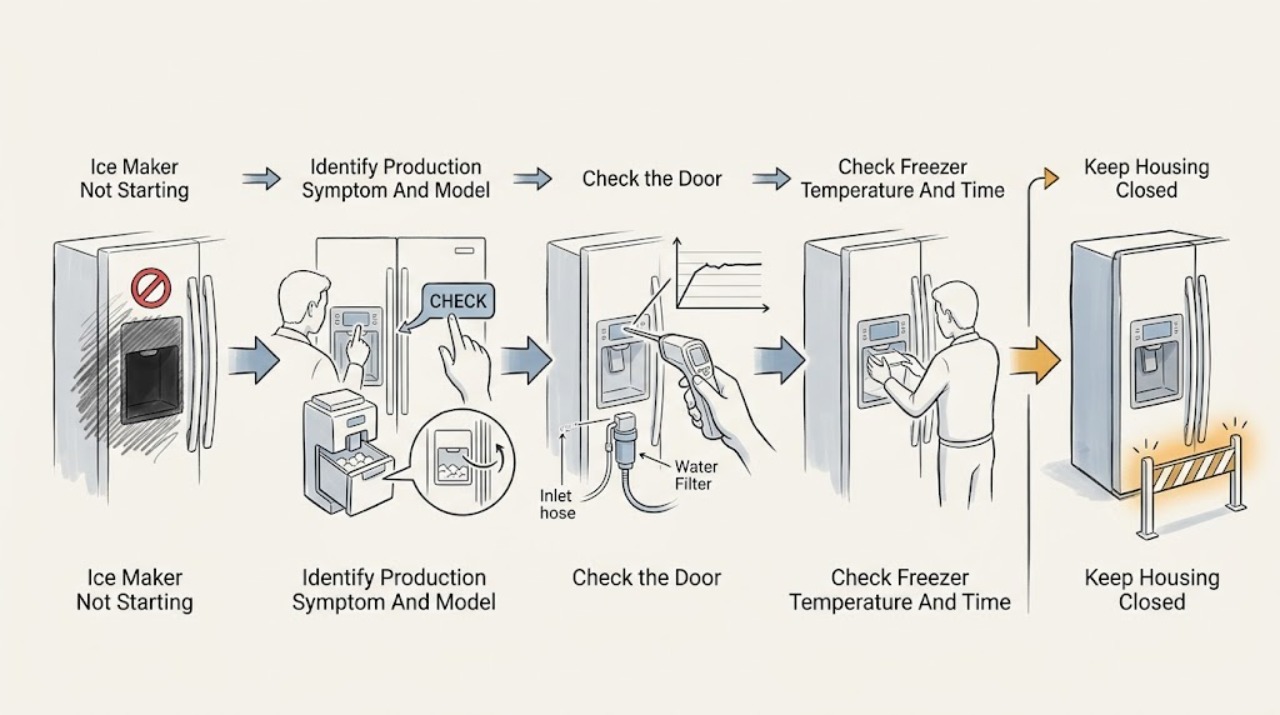
Work through in order
Diagnostic checks
Use only checks that match the exact appliance or system and its official guide.
-
Check 1
Read the exact refrigerator model and serial label and define the symptom as no ice being made, rather than ice being made but not dispensed. Record whether there are any cubes in the bin, whether water dispenses normally if the model has a dispenser, whether the freezer is cold, and where the ice maker is located. Use the matching Frigidaire owner manual because display controls and ice-maker arrangements vary by refrigerator family.
Expected result: There are no cubes and no apparent cycle, cubes exist but will not dispense, the ice maker was recently installed or the refrigerator was newly connected, or the exact model/ice-maker location is unknown.
Next step: Continue with production checks only if there are no cubes. If the problem is dispensing, use the model's dispenser guidance instead. If the model is unknown, identify it before touching the ice-maker assembly.
Stop if: Do not remove the ice-maker module or use a tool to expose a model label or cycle mechanism.
Why this matters
Why: No cubes with no cycle is a production-path symptom; cubes that remain in the bin point away from cycle initiation and toward dispensing. A new installation can legitimately have empty cycles while air is purged. Without the model, an on/off switch, arm, bin, or temperature value cannot be assumed.
-
Check 2
Use only the exact model's normal controls to verify that the ice maker is ON and not disabled by a control-lock, vacation, or another documented state. Check that the correct ice bin is fully seated and that any refrigerator or freezer door required by the model closes completely. Do not assume a visible arm, display icon, or bin arrangement is universal across Frigidaire models.
Expected result: The ice-maker indicator or documented switch is OFF, a lock or special mode is active, the bin is absent/mis-seated, a required door is ajar, or the enable state and bin/door position are normal.
Next step: Correct only the exact model-authorized ON/normal state, seat the bin without forcing it, and close the required door. If the unit remains inoperative, continue to temperature and water checks; do not bypass a sensor or arm.
Stop if: Do not hold a door switch or signal arm down, manually rotate the ejector, remove the ice-maker cover, or use a guessed button sequence.
Why this matters
Why: An OFF state, incompatible control mode, missing/mis-seated bin, or open door can prevent a model's ice-making sequence from being enabled or completed. A normal enable state and properly positioned bin do not prove that the internal motor, sensor, valve, or control is working.
-
Check 3
Check the freezer temperature setting and the actual cold-storage symptom using the refrigerator's normal display or control. Use the model's documented setting rather than copying a number from another Frigidaire family. Note whether the refrigerator was just installed, recently unplugged, affected by an outage, or had its freezer setting changed; minimize door openings while the temperature stabilizes.
Expected result: The freezer is set warmer than the model guidance, the cabinet is not cold, the refrigerator was recently connected or reset, the setting was just changed, or the freezer is stable and cold but ice production still does not begin.
Next step: Restore only the model-authorized freezer setting, keep the door closed, and allow the documented stabilization period. Protect frozen food and arrange refrigerator service if the freezer cannot maintain temperature or if ice production remains absent afterward.
Stop if: Do not remove evaporator covers, touch fans or heaters, use a heat source to defrost, or add refrigerant.
Why this matters
Why: Frigidaire says a freezer that is too warm can prevent proper ice making and recommends allowing 24 hours for temperature stabilization after a setting change. If the freezer is not cold, the ice-maker symptom may be downstream of a refrigerator cooling problem. If it is stable and cold, temperature alone is less likely to explain no cycle.
-
Check 4
Check only the visible water conditions that the exact model permits: the refrigerator is connected to its water supply, the accessible line is not kinked or pinched by the cabinet, and the filter is seated correctly and not overdue or visibly damaged. If the refrigerator or filter was newly installed and the model has a water dispenser, follow the official prime-and-purge procedure; do not substitute a filter based on appearance alone.
Expected result: The water supply is off or absent, the line is kinked, water flow is slow or absent, a filter is incorrectly seated/overdue/damaged, the system is newly installed, or the visible water path is normal.
Next step: Restore only an intentionally closed supply, remove a visible kink without pulling the refrigerator into an unsafe position, or use the exact model's authorized filter and prime/purge instructions. Allow the new system to complete its documented initial cycles; escalate if no ice follows with a cold freezer.
Stop if: Do not disconnect a pressurized line, force a filter, remove a valve, pour water into the mold, or work near a wet electrical area.
Why this matters
Why: The ice maker cannot fill without water. Frigidaire links slow or absent water and overdue or clogged filters to poor ice production, and says air in new plumbing can cause two or three empty ice cycles. A normal visible water path does not rule out a concealed inlet valve, fill tube, sensor, or control fault.
-
Check 5
After an authorized ON state, cold stable freezer, correctly seated bin/door, and normal water path, leave the refrigerator closed and observe production over the model's documented window rather than expecting an immediate tray. For a newly installed unit or filter, complete the exact prime/purge procedure first. Record whether any ice appears, whether the bin position changes, and whether water, noise, or an error indicator appears; do not open the mechanism to force a cycle.
Expected result: The first ice appears after the waiting period, two or three initial cycles are empty after new plumbing, no ice appears despite stable conditions, or the refrigerator shows an error or abnormal sound/water event.
Next step: Use the refrigerator normally if production resumes. If it does not, record the model, freezer temperature history, enable state, water/filter condition, and any indicator or sound, then arrange service for internal diagnosis.
Stop if: Do not repeat forced-cycle attempts, bypass an arm/door switch, or leave a water valve energized without a connected water supply.
Why this matters
Why: Initial delay can be normal after installation or plumbing work, while Frigidaire's general guidance says temperature may need 24 hours to stabilize. Continued absence of ice after the documented window with normal external conditions points to an internal start/fill/harvest problem, not necessarily the bin or dispenser.
-
Check 6
If the ice maker still does not start after the model-authorized enable, bin/door, temperature, water, filter, and waiting checks, prepare a service record. Include the exact model and serial, ice-maker location, whether the dispenser works, freezer setting and temperature symptom, water flow/filter history, installation or outage date, error code or light pattern, and any leak, odor, heat, or unusual sound.
Expected result: The external prerequisites are normal but no cycle starts, the ice maker intermittently starts, an indicator or error returns, or the refrigerator has a cooling or electrical hazard.
Next step: Leave the mechanism intact and arrange Frigidaire or qualified appliance service. If there is an electrical or water hazard, stop using the refrigerator and isolate it only from a safe dry position.
Stop if: Do not remove the ice-maker module, probe wiring, test a valve live, bypass a sensor, or order a replacement part from the symptom alone.
Why this matters
Why: The remaining possibilities may include a concealed sensor, motor/ejector, fill valve, heater, wiring, or control issue, but no external symptom here selects a safe part. A cooling or electrical hazard may also prevent ice production and raises the urgency.
Use your observations
Decision map
Find the observation that best matches what you see, then follow the next safe action.
-
PATH 01Safety boundary
What you see
The refrigerator or water filter was newly installed and the freezer is otherwise cold.
Do this next
Complete the exact model's prime-and-purge procedure if applicable, keep the freezer closed, and allow the documented initial production window. Escalate if there is still no ice after stable temperature and the model-authorized wait.
Why this path and its safety boundary
Why it matters: Frigidaire says air in new plumbing can cause two or three empty ice-maker cycles, and its ice-production guidance says temperature may need 24 hours to stabilize. This is different from a dispenser jam or an immediate proof that the ice maker module failed.
Safety stop: Do not pour water into the ice mold or force a harvest cycle.
-
PATH 02Safety boundary
What you see
The ice maker is off, a model-specific lock/mode is active, the bin is mis-seated, or a required refrigerator/freezer door is not fully closed.
Do this next
Use the exact owner's manual to restore the normal ON state, seat the bin, and close the door without forcing anything. If no cycle begins afterward, continue to temperature and water checks.
Why this path and its safety boundary
Why it matters: The production sequence may be intentionally inhibited. The exact control and bin/door interlock vary across Frigidaire families, so another model's switch or arm position is not reliable evidence.
Safety stop: Do not tape or hold a door switch, arm, or sensor down and do not remove the ice-maker cover.
-
PATH 03Safety boundary
What you see
The freezer is warmer than the exact model's normal setting, recently lost power, or has not stabilized after a setting change.
Do this next
Restore only the model-authorized temperature setting, minimize door openings, protect frozen food, and arrange refrigerator service if the cabinet remains warm or no ice follows stabilization.
Why this path and its safety boundary
Why it matters: Frigidaire identifies a freezer set too warm as a reason for improper ice making and recommends 24 hours for stabilization after a setting change. If the freezer cannot stay cold, the ice maker is not the first component to diagnose.
Safety stop: Do not touch the cooling system, defrost heater, or fan, and do not use a heat source or refrigerant.
-
PATH 04Safety boundary
What you see
Water is slow/absent, the line is kinked, the filter is overdue/incorrectly seated, or the system was recently connected.
Do this next
Correct only a visible supply state or kink, or use the exact model's authorized filter and prime/purge procedure. If flow remains abnormal or no ice follows with a cold freezer, arrange service.
Why this path and its safety boundary
Why it matters: The ice maker may not be reaching its fill condition. Frigidaire links slow or absent water and filter problems to poor ice production and warns of empty cycles while air is purged from new plumbing.
Safety stop: Do not disconnect a pressurized line, force a cartridge, or work on a wet valve or electrical area.
-
PATH 05Safety boundary
What you see
The exact model is enabled, the bin and door are correctly positioned, the freezer is stable and cold, water/filter conditions are normal, and no ice-making cycle begins after the documented window.
Do this next
Arrange model-specific appliance service and provide the complete service record. Keep the refrigerator intact and do not force a cycle.
Why this path and its safety boundary
Why it matters: External prerequisites have been reduced, leaving a possible internal sensor, motor, fill valve, heater, wiring, or control fault. The evidence does not select a replacement part and the ice dispenser is not the same mechanism.
Safety stop: Do not remove modules, probe live circuits, bypass sensors, or order a part from the symptom alone.
-
PATH 06Safety boundary
What you see
No ice production is accompanied by a water leak near electrical parts, smoke, sparks, burning odor, abnormal heat, cord damage, or repeated breaker trips.
Do this next
From a safe, dry position isolate power and water only when it can be done without touching the hazard, protect food if safe, and arrange qualified electrical/appliance service.
Why this path and its safety boundary
Why it matters: This is a stop-use condition, not an ice-cycle experiment. Water and electrical hazards take priority over identifying an ice-maker valve, motor, or control.
Safety stop: Do not restart, reset repeatedly, touch wet electrical parts, or open the ice-maker or control area.
Helpful context
Understand the symptom
Starting an ice cycle is not the same as dispensing ice
An ice maker can fail to produce ice even when a refrigerator's dispenser, auger, or chute is working, and a dispenser can fail even when the ice maker is producing cubes. This article follows the production path: enabled state, freezer temperature, bin/door position, water availability, and time for a cycle. If there are cubes in the bin but they will not come out, that is a separate dispensing problem. If there are no cubes at all, record whether the mold ever fills or harvests only if the exact manual gives a safe external observation; do not force the mechanism.
Do not defeat the ice-maker mechanism
Keep checks to the normal display or switch, visible freezer setting, accessible bin and door position, visible water line/filter condition, and the model-authorized prime/purge procedure. Do not hold a feeler arm or door switch down with a tool, manually rotate an ejector, pour water into the mold, remove covers, reach into moving parts, probe a valve, or perform live electrical testing. If water is leaking near electrical parts, the cord is damaged, there is smoke, a burning smell, abnormal heat, or a repeated breaker trip, stop using the refrigerator and isolate power only from a safe, dry position before arranging qualified service.
Safety boundary
Stop conditions
- Do not confuse no ice production with an ice-dispenser or auger problem; first confirm whether cubes exist in the bin.
- Do not bypass a door switch, signal arm, bin sensor, or control lock, and do not manually force an ice-making cycle.
- Do not remove the ice-maker module, probe wiring, test a fill valve live, pour water into the mold, or work on the refrigerator cooling system.
- Stop for water near electrical parts, smoke, sparks, burning odor, abnormal heat, cord damage, or repeated breaker trips.
- Do not order an ice-maker, valve, motor, heater, sensor, control, filter, or other part without the exact model and a qualified diagnosis.
When checks do not resolve it
Need a professional?
Safety scope: This article covers model identification, normal controls, visible bin/door placement, freezer setting, visible supply/filter conditions, and model-authorized priming. Qualified service must handle the ice-maker module, sensors, motor/ejector, heater, fill valve, wiring, controls, cooling system, and live diagnosis.
Common questions
FAQ
How do I tell whether my Frigidaire ice maker is not starting or the dispenser is the problem?
Look for cubes in the ice bin. No cubes is a production-path problem; cubes that remain in the bin but will not come through the door is a separate dispenser/auger issue. Do not force the dispenser or ice-maker mechanism while diagnosing production.
How long should I wait for a Frigidaire ice maker to start after installation?
A newly installed refrigerator or water filter can have air in the plumbing, and Frigidaire says that can cause two or three empty ice-maker cycles. The freezer may also need time to stabilize; its ice-production guidance says to allow 24 hours after a temperature-setting change. Use the exact model manual for the final production window.
Can a warm freezer stop a Frigidaire ice maker from starting?
Yes. Frigidaire identifies a freezer set too warm as a reason for improper ice making. Restore only the exact model's documented temperature setting, minimize door openings, and allow stabilization. If the freezer itself cannot stay cold, arrange refrigerator service.
Can a water filter or kinked line prevent the ice-making cycle?
Yes. Frigidaire links slow or absent water, an overdue or clogged filter, and a kinked supply line with reduced ice production. Check only the visible line and model-authorized filter seating; use the official prime-and-purge procedure after a new filter when applicable. Do not disconnect a pressurized line.
Why can’t I find the same ice-maker switch or arm shown online?
Frigidaire says refrigerator display features vary by model, and its ice-production guidance applies to multiple refrigerator families. Use the exact owner's manual to identify the ON/OFF control, bin, door condition, and any signal arm. Do not use another model's switch sequence or bypass a sensor.
When should I call for service for a Frigidaire ice maker that will not start?
Call when the ice maker is enabled, the bin/door and water conditions are normal, the freezer is stable and cold, and no production begins after the documented initial window. Stop immediately for water near electrical parts, smoke, burning odor, abnormal heat, cord damage, or repeated breaker trips. Internal ice-maker, valve, sensor, heater, wiring, and cooling work should be handled by qualified service.
Read the exact guide
Official sources
- What should I do if my ice maker is not making enough ice in my refrigerator?Frigidaire Owner Support · Official support article applying to refrigerators, French Door, Side by Side, and Top Freezer families; it addresses production rate and common prerequisites, not a universal mechanical cycle procedure.
- Refrigerators - How do I use the features and functions on my French-Door refrigerator display?Frigidaire Owner Support · Official display guidance for refrigerator families; it is used to support model-dependent controls, not to assign a universal ice-maker button sequence.
- Refrigerator Prime and Purge GuideFrigidaire Owner Support · Official refrigerator water-system guidance; it applies to newly installed units and new water filters where the model has the described dispenser/water system.
Community feedback
Share a repair observation
Share a plain-text repair observation. Accepted observations are published automatically; this page may take a moment to update.