
On this page
Start here
Quick answer
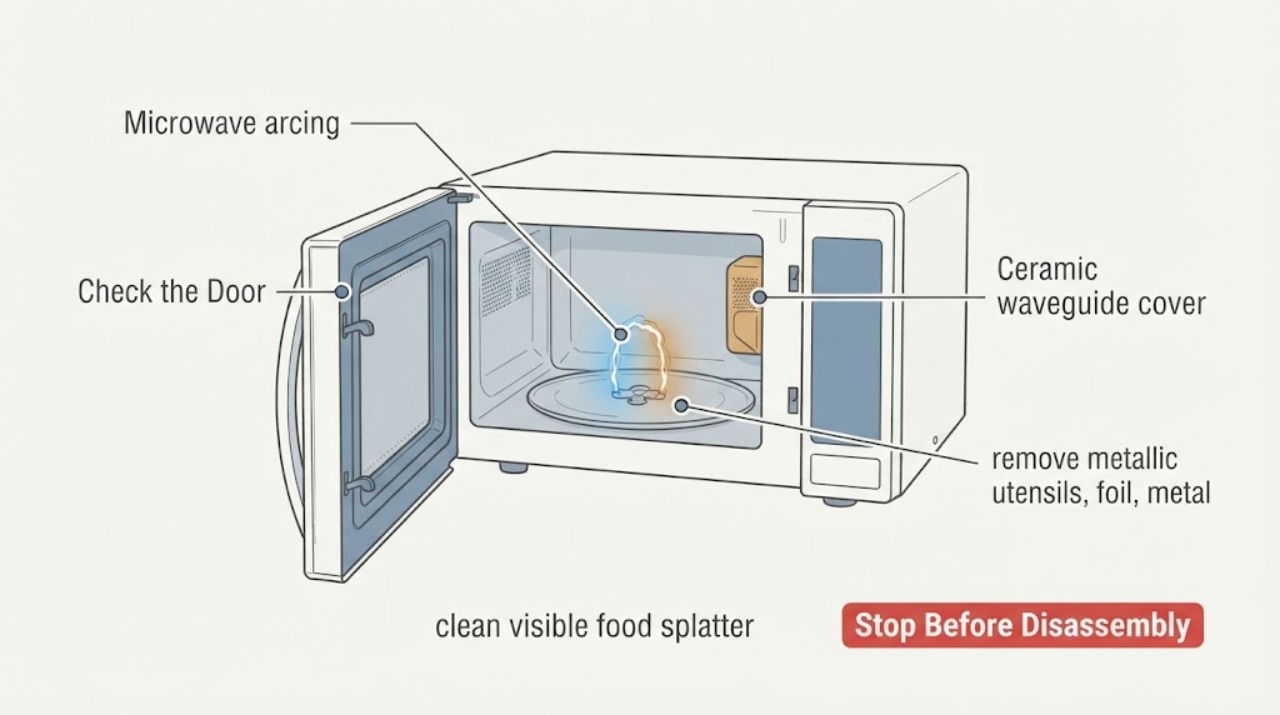
If a Frigidaire microwave arcs or sparks, stop the cycle and keep the door closed; do not run it again just to reproduce the flash. Once power is disconnected safely, remove metal utensils, foil, twist ties, and metal-trimmed cookware, then inspect and clean only the accessible cavity, turntable, roller ring, and waveguide-cover area. Frigidaire's official cleaning guidance says to wipe splatters from the waveguide cover but never remove that cover. Any damaged door, seal, cavity coating, waveguide cover, burnt area, repeated arcing after external cleanup, smoke, or burning smell is a service stop; microwave internal repairs require qualified service and the cabinet should remain closed.
Work through in order
Diagnostic checks
Use only checks that match the exact appliance or system and its official guide.
-
Check 1
If a spark or arc appears, stop the cycle if it is immediately safe, keep the door closed, and disconnect power using a safe plug or breaker. Do not restart the microwave just to reproduce the flash.
Expected result: The arc stops when power is isolated, or smoke, flame, a burning smell, or a damaged cord or door is present.
Next step: Leave the microwave disconnected. Arrange qualified service for smoke, burning odor, visible damage, or any arc that is not explained by a removable external item; do not reach into an active or smoking cavity.
Why this matters
Why: The official guide treats an ignition event as a stop condition: keep the door closed, turn the oven off, and disconnect power or shut off the breaker. It also says a damaged oven must not be operated.
-
Check 2
After the microwave is disconnected and cool, remove metallic utensils, foil, metal twist ties, and metal-trimmed cookware from the cavity. Do not run the oven empty, and do not assume that a rack or other accessory is approved without the exact model guide.
Expected result: A metal utensil, foil, tie, metal trim, or an unsupported accessory was present, or no such item is visible.
Next step: Remove the item and keep the microwave disconnected while completing the remaining visible checks. Do not use an empty-cavity run as a test; use the exact model manual or service if the arc recurs.
Why this matters
Why: The official guide identifies metal items as possible sources of arcing and warns that an empty microwave can be damaged. Finding metal identifies a plausible trigger but does not prove that the oven is safe after one removal.
-
Check 3
With power disconnected, clean visible food splatter from the cavity, turntable, and roller ring with a damp soft cloth and mild soap. Wipe the accessible surface of the waveguide cover gently; never remove that cover, scrape it, or use harsh or abrasive cleaners.
Expected result: Food or grease residue is removable, or there is carbonized residue, a chipped or peeling cavity surface, a burn mark, or damage at the waveguide-cover area.
Next step: If residue cannot be removed gently, or any surface, cover, or cavity coating is damaged, keep the microwave disconnected and arrange service. Do not sand, repaint, replace, or refit the waveguide cover yourself.
Why this matters
Why: Frigidaire's cleaning guidance supports gentle removal of splatter and says never to remove the waveguide cover. A burn mark or damaged surface is not a cleaning result that authorizes continued use.
-
Check 4
Visually inspect the closed door, hinges, latches, sealing surfaces, cavity walls, and waveguide-cover area. Do not operate the microwave with the door open, press or bend a latch, or bypass an interlock.
Expected result: The door is bent or misaligned, a hinge or latch is loose, the seal or sealing surface is damaged, the cavity has an arc mark, or no visible damage is found.
Next step: For any damage, leave the unit disconnected and use qualified service. If no damage is visible but arcing returns or has no removable external cause, stop troubleshooting and do not run another test cycle.
Why this matters
Why: The official safety instructions require a properly functioning door, hinges, latches, and seals and prohibit operation when the oven or door is damaged. No visible damage does not rule out an internal fault.
-
Check 5
Record the rating-label model and serial number, where the arc appeared, what was inside, whether there was smoke or odor, and any visible residue or damage. Use the exact model manual or Frigidaire support path for the service request.
Expected result: The model can be identified, or the label is unavailable; the event includes smoke, odor, repeated arcing, or visible damage.
Next step: Provide the recorded information to Frigidaire or qualified appliance service. Do not open the cabinet or perform internal electrical tests; the official guide reserves those repairs for qualified personnel.
Why this matters
Why: The supplied sources are general microwave guidance rather than an exact model diagnosis. Model and event details let service match the correct manual and safety boundary without guessing at a magnetron, diode, transformer, or other internal part.
Use your observations
Decision map
Find the observation that best matches what you see, then follow the next safe action.
-
PATH 01Next step
What you see
A removable metal item, foil, twist tie, metal trim, or food splatter is found and there is no visible door, cavity, or waveguide-cover damage.
Do this next
Remove the item and clean only as described above while power is disconnected. Do not use an empty or repeated run to prove the symptom is gone; follow the exact model manual or arrange service.
Why this path and its safety boundary
Why it matters: The item or residue is a documented possible external source of arcing, but its removal does not establish that the microwave is safe or that no internal fault exists.
-
PATH 02Next step
What you see
The door, seal, latch, cavity coating, waveguide-cover area, cord, or another visible surface is bent, burned, chipped, peeling, or otherwise damaged.
Do this next
Keep the microwave disconnected, leave the cabinet closed, and contact Frigidaire or qualified service for the identified model. Do not repair, defeat, or substitute a door-safety or waveguide-cover part yourself.
Why this path and its safety boundary
Why it matters: The official safety guidance says not to operate a damaged microwave and requires qualified service for door and interlock safety.
-
PATH 03Next step
What you see
Smoke, a flame, a burning smell, or an active ignition event is present or has just occurred.
Do this next
Keep the door closed and isolate power only when safe; leave the appliance out of service and obtain qualified help. Do not open the cabinet or restart it.
Why this path and its safety boundary
Why it matters: The official guide directs the user to keep the door closed, turn the oven off, and disconnect power or shut off the breaker when materials inside ignite.
-
PATH 04Next step
What you see
No metal, removable residue, or visible damage explains the arc, or arcing returns after the accessible checks.
Do this next
Keep the unit disconnected and arrange model-specific authorized or qualified service. Do not run another cycle, remove the waveguide cover, defeat the door interlock, or open the cabinet.
Why this path and its safety boundary
Why it matters: An internal or model-specific fault cannot be ruled out from external inspection. The available general sources do not support a component diagnosis or a safe repeat test.
Helpful context
Understand the symptom
Arcing is a stop-and-inspect symptom, not a reason to keep restarting the oven. The available Frigidaire/Electrolux owner guidance identifies metal utensils, foil, metal ties, food splatter, and an empty cavity as relevant external conditions, while its safety instructions require a damaged microwave or door/interlock to remain out of operation.
This guide is for a Frigidaire microwave with no model supplied. It covers visible, unplugged checks only. Frigidaire says to clean the accessible waveguide-cover surface gently but never remove the cover; do not open the cabinet, defeat a door interlock, or attempt high-voltage work.
When checks do not resolve it
Need a professional?
The arc is accompanied by smoke, flame, burning odor, a damaged cord, a damaged door, a damaged seal or latch, a burn mark, or cavity or waveguide-cover damage., Arcing returns after the visible metal and residue checks, or there is no removable external cause., The next step would require opening the cabinet, testing high-voltage components, removing the waveguide cover, or bypassing a door interlock.
Common questions
FAQ
Does one spark prove that the magnetron has failed?
No. Frigidaire's general owner guidance identifies metal items, foil, ties, food splatter, and an empty cavity as possible arcing conditions, but it does not provide an internal component diagnosis for an unidentified microwave. If the arc returns or no external cause is found, leave the unit disconnected and use qualified service.
Can I remove the waveguide cover to inspect behind it?
No. Frigidaire's cleaning guidance says to wipe splatters from the accessible surface but never remove the waveguide cover. Keep the cover and cabinet closed and arrange service for damage or persistent arcing.
Can I run the microwave with a cup of water to see whether the arcing stopped?
Do not restart a microwave just to reproduce or check an arcing event, and never run it empty. After an arc, use only the safe external checks above; if the cause is not clearly removable or the arc returns, keep it disconnected and contact qualified service or use the exact model manual.
What should I tell Frigidaire or a technician?
Give the model and serial number, where the arc appeared, what material was in the cavity, whether there was smoke or a burning smell, and any visible door, seal, cavity, or waveguide-cover damage. Do not open the cabinet to collect additional information; the official guide reserves internal microwave repairs for qualified service.
Read the exact guide
Official sources
- How do I clean my microwave?Frigidaire Owner Center · Opened Frigidaire's official microwave support article. It applies to general microwave cleaning; no assigned model was supplied, so it is used only for accessible cleaning and the waveguide-cover boundary.
- Microwave Oven Over-the-Range - Complete Owner's GuideElectrolux Home Products / Frigidaire · Opened the brand-owner PDF. Its introduction says the guide contains general instructions and features for several models, so it is used only for general metal, empty-cavity, door/interlock, cleaning, stop, and qualified-service guidance; it is not used to infer a model-specific part or internal fault for the unidentified microwave.
- Microwaves - No PowerFrigidaire Owner Center · Opened Frigidaire's official microwave no-power support article. It is used only for model/support escalation context, not as an arcing cause or internal diagnosis.
Community feedback
Share a repair observation
Share a plain-text repair observation. Accepted observations are published automatically; this page may take a moment to update.