
On this page
Start here
Quick answer
Stop the GE GCST16S1W1WW as soon as you see arcing, press Cancel/Off once if the controls respond, and leave it out of service if the sparks recur or leave any scorch, hole, blister, smoke, burning odour, door damage, or electrical fault. After it is cool and disconnected from a safe dry position, remove only an obvious metal item, foil, metallic-trim dish, twist tie, or contaminated paper product from the cavity. Inspect the turntable and support, cavity walls, door, and visible seal from outside; do not scrape or remove the magnetron/waveguide cover, open the case, bypass the door interlock, or perform a high-voltage test. GE's opened safety guidance identifies common accessible causes, but recurring arcing or any cavity, door, or cover damage needs qualified microwave service.
Before you begin
Safety first
- Owner checks are limited to canceling the operation, safely disconnecting power, removing an obvious suspect item, and observing the cool cavity, turntable support, door, and visible sealing surfaces. Do not remove the cabinet, waveguide/magnetron cover, control panel, door interlock, or internal fuse; do not bypass a safety device, run the oven empty, or perform high-voltage measurements.
Work through in order
Diagnostic checks
Use only checks that match the exact appliance or system and its official guide.
-
Check 1
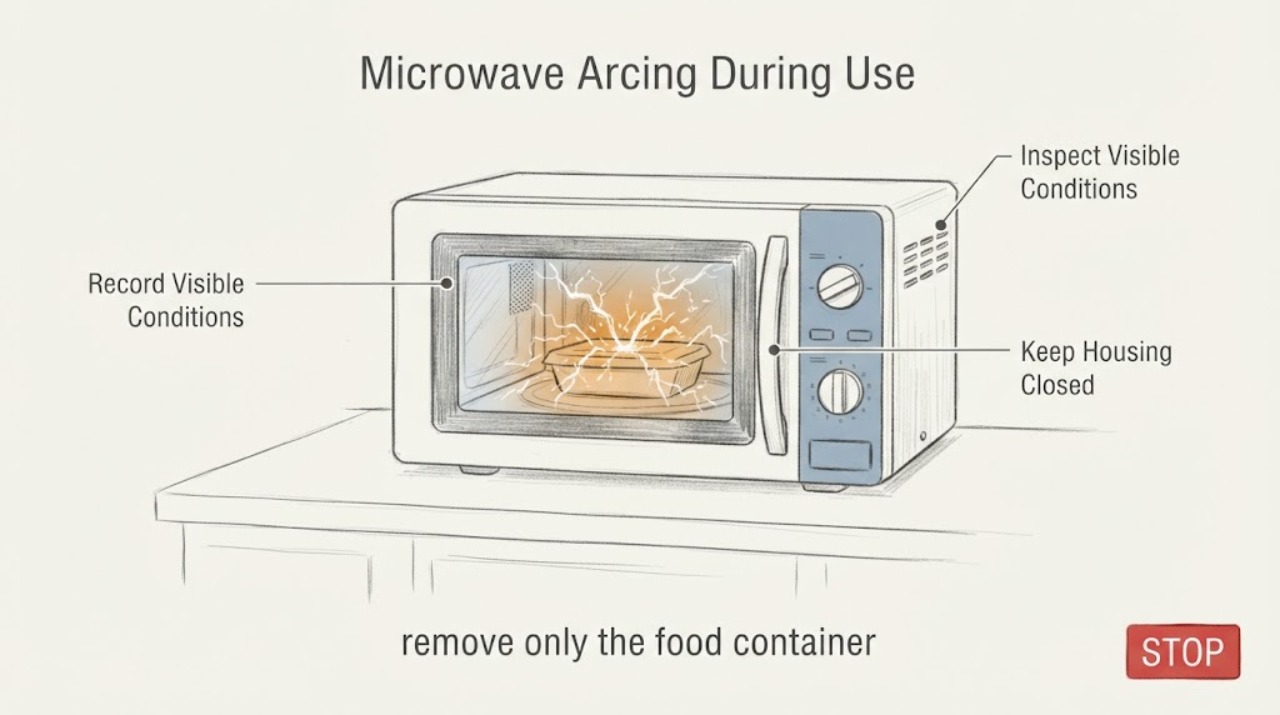
Stop heating immediately when a spark or blue flash appears. Press Cancel/Off once if the control responds, keep the door closed until the event has stopped, and record whether there was smoke, a flame, a loud pop, a burning odour, or a breaker trip. Disconnect power only from a safe dry position after the microwave has stopped.
Expected result: The event stops without smoke or odour, or it continues, produces smoke/flame/odour, trips power, or the cord/outlet is hot or damaged.
Next step: Leave the microwave disconnected and arrange qualified appliance service for any recurring event or warning sign. Do not repeatedly press Start, reset a tripped breaker, or use an empty cavity as a test.
Why this matters
Why: A stopped isolated event still requires cavity inspection before any further use. Smoke, odour, heat, a trip, or continued arcing is a fire/electrical or microwave-energy service condition, not a reason to restart and observe again.
-
Check 2
Once the cavity is cool and power is safely isolated, remove only the food container or loose item that was being heated. Check the item and packaging for metal, foil edges, twist ties, metallic trim or glaze, recycled paper flecks, or a jar/container that was heated empty; do not use a suspect item again in this microwave.
Expected result: A clearly metallic or unsuitable item was present, the item was empty or nearly empty, or no obvious item explains the spark.
Next step: Discard or set aside the suspect item and consult the exact GCST16S1W1WW manual for approved cookware. If the cause is unclear, recurring, or accompanied by a mark in the cavity, keep the microwave out of service and request qualified diagnosis.
Why this matters
Why: GE lists metal/foil, metallic cookware, recycled paper metal flecks, and operating without food as arcing or damage risks. If no obvious item explains the event, the cavity or microwave system cannot be cleared by guesswork.
-
Check 3
Inspect the cool, unplugged cavity from the doorway without touching or removing internal covers. Look for a black or brown spot, blistered or flaking coating, melted plastic, a hole, exposed metal, a scorched waveguide/magnetron cover, food residue at the spark location, or a turntable and support that are cracked, missing, or not seated.
Expected result: The cavity and cover appear intact with only removable residue, or there is any scorch, blister, hole, exposed metal, damaged turntable support, or uncertainty about what the marked cover is.
Next step: Clean only visible food residue with the exact manual's mild-cleaning method and leave the microwave off if the mark is not clearly removable. Do not scrape, sand, paint, tape, glue, remove, or substitute the waveguide/magnetron cover, and do not run a test cycle to see if a scorch has cleared.
Why this matters
Why: A removable residue or incorrectly seated turntable support can be an external cause described by GE. A scorch, blister, cavity damage, exposed metal, or uncertain waveguide-cover condition may allow arcing to recur and requires service evaluation.
-
Check 4
Inspect the door, hinges, latches, window screen, and visible sealing surfaces from outside. Check that the door closes squarely without force and that no food, foil, crack, bent metal, loosened hinge, or damaged seal is visible; do not operate the microwave while holding the door or with a gap.
Expected result: The door and visible sealing surfaces are undamaged and latch normally, or there is any bend, looseness, crack, gap, damaged seal, or latch/interlock uncertainty.
Next step: Keep the microwave disconnected and arrange qualified microwave service for any door, hinge, latch, window, seal, or interlock concern. Do not straighten, shim, tape, bypass, or adjust the door yourself.
Why this matters
Why: GE identifies door, hinge, latch, seal, and sealing-surface condition as part of preventing microwave-energy exposure. A damaged or uncertain door path makes the appliance unsafe to test, regardless of whether the original spark came from cookware.
-
Check 5
Retrieve the exact GCST16S1W1WW owner's manual and record the model/serial information from the accessible label before contacting service. Give the provider the arcing location, the food/container used, whether the cavity was empty, any scorch or odour, and the result of the external door and turntable inspection.
Expected result: The exact model documentation is available and the event is fully recorded, or the label/manual is missing and the event cannot be matched to a model-specific procedure.
Next step: Use only the matching manual for external cleaning or cookware guidance. If the model cannot be confirmed or arcing recurs, stop troubleshooting and arrange qualified appliance service; do not open the case.
Why this matters
Why: GE's support system uses the model number to provide the applicable manual and service path. A similar GCST16S1 variant or a generic internet repair sequence does not prove fit, safe access, or the condition of this microwave's cover and interlocks.
Use your observations
Decision map
Find the observation that best matches what you see, then follow the next safe action.
-
PATH 01Next step
What you see
The spark occurred once with a clearly metallic/foil or unsuitable item, there is no smoke or odour, the cool cavity and door appear undamaged, and the turntable support is intact and seated.
Do this next
Remove the suspect item, follow the exact manual's cookware and cleaning instructions, and do not use the microwave again if any mark, repeat spark, smell, heat, or uncertainty appears.
Why this path and its safety boundary
Why it matters: The item or setup is a plausible external trigger under GE's arcing guidance, but the microwave has not been cleared merely because the spark stopped.
-
PATH 02Next step
What you see
Arcing recurs with ordinary microwave-safe food, no obvious metal is present, a spot or cover is scorched/damaged, the turntable support is damaged or missing, or the exact cause cannot be identified.
Do this next
Leave the microwave disconnected and arrange qualified microwave service. Do not scrape or remove the cover, substitute a part, run an empty-cavity test, or make a high-voltage measurement.
Why this path and its safety boundary
Why it matters: The accessible cookware explanation is insufficient. Cavity, waveguide-cover, interlock, or internal microwave diagnosis may be required, and the reported exact-model scorch pattern is not an owner-level repair signal.
-
PATH 03Next step
What you see
The door, hinge, latch, window screen, sealing surface, cord, or outlet is damaged, loose, hot, wet, or uncertain, or a breaker trips during the event.
Do this next
Keep clear of damaged or wet electrical parts, disconnect power only from a safe dry position if possible, and arrange qualified microwave or electrical service. Do not bypass the door interlock or reset and retest repeatedly.
Why this path and its safety boundary
Why it matters: This is a microwave-energy or electrical safety boundary, independent of the original cookware. Operating the unit to isolate the source can increase risk.
Helpful context
Understand the symptom
Arcing is not a normal cooking sound. A single spark can be caused by an item in the cavity, but repeated sparks can damage the cavity coating, waveguide area, or other microwave components. The exact GE GCST16S1W1WW report used for this article describes arcing after an empty jar was microwaved and scorch marks on the magnetron-cover area; it does not provide a verified or safe repair outcome.
Keep the troubleshooting boundary external. GE's safety manual says to cancel the operation and correct the cause, identifies several cookware and turntable causes, and states that the oven should be adjusted or repaired only by properly qualified service personnel. Removing a cover that appears scorched is not an owner-level correction because its location may be part of the microwave energy path.
When checks do not resolve it
Need a professional?
Use qualified microwave service for recurring or unexplained arcing, scorch or cavity damage, a damaged cover, a door/latch/seal/interlock concern, smoke, burning odour, or any need to access internal parts. Use qualified electrical service for a hot/damaged cord, outlet, or repeated breaker trip.
Safety scope: Owner checks are limited to canceling the operation, safely disconnecting power, removing an obvious suspect item, and observing the cool cavity, turntable support, door, and visible sealing surfaces. Do not remove the cabinet, waveguide/magnetron cover, control panel, door interlock, or internal fuse; do not bypass a safety device, run the oven empty, or perform high-voltage measurements.
Have this ready
- Provide the complete GCST16S1W1WW model and serial, installation location, food/container and packaging used, whether the cavity was empty, spark location and timing, smoke/odour history, scorch or cover observations, door and turntable checks, and any power-trip history.
Common questions
FAQ
Can I keep using the microwave if the spark stopped after removing foil?
Do not assume it is cleared. Let it cool, inspect the cavity and turntable support from outside, and keep it out of service if there is any scorch, blister, hole, odour, repeat spark, or uncertainty about the waveguide-cover area. Follow only the exact GE manual's cookware guidance.
Can I clean or replace the cover over the magnetron myself?
No. A cover near the magnetron or waveguide may be part of the microwave energy path. Do not remove, scrape, paint, tape, glue, or substitute it; leave the microwave disconnected and use qualified service.
Does an empty jar cause microwave arcing?
GE warns against operating a microwave without food and lists metal/foil and unsuitable products as arcing or fire risks. The exact-model community report links its first event to an empty jar, but that report is not a substitute for the manual or a safety clearance.
Is a damaged door still safe if the microwave heats?
No. A microwave that heats can still have a door, latch, hinge, seal, or interlock problem. Do not operate it with a bent or loose door, damaged sealing surface, visible gap, or uncertain latch; arrange qualified microwave service.
Read the exact guide
Official sources
- GE Appliances Service and Support by Product LineGE Appliances · Supports using model-specific GE documentation and qualified service pathways; it does not diagnose the exact arcing event.
- GE microwave arcing electricityReddit r/appliancerepair · Exact-model lived-experience report used to identify the symptom history and visible damage; no unsafe intervention or temporary claim is treated as a safe repair outcome.
- WARNING! ARCINGGE Appliances · General GE microwave safety guidance used for arcing causes, door/seal precautions, empty-cavity warning, and qualified-service boundary; it is not presented as the exact GCST16S1W1WW manual.
- Owner's Manual & Installation InstructionsGE Appliances · Supports retrieving the exact GCST16S1W1WW manual before using cookware or cleaning instructions; it is not the model manual itself.
Community feedback
Share a repair observation
Share a plain-text repair observation. Accepted observations are published automatically; this page may take a moment to update.