
On this page
Start here
Quick answer
No—do not reconnect or run this GE Spacemaker 1800XL after arcing from the magnetron antenna toward the waveguide, even if the magnetron was replaced with one that appears identical. “Spacemaker 1800XL” is a family description, not a complete model number; GE's official owner centers show different JVM models under the XL1800 name and route each one to its own manual. Keep the microwave out of service and have qualified or authorized microwave service inspect the exact model, waveguide and cavity for burn-through or other damage, verify the door and safety interlocks, and perform the required microwave-leakage safety evaluation. Do not open the cabinet, discharge anything, test it, use hot air, patch or sand the waveguide, bypass an interlock, or make a brief cooking run to see whether it works.
Before you begin
Safety first
- This is not a user repair or test. Do not open the cabinet, discharge capacitors, measure high voltage or microwave leakage, replace or adjust internal parts, patch or sand a waveguide/cavity, bypass a door interlock, or reconnect the oven for a trial. Leave it disconnected after the reported arc.
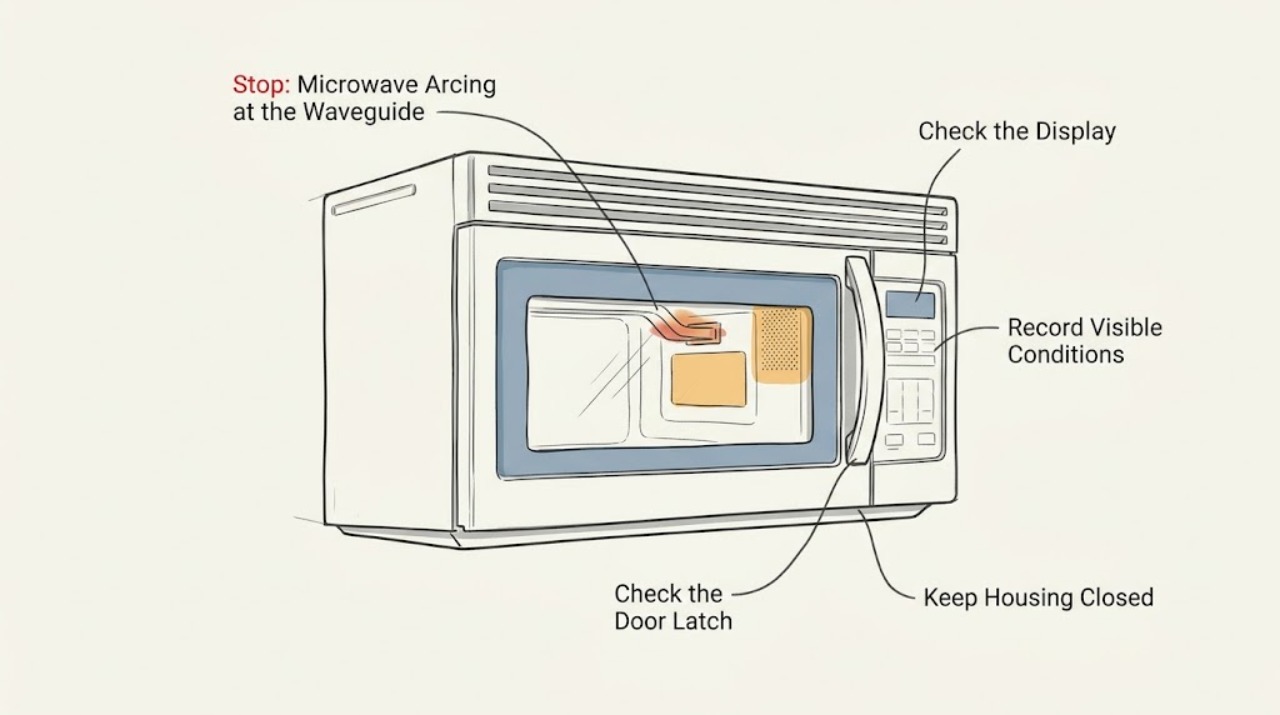
Work through in order
Diagnostic checks
Use only checks that match the exact appliance or system and its official guide.
-
Check 1
Leave the microwave disconnected from power and do not press Start, run a cooking cycle, or reconnect it after the magnetron change. If there is smoke, an active fire, or a hot or damaged cord, keep the door closed and isolate power only from a safe accessible control point or have emergency help do so.
Expected result: The unit is already disconnected, remains connected but idle, or has smoke, fire, a hot cord, burning odor, or visible electrical damage.
Next step: Keep it out of service. For smoke or fire, keep the door closed and contact emergency services as appropriate; do not reopen the door to inspect the arc.
Why this matters
Why: Prior arcing is evidence of an abnormal electrical/cavity event, not a completed repair. Re-energizing the oven could create further damage, fire, or a microwave-containment hazard.
-
Check 2
Read the rating label without removing the unit from the cabinet and record the complete model number, serial information, market, and vent arrangement. Treat “Spacemaker 1800XL” as a family name until the label identifies the exact JVM or other model.
Expected result: The label gives a complete model, gives only Spacemaker 1800XL, or cannot be safely read in place.
Next step: Give the exact label information to authorized service and obtain the matching manual. Do not borrow a procedure or magnetron specification from another XL1800-family model.
Why this matters
Why: GE's official owner centers list multiple different models under the Spacemaker XL1800 name, with separate manuals and vent descriptions. A family name cannot establish the correct parts, cavity construction, or safety procedure.
-
Check 3
Only from normal accessible areas, note whether the door is bent, the latch is loose, the seal or sealing surface is damaged, the cavity has a visible hole, or the interior coating is actively peeling. Do not remove the outer cover, waveguide cover, control panel, or any cabinet fastener.
Expected result: The door, latch, seal, cavity wall, or coating appears damaged, or no damage is visible from the normal user area.
Next step: Keep the oven disconnected and report every visible mark to the technician. Do not scrape, sand, paint, patch, or otherwise attempt to repair the cavity or waveguide.
Why this matters
Why: GE identifies a hole in the cavity wall as non-repairable and says active interior coating flaking or peeling requires discontinuing use. No visible user-area damage does not rule out waveguide or internal damage from the reported arc.
-
Check 4
Write down what preceded the arc—metal or foil, a rack, a spill, an empty cavity, unusual popping, or the antenna-to-waveguide location reported during service. Do not repeat any condition and do not run a water-cup or food test.
Expected result: The arc had a known external trigger, occurred with ordinary cookware, occurred while empty, or its trigger is unknown.
Next step: Give the sequence and photographs to the technician; do not use the oven to distinguish a cookware cause from an internal fault.
Why this matters
Why: GE lists metal, foil, rack placement, food spills, and empty operation as possible arcing contributors, but a known trigger does not prove that the internal waveguide and cavity escaped damage. The described antenna-to-waveguide arc requires professional assessment.
-
Check 5
Request service specifically for the exact model after an internal magnetron replacement and waveguide arcing. Ask the provider to document the waveguide and cavity condition, door and interlock condition, installation correctness, and the microwave-leakage safety evaluation before declaring the appliance usable.
Expected result: A provider can identify the exact model and has the appropriate microwave qualifications, or the provider cannot document the inspection scope.
Next step: Use only a provider who will make the safety decision for the exact model. If the cavity has a hole or the provider cannot verify safe condition, keep the appliance out of service and discuss replacement.
Why this matters
Why: GE's safety instructions reserve adjustment and repair for qualified service personnel. A “same” magnetron and a working display do not establish safe microwave containment or a sound cavity path.
-
Check 6
Preserve the removed part and repair information for the technician: the full model label, magnetron identification as printed on the part, date and sequence of the arc, any visible cavity marks, and who performed the work. Do not reinstall or alter parts while waiting for service.
Expected result: The part identity and repair sequence are documented, incomplete, or uncertain.
Next step: Send the record and photographs with the service request. Do not authorize another part based only on the phrase “magnetron replacement.”
Why this matters
Why: The technician needs to verify fit and installation rather than infer compatibility from appearance. Missing history increases uncertainty about the waveguide, mounting, interlocks, and containment path.
Use your observations
Decision map
Find the observation that best matches what you see, then follow the next safe action.
-
PATH 01Next step
What you see
The label identifies only Spacemaker 1800XL or the exact JVM model cannot be safely confirmed.
Do this next
Keep the oven disconnected and obtain the complete label and matching manual through GE support before any repair decision.
Why this path and its safety boundary
Why it matters: The product identity is incomplete. GE uses the XL1800 family name for multiple model variants, so another model's magnetron, waveguide, or safety procedure cannot be assumed.
-
PATH 02Next step
What you see
The prior arc was at the magnetron antenna-to-waveguide area, regardless of whether the replacement part looks identical.
Do this next
Do not reconnect or perform a cooking trial. Use qualified microwave service for exact-model inspection and the required leakage-safety evaluation.
Why this path and its safety boundary
Why it matters: The internal high-voltage and microwave path remains unverified. A new magnetron does not clear damage to the waveguide, cavity, mounting, seals, interlocks, or containment.
-
PATH 03Next step
What you see
A visible hole, active peeling, severe burn-through, bent door, loose latch, or damaged sealing surface is found from the normal user area.
Do this next
Keep the door closed, leave the oven disconnected, and have authorized service assess whether the unit must be replaced. Do not patch, sand, paint, or operate it.
Why this path and its safety boundary
Why it matters: GE says a cavity-wall hole is non-repairable and directs discontinuation of use for active coating failure; door and sealing damage also creates a microwave-exposure concern.
-
PATH 04Next step
What you see
No damage is visible from the normal user area and the display appears normal.
Do this next
Continue treating the oven as unsafe to use until a qualified provider completes the exact-model inspection and safety evaluation.
Why this path and its safety boundary
Why it matters: That observation cannot rule out internal waveguide, cavity, interlock, installation, or microwave-containment damage caused by the reported arc.
-
PATH 05Next step
What you see
The provider cannot document the exact model, internal inspection scope, or microwave-leakage safety evaluation.
Do this next
Do not reconnect it. Obtain an appropriately qualified or authorized microwave service assessment, or discuss replacement if safe verification is unavailable.
Why this path and its safety boundary
Why it matters: A “works after replacement” statement is not an adequate safety determination for an oven that arced internally.
Helpful context
Understand the symptom
Why a replacement magnetron does not make it safe
Arcing at the antenna-to-waveguide area is an internal high-voltage and cavity event. A matching-looking magnetron does not establish that the waveguide, cavity wall, seals, interlocks, mounting surfaces, or microwave containment are undamaged. GE's safety material says damaged ovens should not be operated and that adjustment or repair belongs to properly qualified service personnel.
What the technician must verify
Give the technician the complete model and the history of the arc and magnetron replacement. The service decision should be based on inspection of the waveguide and cavity, door and latch condition, safety interlocks, correct installation, and a qualified microwave-leakage safety evaluation—not on a short power-on trial or the appearance of one replacement part.
When checks do not resolve it
Need a professional?
Arrange qualified or authorized microwave service before any further use. The provider must identify the exact model, inspect the waveguide and cavity for arc damage, verify the door, latch, seals, and safety interlocks, confirm the magnetron installation, and complete the required microwave-leakage safety evaluation. Discuss replacement if there is a cavity hole, active peeling, severe damage, or no reliable way to verify safe condition.
Safety scope: This is not a user repair or test. Do not open the cabinet, discharge capacitors, measure high voltage or microwave leakage, replace or adjust internal parts, patch or sand a waveguide/cavity, bypass a door interlock, or reconnect the oven for a trial. Leave it disconnected after the reported arc.
Have this ready
- Provide the complete model and serial label, market and vent arrangement, the Spacemaker 1800XL family description, the arc location and sequence, photographs of visible user-area damage, the replacement magnetron identification, and the fact that the oven has not been safely cleared after the repair.
Common questions
FAQ
I installed the same-looking magnetron. Can I run the GE Spacemaker 1800XL now?
No. The magnetron replacement does not prove that the waveguide, cavity, door seals, interlocks, or microwave containment are safe after the reported arc. Keep it disconnected until qualified service completes the exact-model inspection and safety evaluation.
Can I briefly heat water to see whether the repair worked?
No. Do not reconnect or run a test cycle. A working display or heating result cannot clear hidden cavity, waveguide, interlock, fire, or microwave-leakage hazards.
Read the exact guide
Official sources
- Microwave - Arcing or Making SoundsGE Appliances · Official GE guidance on arcing causes and when electrical or mechanical sounds require service; it does not clear an internally arced oven after a magnetron replacement.
- IMPORTANT SAFETY INFORMATION.GE Appliances · Official GE microwave safety manual opened for the no-empty-operation, arcing, fire, and qualified-service precautions; exact model still controls the applicable manual.
- Microwave - Cavity Repair Needed Due to Arcing, Chipping, Peeling or ScorchingGE Appliances · Official GE microwave guidance for arcing and cavity damage; used to set the stop-use and no-user-patching boundary after the reported magnetron-to-waveguide arc.
- User Manual & Care for JVM1860BFGE Appliances · Official GE owner center showing one distinct JVM model under the Spacemaker XL1800 family, with a model-specific manual and outside-venting description.
- User Manual & Care for JVM1850WHGE Appliances · Official GE owner center showing a different JVM model under the Spacemaker XL1800 family, with its own manual and recirculating-venting description.
- PRECAUTIONS TO AVOID POSSIBLE EXPOSURE TO EXCESSIVE MICROWAVE ENERGYGE Appliances · Official GE microwave precautions used only for the safety boundary: do not operate a damaged oven or tamper with interlocks, and use properly qualified service personnel.
Community feedback
Share a repair observation
Share a plain-text repair observation. Accepted observations are published automatically; this page may take a moment to update.