
On this page
Start here
Quick answer
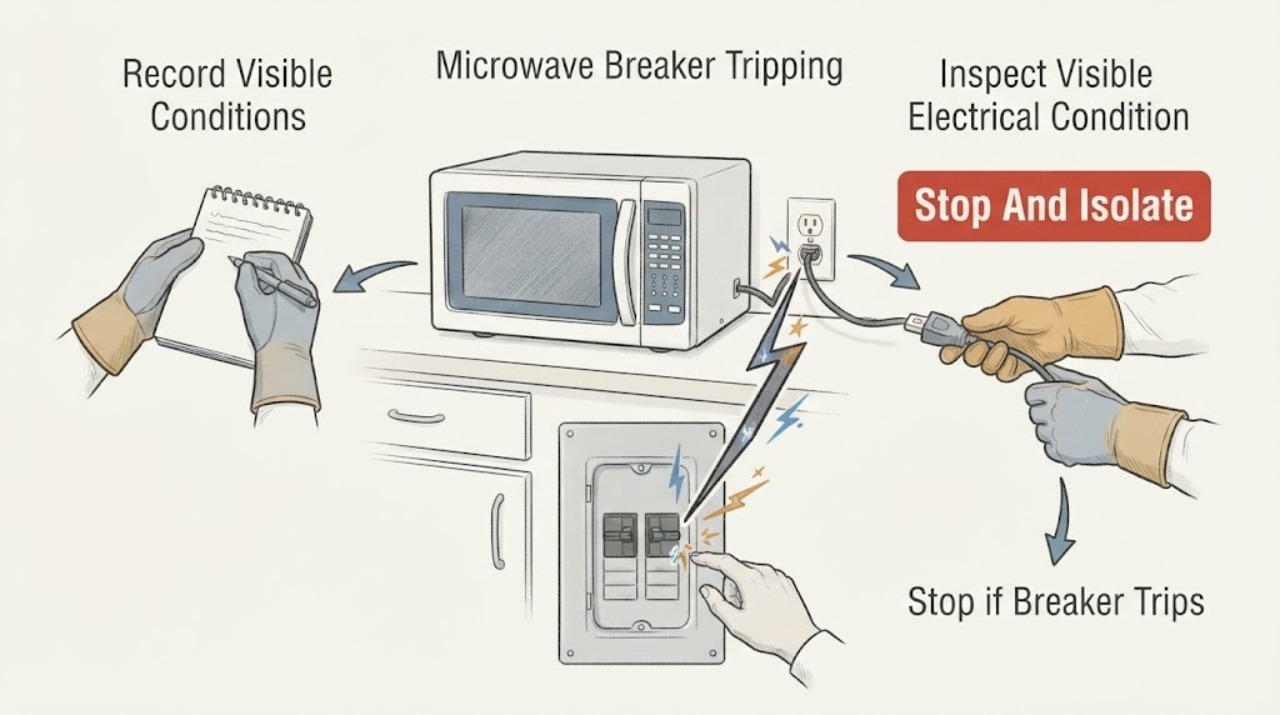
Stop using the Frigidaire microwave and do not keep resetting the breaker to see whether it will run. Frigidaire says a microwave should be on a dedicated non-GFCI circuit with no other appliances sharing it, and that an unresolved electrical issue may require an electrician. A repeated trip is a protective warning, not a microwave reset routine: unplug the appliance or leave its breaker off when safe, and arrange qualified electrical and/or Frigidaire service. From outside only, record the model, circuit type, whether the breaker tripped during the last event, and any hot outlet, damaged cord, moisture, burning odor, smoke or sparking. Do not open the microwave cabinet or test its high-voltage section.
Work through in order
Diagnostic checks
Use only checks that match the exact appliance or system and its official guide.
-
Check 1
Stop using the Frigidaire microwave after the repeated trip; unplug it if the plug and area are safe to approach, or leave its breaker/GFCI off. Do not reset the breaker again to test the appliance.
Expected result: The appliance is isolated without approaching heat, smoke, water or damaged wiring, or isolation cannot be done safely.
Next step: If isolation is unsafe or there is smoke/fire, leave the area and use emergency help. Otherwise continue only with external documentation and arrange qualified service.
Why this matters
Why: Repeated tripping is a protective electrical warning and is not a safe user-level reset problem.
-
Check 2
From outside the appliance, record the complete Frigidaire model/serial information, whether the event occurred at plug-in, door operation, start or during cooking based on the last observed event, and whether the display or interior light had power before the trip; do not recreate any stage.
Expected result: The timing and model are known, or the model/timing remains unknown.
Next step: Give the record to Frigidaire service and the electrician; do not use a generic microwave test sequence.
Why this matters
Why: A remembered event pattern helps service triage but does not diagnose a high-voltage or wiring component, and an unknown model prevents model-specific instructions.
-
Check 3
With the microwave disconnected and the circuit left off, look without touching energized parts for a hot or discolored outlet, loose fit, cracked plug, damaged cord, moisture, burning odor, smoke or visible sparking residue.
Expected result: The outlet/cord area is cool and intact, or any heat, damage, moisture, odor, smoke or sparking evidence is present.
Next step: Do not use a damaged or warm outlet. Keep the appliance off and call a qualified electrician; use emergency help for active smoke/fire.
Why this matters
Why: A visible electrical or fire warning raises the priority to electrical safety service; an intact exterior still does not clear the microwave.
-
Check 4
Without turning the breaker back on, identify whether other appliances share the microwave circuit and whether the receptacle has a GFCI reset/test feature; do not move the microwave to another outlet or use an extension cord as a test.
Expected result: Other loads share the circuit, the receptacle is GFCI-protected, the circuit appears dedicated, or the circuit cannot be identified safely.
Next step: Give the circuit information to a qualified electrician. Do not reconfigure wiring, defeat GFCI protection, change breaker size or keep resetting the circuit.
Why this matters
Why: Frigidaire's owner guidance calls for a dedicated non-GFCI microwave circuit with no other appliances, but the installation observation cannot distinguish household wiring from an appliance fault.
-
Check 5
Arrange service with the microwave disconnected and provide the model, circuit type, last event timing and visible-condition observations; do not remove the cabinet, probe wiring, replace a fuse, bypass an interlock or test high-voltage parts.
Expected result: The breaker remains stable only while the microwave is isolated, or the circuit trips independently/has visible wiring concerns.
Next step: Use Frigidaire factory service for the appliance and a qualified electrician for the circuit/outlet. Keep the breaker off if it trips independently or the electrical condition is unsafe.
Why this matters
Why: Isolation may help the electrician separate appliance service from household circuit work, but it is not proof of an internal microwave component.
Use your observations
Decision map
Find the observation that best matches what you see, then follow the next safe action.
-
PATH 01Next step
What you see
The microwave has repeatedly tripped the breaker or GFCI, even if it appears to work after a reset.
Do this next
Leave the microwave disconnected/off and arrange Frigidaire service plus qualified electrical evaluation as indicated.
Why this path and its safety boundary
Why it matters: The repeated event is an unresolved electrical warning and does not justify another power-on test.
-
PATH 02Next step
What you see
The outlet or plug is hot, loose, discolored, wet or damaged, or there is burning odor, smoke, sparking or a shock.
Do this next
Do not touch or use the outlet; keep the appliance off, leave the area for smoke/fire, and contact a qualified electrician or emergency services.
Why this path and its safety boundary
Why it matters: The visible condition may involve an electrical or fire hazard outside a safe appliance reset path.
-
PATH 03Next step
What you see
The microwave is on a GFCI or shared circuit, and no visible damage is present.
Do this next
Have a qualified electrician evaluate the circuit and installation without repeated resets or improvised rewiring; keep the microwave off until cleared.
Why this path and its safety boundary
Why it matters: The installation may not match Frigidaire's dedicated non-GFCI guidance, but this does not prove that the microwave is healthy.
-
PATH 04Next step
What you see
The circuit is dedicated and the exterior is intact, but the breaker trips when the microwave is used or the cause remains unknown.
Do this next
Keep it disconnected and schedule Frigidaire factory service; do not open the cabinet, replace an internal fuse or test components.
Why this path and its safety boundary
Why it matters: An internal appliance fault remains possible, and the microwave's high-voltage section is not a user diagnostic area.
Helpful context
Understand the symptom
Treat repeated trips as a stop condition
A breaker or GFCI opening the circuit is a safety event. CPSC says an appliance that repeatedly trips a circuit breaker should be unplugged and repaired or replaced, and that a warm outlet or switch should not be used. Do not keep turning the breaker back on, run an empty test, or try to reproduce the trip.
Check the installation from outside only
Frigidaire's microwave support page says the unit should use a dedicated non-GFCI circuit and share it with no other appliances. With the microwave disconnected and the circuit left off, record whether the receptacle is GFCI-protected, what else is on the circuit, and whether the plug, cord or outlet shows heat, looseness, damage or moisture. These observations guide the electrician; they do not prove an internal microwave part has failed.
Leave cabinet and high-voltage work to service
The model, timing and visible condition may help separate a circuit problem from an appliance fault, but they cannot safely identify a magnetron, capacitor, inverter, transformer, interlock or control-board failure. Microwave cabinets and high-voltage sections are outside user-level checks. Use Frigidaire service and a qualified electrician rather than opening the unit.
When checks do not resolve it
Need a professional?
Call Frigidaire service and/or a qualified electrician after any repeated trip. Escalate immediately for smoke, fire, shock, hot/discolored outlet, moisture or damaged wiring.
Have this ready
- Provide the complete model/serial information, microwave type and installation date if known, circuit/GFCI arrangement, event timing from the last occurrence, and exterior cord/outlet observations.
Common questions
FAQ
Should I keep resetting the breaker when my Frigidaire microwave trips it?
No. Stop using the microwave and leave the breaker/GFCI off rather than repeatedly resetting it. CPSC advises unplugging an appliance that repeatedly trips a breaker and having it repaired or replaced.
Can a shared or GFCI circuit cause the microwave to trip?
Frigidaire says its microwave should be on a dedicated non-GFCI circuit with no other appliances sharing it. Have a qualified electrician evaluate the installation; do not defeat GFCI protection or rewire it as a DIY test.
Does a breaker trip prove the microwave's magnetron or capacitor failed?
No. The event can involve the appliance, receptacle, wiring, GFCI or circuit loading. The microwave cabinet and high-voltage section require qualified service diagnosis.
What should I do if I smell burning or see smoke near the microwave?
Do not reset or test it. Leave the area if there is smoke or fire, call emergency services as needed, and keep the appliance and circuit off. A hot, damaged or discolored outlet should be checked by a qualified electrician.
Read the exact guide
Official sources
- Service & RepairElectrolux / Frigidaire · Opened Frigidaire's official service page. It describes factory-trained technicians specializing in Frigidaire appliances and a service route for diagnosis and repair; it does not authorize user microwave cabinet or high-voltage work.
- Appliance and Electrical Fire SafetyU.S. Fire Administration / FEMA · Opened the official USFA/FEMA safety page. It warns about damaged appliance cords, overloaded outlets and electrical fire risks; it is used for visible fire-safety boundaries, not for diagnosing a Frigidaire microwave part.
- CPSC and NESF Urge Consumers to "Plug Into Electrical Safety"U.S. Consumer Product Safety Commission · Opened the CPSC official safety release. It advises unplugging an appliance that repeatedly trips a circuit breaker and having it repaired or replaced; it also flags hot outlets/switches for qualified electrician evaluation.
- Understand Your Breaker Box – Video ShortElectrical Safety Foundation International · Opened ESFI's electrical safety page. It explains that frequent trips indicate an electrical issue and recommends qualified electrician inspection; it is used only for household circuit safety context.
- Microwaves - No Power | FrigidaireElectrolux / Frigidaire · Opened Frigidaire's official microwave support article. It says a microwave should be on a dedicated non-GFCI circuit with no other appliances, notes that an electrical issue may require an electrician, and routes unresolved cases to service.
Community feedback
Share a repair observation
Share a plain-text repair observation. Accepted observations are published automatically; this page may take a moment to update.