
On this page
Start here
Quick answer
Treat a Frigidaire microwave that trips a breaker as an electrical safety problem, not a reset exercise. First note whether the breaker trips immediately when Start is pressed, only after the microwave has run for a while, or when the vent fan or cooktop is also operating. From outside the appliance, identify whether other loads share the circuit and whether the outlet is a GFCI/GFI type; Frigidaire says its microwave should use a dedicated non-GFI circuit with no other appliances on it. A shared-load or recent surge can explain an isolated trip, but do not replace the breaker with a larger rating or keep resetting it. If the microwave alone trips immediately or repeatedly during heating, or if the cord, plug, outlet, cabinet, or display shows heat, scorch, smoke, arcing, or an electrical smell, leave it disconnected and arrange qualified service. Never open the microwave or attempt transformer, magnetron, capacitor, diode, or other high-voltage repair.
Before you begin
Safety first
- This article covers trip timing, external load and outlet observations, safe power-hardware inspection, model/vent identification, and service documentation. Breaker/wiring changes, microwave cabinet access, high-voltage parts, interlocks, controls, internal fans, and energized testing require qualified electrical or appliance service.
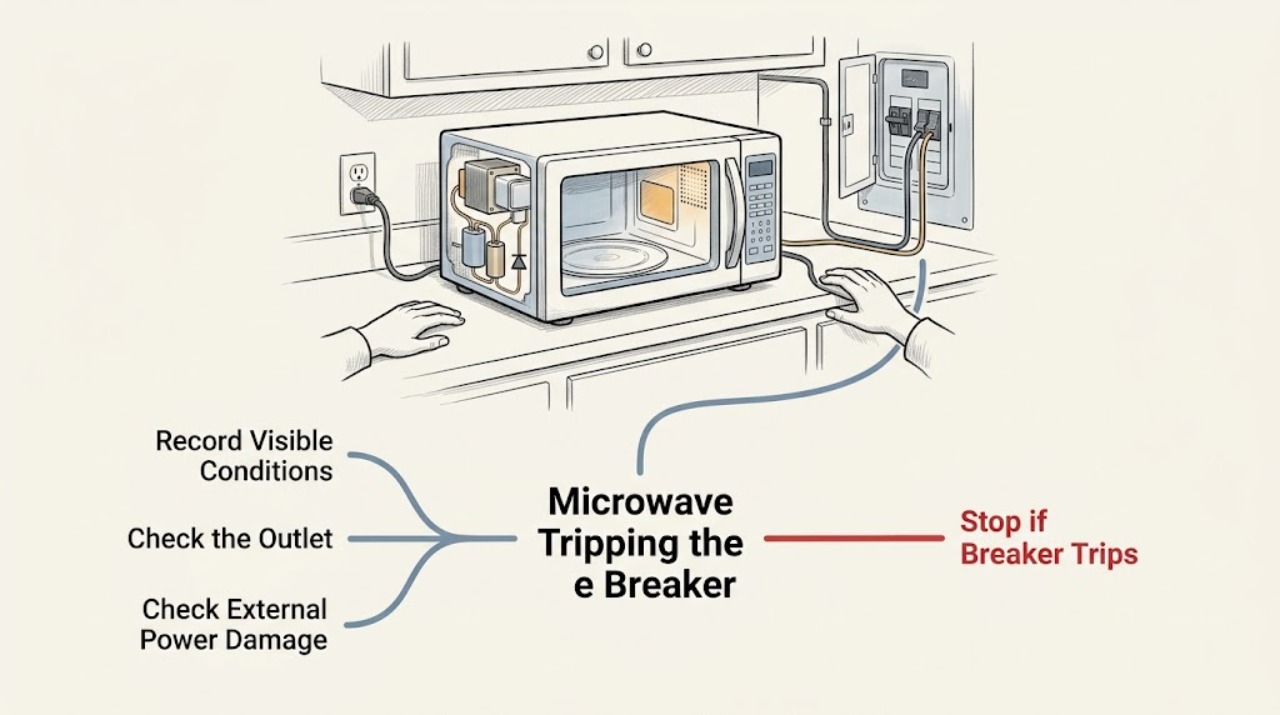
Work through in order
Diagnostic checks
Use only checks that match the exact appliance or system and its official guide.
-
Check 1
Stop using the microwave and write down what happened without resetting the breaker again: did it trip at Start, as heating began, after running, when the vent fan was selected, or when another kitchen appliance operated? Record whether the display went dark, whether the interior light changed, and whether there was smoke, an arc, smell, scorch, heat, or noise.
Expected result: The breaker trips immediately, during heating, after a delay, only with another load, or together with an electrical/fire warning.
Next step: If any smoke, arc, burning/electrical odor, scorch, hot plug/outlet, damaged cord, or repeated trip occurred, leave the microwave disconnected when safe and arrange service. Otherwise continue only with external checks.
Stop if: Do not run another cycle solely to reproduce the trip.
Why this matters
Why: Trip timing helps separate an external shared-load or supply event from a microwave-side fault, but any hazard sign overrides diagnosis and requires stop-use.
-
Check 2
From outside the appliance, identify other devices that lose power when the breaker trips and whether the microwave outlet has a GFCI/GFI reset button. Do not open the receptacle or breaker panel beyond normal user access, and do not use an extension cord or power strip as a test.
Expected result: The microwave shares a circuit with other substantial loads, the receptacle is GFCI/GFI, the breaker trips with other loads but not the microwave alone, or the microwave has a dedicated suitable circuit yet trips alone.
Next step: Have a qualified electrician verify circuit suitability and protection; do not change breaker rating or defeat GFCI protection. Keep the microwave disconnected if it trips alone.
Stop if: Do not remove the receptacle cover, alter house wiring, replace the breaker, or reset a wet, hot, scorched, or damaged outlet.
Why this matters
Why: A shared load or circuit-protection arrangement can explain an external trip. Frigidaire specifically says the microwave should use a dedicated non-GFI circuit with no other appliances on it. A microwave-only trip on a suitable circuit shifts concern toward the appliance or its dedicated supply.
-
Check 3
Inspect only the visible plug, cord, outlet face, and accessible power switch for looseness, wetness, discoloration, melting, scorch marks, or heat. Confirm the display and interior light state without touching damaged parts. If there was a recent surge or outage, record that event rather than repeatedly restoring power.
Expected result: The power hardware looks sound and the trip was isolated, or the plug/outlet/cord is hot, loose, wet, scorched, damaged, or the display remains dead.
Next step: Leave the microwave disconnected for any damage or repeated trip and call a qualified electrician or appliance service as appropriate. Do not move an OTR unit to reach wiring.
Stop if: Do not touch wet or hot electrical parts, insert probes, or continue if insulation is damaged.
Why this matters
Why: A recent outage or surge can affect the breaker or electronic control, while damaged power hardware is an immediate electrical stop-use condition. A dead display after a sound external supply needs service, not a larger breaker.
-
Check 4
For an OTR model, note whether the breaker trips with only the ventilation function or only when microwave heating starts. Record whether the unit recirculates or vents outside according to its installation information, but do not remove ductwork, mounting hardware, or a blower cover.
Expected result: The breaker trips with vent operation alone, with microwave heating alone, with both, or only when the cooktop and microwave operate together.
Next step: Stop the affected function and arrange qualified electrician or appliance service. Keep the OTR installation intact for the technician.
Stop if: Do not access the fan, capacitor, motor, or internal wiring while energized or after a trip.
Why this matters
Why: A vent-only trip points toward the fan or its circuit; a heating-only trip points toward the microwave's cooking power path; a trip only with the cooktop and microwave together can be a broader circuit/load issue. Timing is a routing clue, not a component diagnosis.
-
Check 5
If power was safely restored by a qualified person and there was no hazard, observe only whether the microwave trips immediately when Start is pressed, after a consistent run period, or not at all. Do not change cook time, power level, breaker rating, receptacle type, or wiring to make the test pass.
Expected result: It trips immediately every time, trips after warming or running, trips intermittently, or no longer trips but previously did so with smoke, smell, noise, or weak operation.
Next step: Disconnect the microwave and provide the exact timing and symptom record to qualified service; do not continue testing for a pattern.
Stop if: Never hold a breaker on, bypass a safety device, or perform an energized current or resistance test inside the microwave.
Why this matters
Why: A repeat microwave-only trip at Start or during heating is an appliance/electrical service symptom. A no-repeat result does not prove the unit is safe if a hazard or previous repeated trip occurred.
-
Check 6
Only after power is disconnected and the microwave is cool, inspect the cavity for visible food splatter or a questionable container and clean accessible surfaces as Frigidaire directs. Wipe splatter near the waveguide cover gently; do not remove that cover. Do not treat cleaning as a reset for a breaker trip.
Expected result: There is ordinary residue with no arc or scorch, or there is a scorch mark, damaged cover, persistent odor, or a repeat trip after a clean and dry cavity.
Next step: Arrange qualified microwave service for any hazard or repeat trip. Do not operate with a damaged cover or cavity.
Stop if: Never remove the waveguide cover, open the cabinet, immerse the unit, or clean while connected to power.
Why this matters
Why: Cleaning may remove residue but cannot clear an internal short, damaged waveguide cover, or high-voltage fault. A scorch, persistent odor, or repeat trip remains a stop-use service branch.
-
Check 7
Prepare the complete model and serial information, microwave type, circuit/outlet description, other devices on the circuit, exact trip timing, breaker/GFCI behavior, display state, vent setting, and every smell, arc, scorch, heat, or noise observation for the electrician or appliance technician.
Expected result: The event is fully documented without another energized test, or key details can be obtained only by opening or repeatedly operating the unit.
Next step: Keep the microwave disconnected and arrange qualified service; use an electrician for house-circuit or breaker work and microwave service for appliance internals.
Stop if: Do not open the microwave to obtain a component label or sound recording.
Why this matters
Why: A detailed external record lets professionals separate circuit protection, vent, control, motor, and high-voltage paths without exposing the owner to cabinet hazards.
Use your observations
Decision map
Find the observation that best matches what you see, then follow the next safe action.
-
PATH 01Next step
What you see
The breaker trips when the microwave operates with other kitchen loads or the outlet is GFCI/GFI protected.
Do this next
Stop combining the loads and have an electrician verify the dedicated non-GFI circuit and breaker. Do not install a larger breaker or defeat the protection.
Why this path and its safety boundary
Why it matters: An external load or protection arrangement is more likely than an appliance-only fault, but the circuit still needs qualified verification.
-
PATH 02Next step
What you see
The microwave alone trips the breaker as soon as Start or heating is selected.
Do this next
Leave the microwave disconnected and arrange qualified appliance service. Do not open the cabinet or continue reset attempts.
Why this path and its safety boundary
Why it matters: A microwave-side control, interlock, motor, heater, or high-voltage fault is more likely; timing cannot identify which component.
-
PATH 03Next step
What you see
The microwave runs for a while before the breaker opens.
Do this next
Stop using it and give the technician the elapsed stage and selected function. Do not run longer cycles to reproduce the event.
Why this path and its safety boundary
Why it matters: A heat-, motor-, control-, wiring-, or high-voltage-related fault is possible; a delayed trip is not safer than an immediate trip.
-
PATH 04Next step
What you see
The plug, cord, outlet, switch, or breaker shows heat, moisture, looseness, scorch, or damage.
Do this next
Keep clear, disconnect only when safe, and arrange qualified electrical assessment; do not touch or replace damaged parts yourself.
Why this path and its safety boundary
Why it matters: The external supply is an immediate hazard and the microwave should not be used to determine whether the appliance is at fault.
-
PATH 05Next step
What you see
A breaker trip is accompanied by an arc, spark, smoke, burning odor, scorching, weak heating, or harsh electrical noise.
Do this next
Leave the unit disconnected and arrange qualified microwave service. Never open the cabinet or remove the waveguide cover.
Why this path and its safety boundary
Why it matters: The event is not an ordinary circuit inconvenience. Continued operation could worsen cavity, wiring, control, or high-voltage damage.
Helpful context
Understand the symptom
Trip timing is the first useful clue
A breaker that trips when the microwave and another appliance run together is a circuit-load branch. A trip at the instant Start is pressed, or a trip that happens with the microwave alone on a known-suitable circuit, is more concerning for the appliance or its supply. A trip after several minutes may be heat-, motor-, control-, or wiring-related, but the timing cannot identify a component. Record the sequence once; do not keep reproducing it.
The breaker is a safety device
Do not install a larger breaker, defeat a GFCI/GFI, use an extension cord or power strip, or keep resetting the same breaker. Frigidaire's guidance calls for a dedicated non-GFI circuit with no other appliances sharing it and notes that a power surge may require electrical help. Circuit wiring and breaker ratings must be assessed by a qualified electrician, not guessed from the microwave label.
Microwave high voltage is a professional boundary
Even after the plug is removed, a microwave can contain hazardous stored energy. Do not remove the cabinet, waveguide cover, control panel, or rear cover, and do not test a transformer, magnetron, capacitor, diode, interlock, or internal wiring. If there is arcing, smoke, an electrical smell, scorching, unusual heat, or a damaged cord or outlet, keep the unit out of service and arrange qualified diagnosis.
Safety boundary
Stop conditions
- Stop immediately for a repeated breaker trip, visible arc or spark, smoke, burning/electrical smell, scorch, unusual heat, damaged cord/plug/outlet, or water near electrical parts; disconnect only when safe.
- Do not replace the breaker with a larger rating, defeat GFCI/GFI protection, alter house wiring, use an extension cord or power strip, or repeatedly reset the circuit.
- Never open the microwave cabinet or perform high-voltage discharge, current, resistance, or energized testing; transformer, magnetron, capacitor, diode, interlock, control, and wiring work require qualified service.
- Unplug before cleaning and never remove the waveguide cover; a scorch mark or persistent odor is a stop-use condition.
Only after diagnosis
Potential parts
- power cord or external receptacle
Consider only after a qualified electrician identifies damaged external power hardware or a model-specific cord issue; a cord cannot be used to mask a circuit or appliance fault.
Electrical rating, grounding, receptacle, and installation requirements must be verified by a qualified professional for the exact model. - ventilation fan assembly
Consider only when an OTR vent-only trip is reproduced safely and qualified diagnosis identifies the fan or its circuit as the cause.
OTR fan and duct arrangements vary by model; internal access and electrical work require service. - control or interlock assembly
Consider only after qualified diagnosis finds a control or interlock fault associated with a repeat trip and rules out the circuit and high-voltage path.
Confirm exact model fitment and professional diagnosis; do not bypass or replace a safety interlock based on symptoms alone. - high-voltage assembly
Consider only as a technician-selected repair after a microwave-only trip during heating and qualified high-voltage diagnosis; owners must not test or replace these components.
Transformer, magnetron, capacitor, diode, and related wiring are model-specific hazardous components requiring qualified service.
When checks do not resolve it
Need a professional?
Arrange a qualified electrician for a shared-circuit, outlet, GFCI/GFI, breaker, wiring, or power-hardware concern. Arrange qualified Frigidaire microwave service when the microwave alone trips immediately or during heating, trips after a delay, repeatedly resets, or has weak operation or abnormal noise. Use immediate stop-use service for arcing, smoke, burning/electrical odor, scorching, damaged power parts, water exposure, or repeated trips.
Safety scope: This article covers trip timing, external load and outlet observations, safe power-hardware inspection, model/vent identification, and service documentation. Breaker/wiring changes, microwave cabinet access, high-voltage parts, interlocks, controls, internal fans, and energized testing require qualified electrical or appliance service.
Common questions
FAQ
Why does my Frigidaire microwave trip the breaker when I press Start?
First determine whether other appliances share the circuit and whether the outlet is GFCI/GFI. Frigidaire says its microwave should use a dedicated non-GFI circuit with no other appliances on it. If the microwave alone trips immediately on a suitable circuit, leave it disconnected and arrange qualified service; do not keep resetting the breaker or open the cabinet.
Can I replace the microwave breaker with a larger one?
No. Do not change the breaker rating or alter house wiring to stop trips. Have a qualified electrician verify the circuit and protection. A larger breaker can remove an important safety limit without correcting the microwave fault.
What if the breaker trips only after the microwave has run for a while?
A delayed trip can involve the circuit, vent function, motor, controls, wiring, or high-voltage heating path, and timing alone cannot identify the part. Stop using the microwave and provide the technician the selected function and point at which the trip occurred. Do not run longer cycles to reproduce it.
Is a GFCI outlet causing my Frigidaire microwave to trip?
Frigidaire's no-power guidance says the microwave should be on a dedicated non-GFI circuit with no other appliances sharing it. Have an electrician verify the actual circuit and protection rather than bypassing the GFCI/GFI or using an extension cord.
Can I open the microwave to find the short?
No. Do not open the cabinet, remove the waveguide cover, or test the transformer, magnetron, capacitor, diode, interlock, or wiring. Frigidaire says to unplug before cleaning and never remove the waveguide cover. Arcing, smoke, burning odor, scorching, or repeated trips require qualified service.
Read the exact guide
Official sources
- Support for MicrowavesFrigidaire · Official microwave support category showing model-dependent power, ventilation, cleaning, and installation resources.
- Microwaves - No PowerFrigidaire · Official external power, surge, breaker, GFI/GFCI, and dedicated-circuit guidance.
- Microwaves - What hardware should I use for installing my microwave?Frigidaire · Official OTR installation-hardware guidance.
- Microwaves - How do I change the surface light in my microwave?Frigidaire · Official instruction to unplug or turn off the breaker before an owner-accessible OTR surface-light cover task.
- Microwaves - Where does my over the range microwave vent?Frigidaire · Official OTR vent-arrangement information.
- How do I clean my microwave?Frigidaire · Official unplugging, cavity-cleaning, waveguide-cover, and turntable safety guidance.
Community feedback
Share a repair observation
Share a plain-text repair observation. Accepted observations are published automatically; this page may take a moment to update.