
On this page
Start here
Quick answer
A Samsung microwave that trips a breaker should be treated as an electrical fault until the supply and load are checked. Stop repeated resets, confirm the plug and outlet are undamaged, and have a qualified electrician verify the grounded branch circuit; service is required if the breaker trips again or the microwave shows heat, smoke, or arcing.
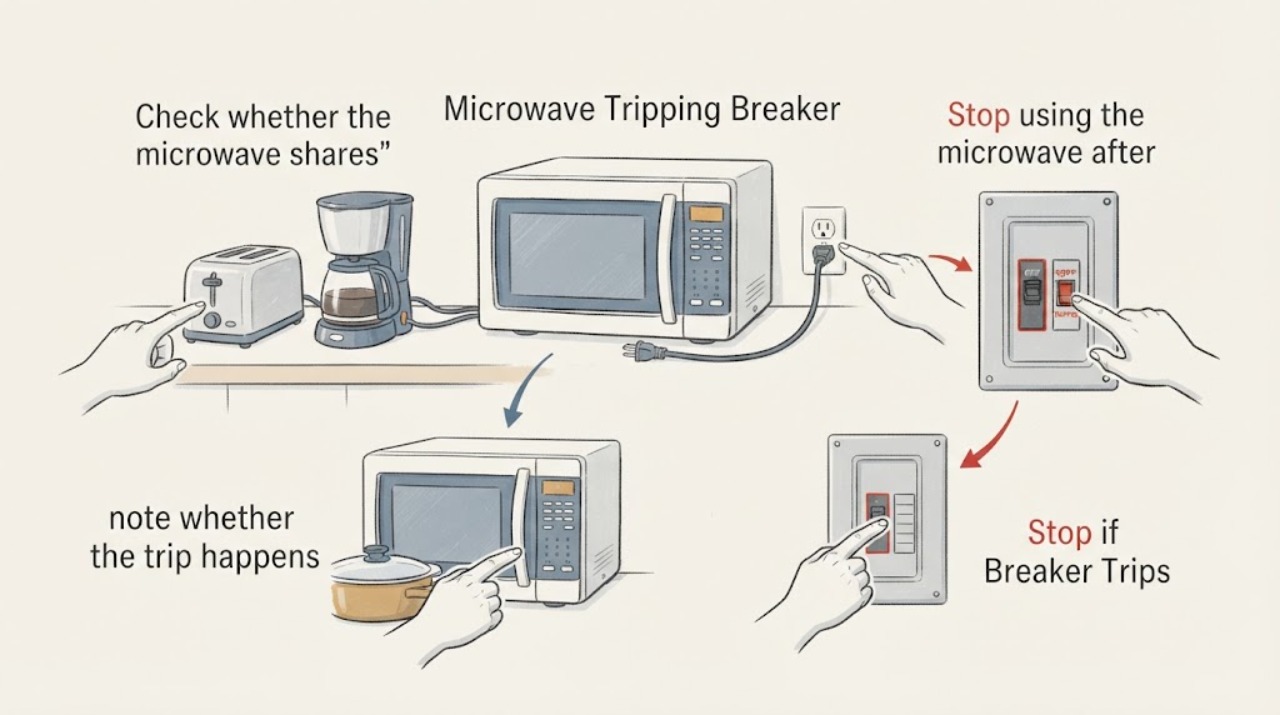
Work through in order
Diagnostic checks
Use only checks that match the exact appliance or system and its official guide.
-
Check 1
Stop using the microwave after the trip and inspect the plug, cord, and receptacle from outside for heat, damage, moisture, or a burning smell.
Expected result: The supply hardware is normal, or it is hot, damaged, wet, or smells burned.
Next step: Leave it disconnected if safe and call a qualified electrician for supply damage; do not open the outlet.
Stop if: Stop and arrange qualified service for smoke, burning odor, sparks, damaged wiring, water near electrics, or repeated protective-device trips.
Why this matters
Why: A damaged or overheated supply is unsafe to diagnose through repeated appliance tests.
-
Check 2
Check whether the microwave shares the circuit with other high-load appliances and confirm the model installation uses a grounded suitable branch circuit.
Expected result: The circuit is shared or unsuitable, or the branch circuit meets the manual requirements.
Next step: Have a qualified electrician correct the circuit; do not use an extension cord or defeat grounding.
Stop if: Stop and arrange qualified service for smoke, burning odor, sparks, damaged wiring, water near electrics, or repeated protective-device trips.
Why this matters
Why: Overloading or an unsuitable circuit can trip protection even when the microwave itself is intact.
-
Check 3
After the circuit is verified and only if no hazard sign exists, note whether the trip happens at idle, on Start, or during heating.
Expected result: The breaker trips immediately, only when heating begins, or no longer trips after a circuit correction.
Next step: Stop testing at any repeat trip and arrange Samsung service.
Stop if: Stop and arrange qualified service for smoke, burning odor, sparks, damaged wiring, water near electrics, or repeated protective-device trips.
Why this matters
Why: Timing separates supply/control concerns from a load-related internal fault, but it does not identify a safe replacement part.
-
Check 4
Check the cavity and door area for metal objects, foil, residue, or visible arcing damage without removing covers.
Expected result: Arcing marks or metal are present, or the cavity is clean and undamaged.
Next step: Remove only an obviously loose nonmetal item; do not operate with scorch marks or a damaged door.
Stop if: Stop and arrange qualified service for smoke, burning odor, sparks, damaged wiring, water near electrics, or repeated protective-device trips.
Why this matters
Why: Metal or damage can explain arcing and a protective trip; a clean cavity with repeated trips needs service.
Use your observations
Decision map
Find the observation that best matches what you see, then follow the next safe action.
-
PATH 01Next step
What you see
The breaker trips with a hot, damaged, wet, or burned outlet, cord, or plug.
Do this next
Keep the microwave off and contact a qualified electrician.
Why this path and its safety boundary
Why it matters: The household supply is the immediate hazard.
-
PATH 02Next step
What you see
The branch circuit is shared or lacks the grounded, suitable supply specified by Samsung.
Do this next
Correct the circuit through a qualified electrician before further use.
Why this path and its safety boundary
Why it matters: Installation or circuit capacity can be the trigger.
-
PATH 03Next step
What you see
The verified circuit is suitable but the microwave trips when heating or trips again after reset.
Do this next
Stop use and request Samsung appliance service; do not remove the cabinet or probe live parts.
Why this path and its safety boundary
Why it matters: An internal microwave fault is more likely and cannot be safely isolated by the user.
Helpful context
Understand the symptom
What the symptom can mean
This samsung microwave symptom can come from an accessible condition, a control state, or a component that requires qualified service.
Use the result to choose the next step
Record what you observed and stop when the safety or service boundary below applies.
When checks do not resolve it
Need a professional?
Arrange qualified appliance service when the symptom persists after the documented user-accessible checks, a protective device trips again, or the diagnosis would require opening panels, accessing wiring, refrigerant circuits, sealed mechanisms, or motor and control components.
Common questions
FAQ
Can I keep using the microwave while this symptom continues?
Use it only when the accessible checks show normal operation and no safety warning; stop for persistent faults, heat, smoke, water near electrics, sparks, or repeated protective-device trips.
When should I stop troubleshooting?
Stop when the symptom repeats after the documented user checks, when a panel or sealed system would need to be opened, or when any electrical, fire, water, or mechanical hazard appears.
Read the exact guide
Official sources
- How to troubleshoot a Samsung microwave ovenSamsung · Samsung microwave oven electrical and operating troubleshooting
- ME21R7051SS Installation Guide and Important Safety InstructionsSamsung · Samsung microwave electrical grounding and branch-circuit requirements
Community feedback
Share a repair observation
Share a plain-text repair observation. Accepted observations are published automatically; this page may take a moment to update.