
On this page
Start here
Quick answer
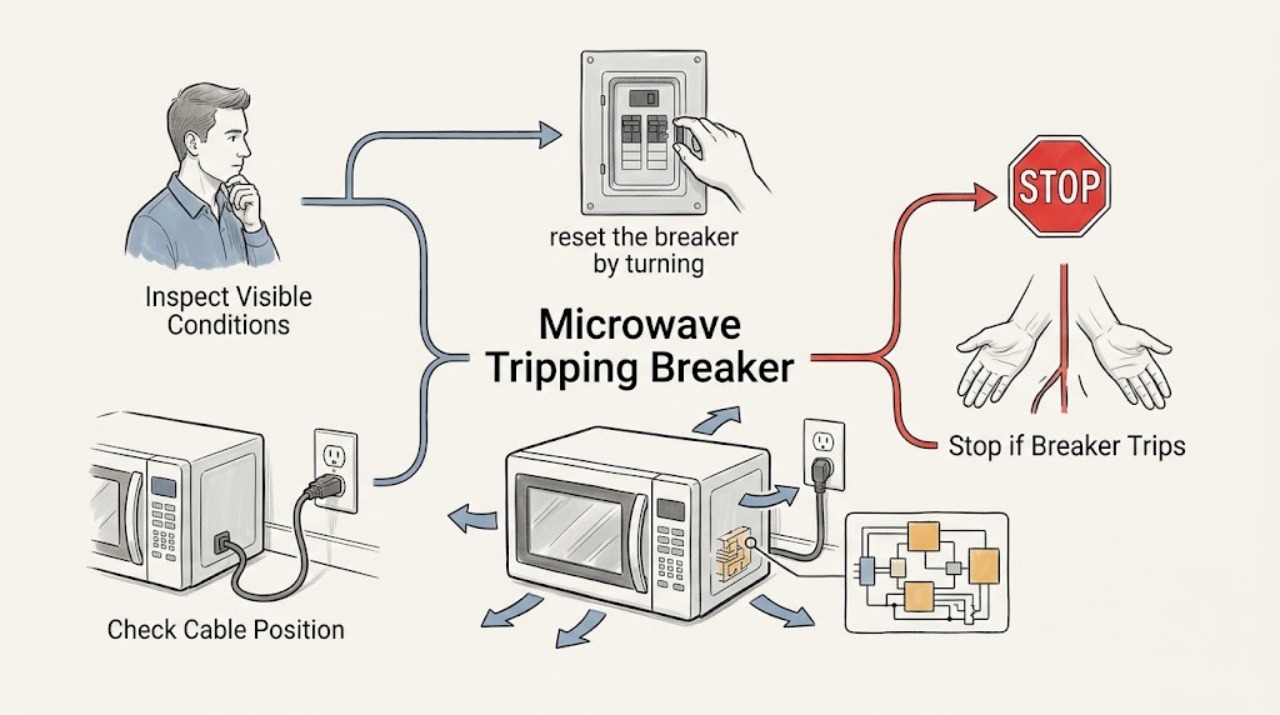
If a GE microwave trips the breaker or blows a fuse, stop using it after the first repeat trip. Confirm from the model's installation instructions that it has the correct grounded, dedicated circuit; standard countertop and over-the-range GE microwaves generally require an individual 120V branch circuit, while a particular model may have different requirements. If safe, reset the breaker once and retry the microwave one time with no extension cord and clear external vents. If it trips again, unplug the oven and arrange qualified service. A trip after a long run can involve blocked airflow or overheating, but an immediate trip, a damaged cord or outlet, smoke, burning odor, arcing, liquid, or a hot/discolored plug must be treated as an electrical stop condition. Do not substitute a larger fuse or breaker, repeatedly reset protection, remove the cover, or perform live or high-voltage tests.
Work through in order
Diagnostic checks
Use only checks that match the exact appliance or system and its official guide.
-
Check 1
Stop the microwave and assess the area without touching wet or damaged electrical parts. Look at the plug, receptacle, cord, case, door, and external vents; if there is smoke, burning odor, arcing, liquid, scorching, a hot plug, or a damaged cord, isolate power at the breaker only if safe and leave the appliance out of use.
Expected result: Record whether the trip happened immediately on plug-in, when Start was pressed, during heating, after a long run, or when another appliance was used. Note whether only the microwave lost power or other loads on the circuit did too.
Next step: Do not re-energize the oven when a safety symptom is present. Otherwise continue only with the external circuit and model checks below; do not open the microwave.
Why this matters
Why: An immediate or appliance-specific trip is more concerning for an appliance or connection fault; a trip that follows a long run may involve overload or thermal conditions. A damaged or wet electrical part is a safety issue regardless of timing.
-
Check 2
Use the model number to read the GE installation instructions and confirm the required voltage, grounding, circuit protection, and whether the microwave is cord-connected or hard-wired. For a standard plug-in countertop or over-the-range unit, verify the accessible receptacle is grounded and that the microwave is not sharing a circuit with high-load appliances; do not use an extension cord to work around the installation.
Expected result: The circuit is shared, the breaker or fuse does not match the model instructions, the receptacle or wiring is loose or discolored, the unit is hard-wired, or the installation appears correct and dedicated.
Next step: Have an electrician or installer correct an incorrect circuit, grounding, receptacle, or hard-wired installation. Do not change the breaker or fuse rating yourself; if the supply is correct, proceed to one controlled reset only.
Why this matters
Why: An incorrect or overloaded circuit is an installation or electrical-system issue, not a microwave part diagnosis. A correct dedicated supply with a repeat trip shifts suspicion toward the appliance or its connection.
-
Check 3
If there is no damage or moisture and the installation is believed correct, reset the breaker by turning it fully off and back on; for a double breaker, follow the model and household-panel procedure because a partial trip can look on. Let the microwave remain off until the reset is complete, then try it once with a normal load and no extension cord.
Expected result: The breaker resets and holds, the microwave trips immediately on Start, or it runs once and trips again during operation.
Next step: If it trips again, unplug the microwave and stop testing. Arrange qualified service; if the breaker trips even with the microwave unplugged, leave it off and have an electrician diagnose the household circuit.
Why this matters
Why: A stable reset with no recurrence may indicate a one-time supply interruption. An immediate or repeat trip after the appliance is connected is not a nuisance to be defeated and may reflect an appliance or circuit fault.
-
Check 4
If the trip occurred after several minutes or a long cooking cycle and power returned after cooling, inspect only the external case vents and model-required clearance. Remove items covering vents and avoid placing the microwave where airflow is restricted; do not spray, pour water into, or dismantle the case.
Expected result: The vents were blocked or clearance was inadequate, the unit returns after approximately 30 minutes, or the trip repeats, power does not return, or the case is abnormally hot or discolored.
Next step: Use the oven only if the model instructions permit and the circuit remains stable. For any repeat trip, hot or damaged case, odor, smoke, arcing, or failure to recover, unplug or isolate it when safe and arrange service.
Why this matters
Why: GE identifies long operation and blocked vents as possible overheating conditions. One recovery after clear airflow supports a thermal explanation, but recurrence or damage indicates a fault or unsafe installation.
-
Check 5
Check whether the breaker trip is associated with a cooking mode, door movement, fan operation, or an error display, but do not repeatedly recreate the trip. Write down the exact message and the moment the protection operated; never use a code from another GE model to justify a component replacement.
Expected result: The trip occurs only when Start is pressed, only after the oven heats, when the door is moved, or with a model-specific fault message; alternatively it occurs regardless of mode.
Next step: Keep the microwave unplugged after a repeat trip and provide the model, circuit type, trip timing, mode, display message, and any odor or damage to a qualified servicer. Do not remove covers or test live wiring.
Why this matters
Why: Timing can help a qualified technician distinguish supply, door-interlock, thermal, control, or heating-circuit symptoms, but it cannot identify the faulty part safely from outside.
-
Check 6
After any service or electrical correction, verify only that the exact model's supply and installation have been approved and that the cord, outlet, door, and vents are intact. Run one supervised normal cycle with a suitable load; stop immediately if protection operates again or any smoke, odor, arcing, heat damage, or abnormal sound appears.
Expected result: The microwave operates without a trip, or the same protection device trips again under a normal load.
Next step: Stop using the microwave and arrange qualified appliance service for a repeat appliance-specific trip; use an electrician for a household breaker, receptacle, or wiring trip that persists with the microwave unplugged.
Why this matters
Why: A stable run after a verified correction supports an external supply or airflow cause. A repeat trip demonstrates that the fault remains and requires qualified diagnosis, even if the oven still appears to power up.
Use your observations
Decision map
Find the observation that best matches what you see, then follow the next safe action.
-
PATH 01Next step
What you see
The breaker trips immediately when the microwave is plugged in or Start is pressed.
Do this next
Do not reset repeatedly or substitute a larger fuse or breaker. Leave the appliance unplugged and use a qualified electrician or microwave servicer according to the confirmed fault boundary.
Why this path and its safety boundary
Why it matters: An installation, circuit, or appliance electrical fault is more likely than overheating from a long run.
-
PATH 02Next step
What you see
The microwave trips only after a long cooking cycle and later powers up again.
Do this next
Clear external airflow and follow the exact manual once. Stop using the oven and arrange service for any recurrence, odor, smoke, arcing, heat damage, or breaker operation.
Why this path and its safety boundary
Why it matters: A temporary thermal condition is more likely only when airflow correction resolves it once. Recurrence points toward a fault or unsafe installation.
-
PATH 03Next step
What you see
The breaker trips even when the microwave is unplugged, or other appliances also lose power.
Do this next
Leave the breaker off if it will not hold and arrange qualified electrician diagnosis. Do not repeatedly energize the circuit to locate the fault.
Why this path and its safety boundary
Why it matters: The household circuit, breaker, receptacle, or shared load is more likely than an internal microwave fault.
-
PATH 04Next step
What you see
The circuit is dedicated and stable until the GE microwave is connected, then it trips again.
Do this next
Keep the microwave unplugged and arrange qualified service. Do not remove the cover, defeat door interlocks, or perform live or high-voltage tests.
Why this path and its safety boundary
Why it matters: An appliance-side connection, control, thermal, door-interlock, or heating-circuit fault is more likely, but no particular part can be identified safely without service equipment.
Helpful context
Understand the symptom
Treat a repeat trip as a stop signal
A breaker or fuse is responding to an electrical or overload condition, and the trip timing matters. GE's microwave-specific instruction is to ensure a dedicated circuit, reset or replace the household protection, try the microwave once more, and unplug it if the breaker trips again. That limited retry is different from repeatedly re-energizing a possibly faulty appliance.
Do not assume every GE microwave has the same supply
GE's standard countertop and over-the-range microwave guidance calls for an individual grounded 120V branch circuit protected according to the model instructions, while installation details such as a hard-wired connection, circuit rating, or built-in configuration must be verified for the exact model. Never install a larger fuse or breaker to stop nuisance trips; an installer or electrician must resolve an incorrect supply.
Overheating can explain timing, not excuse recurrence
If a microwave shuts down only after a long cycle, GE says blocked case vents or inadequate air clearance can contribute to overheating, and power may return after about 30 minutes. Clear only external obstructions and use the model's clearance instructions. A breaker trip that returns, occurs immediately, or accompanies odor, smoke, arcing, or damage requires qualified service.
When checks do not resolve it
Need a professional?
Unplug the GE microwave and arrange qualified service after a second breaker or fuse trip, or immediately for smoke, burning odor, arcing, liquid, a hot or discolored plug or case, a damaged cord or door, or a breaker that will not hold. Have an electrician diagnose an incorrect, shared, ungrounded, hard-wired, or household circuit condition. GE identifies microwave repair as a professional task; do not install a larger fuse or breaker, use an extension cord as a workaround, open the cover, defeat door interlocks, discharge a capacitor, or perform live tests.
Common questions
FAQ
Why does my GE microwave keep tripping the breaker?
GE says a microwave should not trip its protection. Confirm the exact model's dedicated circuit and correct supply, reset and retry only once if there is no damage, and unplug the oven if it trips again. A repeat trip may be an appliance or household electrical fault and needs qualified diagnosis.
Can a blocked GE microwave vent cause a breaker trip?
Blocked vents can contribute to overheating and a shutdown after a long run, according to GE. Clear only external obstructions and use the model's clearance instructions; if the breaker trips again, power does not return after cooling, or the case is hot or damaged, unplug the microwave and arrange service.
Should I keep resetting the breaker when my GE microwave trips it?
No. GE's microwave-specific guidance allows one reset and retry, then says to unplug the microwave and contact service if it trips again. Do not install a larger breaker or fuse, bypass protection, or open the microwave to search for a short.
Read the exact guide
Official sources
- GE Microwave Oven Safety GuideGE Appliances · GE microwave grounding, dedicated-outlet, damage, interlock, and empty-cavity safety
- Microwave - Tripping Circuit BreakerGE Appliances · GE microwave breaker or fuse trip decision and service boundary
- GE Appliance - Circuit Breaker TripsGE Appliances · GE breaker sizing, installation, household wiring, and appliance fault boundary
- Microwave - Runs But Does Not HeatGE Appliances · GE microwave professional-only internal high-voltage repair boundary
- Microwave - Power is OffGE Appliances · GE microwave power-loss, airflow, and overheating checks
- Microwave - Electrical Requirements and Breaker SizeGE Appliances · GE countertop and over-the-range microwave circuit requirements
- Microwave - Error, Fault or Function CodesGE Appliances · GE microwave model-dependent fault-message and service boundary
- GE Appliance - Resetting Your Circuit BreakerGE Appliances · GE appliance breaker reset behavior
Community feedback
Share a repair observation
Share a plain-text repair observation. Accepted observations are published automatically; this page may take a moment to update.