
On this page
Start here
Quick answer
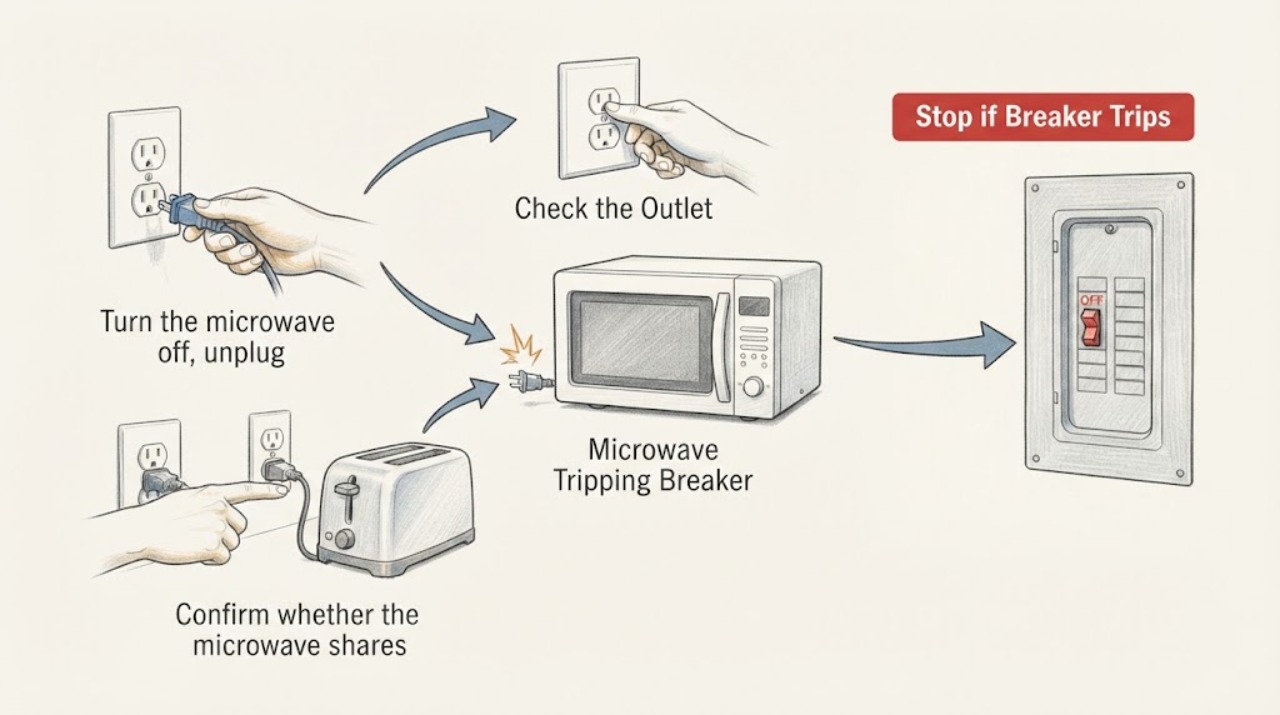
A microwave that trips the breaker needs a controlled stop, not repeated resets. Unplug it, identify whether other high-load devices share the circuit, and check the cord and plug from a safe dry position. Reset the breaker only once if there is no visible damage and the circuit is suitable; if it trips again, unplug the microwave and arrange qualified appliance or electrical service.
Work through in order
Diagnostic checks
Use only checks that match the exact appliance or system and its official guide.
-
Check 1
Turn the microwave off, unplug it, and note exactly when the breaker trips: at plug-in, when starting, after running, or only with another appliance on the same circuit.
Expected result: The trip is immediate, start-related, delayed, or shared with other loads.
Next step: Keep it unplugged while checking the circuit context; do not repeatedly re-energize it.
Stop if: Stop for smoke, burning smell, a hot plug, damaged insulation, or water near the outlet.
Why this matters
Why: Timing separates a supply/short concern from a load or heating-cycle concern, but none proves which internal part failed.
-
Check 2
From a dry position, inspect the plug, cord, outlet, and visible microwave cabinet for scorch marks, looseness, moisture, or damage.
Expected result: Visible damage or moisture is present, or external parts look normal.
Next step: Leave power off and call qualified service/electrical help for damage; otherwise continue to the dedicated-circuit check.
Stop if: Do not remove the cabinet or touch a damaged outlet.
Why this matters
Why: Damage or moisture makes the appliance unsafe to test; normal appearance does not rule out an internal fault.
-
Check 3
Confirm whether the microwave shares its circuit with another high-load appliance and whether the exact installation instructions require a dedicated circuit.
Expected result: The circuit is shared/unsuitable, or it is dedicated and correctly installed.
Next step: Have circuit changes handled by a qualified electrician; do not use a power strip or improvised extension.
Stop if: Do not move a built-in microwave or alter wiring yourself.
Why this matters
Why: A shared or unsuitable circuit can overload; a dedicated circuit that still trips points more strongly to microwave or circuit service.
-
Check 4
If there is no damage and the circuit is suitable, reset the breaker once and make one normal start attempt.
Expected result: The breaker holds and the microwave runs, or it trips again.
Next step: Stop testing after the single retry; unplug the microwave and arrange service if it trips again.
Stop if: Never keep resetting a breaker that trips or becomes hot.
Why this matters
Why: One successful run does not prove a durable fix; a second trip confirms the GE service boundary.
Use your observations
Decision map
Find the observation that best matches what you see, then follow the next safe action.
-
PATH 01Next step
What you see
The breaker trips again on the single normal retry.
Do this next
Unplug the microwave and arrange qualified appliance/electrical service.
Why this path and its safety boundary
Why it matters: This meets the manufacturer’s service boundary and may involve the appliance or circuit.
-
PATH 02Next step
What you see
The microwave and another high-load device share the circuit and the trip occurs during combined use.
Do this next
Use the dedicated circuit specified by the installation instructions through qualified electrical work.
Why this path and its safety boundary
Why it matters: Circuit loading is a plausible contributor, though the microwave still needs evaluation if it trips alone.
-
PATH 03Next step
What you see
The breaker trips immediately at plug-in or the cord/outlet is scorched.
Do this next
Keep it unplugged and seek qualified service; do not retry.
Why this path and its safety boundary
Why it matters: A short or damaged power path is possible and presents immediate risk.
-
PATH 04Next step
What you see
The breaker holds once and the microwave runs normally alone.
Do this next
Monitor without repeated stress and arrange service if it happens again.
Why this path and its safety boundary
Why it matters: The event may have been a transient overload, but recurrence remains significant.
Helpful context
Understand the symptom
What to check first
GE’s troubleshooting guidance treats repeated breaker trips as abnormal and recommends a dedicated circuit, one reset/retry, then service if the trip recurs. A trip can originate in the household circuit, overload, cord/plug, or microwave power system, so the safe checks establish recurrence and circuit context rather than identifying an internal high-voltage part.
When checks do not resolve it
Need a professional?
Arrange qualified appliance or electrical service when the safe external checks do not resolve the symptom. Provide the exact model and what you observed; do not open sealed, gas, high-voltage, or refrigerant systems yourself.
Common questions
FAQ
Can I keep resetting the breaker?
No. GE guidance allows one reset/retry in the safe context; a repeat trip means unplug the microwave and contact service.
Does a dedicated circuit guarantee the microwave is safe?
No. It reduces shared-load ambiguity but does not clear a damaged cord, outlet, breaker, or microwave fault.
Can I inspect the microwave’s internal fuse?
No. Microwave high-voltage components require qualified service. Keep the unit unplugged and provide the trip timing.
Read the exact guide
Official sources
- Microwave - Tripping Circuit BreakerGE Appliances · GE microwave ovens
Community feedback
Share a repair observation
Share a plain-text repair observation. Accepted observations are published automatically; this page may take a moment to update.