
On this page
Start here
Quick answer
Do not open the Frigidaire Gallery FGMV155CTF to replace an internal fuse yourself. Frigidaire's model support page identifies FGMV155CTF as a 1.5 cu. ft. over-the-range convection microwave, and its exact Owner's Guide says the oven should be adjusted or repaired only by qualified service personnel; the guide's service check says that if the outlet, fuse, and breaker are functioning properly, contact an Electrolux Authorized Servicer and that a microwave should never be serviced by a do-it-yourself repair person. From a dry, safe position, first separate a household power problem from an appliance problem: check whether the display and cavity light work, inspect the accessible plug and outlet, and check the breaker or GFCI once. If power is present but the microwave is dark, or if it has partial operation, a repeated trip, burning smell, arcing, door damage, or a hot cord, leave it off and arrange qualified service rather than replacing a fuse or running repeated tests.
Work through in order
Diagnostic checks
Use only checks that match the exact appliance or system and its official guide.
-
Check 1
From a dry, safe position, photograph the rating label and confirm the model is FGMV155CTF, then record whether the display, cavity light, vent fan, and surface light work. Note whether the symptom is a completely dark unit, a lit display with no cooking, or partial operation.
Expected result: The model matches FGMV155CTF and the display/cavity-light pattern is clear, or the model is different or the symptom is ambiguous.
Next step: Use the exact FGMV155CTF guide only when the model is confirmed. If the model differs, use its own documentation and do not transfer a fuse or wiring assumption from FGMV155CTF.
Stop if: Do not remove the cabinet, search for the fuse, or use an internal part number from another Frigidaire model.
Why this matters
Why: Frigidaire provides model-specific documentation for FGMV155CTF, and a dark unit is a different decision from a lit display that will not cook. A fan or surface light can operate without proving that the microwave heating circuit is healthy.
-
Check 2
If the microwave is dark and there is no hazard, inspect the accessible plug and cord for looseness or visible damage and check the outlet with a small known-good appliance. Check the household breaker or GFCI/GFI once; do not remove the outlet or use an extension cord.
Expected result: The outlet is dead, the breaker or GFCI trips again, the outlet works but the microwave remains dark, or the display returns after power is restored.
Next step: Use a qualified electrician for a failed outlet or recurring breaker/GFCI event. If the outlet is normal but the microwave remains dark, leave it disconnected and arrange Frigidaire or qualified appliance service.
Stop if: Do not repeatedly reset the breaker/GFCI, change its rating, use a damaged cord, add an extension-cord workaround, or open the receptacle.
Why this matters
Why: A dead outlet or recurring protection event points toward household electrical diagnosis. A known-good outlet with a dark microwave makes an appliance-side power fault more likely, but it does not identify an internal fuse or authorize opening the unit.
-
Check 3
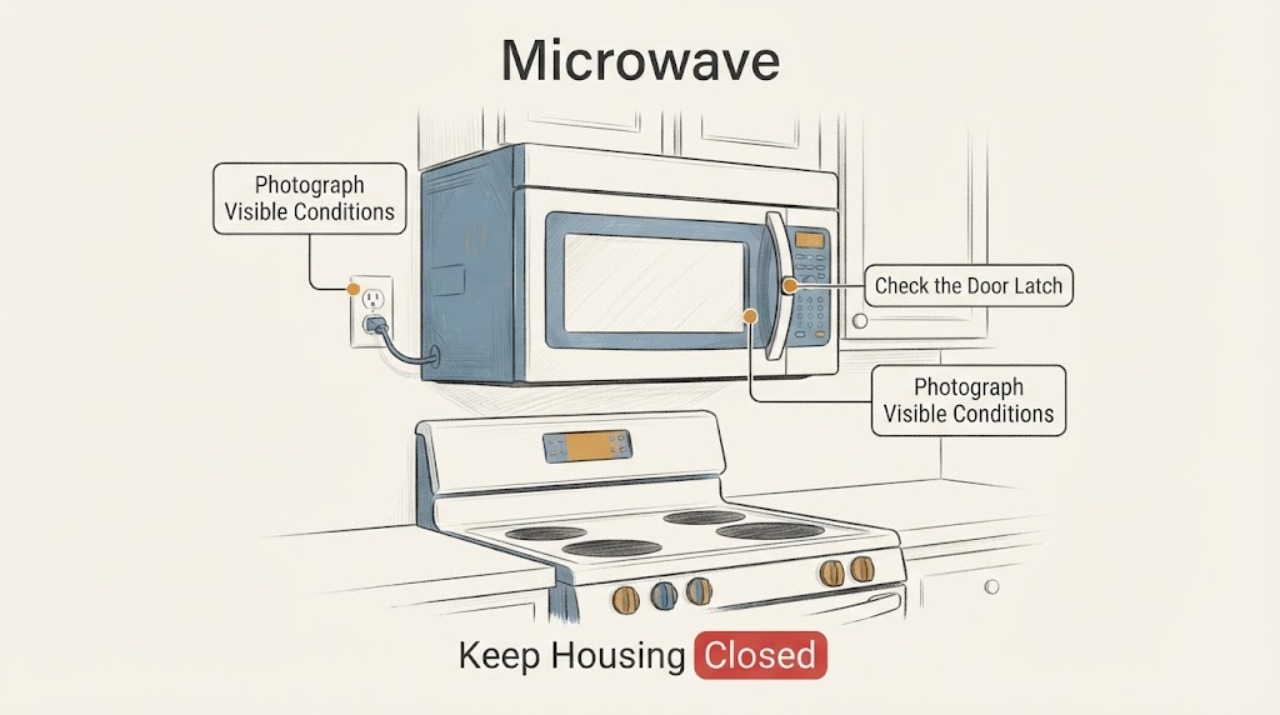
Before any functional test, inspect the closed door, hinges, latches, seals, window, and visible cavity for bending, looseness, cracks, heavy arcing marks, or a damaged waveguide-cover area. Only wipe accessible splatter with the power disconnected and the method in the guide; never remove the waveguide cover.
Expected result: The door closes normally and no damage is visible, or the door/latch/window/waveguide area is damaged, loose, scorched, or arcing has occurred.
Next step: For any damage, arcing mark, smoke, or burning odor, keep the oven off and arrange qualified appliance service. If the accessible surfaces are intact, continue only with the external power and one safe service-check decision.
Stop if: Do not force the door, tape or bridge an interlock, operate with a damaged door or cover, or clean while energized.
Why this matters
Why: The FGMV155CTF guide says the oven must not be operated if the door, hinges, latches, seals, or sealing surfaces are damaged and says the waveguide cover must not be removed. A damaged interlock or cover is a service boundary, not a fuse-replacement opportunity.
-
Check 4
Only when the outlet is confirmed good, the door and cavity are intact, and there is no smoke, burning odor, arcing, liquid intrusion, or repeated trip, follow the exact guide's service-call check once: place one cup of water in a glass measuring cup, close the door securely, and run one minute at HIGH 100%. Observe the oven light, cooling fan, turntable, and whether the water becomes warm.
Expected result: Any of the light, fan, turntable, or warming result is absent, or all four observations are normal.
Next step: If any answer is no, stop testing and contact an Electrolux/Frigidaire Authorized Servicer. If all answers are normal, the original symptom may have been intermittent, but do not open the cabinet or replace a fuse without qualified diagnosis.
Stop if: Do not run an empty microwave, repeat the test after arcing or overheating, or perform this test if the door or waveguide area is damaged.
Why this matters
Why: The exact guide uses these four observations to separate a functional cooking check from a power or service problem. A failed item does not identify a fuse, switch, magnetron, capacitor, board, or other part; it only supports service escalation.
-
Check 5
Prepare the service handoff with the exact FGMV155CTF model and serial number, display/cavity-light state, outlet and breaker/GFCI result, door and waveguide-cover observations, the four service-check results if safely completed, and whether the unit recently surged, tripped, smoked, or arced.
Expected result: The microwave remains dark, the display is lit but cooking does not start, only the fan or surface light works, a breaker trips again, or any safety warning recurs.
Next step: Leave the microwave out of service and arrange Frigidaire/Electrolux Authorized Service or qualified appliance service. Use a qualified electrician when the outlet, breaker, GFCI, or branch circuit is the problem.
Stop if: Do not order or install an internal fuse, bypass a safety device, discharge a capacitor, test live wiring, or access the high-voltage section as a DIY repair.
Why this matters
Why: The symptom record tells the qualified technician whether to evaluate supply, controls, door interlock, or heating circuitry. It cannot establish that one internal fuse is the correct repair.
Use your observations
Decision map
Find the observation that best matches what you see, then follow the next safe action.
-
PATH 01Next step
What you see
The outlet is dead or the breaker/GFCI will not stay on, while the microwave's model and cord are otherwise intact.
Do this next
Stop resetting protection and have a qualified electrician assess the outlet or circuit. Leave the microwave disconnected if it causes the trip.
Why this path and its safety boundary
Why it matters: The immediate problem is on the household supply/protection side or a fault is causing the protection to operate; the internal fuse cannot be diagnosed from this observation.
-
PATH 02Next step
What you see
The outlet is good but the FGMV155CTF remains dark, or the guide's service check has any missing light, fan, turntable, or warming result.
Do this next
Leave the microwave off and arrange Frigidaire/Electrolux Authorized Service. Do not open the cabinet or replace a fuse based on darkness or one failed service-check result.
Why this path and its safety boundary
Why it matters: An appliance-side fault is more likely, but the pattern does not identify whether the cause is a fuse, control, interlock, or heating assembly.
-
PATH 03Next step
What you see
The display or fan/surface light works but cooking will not start, or the door does not close and latch normally.
Do this next
Stop repeated starts and arrange qualified microwave service. Do not tape, bridge, force, or adjust the latch/interlock.
Why this path and its safety boundary
Why it matters: This is partial operation or a door-start permission problem, not proof that the outlet or internal fuse is the only issue. The guide warns not to defeat safety interlocks.
-
PATH 04Next step
What you see
There is smoke, burning odor, arcing, a hot or damaged cord, liquid near electrical parts, a cracked or damaged door/window/waveguide area, or a breaker trips again.
Do this next
From a safe location isolate power if possible, keep people away, and contact qualified appliance service or an electrician as appropriate. Use local emergency procedures for fire or continuing smoke.
Why this path and its safety boundary
Why it matters: This is an immediate safety stop; a fuse replacement or cooking test cannot establish safe operation.
Helpful context
Understand the symptom
What the FGMV155CTF documentation supports
Frigidaire's exact model support page identifies FGMV155CTF as a discontinued Frigidaire Gallery 1.5 cu. ft. over-the-range convection microwave and provides the matching English Owner's Guide. The guide is the relevant identity lock: it specifies this model family, identifies the required 120 V, 60 Hz supply, and provides a service-call check. It does not give the reader an internal fuse-replacement procedure; instead, it says the microwave should be serviced only by qualified personnel.
Why a fuse is not a diagnosis
A blown internal fuse is a symptom of an electrical or control fault, not proof that replacing the fuse alone will make the microwave safe. The FGMV155CTF guide warns not to tamper with the safety interlocks, not to remove the waveguide cover, and not to operate a damaged oven; it directs a failed service check to an Authorized Servicer. A part listing or a fuse rating from a non-manufacturer page is not enough to authorize cabinet access or establish compatibility.
When checks do not resolve it
Need a professional?
Contact a Frigidaire/Electrolux Authorized Servicer when the outlet is good but the FGMV155CTF remains dark, any item in the exact guide's service check fails, cooking will not start, or the symptom returns. Use a qualified electrician for a dead outlet or recurring breaker/GFCI event. Stop immediately for smoke, burning odor, arcing, liquid near electrical parts, damaged door or waveguide area, a hot cord, or repeated trips.
Have this ready
- Exact FGMV155CTF model and serial number, display/cavity-light state, outlet and breaker/GFCI result, door and waveguide-cover condition, safe service-check observations, and any surge, trip, smoke, odor, or arcing history.
Common questions
FAQ
Can I replace the fuse in a Frigidaire FGMV155CTF microwave myself?
No. The exact FGMV155CTF Owner's Guide says the microwave should be adjusted or repaired only by qualified service personnel and explicitly says it should never be serviced by a do-it-yourself repair person. Check the accessible outlet and household protection once, then arrange qualified service if the appliance remains faulty.
What should I check before calling service for FGMV155CTF?
From a safe, dry position, confirm the model, see whether the display and cavity light work, check the accessible outlet and breaker/GFCI once, and inspect the door and visible cavity for damage. If the outlet is good, do not open the microwave; use the exact guide's service check only when there is no hazard.
Why does the fan or surface light work while the microwave does not heat?
The FGMV155CTF has separate ventilation and surface-light functions, so partial operation does not prove that the microwave cooking circuit is healthy. Record which functions work and arrange qualified service instead of testing repeatedly or replacing a fuse based on that observation.
When should I stop testing the Frigidaire microwave?
Stop for smoke, burning odor, arcing, a hot or damaged cord, liquid near electrical parts, a damaged door/window/waveguide area, or a breaker/GFCI that trips again. Isolate power from a safe location if possible and obtain qualified appliance or electrical service.
Read the exact guide
Official sources
- Product Support: Frigidaire Gallery 1.5 Cu. Ft. Over-The-Range Microwave with Convection Stainless Steel-FGMV155CTFFrigidaire Canada · Opened Frigidaire product-support page for the exact FGMV155CTF model; it identifies the appliance as a 1.5 cu. ft. over-the-range convection microwave and links the matching Owner's Guide.
- All about the Use & Care of your Microwave OvenFrigidaire / Electrolux Home Products · Opened from the exact FGMV155CTF Frigidaire support page; the PDF identifies FGMV155CTF in its specification section and provides model-specific service, door, waveguide, and electrical guidance.
- Microwaves - No PowerFrigidaire · Opened Frigidaire microwave support guidance; used for the accessible display/light, outlet, breaker/GFCI, and service routing checks, not to infer an internal fuse fit.
Community feedback
Share a repair observation
Share a plain-text repair observation. Accepted observations are published automatically; this page may take a moment to update.