
On this page
Start here
Quick answer
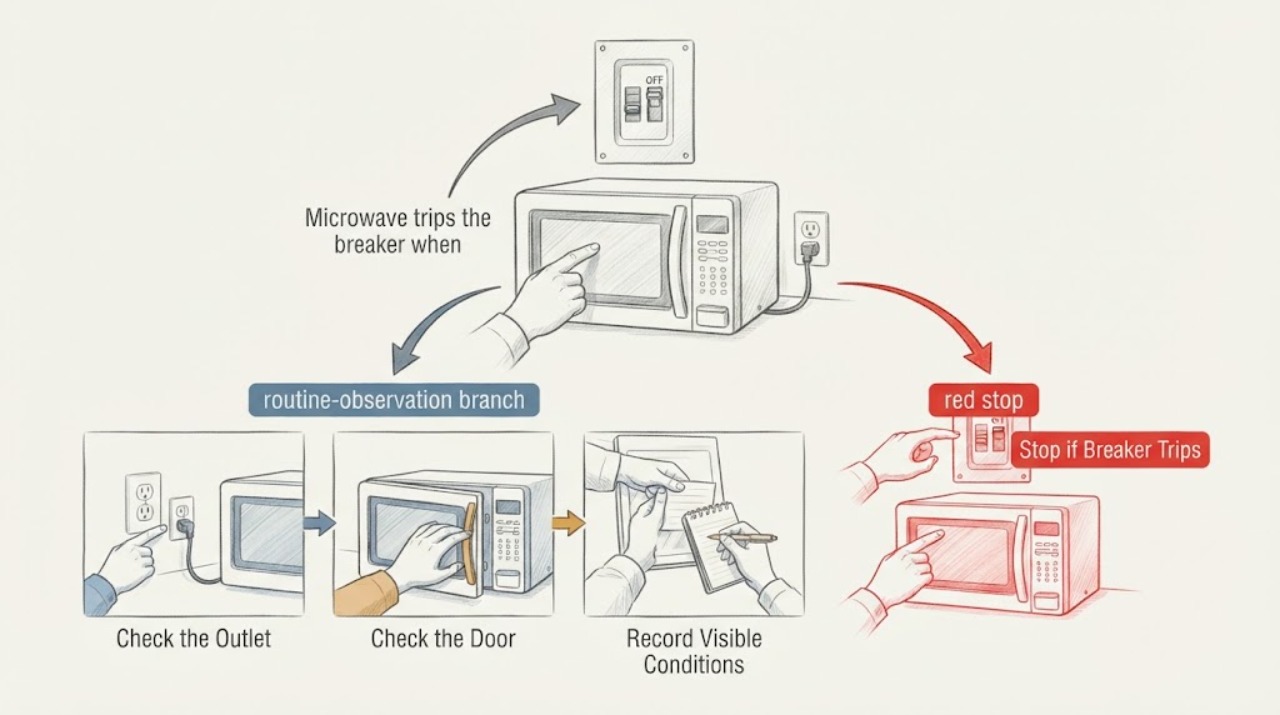
A Frigidaire microwave that trips the breaker as the door closes should be taken out of use. Frigidaire's official no-power guidance says a breaker trip can be an electrical issue requiring an electrician, and says a microwave should be on a dedicated non-GFCI circuit with no other appliances sharing it. Because the trip is tied to closing the door, do not keep resetting the breaker, repeatedly close the door to reproduce the fault, open the microwave, or attempt to adjust the door-safety system. Leave the appliance disconnected or the circuit off when safe, record the model and serial information, and arrange Frigidaire service or a qualified electrician.
Work through in order
Diagnostic checks
Use only checks that match the exact appliance or system and its official guide.
-
Check 1
Stop using the microwave and do not repeatedly reset the breaker or close the door to reproduce the trip. If the breaker is already open, leave it open; if the appliance is plugged into an accessible outlet, disconnect it only if doing so is dry and safe.
Expected result: The breaker remains stable with the microwave disconnected, or it trips again with the microwave isolated from use.
Next step: Do not reconnect the microwave for a comparison test. Arrange qualified appliance service or an electrician, and describe that the trip is synchronized with closing the door.
Why this matters
Why: A stable circuit after disconnection points to the microwave or its connection as the service subject; a breaker that still trips with the appliance isolated points to a broader circuit issue. Frigidaire says a breaker trip may be an electrical issue requiring an electrician.
-
Check 2
Without resetting the fault, identify whether the microwave shares the circuit with other appliances and whether the receptacle has a GFCI reset button. Do not move the microwave to another circuit as a test while the door-triggered symptom remains.
Expected result: The microwave is on a dedicated non-GFCI circuit, or it shares a circuit or is connected through a GFCI device.
Next step: Give the circuit information to the electrician or Frigidaire service. Keep the microwave out of use until the door-related trip has been evaluated; do not defeat or bypass GFCI protection.
Why this matters
Why: Frigidaire says a microwave should use a dedicated non-GFCI circuit with no other appliances. A shared or GFCI-protected installation is relevant context, but it does not prove that installation caused a trip tied to door closure.
-
Check 3
From outside the appliance, record whether the display and interior light were working before the trip, whether there was a burning smell, smoke, heat, visible cord or plug damage, moisture, or a recent power surge. Do not open the cabinet or remove any door or control component.
Expected result: A visible electrical or moisture hazard is present, a recent surge or outage preceded the issue, or there is no visible external clue.
Next step: If there is smoke, burning odor, abnormal heat, moisture, or damaged wiring, keep the unit disconnected and obtain urgent qualified service. Otherwise record the observation for the service call and do not retest the door.
Why this matters
Why: Frigidaire lists the display and interior light as initial power observations and says a power surge can trip the breaker and affect electronic controls. None of these observations identifies an internal door-switch, wiring, or high-voltage fault.
-
Check 4
Read the model and serial label from the location specified for the particular Frigidaire microwave, or use the owner's records if the unit cannot be safely accessed. Record the complete identity and whether the unit is countertop, built-in, or over-the-range.
Expected result: The full model and serial information is available, or the label cannot be reached without moving, opening, or energizing the microwave.
Next step: Give the complete model and serial information to Frigidaire service or the electrician. If the label is inaccessible, do not move or disassemble the appliance just to retrieve it.
Why this matters
Why: Frigidaire provides model-label guidance and directs owners to manuals and service support. The model controls which manual, installation arrangement, and service path apply; the door-triggered breaker symptom is not a universal part diagnosis.
-
Check 5
When contacting service, state that the breaker trips as the microwave door closes, identify the circuit type, report whether the trip stops when the microwave is disconnected, and provide any external hazard observations. Do not ask for or attempt an internal door-interlock adjustment, high-voltage test, or cabinet repair as a home step.
Expected result: The service provider has the model information and the exact trigger, or the unit cannot be safely identified or isolated.
Next step: Leave the microwave out of service until the professional confirms it is safe. Follow the model-specific service decision; do not restore operation merely because one breaker reset temporarily holds.
Why this matters
Why: Frigidaire's official guidance sends unresolved microwave power problems to service and notes that an electrician may be required. A door-synchronized trip requires professional isolation of the appliance and circuit rather than a user diagnosis of the internal cause.
Use your observations
Decision map
Find the observation that best matches what you see, then follow the next safe action.
-
PATH 01Next step
What you see
The breaker remains stable while the microwave is disconnected, but the door-related trip returns when the appliance is reconnected or used.
Do this next
Keep the microwave disconnected and arrange Frigidaire service or qualified appliance repair. Do not reconnect it for another door test.
Why this path and its safety boundary
Why it matters: The microwave or its immediate connection remains the service focus; the exact internal cause is not established by this observation.
-
PATH 02Next step
What you see
The microwave shares a circuit with other appliances or is supplied through a GFCI-protected receptacle.
Do this next
Keep the microwave out of use and have the circuit and appliance evaluated. Do not defeat GFCI protection or relocate the appliance as a trial.
Why this path and its safety boundary
Why it matters: Frigidaire identifies dedicated non-GFCI supply as the expected microwave arrangement, so the installation context needs electrician review; it does not prove the door symptom is only a circuit-load problem.
-
PATH 03Next step
What you see
Smoke, burning odor, abnormal heat, moisture, damaged cord or plug, or scorched material is visible.
Do this next
Leave power off when safe, keep the area clear, and obtain qualified electrical or appliance service. Do not touch wet or damaged electrical connections.
Why this path and its safety boundary
Why it matters: The appliance presents an external electrical safety concern that should not be explored by repeated resets or door movements.
-
PATH 04Next step
What you see
The exterior appears intact and the circuit context is known, but the breaker still trips exactly when the door closes.
Do this next
Keep the unit out of service and provide the exact trigger and model information to Frigidaire service or an electrician. Do not open the cabinet or perform live tests.
Why this path and its safety boundary
Why it matters: The absence of an external clue does not clear the microwave's internal electrical or door-related systems.
Helpful context
Understand the symptom
A door-triggered trip is a stop-use symptom
The exact component causing this symptom cannot be identified from the door timing alone. A breaker that opens when the door closes is an electrical safety event, so repeated resets and repeated door tests can make the situation worse. Keep the microwave out of service while the circuit and appliance are evaluated.
Check the installation context without testing the fault again
Frigidaire's official microwave guidance calls for a dedicated non-GFCI circuit with no other appliances sharing it. That installation check can explain a nuisance trip from a shared or GFCI-protected circuit, but it does not clear an appliance that trips specifically as the door closes. Do not use circuit changes as a workaround for a persistent door-related trip.
When checks do not resolve it
Need a professional?
Contact Frigidaire service or a qualified electrician immediately for a breaker trip that repeats when the door closes, especially if the trip persists with a dedicated circuit, or if there is smoke, burning odor, heat, moisture, or cord damage.
Common questions
FAQ
Should I reset the breaker one more time to see whether the microwave works?
No. Frigidaire mentions resetting after a power surge, but a breaker that repeatedly trips when the door closes should be treated as an electrical service issue. Keep the appliance out of use and arrange qualified service instead of repeating the trigger.
Does this prove that the door switch is bad?
No. The timing makes the door-related electrical system part of the professional diagnosis, but the official guidance does not identify a specific internal component from this symptom. Do not open or adjust the door-safety system.
Could the circuit be the reason the breaker trips?
It may be relevant. Frigidaire says the microwave should be on a dedicated non-GFCI circuit with no other appliances sharing it, but a door-triggered trip still requires the appliance and circuit to be evaluated rather than assuming the circuit alone is at fault.
Read the exact guide
Official sources
- Microwaves - No PowerFrigidaire · Opened Frigidaire's official microwave support article. It covers microwave no-power symptoms, breaker trips, dedicated non-GFCI circuits, power-surge context, and escalation to an electrician or Frigidaire service; it does not identify an internal door component.
- Microwaves - How do I change the oven light on my over-the-range microwave?Frigidaire · Opened Frigidaire's official microwave maintenance article. Its relevant safety boundary is to unplug the microwave or turn off its circuit breaker before work; this article is not used to infer a door-switch or high-voltage diagnosis.
- Where can I find my model and serial number?Frigidaire · Opened Frigidaire's official identification article. It places wall-oven and microwave model labels along the interior side trim and directs owners to manuals and service support; it does not support internal microwave repair.
Community feedback
Share a repair observation
Share a plain-text repair observation. Accepted observations are published automatically; this page may take a moment to update.