
On this page
Start here
Quick answer
A Frigidaire oven cycle that appears not to complete can be normal when a programmed cook time has ended, when a self-clean cycle is waiting for the oven to cool, or when the cooling fan continues after the heat is off. It is not normal if the oven stops early while food is cold, loses the display, shows a recurring error, cannot release a lock after it is cool, trips a breaker, or produces smoke, a burning smell, a gas smell, sparks, or uncontrolled heat. First identify the mode and programmed time, note exactly when the cycle stopped, and check the display, fan, door state, and food temperature. Use the model's Use and Care guide for any code-specific procedure; do not force a locked door or open live electrical panels.
Before you begin
Safety first
- A technician can isolate control, power, sensor, heating, cooling, or door-lock faults and verify safe operation. Do not open live panels, bypass a lock, or replace a part based only on a generic symptom.
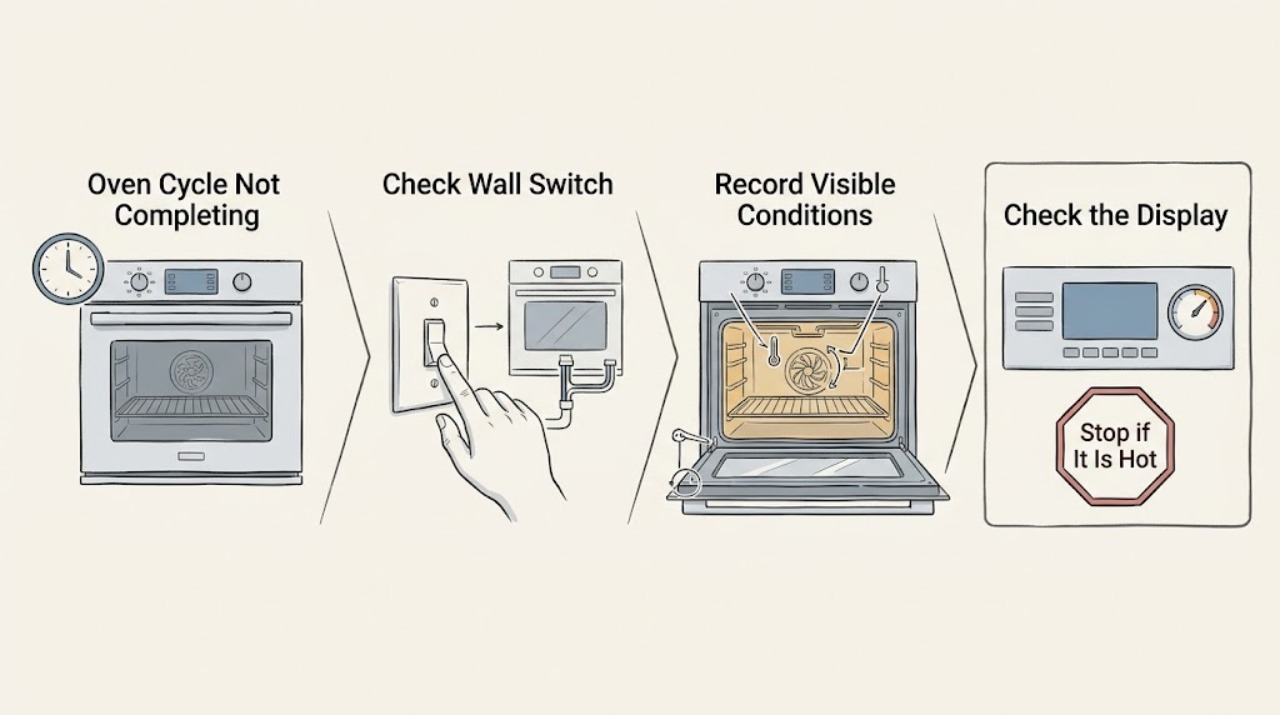
Work through in order
Diagnostic checks
Use only checks that match the exact appliance or system and its official guide.
-
Check 1
Stop using the oven and move people away if you see smoke or sparks, smell gas or a strong burning odor, see an uncontrolled flame, find cracked glass, feel runaway heat, or the circuit trips. If there is a gas smell, leave the area and follow local emergency guidance; do not operate switches or attempt a repair.
Expected result: The oven either has a safety hazard, or it is quiet and stable with no smoke, unusual odor, sparks, uncontrolled flame, or breaker trip.
Next step: If any hazard is present, stop and arrange qualified service after the appliance is safe. If none is present, continue to classify the cycle.
Stop if: Smoke, gas odor, sparking, runaway heat, cracked glass, or a tripped circuit ends user testing.
Why this matters
Why: A hazard is not a timer or cycle-completion diagnosis. A stable oven permits only low-risk observation and control checks.
-
Check 2
Write down whether the oven was baking, broiling, convection cooking, delayed or timed cooking, or self-cleaning. Compare the programmed cook time with the actual stop point, then note whether the display says the cycle ended, the food is done, the fan is running, and the door is locked.
Expected result: An end message with cooked food points to a completed program; a cold oven or missing display before the expected end points to a premature stop. A running fan or locked self-clean door points to cooldown that may outlast the heating period.
Next step: For a normal end with cooldown, allow it to cool. For an early stop, retain the exact mode, time, display, and door observations for the control and error checks.
Stop if: If the oven is still heating after the expected end, will not stop, or the door remains locked after it is fully cool, stop testing and call service.
Why this matters
Why: The end state separates normal program behavior from a control, heating, sensor, power, or lock problem and tells you which branch to follow.
-
Check 3
Check the selected function, temperature, timer, and Start sequence from the front controls without removing panels. If you need a different cooking function, use the off control first, select the new function and time, and start the new cycle according to the control panel.
Expected result: The oven accepts the selected function and begins a normal cycle, or it refuses the change, cancels early, or will not start after the proper sequence.
Next step: If the controls work, run only a brief safe observation. If the controls refuse the sequence or the same stop recurs, photograph the display and arrange model-specific service.
Stop if: Do not keep pressing controls if the oven starts heating without a valid command or cannot be stopped.
Why this matters
Why: An incorrect active-cycle change can explain an apparent control problem; refusal or another early stop after a clean restart suggests a control, power, sensor, or heating fault rather than a simple mode selection.
-
Check 4
After turning the oven off normally, listen for the cooling fan and observe the door without forcing it. For self-clean, allow the oven to cool fully and wait for the lock to release; do not pull the door or disconnect a hot locked oven just to speed the process.
Expected result: The fan runs and later stops as the oven cools, or a self-clean lock releases after cooldown. Alternatively, the fan never runs when the oven is excessively hot, or the lock remains engaged after the appliance is cool.
Next step: If cooldown completes normally, return to the early-stop evidence. If it does not, stop using the affected function and provide the technician the cooling time, door state, and mode.
Stop if: Never force the door or work inside the control or door-lock area as an ordinary-user test.
Why this matters
Why: Post-cycle fan operation and a temporary self-clean lock can be normal. A failed cooldown pattern or a lock that remains engaged when cool needs professional diagnosis.
-
Check 5
If an error appears, photograph the complete code and note whether the oven was hot, heating, cooling, or trying to lock. Follow the error guide and the model's Use and Care guide; only when the oven is safe and cool, perform one documented power reset by removing power for about 30 seconds, then restore it.
Expected result: The code clears and the oven completes a normal safe check, or the same code returns, the display remains blank, or the oven stops again at the same stage.
Next step: Keep the code, operating mode, and reset result. If it returns, stop further testing and call a qualified appliance technician.
Stop if: Do not reset a hot, smoking, sparking, gas-smelling, or uncontrolled oven, and do not bypass a lock or safety control.
Why this matters
Why: A one-time reset can clear a transient control state. A recurring temperature, probe, door-lock, or power-related code is evidence for a model-specific repair path, not permission for repeated resets.
-
Check 6
Only if the oven is stable, no hazard is present, and the controls respond, make one short normal-cycle observation rather than running self-clean. Record whether heating begins, whether the display advances, and the exact point where the cycle stops.
Expected result: The short cycle proceeds normally, or it loses power, stops before heating, stops while heating, shows a code, or fails to finish again.
Next step: End testing after this observation. Give the technician the model number, mode, target temperature, programmed time, error code, stop stage, door state, and fan behavior.
Stop if: A repeat failure, cold food, power loss, recurring code, uncontrolled heat, or lock failure requires service rather than more user tests.
Why this matters
Why: A successful short observation supports a one-time setup or transient control issue; the same failure stage narrows the service handoff toward controls, temperature sensing, heating, cooling, power, or door-lock components.
Use your observations
Decision map
Find the observation that best matches what you see, then follow the next safe action.
-
PATH 01Next step
What you see
Smoke, gas odor, sparks, uncontrolled flame, runaway heat, cracked glass, or breaker trip
Do this next
Stop immediately, leave the appliance area if needed, and obtain qualified or emergency help appropriate to the hazard. Do not reset or open the oven.
-
PATH 02Next step
What you see
The programmed time ended, the display reports completion, and the food is cooked
Do this next
Treat the heating portion as complete; allow the oven and fan to cool normally and verify the door state without forcing it.
-
PATH 03Next step
What you see
The fan continues after the oven is turned off, but the oven is cooling and no hazard is present
Do this next
Wait for the internal temperature to fall. Arrange service if the fan never stops, the oven overheats, or the fan does not operate when cooling is clearly needed.
-
PATH 04Next step
What you see
Self-clean ended but the door is still locked while the oven is hot
Do this next
Allow complete cooldown and do not force the door or interrupt the lock mechanism.
-
PATH 05Next step
What you see
The oven will not change function or stops after a timer/control change
Do this next
Stop the current cycle, select the desired function and time, and start it again using the documented control sequence. If it still stops early, call service.
-
PATH 06Next step
What you see
A code returns, the display stays blank, or the cycle stops early again
Do this next
Stop repeated resets and provide the code, temperature state, mode, timing, power behavior, fan behavior, and door state to a qualified technician.
Helpful context
Understand the symptom
Separate a normal end from an early stop
Start by deciding whether the oven finished its programmed job or stopped before it could heat and cook. A timed bake may end when its cook time expires, while a delayed or timed setting can look different from a manual cycle. Record the selected mode, target temperature, programmed time, the time shown when the problem appeared, and whether the food is cooked. If the display says the cycle has ended and the food is done, the oven may be behaving normally. If the food is cold or the display vanished before the expected end, continue with the checks below.
Allow for cooling and lock release
A cooling fan can remain audible after heating stops; Frigidaire explains that it may continue until the oven's internal temperature falls. A self-clean door can also stay locked during cooldown. Treat those signs as a cooling state, not proof that the controls are still stuck. Keep the area clear, do not force the door, and do not interrupt a hot self-clean cycle unless the exact model instructions direct a safe action.
Use the control sequence that matches the symptom
If the cycle was started with the wrong function or time, use the normal off-and-restart sequence rather than pressing several functions while the oven is running. If the display shows a code, write it down before resetting. A single safe reset can clear a transient control state, but a repeated early stop is a fault pattern that needs the model-specific service procedure.
Know when to stop testing
Do not continue a test when there is smoke, a gas smell, sparking, a breaker trip, an uncontrolled flame, or heat that cannot be stopped. For a safe appliance with no hazard, one short retest can distinguish a one-time control mistake from a repeatable failure. If the same stage fails again, preserve the code and timing details for a qualified appliance technician instead of opening the control area or replacing a part by guesswork.
Only after diagnosis
Potential parts
- temperature sensor or probe
Consider this category only if the oven stops at a repeatable temperature-related stage or the model-specific error guidance points to sensing, after wiring and control checks are performed by a technician.
Confirm the complete oven model and the manufacturer's fit information before ordering any component. - electronic control or timer assembly
Consider this category only if the display, timer, function selection, or cycle state fails repeatedly after the correct start sequence and a safe reset does not resolve it.
Control assemblies vary by model and revision; a qualified technician should confirm the diagnosis and exact fit. - cooling fan or thermal control
Consider this category only if cooling behavior is abnormal, such as a fan that never runs when required or never stops after the oven is cool.
Confirm model-specific fit and electrical specifications; do not access live wiring as a user test. - heating element or ignition component
Consider this category only when the oven begins a cycle but does not heat, or a technician confirms a heating-side failure rather than a timer or sensor issue.
The correct component depends on the oven type and model; verify fitment before any replacement. - door-lock assembly
Consider this category only if a fully cooled self-clean cycle leaves the door locked or a documented door-lock code returns.
Confirm the exact model and have a qualified technician handle lock and safety-control work.
When checks do not resolve it
Need a professional?
Call a qualified appliance technician for any hazard, a recurring early stop, a blank display or breaker trip, a recurring code, heating that cannot be controlled, abnormal cooling, or a door that remains locked after full cooldown.
Safety scope: A technician can isolate control, power, sensor, heating, cooling, or door-lock faults and verify safe operation. Do not open live panels, bypass a lock, or replace a part based only on a generic symptom.
Have this ready
- Provide the complete model number, cooking mode, target temperature, programmed time, actual stop stage, display or error code, whether food was cold, fan behavior, door state, and any reset result.
Common questions
FAQ
Why does my Frigidaire oven fan keep running after the cycle?
The cooling fan may continue after heating stops while the oven's internal temperature falls. Allow it to cool; arrange service if it never stops, the oven overheats, or cooling behavior is unsafe.
Why is my Frigidaire self-clean door still locked?
The door can remain locked while the oven cools after self-clean. Do not force it. If it remains locked after complete cooldown or a lock code returns, stop using that function and call service.
Why does the oven stop before the food is done without an error?
Check whether a cook-time or delayed setting ended, whether the controls accepted the intended function and temperature, and whether power was interrupted. If it stops early again with cold food, record the exact stage and arrange model-specific diagnosis.
Can I change the cooking function while the oven is running?
Frigidaire's guidance says to stop the current cycle, select the desired function and time, and start the new cycle rather than changing the function mid-cycle.
Should I keep resetting an oven that will not finish its cycle?
No. If the oven is safe and cool, one documented power reset may be reasonable under the model guidance. A returning code, blank display, repeat early stop, or hazard calls for qualified service instead of repeated resets.
Read the exact guide
Official sources
- Oven Error Codes and Alarms GuideFrigidaire Owner Support · Error-code reset and model-dependent guidance for temperature, probe, door-lock, and demonstration-mode conditions.
- Ovens - How do I set my oven or range to self-clean?Frigidaire Owner Support · Self-clean setup and cooldown/door-lock behavior; availability and controls vary by model.
- How do I change the cooking function during cooking?Frigidaire Owner Support · Control behavior for changing a cooking function during an active cooking cycle; exact controls vary by model.
- Ranges - Is it normal for a fan to come on while using my range and when does it stop running?Frigidaire Owner Support · Fan operation during preheat or baking and after the oven is turned off; exact behavior varies by model.
Community feedback
Share a repair observation
Share a plain-text repair observation. Accepted observations are published automatically; this page may take a moment to update.