
On this page
Start here
Quick answer
Treat an oven element that appears to touch the floor as an electrical and heat hazard. Turn all controls off, disconnect the oven at the breaker or approved disconnect, and wait until the oven is completely cold. Do not bend the element, lift it into place, test it with power on, put foil or a pan on the oven floor, or remove the element without the exact Frigidaire manual. First determine whether the object touching the floor is a pan, foil, liner or debris; Frigidaire says the oven bottom must stay clear. If the element itself is sagging, loose, cracked, scorched, contacting the cavity floor or insulation, or has tripped power, leave the breaker off and arrange Frigidaire-qualified service with the full model number.
Before you begin
Safety first
- Do not bend, lift, tape, shim or tie the element; do not test it with power on; do not remove panels, disconnect wires or restore power after a breaker trip; do not use foil, liners, pans or bakeware on the oven floor. Disconnect power and allow complete cooling before any external observation.
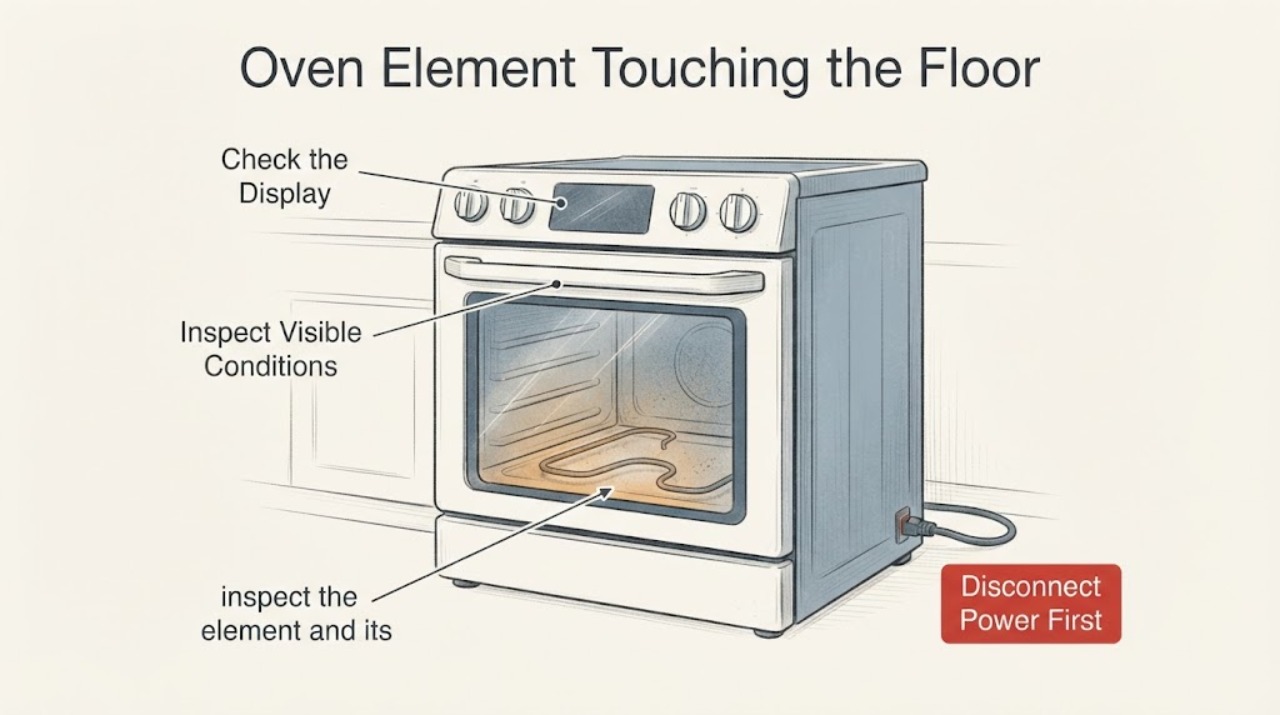
Work through in order
Diagnostic checks
Use only checks that match the exact appliance or system and its official guide.
-
Check 1
Turn every oven control to OFF and disconnect power at the circuit breaker or the appliance's approved disconnect. Keep the door closed while the cavity is hot, warn others not to use the oven, and wait until the racks, floor and element are completely cool before looking closely.
Expected result: The breaker is clearly identified and remains off, or the oven is hard-wired/uncertain and power cannot be positively isolated; smoke, arcing, a burning odor or a tripped breaker is present or absent.
Next step: If power cannot be positively isolated, or if there is smoke, arcing, scorching or a repeated trip, leave the oven out of use and have a qualified electrician or appliance technician isolate and assess it. Do not restore power for a test.
Stop if: Stop immediately for smoke, sparks, exposed conductor, melted insulation, a hot electrical connection or a breaker that trips again.
Why this matters
Why: A heating element and nearby metal can remain hazardous after the controls are switched off. Uncertain isolation, arcing, smoke or repeated breaker trips means the appliance cannot be safely inspected as a live unit.
-
Check 2
With the oven cold and power isolated, determine whether the item touching the floor is actually the element. Look for a pan, foil, liner, baking stone, rack accessory, spilled material or debris resting on the oven bottom; remove only loose items that can be lifted away without contacting the element or scraping the cavity.
Expected result: The apparent contact is caused by cookware, foil, a liner or debris, or the bare element itself is visibly at the floor with no removable object present.
Next step: Do not use foil, liners, pans or bakeware on the oven floor. If the bare element still appears to touch the floor, continue only with the model-identification and service steps; do not bend or lift it.
Why this matters
Why: Frigidaire says the oven bottom must be kept clear because objects there can affect air circulation and direct heat. If the bare element is the contact point, cleaning cannot correct a displaced or damaged electrical component.
-
Check 3
From outside the cold cavity, inspect the element and its visible supports without moving them. Note whether it is straight and supported as shown in the exact Use and Care manual, or whether it is sagging, loose at a visible support, cracked, blistered, scorched, displaced, or touching the oven floor, side wall or insulation.
Expected result: The element position matches the model manual and no damage is visible, or the element is displaced/damaged or its support is loose or missing.
Next step: If the position is abnormal or damage is visible, keep power off and request Frigidaire-qualified service with the model number and photographs. Do not straighten, tie, shim or tape the element.
Why this matters
Why: A manual-confirmed normal layout is different from a new physical displacement. A damaged or unsupported element can create an abnormal heat path or electrical hazard; its appearance alone does not identify whether the element, support, wiring or cavity needs replacement.
-
Check 4
Find the complete Frigidaire model number on the oven frame, rating label or owner documentation and open the matching Use and Care/manual support page. Compare the manual's element layout and approved service instructions without relying on a similar-looking Frigidaire model or an aftermarket part listing.
Expected result: The exact model is available and its manual shows the element location and service boundary, or the model is missing/illegible or the manual does not match the observed cavity.
Next step: If the exact model cannot be matched, do not power the oven to compare positions; provide the label information and photos to Frigidaire or a qualified technician. If the manual shows a user-safe external check, follow only that procedure with power isolated.
Why this matters
Why: Frigidaire states that model procedures vary and directs owners to the Use and Care manual. A generic oven diagram cannot establish element placement, fastener access, wiring isolation or replacement compatibility.
-
Check 5
Check the context without energizing the oven: note whether the problem appeared after moving the appliance, cleaning, a self-clean cycle, a spill, an impact, an over-temperature event, or a breaker trip. Record any failed preheat, uneven heating, burning smell or visible insulation damage.
Expected result: The contact followed an event or is accompanied by a breaker trip, smoke, odor, failed heating or visible cavity damage, or it was noticed with no known event.
Next step: Keep the oven disconnected and arrange service for any associated hazard or persistent contact. Do not reset the breaker repeatedly or run a preheat cycle to see whether the element moves away from the floor.
Why this matters
Why: A new displacement or a safety symptom increases the need for inspection of the element supports, wiring, cavity and insulation. A lack of a known event does not prove the position is safe or normal.
-
Check 6
Arrange model-matched service rather than attempting an adjustment if the element itself touches the floor, the visible support is loose, the element is cracked or scorched, insulation is exposed, or the issue requires removing a panel or disconnecting wires. Give the technician the model number, circuit status, photographs and the observations above.
Expected result: The element is clearly displaced/damaged or the safe external checks cannot distinguish normal placement from a fault.
Next step: Leave the breaker off until a qualified appliance technician confirms the repair and safe reassembly. Do not order an element by appearance or restore power to test a suspected repair.
Stop if: Do not use the oven until service clears any floor contact, exposed wiring, damaged insulation, repeated breaker trip or burning odor.
Why this matters
Why: The remaining diagnosis involves high-voltage supply, hot surfaces and model-specific mounting or wiring. Frigidaire's support pages direct unresolved heating issues to professional service and do not support a universal element adjustment.
Use your observations
Decision map
Find the observation that best matches what you see, then follow the next safe action.
-
PATH 01Next step
What you see
The apparent contact is a pan, foil, liner, baking stone or debris on the oven floor rather than the bare element.
Do this next
With power isolated and the oven cold, remove the loose item without touching the element, then keep the oven floor clear. Do not resume use if the element itself is bent, damaged or touching the floor.
Why this path and its safety boundary
Why it matters: The oven bottom is obstructed, and Frigidaire says items in that location can affect air circulation and direct heat.
-
PATH 02Next step
What you see
The bare element is sagging, loose, cracked, scorched or touching the oven floor or insulation after the cavity is cold.
Do this next
Keep the breaker off, photograph the condition and arrange Frigidaire-qualified appliance service. Do not run a heat cycle or open the wiring compartment.
Why this path and its safety boundary
Why it matters: This is an abnormal physical condition that cannot be safely resolved by bending or repositioning the element without model-specific service instructions.
-
PATH 03Next step
What you see
The exact model manual shows the element in that position and there is no damage, object on the floor, odor, breaker trip or abnormal heating result.
Do this next
Follow the exact model manual and contact Frigidaire support if the element's clearance remains uncertain. Do not alter the element just to create a different visual gap.
Why this path and its safety boundary
Why it matters: The position may be a model-specific normal layout, but a generic image or visual assumption cannot confirm that for an unknown Frigidaire model.
-
PATH 04Next step
What you see
The condition appeared after a breaker trip, self-clean or overheating event, and the oven now has smoke, odor, failed preheat, exposed insulation or repeated electrical trips.
Do this next
Leave the circuit off and request professional inspection of the oven, element supports, wiring and cavity before any further use.
Why this path and its safety boundary
Why it matters: The event may have affected more than the visible element, and repeated energizing could worsen an electrical or heat hazard.
Helpful context
Understand the symptom
Why the element should not be adjusted by feel
A Frigidaire oven can have different element layouts and service procedures by model. The official support material available for this topic explains that the oven bottom must remain clear, that electrical supply and door sealing affect heating, and that unresolved issues should go to service; it does not authorize bending or repositioning an energized element. A physical contact point can be a displaced element, a damaged support, a cavity or insulation problem, or an object placed on the floor, so the safe first step is identification with power disconnected—not a part diagnosis.
What to record for the service call
Photograph the cold cavity from outside without touching the element, record the complete model number from the frame or owner documentation, and note whether the oven was recently moved, cleaned, self-cleaned, overheated, tripped a breaker, smoked or produced a burning odor. Do not remove panels or test terminals. Frigidaire's support pages direct owners to the Use and Care manual and service when the issue remains unresolved, and the manual is the only reliable source for the element layout and model-specific replacement procedure.
When checks do not resolve it
Need a professional?
Request Frigidaire-qualified service when the element itself touches the oven floor, is bent, loose, cracked, scorched or unsupported; when insulation is exposed; when the oven has smoke, burning odor, failed preheat or repeated breaker trips; or when the exact model manual cannot confirm the observed position.
Safety scope: Do not bend, lift, tape, shim or tie the element; do not test it with power on; do not remove panels, disconnect wires or restore power after a breaker trip; do not use foil, liners, pans or bakeware on the oven floor. Disconnect power and allow complete cooling before any external observation.
Have this ready
- Provide the complete Frigidaire model number, oven type, photographs of the cold cavity and contact point, whether the object is the bare element or floor debris, breaker status, recent cleaning/moving/impact history, smoke or odor, insulation damage and heating behavior.
Common questions
FAQ
Can I bend a Frigidaire bake element away from the oven floor?
Do not bend or reposition it based on appearance. Turn the oven off, disconnect power and let it cool; then identify the exact model and use its manual or qualified service path. A bent or floor-contacting element can involve the support, wiring, insulation or cavity, so the visible gap alone does not identify a safe adjustment.
Can foil or a pan on the oven floor make the element appear to touch the floor?
Yes, the object may be the contact point rather than the bare element. Frigidaire says to keep the oven bottom clear and not place foil, liners or bakeware there. Remove only loose objects after disconnecting power and complete cooling; do not use the oven if the bare element is displaced or damaged.
What if the oven still heats but the element is touching the floor?
Heating does not prove that the physical condition is safe. Leave the breaker off and arrange model-matched service if the bare element is touching the floor, is loose or damaged, or the oven has odor, smoke, insulation damage or electrical trips. Do not keep testing it to see whether it fails.
Read the exact guide
Official sources
- Oven - Is too HotFrigidaire · Official Frigidaire support page used for the no-test/service boundary and model-specific manual requirement. It does not establish a universal heating-element replacement or adjustment procedure.
- Ovens - How do I keep my air frying oven clean?Frigidaire · Official Frigidaire oven guidance used only for the floor-obstruction check; it does not support touching, bending or replacing a heating element.
- Ovens - Can you use aluminum foil in an air fryer oven?Frigidaire · Official Frigidaire oven support guidance used for the external distinction between a bare element and an object on the oven floor; it does not authorize element adjustment or establish a model-specific element layout.
- Oven - Is Not Hot EnoughFrigidaire · Official Frigidaire support page for electric range ovens and wall ovens. It supports checking power and visible door-seal context and escalating unresolved heating problems; it does not diagnose a floor-contacting element or authorize live testing.
Community feedback
Share a repair observation
Share a plain-text repair observation. Accepted observations are published automatically; this page may take a moment to update.