
On this page
Start here
Quick answer
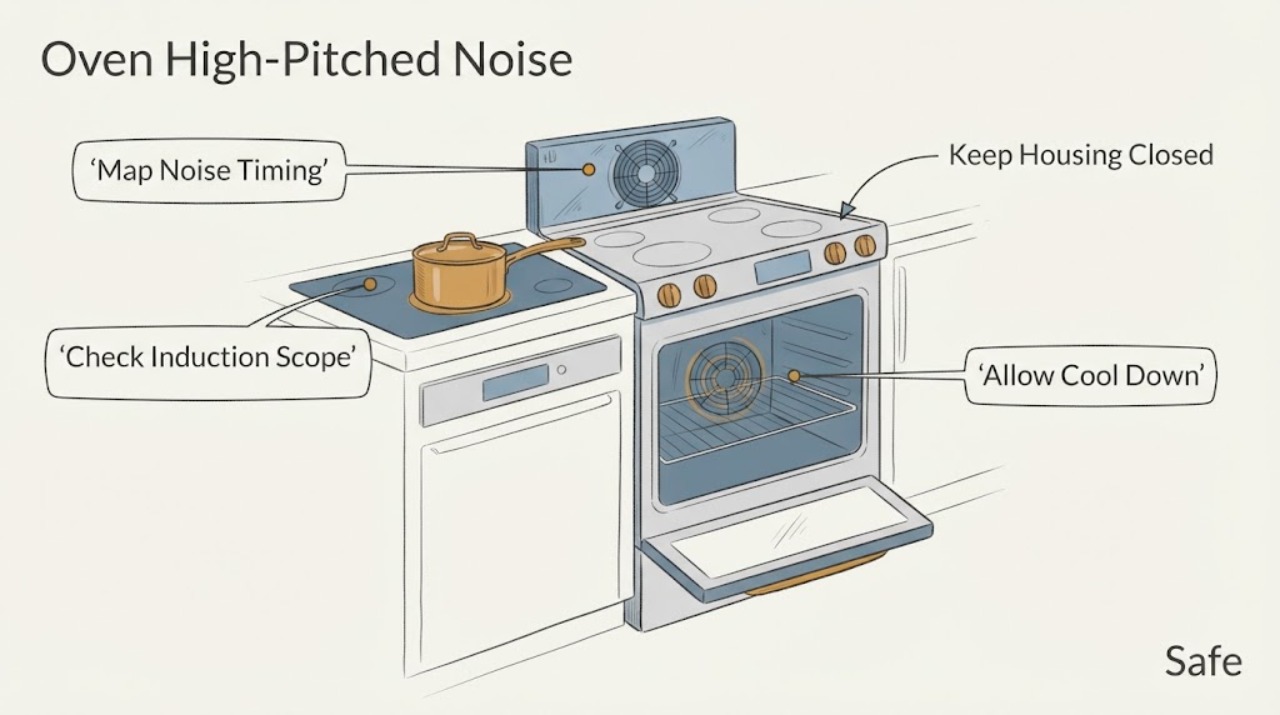
A high-pitched noise is a description, not a component diagnosis. First note whether it starts during preheat, convection cooking, cool-down or while the oven is off but still hot. Frigidaire says oven fans can run during preheat, cycle on and off while baking and remain on after the oven is turned off until it cools. For an induction range, Frigidaire also says cookware can hum or buzz, controls can click and different fans can run even when the range is off. Match the sound and timing to the exact model and cooking technology. If the sound is a new harsh scrape, electrical buzz, burning odor, smoke, visible damage or persists after the oven is fully cool, stop using the oven and arrange qualified service; the pitch alone does not identify a fan motor, control or other failed part.
Before you begin
Safety first
- Limit owner checks to recording the model and sound timing, using normal controls, confirming the product type and allowing the oven to cool. Do not open panels, reach behind the oven, stop a fan by hand, perform live electrical tests or replace a fan motor or control from sound alone.
Work through in order
Diagnostic checks
Use only checks that match the exact appliance or system and its official guide.
-
Check 1
Record when the high-pitched sound starts and stops: preheat, bake, convection, cool-down, control use or after the oven is fully cool.
Expected result: The sound tracks heating or cooling, or it continues outside those periods.
Next step: Follow the matching fan or service branch and do not diagnose a motor from pitch alone.
Why this matters
Why: Frigidaire documents fan operation during preheat, baking and cool-down; persistence after full cooling is not explained by that normal fan timing.
-
Check 2
If the appliance is an induction range, note whether the sound changes with cookware on the surface or with control operation; if it is not induction, exclude this branch.
Expected result: The sound occurs only with particular induction cookware or control activity, or it is present from the oven on a non-induction appliance.
Next step: Use the exact induction-range guidance only when the appliance identity is confirmed; otherwise continue with oven fan timing and model-specific support.
Why this matters
Why: Frigidaire says induction cookware can hum or buzz and controls can click, while that explanation is limited to induction products.
-
Check 3
After baking, switch the oven off normally and allow the internal temperature to cool without reaching behind the appliance or attempting to stop a fan by hand.
Expected result: The sound stops as the oven cools, or it remains once the appliance is fully cool.
Next step: Monitor a normal fan pattern; for persistent, harsh or hazardous noise, keep the oven off and arrange service.
Why this matters
Why: A fan that stops with cooling fits Frigidaire's normal post-bake behavior; a persistent sound needs model-specific evaluation.
-
Check 4
Record the complete model number, fuel or induction type, oven mode and whether the unit is a range or wall oven before applying any manual instruction.
Expected result: The exact model and mode are known, or the identity remains incomplete.
Next step: Use the matching Use and Care Manual or Frigidaire support path, and do not copy another model's button sequence or internal repair steps.
Why this matters
Why: Frigidaire's oven support says procedures and features vary by model; incomplete identity prevents a precise acoustic or control diagnosis.
-
Check 5
Stop using the oven if the high pitch is accompanied by smoke, burning odor, electrical buzzing, arcing, visible damage, a harsh scrape or abnormal heat.
Expected result: A fire, electrical or mechanical hazard sign is present, or the sound follows a normal fan/cookware timing pattern.
Next step: Keep the oven off, do not open panels or repeat tests, and arrange qualified appliance service; use gas/emergency procedures if a gas odor is present.
Why this matters
Why: The normal-sound explanations do not cover hazardous symptoms; continuing to run the oven could worsen damage.
-
Check 6
Give Frigidaire support or qualified service the model number, sound recording made from a safe distance, operating mode, timing and whether the sound persists after full cool-down.
Expected result: The sound persists outside a documented fan or induction context, or the appliance shows a hazard sign.
Next step: Keep the oven off and arrange model-matched qualified service without opening the cabinet or ordering a guessed part.
Why this matters
Why: The public guidance supports timing and product-type classification, not a definitive fan motor, control or wiring diagnosis.
Use your observations
Decision map
Find the observation that best matches what you see, then follow the next safe action.
-
PATH 01Next step
What you see
The pitch begins with preheat or baking and stops after the oven has cooled.
Do this next
Treat the timing as a normal fan possibility and monitor; escalate if the sound becomes harsh, changes character or continues after full cooling.
Why this path and its safety boundary
Why it matters: Frigidaire says oven fans can run during preheat, cycle while baking and remain on after shutoff until internal temperature cools.
-
PATH 02Next step
What you see
The appliance is confirmed to be an induction range and the sound occurs with cookware or control operation.
Do this next
Use the exact induction-range manual and cookware guidance; do not transfer this explanation to another oven type.
Why this path and its safety boundary
Why it matters: Frigidaire says induction cookware may hum or buzz, controls may click, and fans may run to heat or cool parts of the range.
-
PATH 03Next step
What you see
The high-pitched noise remains after the oven is fully cool or has no relation to a documented mode.
Do this next
Keep the oven off and arrange Frigidaire or qualified service with the model number and timing details.
Why this path and its safety boundary
Why it matters: The available official pages do not establish a normal explanation or identify a failed internal part for this no-model symptom.
-
PATH 04Next step
What you see
Smoke, burning odor, electrical buzzing, arcing, visible damage, severe heat or a harsh scrape accompanies the sound.
Do this next
Stop use, keep clear of hot or energized parts, do not open the oven, and arrange qualified service; follow emergency gas procedures if gas odor is present.
Why this path and its safety boundary
Why it matters: This is a safety or service condition outside the normal fan/cookware explanations.
Helpful context
Understand the symptom
Record when the high pitch occurs
Note whether the sound begins as soon as preheat starts, follows convection or another fan-assisted mode, continues after the oven is switched off, or remains after the oven is fully cool. Frigidaire says the oven fan can run during preheat, cycle during baking and continue during cool-down. This timing can identify a normal fan context, but it does not prove that a particular fan or motor is healthy.
Keep induction-only sounds in their proper scope
If the appliance is an induction range, record whether the pitch occurs only while cookware is on the cooking surface or while a control is being used. Frigidaire says some cookware can hum or buzz, controls can click, and fans can run to heat or cool parts of an induction range even when it is off. Do not transfer those explanations to a gas or non-induction oven.
Let the cooling cycle finish before judging the sound
After baking, leave the oven controls off and allow the appliance to cool as designed. Frigidaire says the fan may remain on after the oven is turned off and stops once the internal temperature cools. Do not reach behind panels or try to stop a fan by hand. If the high pitch remains after the oven is fully cool, it is outside the normal timing described by that support page.
Use the model manual for mode and temperature context
Record the complete model number and whether the unit is a range oven or wall oven, then check the matching Use and Care Manual for convection, cooling-fan and control behavior. Frigidaire notes that preheat and temperature procedures vary by model. Do not use a button sequence or internal-fan diagnosis borrowed from another Frigidaire oven.
Stop for hazardous or persistent noise
Keep the oven off and arrange qualified service if the sound is a new harsh scrape, electrical buzz, burning odor, smoke, visible damage, or remains after the oven is fully cool. The opened official pages explain normal fan and conditional induction sounds, but do not identify a failed fan motor, control or wiring from pitch alone.
When checks do not resolve it
Need a professional?
Use Frigidaire or qualified service for persistent or unexplained high-pitched noise, hazardous symptoms, or any diagnosis requiring access inside the range or wall oven.
Safety scope: Limit owner checks to recording the model and sound timing, using normal controls, confirming the product type and allowing the oven to cool. Do not open panels, reach behind the oven, stop a fan by hand, perform live electrical tests or replace a fan motor or control from sound alone.
Common questions
FAQ
Is it normal for a Frigidaire oven fan to make noise after shutoff?
It can be. Frigidaire says the oven fan may stay on after baking and stops once the internal temperature cools. A sound that remains after full cool-down needs service evaluation.
Can induction cookware make a high-pitched sound?
Some induction cookware can hum or buzz, according to Frigidaire. That explanation applies only when the appliance is confirmed to be an induction range or cooktop.
Does a high-pitched sound prove the oven fan motor is failing?
No. The pitch alone does not identify a fan motor, control or wiring fault. Record when it occurs and use the exact model manual or qualified service for a persistent sound.
Should I keep using the oven if the sound is accompanied by smoke or burning odor?
No. Stop using it and arrange qualified service. Do not open panels or repeat tests to identify the source.
Read the exact guide
Official sources
- Ranges - Is it normal for a fan to come on while using my range and when does it stop running?Frigidaire Owner Support · Direct Frigidaire range support page; used for oven fan timing and not as a diagnosis of a specific high-pitched component.
- Oven - Is too HotFrigidaire Owner Support · Direct Frigidaire oven support page; used for model-dependent preheat/manual/service boundaries rather than an acoustic diagnosis.
- Why does my Induction Range make noises when I’m cooking?Frigidaire Owner Support · Conditional source used only when the task's oven/range is confirmed to be induction; it explains cookware hum/buzz, control clicks, thermal expansion and fan operation.
Community feedback
Share a repair observation
Share a plain-text repair observation. Accepted observations are published automatically; this page may take a moment to update.