
On this page
Start here
Quick answer
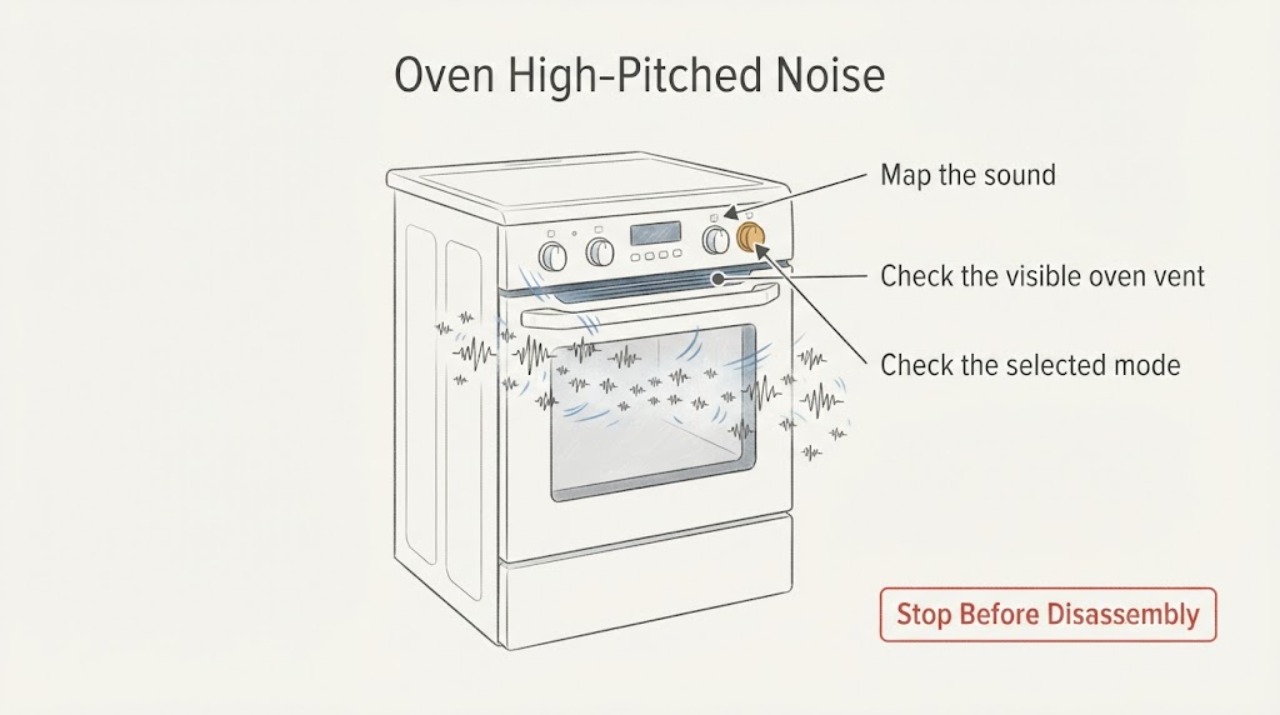
A high-pitched sound from a Bosch oven is not enough to identify a failed fan or motor. First note whether it occurs while preheating, during a convection mode, during ordinary cooking, or after the oven is turned off. Bosch manuals for documented oven families say the cooling fan can run during cooking and continue after shutoff until the oven cools; convection-fan behavior varies by mode and model. Keep the oven vents clear, do not remove panels or test live parts, and record the E-Nr/model and any error, heat, odor, smoke or cooking-performance change. If the pitch is new, continuous, accompanied by grinding/scraping, an error or abnormal heating, stop using the oven and arrange Bosch service.
Work through in order
Diagnostic checks
Use only checks that match the exact appliance or system and its official guide.
-
Check 1
Map the sound to the oven state without opening the appliance: note whether it starts during preheat, only in convection, during ordinary bake/broil, when the oven is idle, or after shutoff.
Expected result: Bosch’s documented wall-oven manual says the cooling fan runs during cooking and may be heard at the vent; the slide-in manual says its cooling fan can run in every cooking mode and after shutoff, while the convection fan is tied to convection modes and may run during some preheats.
Next step: Compare the timing with the exact E-Nr owner manual. If the noise occurs while idle when no fan/cooling stage is expected, or remains after the documented cool-down period, move to the service branch.
Why this matters
Why: A sound that follows a documented fan stage may be normal for that model; timing alone does not prove a failed motor or bearing.
-
Check 2
Check the visible oven vent area and surrounding clearance while the appliance is cool: make sure cookware, foil, cabinetry items or cleaning materials are not blocking the vent.
Expected result: Bosch says warm air or steam can leave the oven vent and that the vents are important for air circulation; blocked vents can cause overheating. Note whether the pitch changes with airflow or whether the oven becomes unusually hot outside the cavity.
Next step: Clear only an obvious external obstruction without moving hot cookware or removing trim. If the vent is clear but the sound or heat remains abnormal, stop and arrange service.
Why this matters
Why: An obstructed vent can affect cooling and create an abnormal operating condition, but it does not identify a particular fan or electrical part.
-
Check 3
Check the selected mode and visible loading only after the oven is cool: confirm whether convection is enabled and that racks or cookware are seated as the model manual specifies, without reaching toward a fan or heating element.
Expected result: A sound limited to a convection mode is a different observation from a sound present in every mode or after shutoff. Record whether heating, temperature control and cooking results remain normal.
Next step: Use the exact manual for mode behavior and rack placement. Do not remove a fan cover, bend a guard or run the oven with panels removed to reproduce the sound.
Why this matters
Why: Mode correlation helps separate expected airflow from a new noise accompanied by poor performance; it still cannot diagnose a hidden fan, motor or control.
-
Check 4
Record the appliance identity and any accompanying signs for service: capture the complete E-Nr/model and FD number, the sound timing, error display, heating behavior and whether there is odor, smoke, scraping or vibration.
Expected result: Bosch asks users to keep the complete model number and FD number available for support. A new persistent pitch, error, abnormal temperature, smoke/odor or mechanical scraping makes the issue more than a normal operating-sound question.
Next step: Contact Bosch or an authorized servicer if the noise is new, continuous, or paired with performance or safety symptoms. Keep the oven off if there is smoke, burning odor, exposed damage or unsafe heat.
Why this matters
Why: The identity and symptom history let Bosch match the correct manual and service route; a generic sound cannot establish part compatibility.
-
Check 5
Keep the repair boundary explicit: do not remove the oven from its cabinet, open electrical covers, probe wiring, lubricate a fan, or order a motor/fan from a generic picture.
Expected result: If the sound persists after the documented external checks, comes from behind a panel, or returns after a reset, the remaining cause is not identifiable from the symptom alone.
Next step: Stop testing and arrange Bosch service. If there is smoke or a burning smell, turn the oven off and isolate power only if safely reachable; do not re-energize it to reproduce the noise.
Why this matters
Why: Bosch’s parts and support pages require the appliance model for compatible parts, and Bosch routes oven problems to its service team rather than publishing a universal internal repair procedure.
Use your observations
Decision map
Find the observation that best matches what you see, then follow the next safe action.
-
PATH 01Next step
What you see
If the pitch occurs only during a documented cooling period while warm air exits the vent and the oven otherwise heats normally
Do this next
Keep vents clear and compare the duration with the exact manual. Arrange service if the sound changes, continues indefinitely or affects heating.
Why this path and its safety boundary
Why it matters: The fan behavior may be normal for that Bosch oven family; the source does not establish a failed part from pitch alone.
-
PATH 02Next step
What you see
If the pitch begins only when convection is selected
Do this next
Check the exact E-Nr manual and stop if the sound is accompanied by scraping, vibration, smoke, odor or poor cooking.
Why this path and its safety boundary
Why it matters: The selected mode is engaging an airflow system, but model-specific fan timing varies and the sound is not a diagnosis.
-
PATH 03Next step
What you see
If the noise is present while the oven is idle, remains after the documented cool-down, or is accompanied by an error or abnormal heating
Do this next
Leave the oven off and contact Bosch or an authorized servicer; do not remove covers or perform live tests.
Why this path and its safety boundary
Why it matters: The sound falls outside the normal operating patterns described in the opened manuals, and an internal cause cannot be safely identified by observation.
-
PATH 04Next step
What you see
If there is smoke, burning odor, exposed wiring, a hot damaged control area or repeated electrical tripping
Do this next
Stop using the oven, isolate power only if safely reachable, and obtain qualified appliance/electrical help. Do not restart it to reproduce the sound.
Why this path and its safety boundary
Why it matters: This is a safety condition rather than a noise-only troubleshooting case.
Helpful context
Understand the symptom
“High-pitched noise” is a sound description rather than a Bosch fault code. In the Bosch oven manuals opened for documented wall-oven and slide-in families, cooling-fan operation is expected during cooking and may continue after shutoff; convection-fan operation depends on the selected mode and model. With no E-Nr supplied, the safe decision is to correlate the pitch with the mode, vent airflow and oven performance, then stop at service if it is new or abnormal rather than guessing a fan, bearing, motor or control-board failure.
When checks do not resolve it
Need a professional?
Contact Bosch or an authorized servicer for a new or persistent high-pitched noise, noise while idle, grinding/scraping, abnormal vibration, error display, poor heating, smoke, burning odor, exposed damage or repeated electrical trips. Do not remove panels, access live wiring, lubricate a fan, bypass a safety device, or select a replacement motor/fan without the exact E-Nr.
Common questions
FAQ
Is a fan sound after a Bosch oven is turned off normal?
For the documented Bosch slide-in family opened here, the cooling fan may continue after shutoff until the oven cools. Check the exact E-Nr manual because fan behavior varies by model; a sound that remains indefinitely or is accompanied by poor performance needs service.
Can I remove the fan cover to find the source of the high pitch?
No. Do not open covers or test live parts. Bosch requires the model number for compatible parts and routes unresolved oven problems through its support and service channels.
What information should I give Bosch service?
Provide the complete E-Nr/model and FD number, when the sound starts and stops, selected mode, any error message, and whether heating, vent airflow, odor, smoke or vibration changed.
Read the exact guide
Official sources
- Bosch Slide-in Range Use and Care ManualBosch Home Appliances · Official Bosch manual for a documented slide-in range family. Used only to explain that its cooling fan can run during cooking and after shutoff and that convection behavior is mode-specific; not universal across Bosch ovens.
- Bosch Oven Replacement PartsBosch Home Appliances · Official Bosch US parts page. It says parts must be searched by appliance model and routes unresolved oven problems to Bosch support; it is not evidence that any listed fan or motor fits this unidentified oven.
- Oven FAQs | Top TipsBosch Home Appliances · Official Bosch US oven support page. It supports keeping vents clear, retaining model/FD details and calling support when an error returns; it does not diagnose high-pitched noise or authorize internal repair.
- Use and Care Manual HBNxxx1UC, HBLxxx1UC, HBLxxx2UCBosch Home Appliances · Official Bosch oven manual for documented HBNxxx1UC/HBLxxx1UC/HBLxxx2UC families. Used only for cooling/convection fan and vent behavior within those families; not generalized to an unidentified Bosch oven.
- Get Support - Ovens & RangesBosch Home Appliances · Official Bosch US oven support hub. Used only for owner-manual/service routing, not as technical evidence for a specific noise cause.
Community feedback
Share a repair observation
Share a plain-text repair observation. Accepted observations are published automatically; this page may take a moment to update.