
On this page
Start here
Quick answer
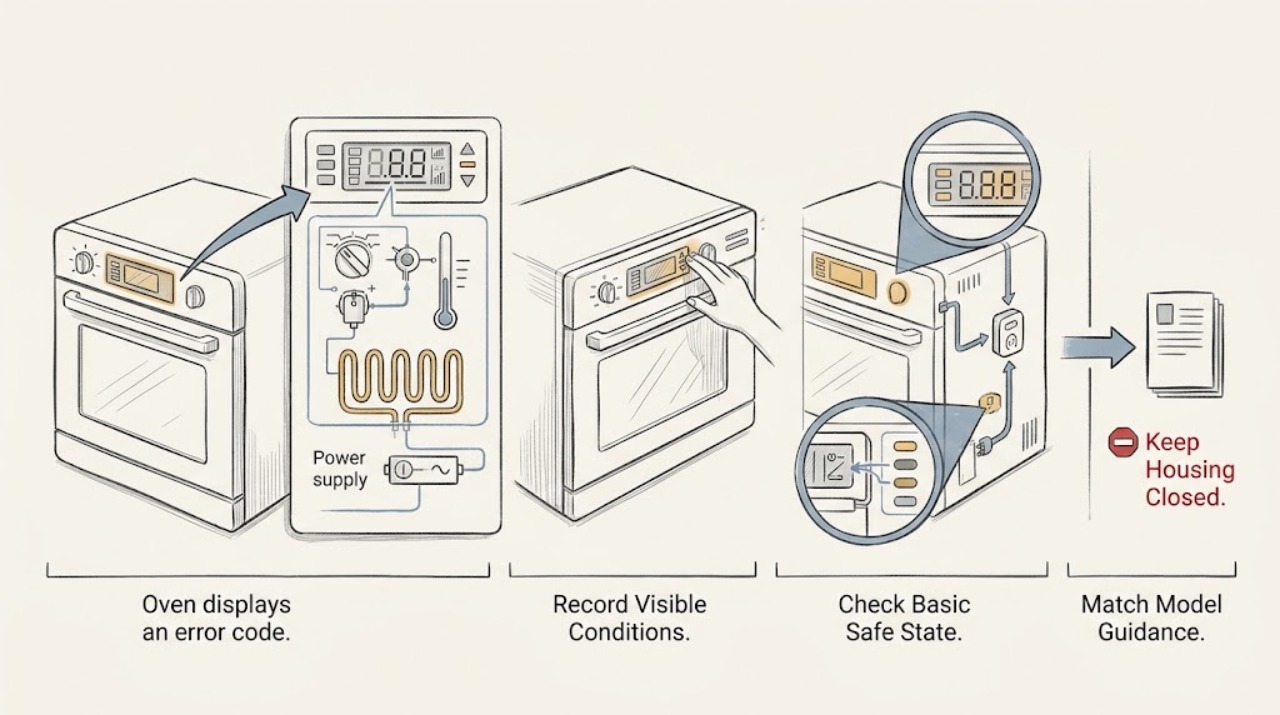
Write down the complete Bosch oven message before clearing it. An E followed by a number is a fault or malfunction message, but the meaning and reset sequence depend on the model and code. Press a key only to silence beeping, then follow the model's owner manual for a reset; Bosch support pages describe switching off the oven's fuse or breaker for a model-specific interval and restoring power once. If the code remains or returns, stop using the oven and arrange qualified Bosch service. Do not open the control area, test live wiring, bypass a safety message, or keep resetting a recurring code. Treat smoke, a gas odor, sparks, overheating, a tripped breaker, or a damaged cord as an immediate stop condition.
Before you begin
Safety first
- This article covers reading the display, identifying the exact model, ordinary external checks, drying a control surface when Bosch permits it, and one model-directed power reset. A technician must handle panels, wiring, sensors, heaters, controls, locks, gas components, and live or high-temperature diagnosis.
Work through in order
Diagnostic checks
Use only checks that match the exact appliance or system and its official guide.
-
Check 1
Read the display without opening the appliance and record every character, number, symbol, beep pattern, and whether the oven is hot, heating, self-cleaning, or idle. Take a photo only if doing so is safe.
Expected result: The display shows E plus a number, F plus a number, a touch-key or communication message, a voltage or temperature warning, or a code that cannot be read completely.
Next step: Keep the oven off if the code is accompanied by smoke, gas odor, sparks, overheating, or loss of control. Otherwise locate the exact model manual and compare the complete message with its error-code guidance.
Stop if: Do not guess the code, continue cooking through a safety warning, or open the control area to read a hidden label while the appliance is energized or hot.
Why this matters
Why: Bosch uses different code families and meanings across ovens, ranges, and models. A complete code is needed to select the matching Bosch manual; an incomplete code cannot support a part or repair conclusion.
-
Check 2
Press a control only as needed to stop an audible alert, then check from outside that the oven is not in an active self-clean cycle, the door is not being forced, and the display responds normally. Do not touch hot surfaces or block vents.
Expected result: The beeping stops and the message clears, the oven remains locked or hot, the controls do not respond, or the code remains visible with a heating or power symptom.
Next step: Allow a hot oven to cool naturally and consult the model manual. If controls remain unresponsive or the message is still present, stop and arrange Bosch service rather than forcing the door or controls.
Stop if: Do not pry the door, interrupt self-cleaning by force, pour water into the oven, or continue operation with smoke, gas odor, sparks, or uncontrolled heat.
Why this matters
Why: Silencing a beep does not repair the fault. A locked, unresponsive, hot, or power-related state needs the exact model procedure and may require service before another test.
-
Check 3
Find the Bosch E-Nr/model and product family from the rating plate or owner manual, then use Bosch's oven error-code page or the exact manual to match the recorded message. Do not apply a reset interval or code meaning from a different model.
Expected result: The code has a direct Bosch entry for the exact model family, only a general fault entry is available, or no matching entry can be found.
Next step: Follow only the ordinary-access steps in the matching Bosch guidance. If the entry is missing, ambiguous, or calls for service, keep the oven off and give the code and model to a qualified technician.
Stop if: Do not infer that an E-number identifies a particular board, sensor, or heater without exact Bosch model evidence.
Why this matters
Why: A direct entry can provide a limited owner reset or inspection. A general or missing entry means the cause is not safely identifiable from the display alone and may include electronics, sensing, heating, or supply faults.
-
Check 4
If the exact Bosch guidance permits a reset and there is no active safety symptom, turn the oven off at its control and isolate power at the labeled fuse or breaker for the interval stated by that guide. Restore power once, without removing covers, and observe the display.
Expected result: The display returns to normal and the code does not recur, the code returns immediately, the breaker trips again, or the oven loses normal control or heating.
Next step: If the code returns or operation is abnormal, leave the oven off and arrange service. If the display is normal, perform no repair based on the reset alone; monitor the next normal use and stop at recurrence.
Stop if: Do not guess a reset interval, repeatedly cycle the breaker, bypass a fuse, work inside the appliance, or reset power while smoke, gas odor, water, sparks, or overheating is present.
Why this matters
Why: A one-time clear may indicate a transient control state, but a returning code, repeated protection trip, or abnormal heating supports an unresolved electrical, sensor, control, or appliance fault.
-
Check 5
After a successful model-directed reset, confirm from outside that the display remains clear, controls respond, the door operates normally, and the oven does not show unusual heat, smell, smoke, sound, or breaker activity. Do not run a long cooking cycle to prove the fault is gone.
Expected result: The oven stays clear and behaves normally, the same code returns during preheat or cooking, heating is uneven or absent, or a new safety symptom appears.
Next step: Stop the affected function and arrange qualified Bosch service for recurrence, abnormal heat, absent heating, a new code, or a control problem. Provide the complete history rather than repeating the reset.
Stop if: Stop immediately for smoke, gas odor, sparks, exposed wiring, a damaged cord, overheating, an uncontrolled element, or another tripped breaker.
Why this matters
Why: Stable operation lowers concern for a transient message but does not identify the original cause. Recurrence or an operating change means the reset did not resolve the fault.
-
Check 6
Before requesting service, collect the exact model/E-Nr, serial or rating-plate details, complete code, date and mode of occurrence, whether the oven was hot or self-cleaning, reset result, and any heating or safety symptom. Leave the oven off when the error is persistent or unsafe.
Expected result: The code and conditions are repeatable and documented, or the event is intermittent, incomplete, or linked to a safety symptom.
Next step: Arrange qualified Bosch appliance service when the code remains, returns, cannot be identified, or is paired with abnormal operation. Follow the technician's instructions for any further use.
Stop if: Do not remove panels, inspect live terminals, replace a board or sensor based only on a code, or continue operating while a safety symptom is unresolved.
Why this matters
Why: This information helps Bosch or an authorized technician distinguish a model-specific code from a general control, sensor, heating, or power problem without unsafe owner testing.
Use your observations
Decision map
Find the observation that best matches what you see, then follow the next safe action.
-
PATH 01Safety boundary
What you see
The complete message matches a Bosch model entry, there is no safety symptom, and one model-directed power reset clears it without abnormal operation.
Do this next
Record the reset result and monitor the next normal use. Arrange service if any code, heating change, control issue, or unusual smell returns.
Why this path and its safety boundary
Why it matters: A transient control state is possible, but the reset does not establish that a component is healthy or that recurrence will not happen.
Safety stop: Do not repeat resets as a routine solution or continue if a safety symptom appears.
-
PATH 02Safety boundary
What you see
The code remains after the exact Bosch reset, returns on power-up or during operation, or no exact model entry supports a safe owner step.
Do this next
Leave the oven off and arrange qualified Bosch service with the complete code, model, timing, and reset result.
Why this path and its safety boundary
Why it matters: An unresolved electronics, sensor, heating, communication, or supply fault is more likely than a temporary display state.
Safety stop: Do not select a replacement part, open panels, test live circuits, or keep cycling the breaker.
-
PATH 03Safety boundary
What you see
The code appears with smoke, gas odor, sparks, an uncontrolled or excessive temperature, a tripped breaker, damaged wiring, or loss of normal control.
Do this next
Stop using the oven, keep clear of hot or energized areas, and use the appropriate qualified appliance, electrical, or gas-safety service response.
Why this path and its safety boundary
Why it matters: The display is secondary to an immediate appliance, electrical, or fuel-safety concern; ordinary reset advice is not an adequate response.
Safety stop: Do not operate the oven, repeatedly restore power, investigate a gas smell with a flame, or remove covers.
-
PATH 04Safety boundary
What you see
The code points to touch-key behavior or a control-panel response issue, and the panel is visibly wet, dirty, or unresponsive.
Do this next
With the appliance safe and cool, wipe the control surface dry as the Bosch guidance permits, then perform at most one exact-model reset. Escalate if the message returns.
Why this path and its safety boundary
Why it matters: Bosch identifies some touch-key faults as potentially related to condensation and gives a dry-cloth and model-directed power step for applicable units; a recurring message still requires service.
Safety stop: Do not spray cleaner into controls, use a wet cloth, remove the panel, or continue if the surface is damaged or the oven behaves abnormally.
Helpful context
Understand the symptom
The code is a clue, not a universal diagnosis
Bosch oven displays can show an E with a number, an F message, or a model-specific code. Similar-looking messages can indicate different electronics, sensor, heating, touch-panel, or supply issues on different product families. Keep the exact characters, punctuation, and whether the control is beeping; do not substitute a code from another Bosch model.
Use one controlled reset only
Bosch's general oven guidance treats an E-number message as a fault and directs a model-appropriate power reset. Some Bosch guides specify turning the oven fuse or breaker off for a stated interval, then restoring it. A reset can clear a transient control state, but it does not prove a failed sensor, heating circuit, or power connection has been repaired. If the same message returns, preserve the code and stop troubleshooting at the control level.
Protect the oven and the person using it
Do not remove panels or measure live circuits to identify an error. If the oven is hot, allow it to cool before ordinary inspection; if it smells of gas, smokes, sparks, overheats, or trips protection, leave it off and use the appropriate appliance or utility safety response. Bosch's owner-support material points owners to the exact manual and authorized service path when a code persists.
Safety boundary
Stop conditions
- Stop immediately for smoke, gas odor, sparks, exposed wiring, a damaged cord, overheating, an uncontrolled heating element, a tripped breaker, or loss of temperature or door control.
- Do not open control or rear panels, test live wiring, bypass a fuse or safety control, or replace a board, sensor, heater, or lock based only on a display code.
- Do not repeatedly reset the fuse or breaker, force an oven door, interrupt a hot self-clean cycle by force, or continue cooking through a persistent fault.
- If the complete code cannot be matched to the exact Bosch model, treat the message as unresolved and arrange qualified service rather than borrowing another model's remedy.
- Stop after one exact-model reset when the code returns, the oven does not operate normally, or any safety symptom appears.
Only after diagnosis
Potential parts
- oven control module
Consider this category only if a qualified diagnosis confirms the exact model's control is faulty after power, wiring, and connected components are checked.
Confirm the exact Bosch model/E-Nr, control revision, connectors, and manufacturer's fit information before ordering. - oven temperature sensor
Consider this category only when the exact Bosch code and technician testing identify a failed temperature sensor or its circuit rather than a control or wiring issue.
Confirm the exact Bosch model, sensor type, connector, mounting, and manufacturer's fit information before ordering; do not live-test it as a user. - oven heating or safety component
Consider this category only after a qualified technician confirms that the code and symptom are caused by a failed heater, thermal safety device, or related circuit.
Confirm the exact Bosch model, oven position, electrical rating, safety design, and manufacturer's fit information before ordering.
When checks do not resolve it
Need a professional?
Arrange qualified Bosch appliance service when the code remains after the exact model's permitted reset, returns, cannot be identified, appears with a heating or control problem, or is linked to a sensor, electronics, communication, power, lock, or safety condition. Electrical diagnosis, control-panel access, live testing, gas work, heating circuits, and safety-device repair require a technician.
Safety scope: This article covers reading the display, identifying the exact model, ordinary external checks, drying a control surface when Bosch permits it, and one model-directed power reset. A technician must handle panels, wiring, sensors, heaters, controls, locks, gas components, and live or high-temperature diagnosis.
Common questions
FAQ
What should I do first when my Bosch oven displays an error code?
Record the complete display, including the letter, number, symbol, and beep behavior. Compare it with the exact Bosch model manual or Bosch error-code page. Silence a beep only as instructed, and stop for smoke, gas odor, sparks, overheating, or loss of control.
Can I reset a Bosch oven error code?
Only if the exact Bosch model guidance permits it. Bosch materials describe model-specific power isolation and reset steps; perform one controlled reset, then arrange service if the code remains or returns. A reset is not proof that a component is repaired.
Does an E-number identify one specific Bosch oven part?
Not by itself. Bosch uses different code families and meanings across ovens and ranges, so the exact model and complete message are needed before a sensor, control, heater, or other part is considered. Do not order a part from a code alone.
What if the code disappears after I turn the breaker off and on?
Record that it cleared and monitor one normal use without repeating the reset. If the code, abnormal heating, control issue, or safety symptom returns, leave the oven off and arrange Bosch service with the original code and reset result.
When should I stop using the Bosch oven and call for service?
Stop when the message remains or returns, cannot be matched to the exact model, or is paired with smoke, gas odor, sparks, overheating, a tripped breaker, damaged wiring, loss of control, or abnormal heating. Panels, live electrical tests, gas work, and safety-component diagnosis require a qualified technician.
Read the exact guide
Official sources
- Oven & Microwave | Error Codes | BoschBosch Home Appliances · Official Bosch US error-code page; code meanings and available steps vary by model family.
- TroubleshootingBosch Home Appliances · Official Bosch owner guide for applicable oven models; the exact owner's manual controls for other models.
- Bosch Slide-in Range Error Codes | Support | Error CodesBosch Home Appliances · Official Bosch range support used to show that code meanings and reset steps differ across product families.
- Get Support - Ovens & Ranges | Bosch Home AppliancesBosch Home Appliances · Official Bosch US support hub used to direct model lookup and service; it does not diagnose an individual code.
- Bosch Oven Replacement Parts.Bosch Home Appliances · Official Bosch parts page used only to require model-based fit confirmation after diagnosis.
- Freestanding Range | Error Codes | BoschBosch Home Appliances · Official Bosch support for freestanding ranges; it is not a claim that every Bosch oven uses these codes.
Community feedback
Share a repair observation
Share a plain-text repair observation. Accepted observations are published automatically; this page may take a moment to update.