
On this page
Start here
Quick answer
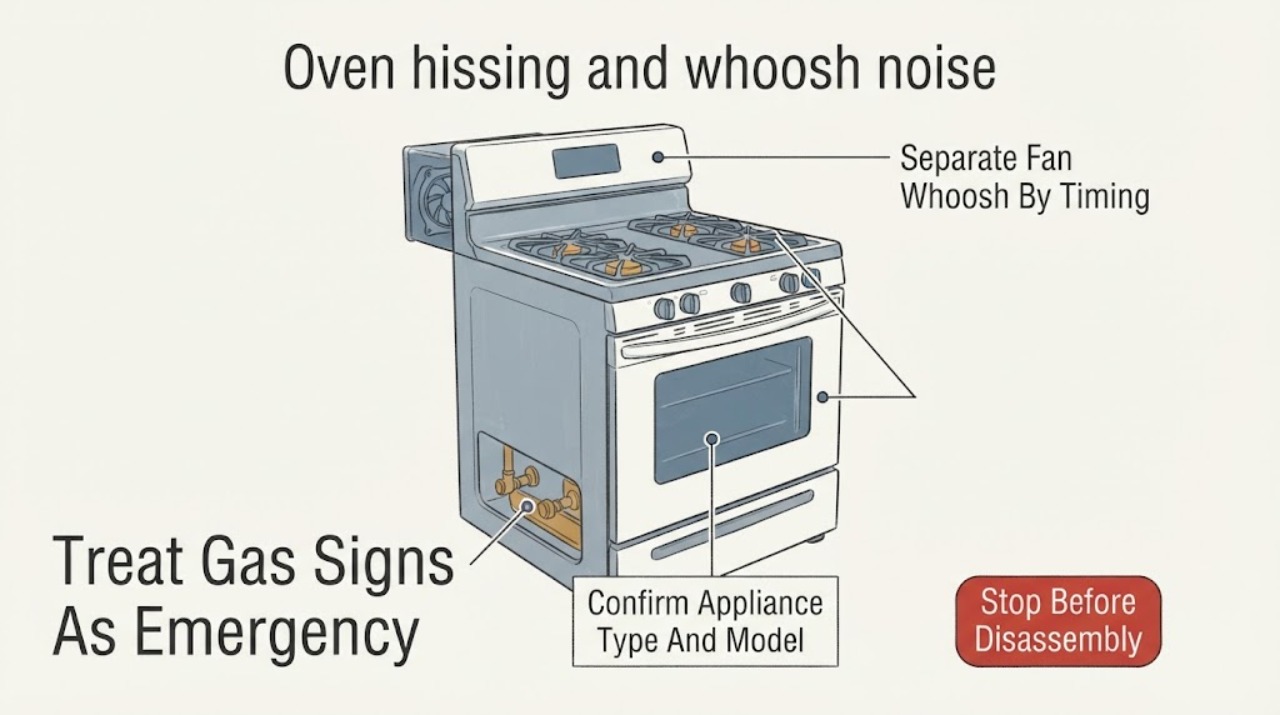
First separate an airflow whoosh from a possible gas leak. Frigidaire identifies its gas-range sound guidance as applying to gas ranges, and says an oven fan can run during preheat, cycle during baking and remain on after the oven is turned off until it cools. That can explain a broad fan-like whoosh when the timing matches, but it does not make a persistent hiss safe to ignore. If there is a rotten-egg or unusual gas odor, hissing or roaring while the appliance is off, smoke, an abnormal flame, or carbon-monoxide symptoms, leave immediately without operating switches or phones inside and call the local gas utility or 911 from a safe location. If there is no odor and the sound occurs only with a documented preheat or cool-down fan period, identify the exact model manual; a sound that persists, changes, or does not match that timing needs qualified appliance service.
Work through in order
Diagnostic checks
Use only checks that match the exact appliance or system and its official guide.
-
Check 1
If you smell rotten eggs or another unusual gas odor, hear hissing/roaring/whistling while the oven is not intentionally operating, or see smoke or feel unwell, stop troubleshooting and leave the home with people and pets. Do not operate switches, appliances, phones or flames inside.
Expected result: A gas odor, unusual gas-appliance sound, smoke, or symptoms such as headache, dizziness or nausea are present; or none is present.
Next step: From a safe location, call the local gas utility or 911 and do not re-enter until responders or the utility says it is safe. If no emergency sign is present, continue only with non-invasive timing and identity checks.
Why this matters
Why: The New York State Department of Public Service lists odor and roaring, hissing or whistling as leak signs and treats a suspected leak as an evacuation and ignition-source-avoidance event. This evidence does not identify the leak location or a failed oven part.
-
Check 2
Without opening the oven or deliberately reproducing a gas sound, record when the whoosh was heard: during preheat, intermittently while baking, immediately after shutoff, or while the oven was idle. Also record whether the sound is broad airflow or a sharp hiss and whether any odor was noticed.
Expected result: The sound follows preheat/baking/cool-down timing, occurs while idle, or its timing and character are unknown.
Next step: If timing does not match a fan period, or the sound is persistent or worsening, keep the oven off and arrange qualified service. Do not keep running it to compare sounds.
Why this matters
Why: Frigidaire says an oven fan may run during preheat, cycle during baking and continue after shutoff until the oven cools. Timing that matches those periods can support a cooling-air explanation, while an idle or persistent hiss remains unresolved and is not cleared by the fan guidance.
-
Check 3
Read the model and fuel information from the accessible rating label or owner documents without removing panels, then open the matching Frigidaire manual/support entry. Do not apply a gas-range instruction to an electric or induction model, or a different Frigidaire family.
Expected result: The oven is confirmed as gas, electric or induction and the exact model can be matched; or the model/fuel type remains uncertain.
Next step: Use the exact manual to compare the sound timing and operating conditions. If identity remains uncertain, give the label information and a sound description to Frigidaire support or a qualified appliance technician rather than borrowing another model's procedure.
Why this matters
Why: Frigidaire labels the sound article as Gas Range, while its fan guidance is for Ranges generally. The available evidence cannot assign a burner, gas valve, igniter, fan or control diagnosis without the appliance identity.
-
Check 4
With the oven off and cool, look only at accessible surroundings for a blocked vent, visible soot, melted material, damage, moisture or a damaged power cord. Do not remove the back, lift the cooktop, disturb gas tubing, relight a burner, or make electrical or gas adjustments.
Expected result: Visible damage, soot, moisture, an obstructed vent or a burning smell is present; or accessible surroundings look normal.
Next step: Keep the oven out of service and arrange qualified appliance/gas service for any damage, soot, burning smell or unexplained persistent sound. If the exterior is normal, use the model-specific manual and the recorded timing rather than opening the appliance.
Why this matters
Why: Visible damage or combustion-related evidence raises the service and safety boundary, while a normal exterior cannot rule out an internal gas, ignition, combustion or fan problem.
-
Check 5
Arrange qualified Frigidaire appliance service when the hiss or whoosh persists outside a documented fan period, occurs while the oven is idle, returns with an odor, changes the flame or heating behavior, or cannot be matched to the exact manual.
Expected result: The sound remains after safe timing and identity checks, or any gas/combustion warning sign is present.
Next step: Keep the appliance off as appropriate and provide the technician with the model, fuel type, sound timing, odor history and any visible observations. Do not continue test cycles or open the cabinet.
Why this matters
Why: The public sources support a fan timing explanation and a gas-leak emergency response, but they do not establish a specific failed valve, igniter, burner, regulator, fan motor or control.
Use your observations
Decision map
Find the observation that best matches what you see, then follow the next safe action.
-
PATH 01Next step
What you see
Gas odor, idle hissing/roaring/whistling, smoke or illness is present.
Do this next
Leave immediately, avoid switches, appliances, phones and flames inside, then call the gas utility or 911 from a safe location. Do not re-enter until cleared.
Why this path and its safety boundary
Why it matters: Treat the situation as a possible gas or combustion emergency; the sound is not established as normal fan operation.
-
PATH 02Next step
What you see
No odor is present and a broad whoosh occurs only during preheat, baking or cool-down.
Do this next
Confirm the exact model manual. Arrange service if the sound becomes sharp, persistent, unusually loud or continues while idle.
Why this path and its safety boundary
Why it matters: The timing is consistent with Frigidaire's documented oven-fan behavior, but it does not prove that every sound from every model is normal.
-
PATH 03Next step
What you see
The appliance is electric or induction, or the fuel type is unknown.
Do this next
Use the exact model manual/support route and keep the oven off if the sound is unexplained or accompanied by heat, smoke, odor or damage.
Why this path and its safety boundary
Why it matters: Gas-leak guidance and gas-range sound assumptions cannot be assigned until the appliance identity is known.
-
PATH 04Next step
What you see
The model is known but the sound does not match the manual's operating timing.
Do this next
Stop reproducing the noise and arrange qualified Frigidaire appliance service with the timing and safety observations.
Why this path and its safety boundary
Why it matters: A manual mismatch leaves the cause unresolved; no internal component has been confirmed.
Helpful context
Understand the symptom
Separate a cooling-air whoosh from a gas warning
Frigidaire says the oven fan may run during preheat, cycle during baking and continue after shutoff until the oven cools. That timing can explain a broad whoosh. It does not establish that an idle or persistent hiss is normal, especially on an unidentified gas model.
Gas odor or idle hissing means leave first
The New York State Department of Public Service lists a strong rotten-egg odor and roaring, hissing or whistling as possible gas-leak signs. Its response is to evacuate, avoid actions that could create a spark, and call the gas utility or 911 from a safe location. Do not keep testing the oven or try to locate the leak yourself.
Use the exact model before any non-emergency diagnosis
Frigidaire's gas-range sound article is explicitly scoped to Gas Range, while the fan article applies to Ranges generally. Confirm whether this appliance is gas, electric or induction and match its exact manual. Without that identity, do not assign the noise to a valve, igniter, burner, regulator, fan motor or control.
Escalate an unexplained or changing sound
Keep the oven off for a persistent sound, a sound that continues while idle, or any noise paired with soot, smoke, burning odor, abnormal flame or heating changes. Give qualified service the exact model, fuel type, sound timing and safe observations. Do not open panels or alter gas or electrical connections.
When checks do not resolve it
Need a professional?
Leave immediately and call the local gas utility or 911 from outside for gas odor, hissing/roaring/whistling while idle, smoke, suspected combustion trouble or illness. For a persistent or unexplained noise without emergency signs, keep the oven off and contact Frigidaire or qualified appliance service with the exact model, fuel type and sound timing. Do not open the cabinet, alter gas/electrical connections or keep running cycles to reproduce the noise.
Common questions
FAQ
Is a whooshing sound from a Frigidaire oven always normal?
No. Frigidaire says an oven fan can run during preheat, cycle while baking and remain on after shutoff until the oven cools, which can explain a fan-like whoosh at those times. A persistent sound, an idle hiss, an unusual odor, smoke or abnormal heating needs the safety and service branch instead.
What should I do if the hissing comes with a gas smell?
Leave immediately and avoid operating switches, appliances, phones or flames inside. From a safe location, call the local gas utility or 911 and do not re-enter until responders or the utility says it is safe.
Can I identify the failed valve or igniter from the sound?
Not from the available model-free evidence. Confirm the exact fuel type and model, record when the sound occurs without repeatedly running the oven, and use qualified Frigidaire appliance or gas service for an unexplained or persistent noise.
Read the exact guide
Official sources
- Ranges - Is it normal for a fan to come on while using my range and when does it stop running?Frigidaire · Official general range guidance for oven-fan timing; it does not diagnose gas leaks or identify internal parts.
- Electric and Natural Gas Safety TipsNew York State Department of Public Service · State consumer safety guide listing odor and roaring/hissing/whistling as possible leak signs and directing evacuation, spark avoidance and a call from a safe location.
- Understanding Sounds & Lights of Your Gas RangeFrigidaire · Official Frigidaire support article scoped to Gas Range; the opened page also provides the official manuals and support route.
Community feedback
Share a repair observation
Share a plain-text repair observation. Accepted observations are published automatically; this page may take a moment to update.