
On this page
Start here
Quick answer
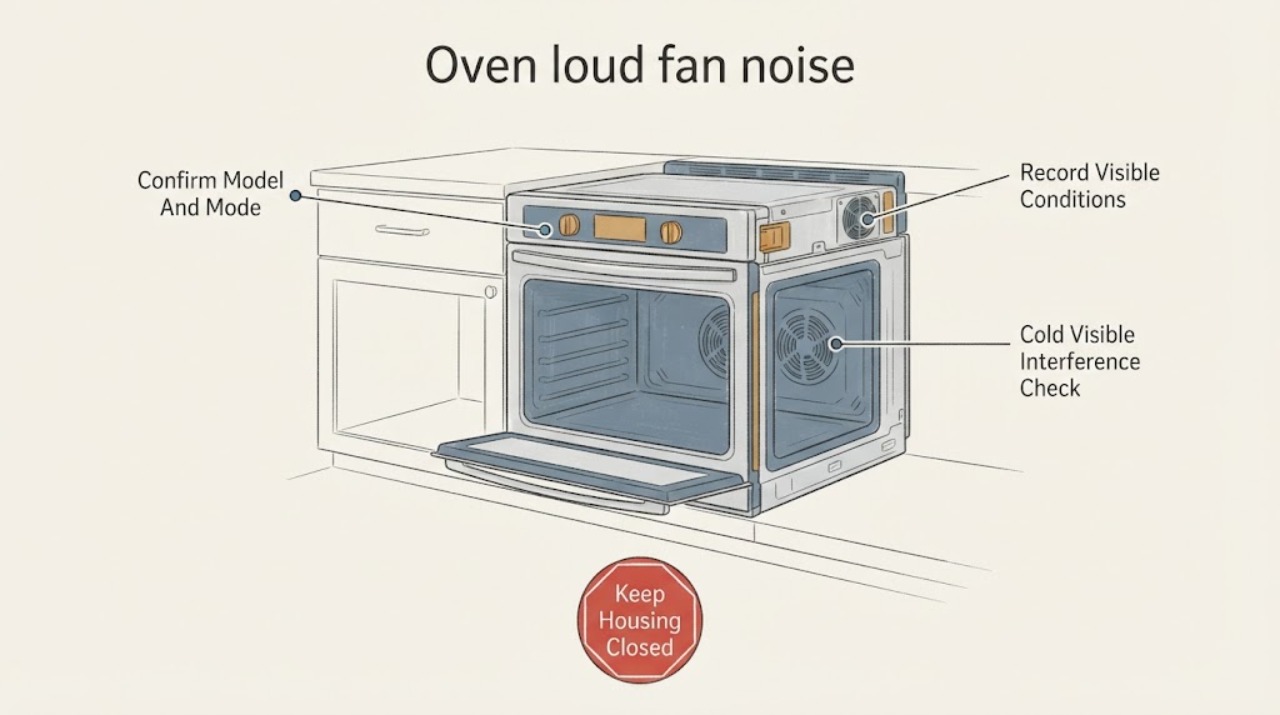
First note whether the sound occurs during convection cooking, preheat, ordinary baking, or after the oven is switched off. Frigidaire says an oven fan can run during preheat and baking and can remain on after the oven is turned off until the internal temperature cools; convection mode also intentionally uses a fan to circulate heat. That normal timing does not explain a new scraping, grinding, rattling, burning smell, smoke or fan that never stops. With the oven off and fully cool, check only visible racks or loose cookware and confirm the selected mode from the exact model manual. Do not reach through the fan guard, remove panels or run the oven with parts exposed. If the noise is persistent, abnormal, accompanied by heat damage or an error, stop using the oven and arrange Frigidaire service rather than diagnosing a fan motor or ordering a generic part.
Work through in order
Diagnostic checks
Use only checks that match the exact appliance or system and its official guide.
-
Check 1
From a safe position, record the selected mode and when the noise begins: preheat, convection cooking, ordinary baking, door opening, or after the oven is switched off. Do not deliberately run a cycle if there is smoke, burning smell, exposed damage or an electrical concern.
Expected result: The fan runs during preheat or convection, continues briefly after a hot cycle, cycles with heating, or produces a new continuous scrape/grind/rattle.
Next step: If the timing matches the documented normal examples and the oven is otherwise safe, continue to the model and cold-inspection checks. If the sound is abnormal or a hazard is present, stop using the oven and arrange service.
Why this matters
Why: Frigidaire documents fan operation during preheat/baking and post-cycle cooling as normal possibilities. A new mechanical-sounding noise or indefinite operation is outside that normal timing description.
-
Check 2
Read the oven's model label and the exact Use and Care guide, then confirm whether the selected mode is convection, air fry, bake, broil or a cooling function. Do not copy a fan or control sequence from another Frigidaire model.
Expected result: The mode intentionally uses convection airflow, the guide describes a post-cycle cooling fan, or the guide does not match the appliance.
Next step: Use only the matching guide to interpret normal fan behavior. If the model cannot be identified or the sound is not described, stay at the external checks and use Frigidaire service for persistent symptoms.
Why this matters
Why: Frigidaire says convection uses a fan and its model-specific documents can define different fan timing. A mismatched guide cannot establish that a sound is normal for this oven.
-
Check 3
Turn the oven off, disconnect power only if safely accessible, wait until the cavity and surrounding surfaces are fully cool, and inspect visible racks, trays and loose cookware for contact with the cavity or fan guard. Do not reach into a guard or remove panels.
Expected result: A visible rack or item is contacting the cavity, everything visible is clear, or checking the fan would require tools or opening the appliance.
Next step: Remove or reposition only a clearly loose, cool item and monitor without forcing anything. If the sound remains or access requires disassembly, leave the oven off and arrange service.
Why this matters
Why: A visible obstruction can explain a rattle without proving a fan defect. A clear exterior does not rule in a motor, bearing or control problem, and tool-required access is outside a safe user check.
-
Check 4
Check for smoke, burning smell, scorch marks, melted material, an error display, abnormal heat at the controls, or a fan that continues indefinitely after the oven is cool. Do not touch hot surfaces to test them.
Expected result: No hazard is present and the fan stops after cooling, or a hazard, error or indefinite operation is present.
Next step: For any hazard or error, stop using the oven, isolate power at the accessible control or breaker only if safe, and arrange qualified service. Do not repeatedly restart it to reproduce the noise.
Why this matters
Why: Normal fan guidance describes stopping after the internal temperature cools. Smoke, burning smell, damage, error or indefinite operation changes the situation to a safety and service decision.
-
Check 5
Give service the exact model, mode, time in the cycle, whether the sound changes with heating or cool-down, the cold-inspection result and any error or damage. Keep the oven unused if the loud noise persists or returns without a visible cause.
Expected result: The sound disappears after a visible item is repositioned, matches the exact guide's normal fan timing, or persists without an external explanation.
Next step: Monitor only when the oven is safe and the sound matches documented operation. Otherwise arrange Frigidaire service and do not open the fan housing, motor wiring or control compartment.
Why this matters
Why: A corrected visible contact or documented timing supports a normal/external explanation. Persistent unexplained noise needs diagnosis; it does not identify a safe user-replaceable fan part.
Use your observations
Decision map
Find the observation that best matches what you see, then follow the next safe action.
-
PATH 01Next step
What you see
The fan starts during preheat or convection and stops after the oven cools, with no scraping, smoke, smell or error.
Do this next
Continue using the matching model instructions and monitor for a change in sound or timing; no fan-part diagnosis is established.
Why this path and its safety boundary
Why it matters: Frigidaire documents this timing as a normal fan function for its applicable range/oven guidance.
-
PATH 02Next step
What you see
The sound is a brief rattle and a cool, visible rack or tray is contacting the cavity or fan guard.
Do this next
Reposition only the cool visible item, then monitor. If the noise remains, stop and arrange service rather than reaching through the guard.
Why this path and its safety boundary
Why it matters: A visible loose item is a possible external source of the rattle, but it does not prove that the fan assembly is intact.
-
PATH 03Next step
What you see
The fan makes a new grinding/scraping sound, continues after the oven is fully cool, or the sound returns with no visible obstruction.
Do this next
Leave the oven off and arrange model-matched Frigidaire service; do not run it with panels removed or order a generic fan part.
Why this path and its safety boundary
Why it matters: The symptom is not covered by the normal fan-timing examples and cannot safely identify a motor, bearing, control or wiring fault remotely.
-
PATH 04Next step
What you see
Smoke, burning smell, scorch marks, melted material, an error or abnormal heat accompanies the noise.
Do this next
Stop using the oven, isolate power only when safe, keep clear of hot or damaged areas and contact qualified service. Do not restart it to reproduce the noise.
Why this path and its safety boundary
Why it matters: This is a safety condition rather than a normal cooling/convection decision.
Helpful context
Understand the symptom
Classify the timing before calling the fan loud
Write down whether the fan starts during preheat, only in a convection mode, cycles during baking, or continues after the controls are turned off. Frigidaire says fan operation during preheat and baking is normal and that the fan may continue after baking until the oven cools. A delayed stop after a hot cycle is therefore a different decision from a new scraping or grinding sound.
Keep convection and cooling functions model-specific
Convection uses a fan to circulate heat, but the exact mode names, fan timing and cooling behavior vary. Frigidaire's opened PowerPlus sheet describes one documented convection implementation, including fan use during preheat, while its general support article applies to ranges. Use the rating label and exact Use and Care guide before interpreting a fan cycle or control sequence on an unknown oven.
Make only an external, cold inspection
Turn the oven off, disconnect power only when safe, and wait until it is fully cool. Check that a rack, tray or visible loose item is not contacting the cavity or fan guard. Do not put fingers or tools through a guard, remove the rear panel, or run the oven with a cover removed; those steps would require model-specific service information and create burn or electrical risk.
Escalate an abnormal sound
A persistent grinding, scraping or rattling sound, a fan that runs indefinitely after cool-down, smoke, burning smell, visible heat damage or an error is not established as normal by the fan timing guidance. Stop using the oven and use Frigidaire's model-support/service path. A sound alone cannot identify the fan motor, bearing, control or wiring part.
When checks do not resolve it
Need a professional?
Arrange Frigidaire service for persistent grinding, scraping or rattling, a fan that does not stop after the oven cools, smoke, burning smell, visible heat damage, an error, or any step requiring the fan housing, motor, wiring, controls or panels. Provide the exact model, cooking mode and noise timing; do not select a replacement fan or motor from this symptom alone.
Common questions
FAQ
Is it normal for a Frigidaire oven fan to keep running after I turn the oven off?
Frigidaire says the fan may stay on after baking until the oven's internal temperature cools. The exact timing varies by model. If it never stops after the oven is cool or makes a new grinding or scraping sound, arrange service.
Why is the fan loud during preheat or convection cooking?
Frigidaire identifies the fan as part of oven temperature circulation and convection cooking. A change in sound quality, a rattle, grinding, burning smell or error is different from ordinary airflow and should not be diagnosed by sound alone.
Can I remove the fan cover to see what is making the noise?
No. Keep the oven off and fully cool, and limit checks to visible racks or loose items. Fan housing, wiring and panels require model-specific service; do not run the oven with a cover removed.
Does a loud fan prove that the fan motor is bad?
No. Frigidaire's public guidance establishes normal fan timing but does not make a component diagnosis from an unspecified sound. Persistent abnormal noise needs a technician with the exact model information.
Why do I need the exact Frigidaire model before following a fan or convection step?
Frigidaire's convection modes and fan timing are not universal across ovens and ranges. Use the model's Use and Care guide; the opened PowerPlus document is evidence for its documented family only, not a universal button sequence.
Read the exact guide
Official sources
- Ovens - What is convection?Frigidaire · Frigidaire ovens; general explanation that Convection Cook uses a fan, with availability varying by model.
- To set the oven for convection bakeFrigidaire · The documented PowerPlus convection oven/range family; fan use during electric preheat and model-specific convection controls.
- Ranges - Is it normal for a fan to come on while using my range and when does it stop running?Frigidaire · Frigidaire ranges; normal oven fan operation during preheat/baking and after a cycle while the oven cools.
- Ranges | FrigidaireFrigidaire · Frigidaire range support index, model manuals and service/support routing for unresolved range/oven issues.
Community feedback
Share a repair observation
Share a plain-text repair observation. Accepted observations are published automatically; this page may take a moment to update.