
On this page
Start here
Quick answer
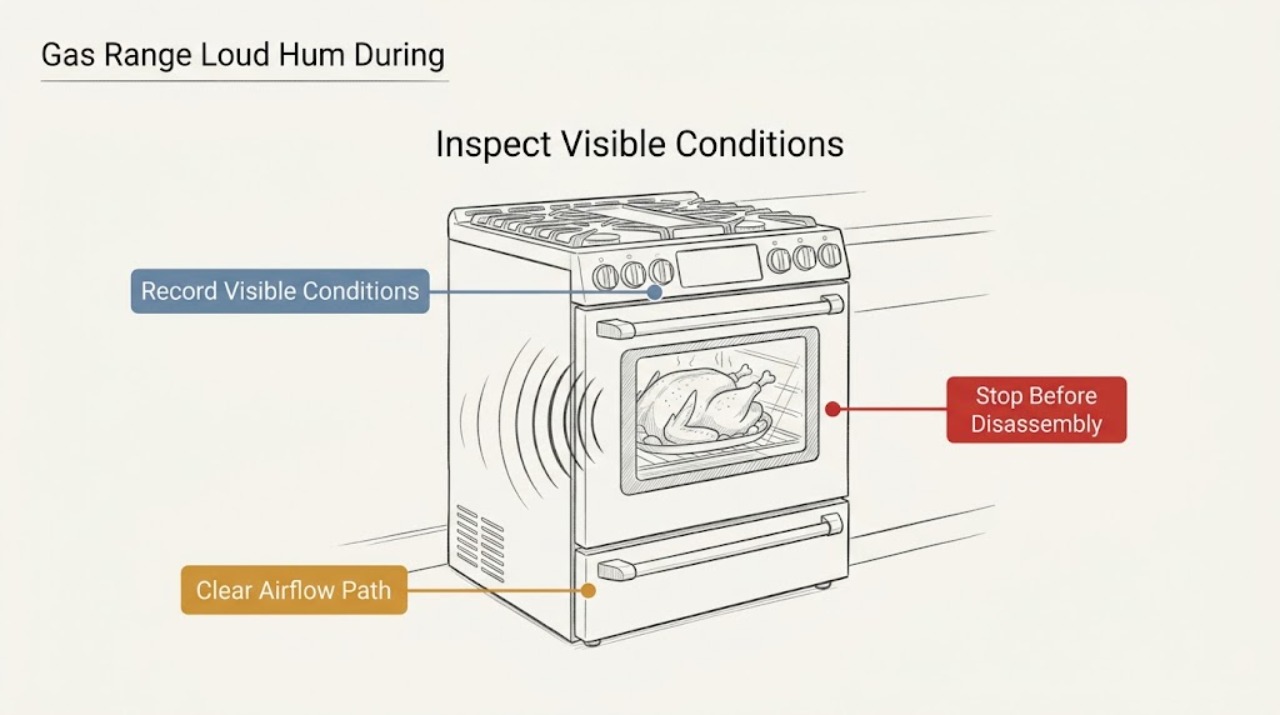
The FCFG3062AS is a Frigidaire gas range, and a fan-related hum can be normal when it follows the oven heat timeline. The model guide says its convection fan starts about six minutes into gas preheating and cycles during baking; Frigidaire also says a range fan may continue after the oven is turned off until the internal temperature cools. Record when the hum starts, whether it cycles with heating, and whether it fades and stops during cooldown. A steady airflow hum with no scraping, strong vibration, gas odor, smoke, sparks, burning smell, delayed ignition, or abnormal flame is consistent with that documented fan timeline, not proof of a failed part. Stop using the range and arrange qualified service if the sound is new and worsening, metallic or rubbing, causes visible vibration, continues after the appliance is fully cool, or is accompanied by a gas or electrical safety symptom.
Work through in order
Diagnostic checks
Use only checks that match the exact appliance or system and its official guide.
-
Check 1
Write down the full FCFG3062AS model from the rating label or paperwork, the selected oven mode, and the hum timeline: whether it begins during preheat or baking, cycles with heat, remains after OFF, and finally stops. If the range is still hot, observe from a safe position without touching the vent or hot surfaces.
Expected result: The hum begins after heating starts, changes with the bake cycle, continues for a cooldown period after OFF, and then stops; or it starts while the oven is idle and remains independent of heating.
Next step: If the sound follows the heat-to-cooldown pattern and there are no hazard signs, keep the record and monitor it without trying to identify a part by ear. If it is independent of heat or persists after full cooldown, stop using the oven and request qualified service with the timeline.
Why this matters
Why: The exact guide says the convection fan starts about six minutes into gas preheating and cycles during baking, while Frigidaire says a range fan may run after shutoff until the internal temperature cools. A heat-linked sound that fades with cooling is therefore consistent with fan operation. An idle-dependent sound or one that does not stop once fully cool is not explained by that timeline.
-
Check 2
From outside the range and only when it is safe to observe, characterize the sound without opening anything: describe a smooth airflow hum versus scraping, rattling, pulsing, a metallic buzz, or cabinet vibration. Note whether the volume is stable, worsening, or linked to a particular mode; do not place fingers near the vent or fan path.
Expected result: The sound is a stable airflow-like tone that tapers as the range cools, or it has rubbing, grinding, rattling, strong vibration, a sudden volume increase, or a new intermittent pattern.
Next step: For a stable, heat-linked tone with normal cooling, avoid blocking the vent and continue only if no other stop condition is present. For rubbing, grinding, rattling, strong vibration, or worsening noise, turn the range off and arrange service; do not lubricate, remove covers, or repeat the test.
Why this matters
Why: The official guidance supports a fan operating during and after oven use, but neither the guide nor the fan article identifies a particular failed component from a sound description. A rubbing or vibration pattern is an abnormal symptom that needs inspection, not evidence that a fan bearing or motor is the failed part.
-
Check 3
Record gas or flame warning signs if they occur during ordinary use without deliberately relighting or repeating ignition: gas odor, delayed ignition, a whoosh or bang, yellow or unstable flame, smoke, or a flame that does not behave normally. Do not use a phone or operate switches inside if gas is smelled.
Expected result: There is no gas odor or abnormal flame and the oven otherwise heats normally, or any gas odor, delayed ignition, whoosh or bang, yellow or unstable flame, or smoke is present.
Next step: For any gas odor or combustion warning, do not try to light an appliance, touch switches, or use a phone inside the building; leave and contact the gas supplier from a neighbor's phone or the fire department as the guide directs. Do not reuse the range until qualified service clears it. If there are no such signs, continue only with the external timeline record.
Why this matters
Why: The FCFG3062AS guide treats gas odor as an emergency and requires qualified installation or service. A normal-looking flame record does not prove that a hum is harmless, but gas or combustion symptoms take priority over sound classification.
-
Check 4
With the range off and safe to approach, document non-gas electrical symptoms rather than opening the controls: a display reset, loss of clock, breaker trip, sparks, burning electrical smell, visibly damaged cord or wiring, or heating that seems uncontrolled. Do not touch hot, energized, or damaged parts.
Expected result: The display and power remain stable with no sparks, electrical odor, breaker event, damaged visible wiring, or uncontrolled heat, or one of those symptoms occurs.
Next step: If any electrical or uncontrolled-heating symptom occurs, stop using the range, keep clear of hot or damaged areas, and arrange qualified appliance or electrical service. Do not repeatedly reset the breaker, remove a panel, or perform a live test.
Why this matters
Why: A normal display and stable power reduce the urgency of an electrical branch but do not identify the sound source. A breaker trip, spark, electrical odor, damaged wiring, or uncontrolled heat makes continued cooking unsafe and cannot be resolved by a fan-sound interpretation.
-
Check 5
After documenting one ordinary use episode, note whether the hum stops when the internal temperature has cooled, without starting another cycle or opening hot areas. Keep the model number, mode, start/stop times, and any safety symptoms for the service appointment.
Expected result: The hum stops as the range cools, or it remains when fully cool, returns while idle, or becomes louder or more mechanical on a later ordinary use episode.
Next step: Use the timeline only as a normal-operation screen. If the sound persists when cool, worsens, or is accompanied by any gas, combustion, electrical, smoke, or heating-control symptom, leave the range off and give the complete record to qualified service. Do not run additional confirmation cycles.
Why this matters
Why: Stopping with cooldown supports the documented fan timeline; persistence while fully cool or a change toward mechanical vibration is an independent service decision even if the oven still heats. The exact sources do not support naming a replacement part from that observation.
Use your observations
Decision map
Find the observation that best matches what you see, then follow the next safe action.
-
PATH 01Next step
What you see
The hum starts with preheating or baking, may continue after OFF, fades as the range cools, and there is no scraping, strong vibration, gas odor, smoke, spark, electrical odor, or uncontrolled heat.
Do this next
Keep the vent clear, record the behavior, and monitor without repeated tests. Use the exact manual for mode operation and arrange service if the pattern changes or a safety symptom appears.
Why this path and its safety boundary
Why it matters: This pattern is consistent with Frigidaire's documented oven-fan timeline for the exact gas-range family; it does not establish a failed fan or other part.
-
PATH 02Next step
What you see
The hum is present while the oven is idle, continues after the appliance is fully cool, or changes into scraping, grinding, rattling, pulsing, or visible cabinet vibration.
Do this next
Stop using the range and request qualified service with the exact model and timeline. Do not block vents, lubricate, remove panels, or order a fan or motor based only on the noise.
Why this path and its safety boundary
Why it matters: The sound is no longer explained by the documented heat-and-cooldown behavior. It could involve an installation, airflow, or mechanical issue, but the opened sources do not identify a component from sound alone.
-
PATH 03Next step
What you see
The hum occurs with gas odor, delayed ignition, a whoosh or bang, yellow or unstable flame, smoke, or another combustion warning.
Do this next
Leave the area and follow the guide's emergency instruction to contact the gas supplier from a neighbor's phone or the fire department. Do not relight, repeat the ignition, or reuse the range until qualified service clears it.
Why this path and its safety boundary
Why it matters: This is a gas-safety event, not a normal fan-noise branch. The exact owner guide says not to light appliances, touch electrical switches, or use a phone in the building when gas is smelled.
-
PATH 04Next step
What you see
The hum is accompanied by sparks, a burning electrical smell, repeated breaker trips, display or power loss, damaged visible wiring, uncontrolled heat, or smoke.
Do this next
Turn the range off if it is safe to do so, keep people away from hot or damaged areas, and arrange qualified appliance or electrical service. Do not reset repeatedly, open the control area, or continue cooking for a holiday meal.
Why this path and its safety boundary
Why it matters: An electrical or overheating symptom overrides the normal-fan interpretation and requires a safety stop.
Helpful context
Understand the symptom
This is a timing-and-symptom question, not a sound-to-part diagnosis. The exact Frigidaire support page identifies FCFG3062AS as a 30-inch front-control gas range and links its owner guide. The guide describes a convection fan that starts during gas preheat and cycles as needed; a separate Frigidaire range article explains that a fan can remain on after baking until the internal temperature cools. A Thanksgiving cooking schedule does not make an abnormal noise safe to ignore, so capture the timeline before deciding whether the range can be used.
Do not put a hand near the oven vent, remove a panel, block a vent, add lubricant, or run the oven repeatedly just to reproduce the noise. Never use sound alone to select a fan, motor, control, or other replacement part. Keep the range out of service for gas odor, delayed ignition, a whoosh or bang, yellow or unstable flame, smoke, sparks, burning electrical odor, uncontrolled heating, or a breaker that trips again.
If the oven is needed for a gathering, use the following record to separate a documented cooldown pattern from an abnormal vibration or a safety event. The checks are external and observational; anything requiring access to gas, wiring, controls, or the hot interior belongs to qualified service.
When checks do not resolve it
Need a professional?
Request qualified Frigidaire or appliance service when the hum persists after the range is fully cool, occurs while idle, becomes scraping, grinding, rattling, pulsing, or visibly vibratory, or remains unexplained after the timeline record. Stop immediately for gas odor, delayed ignition, a whoosh or bang, yellow or unstable flame, smoke, sparks, burning electrical odor, uncontrolled heating, a damaged cord or wiring, or a breaker that trips again. Do not block the oven vent, open panels, lubricate a fan, repeat ignition, reset a tripping breaker, or continue cooking through a safety symptom.
Common questions
FAQ
Is a fan noise after turning off the FCFG3062AS oven normal?
It can be. Frigidaire says a range fan may continue after baking until the internal temperature cools, and the exact model guide describes fan operation during gas preheating and baking. Confirm that the sound fades and stops with cooling and is not accompanied by rubbing, vibration, gas odor, smoke, sparks, or electrical odor.
Does a loud hum prove that the cooling fan or motor needs replacement?
No. The official sources support a normal fan timeline but do not identify a failed component from sound alone. An idle hum, noise that persists after full cooldown, scraping, rattling, or strong vibration should be handled by qualified service rather than a guessed part order.
What should I do if the hum occurs with a gas smell or unusual flame?
Do not try to relight the range. The exact owner guide says not to light appliances, touch electrical switches, or use a phone in the building when gas is smelled; leave and contact the gas supplier from a neighbor's phone or the fire department. Do not reuse the range until qualified service clears it.
Read the exact guide
Official sources
- Frigidaire 30'' Front Control Gas Range with Steam Clean Stainless Steel-FCFG3062ASFrigidaire Canada · Exact-model product page opened to confirm the gas-range identity and operating-feature context; it is not used to name a noise component.
- Frigidaire 30'' Front Control Gas Range with Steam Clean Stainless Steel-FCFG3062ASFrigidaire Canada · Exact-model product support page opened to confirm identity and its model-specific owner-guide and service links.
- New Frigidaire gas oven makes a loud annoying hum during and after the oven is used. What is it?Reddit · Exact Reddit permalink opened as an anecdotal comparison; it does not verify the cause or a repair outcome.
- FCFG3062AS Complete Owner's Guide A23936601Frigidaire · Exact-model guide opened from the exact support page; covers the convection-fan timeline, gas safety, venting, and qualified-service boundaries.
- Ranges - Is it normal for a fan to come on while using my range and when does it stop running?Frigidaire · Official range guidance opened for the general post-shutoff cooling behavior; the exact model manual remains the controlling source for model-specific operation.
Community feedback
Share a repair observation
Share a plain-text repair observation. Accepted observations are published automatically; this page may take a moment to update.