
On this page
Start here
Quick answer
Do not turn a Frigidaire CPES389AC2 back on after a loud bang, a tripped breaker, an F1 display, and a dead screen or oven. A Frigidaire electric-range F1 page labels F1 as a shorted keypad and gives a normal 30-second power reset, but that generic reset is not appropriate as a diagnostic after a bang and electrical trip. Keep the range isolated and have a qualified appliance technician and, when the breaker, outlet, wiring, smoke, heat, or arcing is involved, a qualified electrician assess it. The Frigidaire Canada model-support lookup opened for CPES389AC2 did not return an exact match, so do not borrow an element, control-board, keypad, or wiring diagnosis from another CPES389 model. Photograph the rating plate, display, breaker position, and any visible scorch, melted material, smoke residue, or damage from a safe distance; never open the back, remove panels, reset the breaker repeatedly, or make a live measurement.
Before you begin
Safety first
- The owner's scope ends at keeping the circuit isolated, photographing the rating plate and visible condition from a safe distance, and recording the event. Do not reset the breaker, open the range, remove panels or terminal covers, probe energized wiring, bridge a keypad or interlock, or run an element/oven test after the bang and trip.
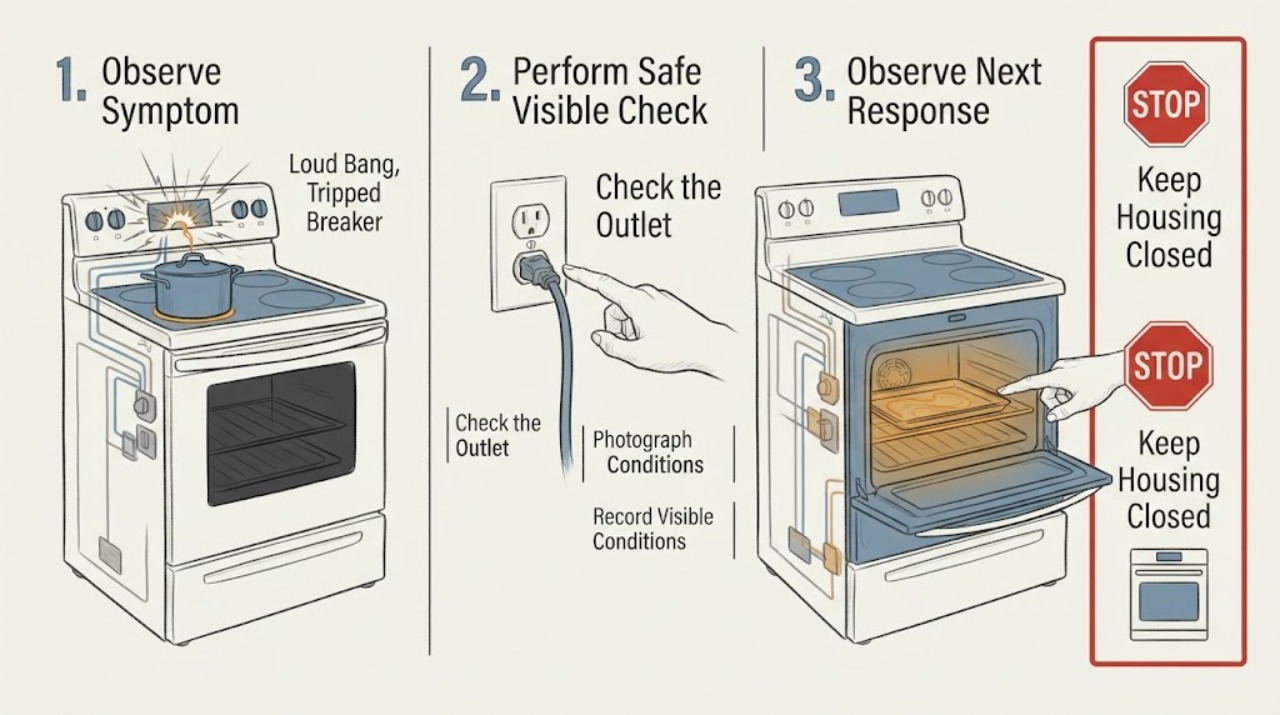
Work through in order
Diagnostic checks
Use only checks that match the exact appliance or system and its official guide.
-
Check 1
Leave the range and its circuit off after the bang and trip. From a dry, safe position, keep clear of the range and do not touch the plug, cord, terminal cover, control panel, cooktop, or any hot or wet area. If there is smoke, flame, a continuing electrical smell, glowing or melted material, sparking, or heat at the outlet or wall, leave the area as needed and contact appropriate emergency, fire, or electrical help.
Expected result: The appliance is cool and dry with no visible hazard, or any smoke, flame, burning smell, arcing, melted material, water, or hot electrical connection is present or returns.
Next step: Keep the breaker off and arrange qualified appliance service; use an electrician or emergency service for the circuit, outlet, wiring, smoke, fire, or arcing concern.
Stop if: Do not reclose the breaker, plug the range into another outlet, run a burner or oven test, or open any panel to look for the source.
Why this matters
Why: A loud bang plus a protective trip is an electrical or component safety event, regardless of what F1 means. The display going dead does not make it safe to restore power; a visible or continuing hazard takes priority over all code interpretation.
-
Check 2
Without moving or dismantling the range, photograph the rating plate and write the complete model and serial numbers, market or province, the exact F1 characters, and the sequence and timing of the cooking mode, loud bang, breaker trip, F1 display, and loss of display or oven operation.
Expected result: The plate clearly reads CPES389AC2, a suffix or character is different, the appliance identity cannot be read, or the event order is uncertain.
Next step: Give the photos and timeline to the service provider and ask them to verify the exact model documentation before interpreting F1 or naming a part.
Stop if: Do not substitute a CPES389, PLES389, or other Frigidaire range manual, code table, wiring diagram, or keypad procedure because the family name looks similar.
Why this matters
Why: F1 is documented by Frigidaire for electric ranges, but the opened model-support lookup did not provide an exact CPES389AC2 match. A different suffix, market, or display format can change the applicable manual and service information.
-
Check 3
Inspect only the household electrical panel from a dry, safe position and record that the range breaker remains tripped or was turned off after the event. Do not reset it, remove panel covers, alter wiring, use an extension connection, or move the range to another circuit; leave all electrical testing to a qualified electrician.
Expected result: The breaker is open, the breaker will not remain set, another circuit is also affected, or the panel appears normal but the range is still dead.
Next step: For breaker, outlet, or wiring concerns, arrange qualified electrical assessment. For a range-only fault with a sound circuit, have a qualified appliance technician inspect the appliance while it remains isolated.
Stop if: Do not repeatedly operate the breaker, defeat protection, replace it with a larger rating, or ask the user to take a meter reading on energized wiring.
Why this matters
Why: The trip establishes that the supply protection operated; it does not identify whether the cause was the household circuit, range wiring, a heating load, control electronics, or another component. Repeated operation can increase fire or shock risk.
-
Check 4
Treat F1 as a record for the service call, not as a confirmed failed keypad. Frigidaire's opened F1 page says it applies to electric ranges, labels F1 'Shorted Key Pad,' and describes a brief power reset for an otherwise ordinary code complaint; do not perform that reset after this bang-and-trip event.
Expected result: F1 was shown before the display died, F1 appeared only after power was disturbed, another code was also present, or the code was seen only in a report or photograph.
Next step: Provide the exact code image and timing to the qualified technician and request a system-level inspection before authorizing a part.
Stop if: Do not clear F1, enter a diagnostic mode, press hidden key combinations, unplug and replug repeatedly, or replace the keypad/control from a generic F1 guide.
Why this matters
Why: The code timing may help the technician separate a control indication from the initiating electrical event, but it cannot prove the keypad, control board, heating element, wiring, or another part is defective on CPES389AC2.
-
Check 5
From outside the appliance only, record whether the door, storage drawer, cooktop surface, knobs, cord or visible conduit, wall receptacle, and surrounding floor show impact, scorch, melted material, water, or a displaced range. Do not pull the range forward or remove the drawer, rear cover, terminal cover, or control panel to investigate.
Expected result: There is visible damage or moisture, the range appears displaced, or no external damage is visible and the display remains dead.
Next step: Photograph only from a safe distance and tell the service provider whether an electrician, appliance technician, landlord, or emergency responder also needs to assess the location.
Stop if: Do not touch scorch marks, melted insulation, loose conductors, wet areas, hot glass, or a displaced appliance, and do not attempt to restore anti-tip or wiring components yourself.
Why this matters
Why: Visible damage or moisture raises the urgency of electrical isolation but does not identify the internal failed element. No visible damage does not rule out internal wiring, control, or heating-circuit damage after a bang and trip.
-
Check 6
Prepare a service handoff with the model and serial photos, the F1 photo, breaker position, cooking mode and load, the exact sound description, whether any burner or oven function was operating, and every smell, flash, smoke, heat, or visible mark. State explicitly that the range was not re-energized after the trip.
Expected result: The provider has the exact identity and event timeline, or the model, market, circuit, and event order remain incomplete.
Next step: Keep the range off until qualified appliance and, when indicated, electrical service has inspected it and confirmed a safe return to operation.
Stop if: Do not approve a keypad, control board, element, harness, or breaker replacement solely from F1, the bang, or the number of parts that have not yet been changed.
Why this matters
Why: A complete timeline lets the provider separate a supply event from an appliance fault and avoids treating F1 as the cause. Missing identity or an unresolved circuit condition is a reason for assessment, not a reason to guess.
Use your observations
Decision map
Find the observation that best matches what you see, then follow the next safe action.
-
PATH 01Next step
What you see
Smoke, flame, electrical odor, arcing, melted material, abnormal heat, water near electrical parts, or a continuing hazard is present after the bang and trip.
Do this next
Keep clear, leave the circuit isolated if safe, and contact emergency or qualified electrical help as the situation requires; do not return the range to service.
Why this path and its safety boundary
Why it matters: This is an immediate electrical or fire-safety escalation. F1 does not lower the priority or make a reset appropriate.
-
PATH 02Next step
What you see
The breaker is open and the range is dead, with no smoke or visible damage, but the appliance has not been assessed after the loud bang.
Do this next
Keep the breaker off and have a qualified electrician assess the circuit as needed and a qualified appliance technician assess the CPES389AC2 without user live testing.
Why this path and its safety boundary
Why it matters: The protective trip and dead display are evidence of an unresolved supply or appliance event, not proof that F1's keypad label is the root cause.
-
PATH 03Next step
What you see
F1 is the only documented code, the range is otherwise an ordinary powered electric-range complaint, and there was no bang, trip, smoke, heat, or loss of display.
Do this next
For this task's event, preserve the power-off state and use F1 only as service evidence; follow any reset only when the exact model documentation and a qualified provider establish that the safety event is not present.
Why this path and its safety boundary
Why it matters: Frigidaire's public electric-range page labels F1 as a shorted keypad and gives a brief power-disconnect step, but that ordinary-code guidance does not transfer to the present bang-and-trip case.
-
PATH 04Next step
What you see
The rating plate does not clearly match CPES389AC2, the market is uncertain, or the Frigidaire lookup still has no exact model documentation.
Do this next
Ask the provider to verify the complete model, market, and service documentation before selecting a component or procedure; keep the range isolated meanwhile.
Why this path and its safety boundary
Why it matters: F1 and power behavior can vary by platform and configuration. Similar-looking CPES389 or PLES389 models are not safe substitutes for an exact wiring or reset instruction.
-
PATH 05Next step
What you see
The circuit is cleared by an electrician but the range remains dead, or the display returns and F1 or another code recurs after qualified assessment.
Do this next
Have a qualified appliance technician perform the model-appropriate de-energized and controlled diagnosis and document the failed path before replacing a part.
Why this path and its safety boundary
Why it matters: A circuit that is available does not clear an appliance fault. Recurrence after a safe supply assessment supports appliance service, but it does not select the keypad, board, element, or harness without tests performed by the provider.
Helpful context
Understand the symptom
Why F1 is not the first decision here
Frigidaire's electric-range support page assigns F1 to a shorted keypad and offers a brief power reset for an ordinary F1 complaint. That label is useful for the service handoff, but it cannot explain away a loud bang followed by a breaker trip and a dead display. Those events can involve the household supply, range wiring, a control or heating circuit, or visible damage; the exact CPES389AC2 documentation was not returned by the opened Canadian model lookup. The safe conclusion is to preserve the power-off state and obtain a qualified diagnosis, not to assume the keypad or a control board caused the event.
The exact model and the event record matter
The rating plate should be treated as the identity authority. The Frigidaire lookup page opened for this research reported that it could not find an exact match for the entered model, and Frigidaire states that product information varies by model and points owners to the matching manual. Record the model and serial information, country, display text, breaker behavior, cooking mode, and the order of the bang, trip, F1, and loss of power. Do not use a similar CPES389, PLES389, or another Frigidaire range manual as a substitute for the missing exact match.
When checks do not resolve it
Need a professional?
Contact a qualified Frigidaire appliance technician for the CPES389AC2 event and F1 record. Contact a qualified electrician when the breaker, receptacle, cord/conduit, supply wiring, or repeated protection operation is involved. Use emergency services for smoke, fire, arcing, or dangerous heat.
Safety scope: The owner's scope ends at keeping the circuit isolated, photographing the rating plate and visible condition from a safe distance, and recording the event. Do not reset the breaker, open the range, remove panels or terminal covers, probe energized wiring, bridge a keypad or interlock, or run an element/oven test after the bang and trip.
Have this ready
- Provide the complete model and serial label, market, exact F1 display photo, cooking mode and load, order and timing of the loud bang, trip, F1, and dead display, breaker position, whether burners or oven were active, any smell/smoke/flash/heat/water, and confirmation that the range was not re-energized.
Common questions
FAQ
Does F1 prove the keypad is the part that failed?
No. Frigidaire labels F1 as a shorted keypad for electric ranges, but a loud bang, tripped breaker, and dead display are a separate safety event. Keep the range off and have the exact model and circuit assessed before any part is selected.
Can I reset the breaker for 30 seconds to clear F1?
Frigidaire's ordinary F1 guidance mentions a brief power reset, but do not use that reset after this range made a loud bang and tripped the breaker. Re-energizing could repeat an electrical fault; keep the circuit isolated and obtain qualified service.
What should I photograph for the technician?
From a safe distance, photograph the rating plate, F1 display if available, breaker position, and any visible scorch, melted material, or displacement. Write down the cooking mode, exact sound, trip timing, and whether the display went dead. Do not remove covers or touch damaged parts.
Read the exact guide
Official sources
- Ranges Error Code F1 - Shorted Key PadFrigidaire · Official Frigidaire range support page opened directly; it applies to electric ranges generally and does not prove the initiating cause of the CPES389AC2 bang-and-trip event.
- Product Support and Appliance ManualsFrigidaire Canada · Official Frigidaire Canada support lookup opened with the assigned CPES389AC2 identity; the page reported that it could not find an exact match, so it is evidence of a documentation gap rather than an exact wiring or repair source.
- Oven Error Codes and Alarms GuideFrigidaire · Official Frigidaire error-code guide opened for the general reset boundary and model-manual reminder; it is not an exact CPES389AC2 service manual and does not override the bang/trip safety decision.
- Ranges | FrigidaireFrigidaire · Official Frigidaire range-support landing page opened to verify the range category, its model-specific support boundary, and the linked F1 article.
Community feedback
Share a repair observation
Share a plain-text repair observation. Accepted observations are published automatically; this page may take a moment to update.