
On this page
Start here
Quick answer
Because this range came with the home, verify the complete model suffix and the gas and electrical installation history before treating “not heating” as a failed part. The Frigidaire page that could be opened is for the related FGGF3036TW variant, not a confirmed FGGF3036TFA manual; it identifies that family as a gas range and links to model support. Confirm the rating label, controls, and visible installation history first. If there is a gas odor, delayed ignition, abnormal flame, smoke, or electrical damage, stop using the oven and leave the area if needed; do not keep trying to ignite it, open panels, or adjust gas components.
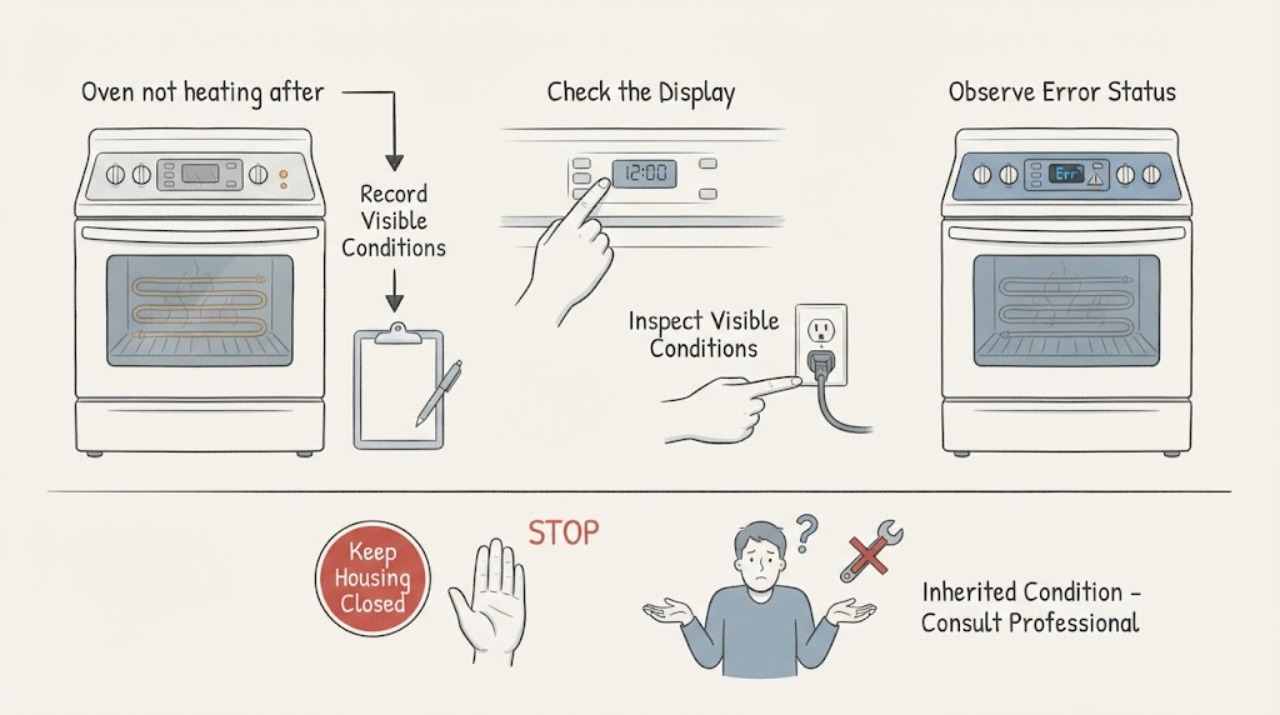
Work through in order
Diagnostic checks
Use only checks that match the exact appliance or system and its official guide.
-
Check 1
Open only the oven door or storage drawer and read the appliance rating label; confirm that it says FGGF3036TFA and record the complete suffix and serial. Gather any handover or service paperwork without removing a panel.
Expected result: The label matches FGGF3036TFA, shows a different suffix, or cannot be read; installation or repair history is known, incomplete, or unavailable.
Next step: If the suffix is not an exact match or the gas history is unknown, stop model-specific troubleshooting and arrange a qualified appliance or gas-installation check before another ignition attempt. Use the exact manual only after the identity is confirmed.
Stop if: Do not remove covers, loosen gas fittings, or try to identify a part by appearance.
Why this matters
Why: The official page that was found is for FGGF3036TW, so a suffix mismatch or missing label prevents safe transfer of its settings or parts information. An inherited appliance with unknown gas work has an additional installation uncertainty.
-
Check 2
With the cavity empty and the door closed, use the confirmed model manual to check that the display responds, no lock or setup message is active, and the normal Bake temperature-and-Start sequence was actually completed. Review the last safe attempt rather than repeatedly restarting the burner.
Expected result: The display is dead, Bake never starts, a lock or message remains, or the cycle starts and indicates preheat but the cavity stays cold.
Next step: Record the exact display message and mode. If the display is dead, inspect only the accessible breaker or fuse and arrange electrical service for damage or repeat trips; if controls run but heating does not begin, stop repeated starts and use qualified gas-appliance service.
Stop if: Do not enter service mode, remove the control panel, or attempt manual lighting.
Why this matters
Why: A control or setup problem can look like no heat; a cycle that starts but stays cold moves the question toward the gas-heating path. Frigidaire's gas-range support directs owners to model manuals and service rather than a universal button sequence.
-
Check 3
From a safe, dry, accessible position outside the appliance, note whether the range's gas shutoff is visibly closed or its status is unknown, and look for obvious cord, plug, or receptacle damage. Do not loosen a connection or adjust a regulator.
Expected result: The shutoff is closed, the gas supply status is unknown after the move, the electrical connection is damaged, or no exterior problem is visible.
Next step: For an unknown or changed gas installation, have a qualified gas-appliance professional verify the installation. For visible electrical damage or a breaker that trips again, leave the range off and use a qualified electrician; if no exterior issue is visible, continue only with the exact manual and the safe symptom branch below.
Stop if: Do not energize a visibly damaged connection, probe wiring, or alter gas supply hardware.
Why this matters
Why: A closed or undocumented supply can explain a cold gas oven without identifying an igniter or valve fault. Electrical damage is a separate safety issue even though a gas oven still needs electrical controls and ignition.
-
Check 4
If a previous safe Bake attempt was already observed, record what happened through the normal viewing path: no expected ignition, a normal flame, a delayed or abnormal flame, or an odor. Do not reproduce the attempt just to watch the igniter.
Expected result: A stable normal flame was seen, no flame appeared, ignition was delayed or abnormal, or any gas odor was noticed.
Next step: If there was no flame, delayed ignition, abnormal flame, or gas odor, turn the controls off, stop attempts, leave the area for persistent odor, and arrange qualified gas-appliance service. Do not guess or replace an igniter or valve from this observation alone.
Stop if: Never manually light the oven or continue cycling it after a failed or abnormal ignition.
Why this matters
Why: A normal flame points away from a total ignition failure and toward a preheat, temperature, or airflow complaint; no flame or abnormal ignition leaves the gas supply, ignition system, controls, and installation unresolved. A gas odor is an immediate safety signal, not a part-identification clue.
-
Check 5
If the oven is known to ignite normally and there is no odor, smoke, or electrical concern, judge heating only after the exact manual's full preheat indication with the door closed; note whether it remains cold, warms slowly, or reaches heat but cooks unevenly.
Expected result: The cavity remains cold, warms but does not reach expected heat, or reaches heat after a complete preheat but the cooking result remains uneven.
Next step: For a cold cavity or recurring heating failure, keep the oven out of service and give the technician the confirmed suffix, mode, preheat result, and prior ownership history. For a consistent temperature complaint without hazards, follow only the exact manual's calibration guidance once, then request service if it persists.
Stop if: Do not open panels or conduct electrical or gas-component tests.
Why this matters
Why: A cold cavity after a normal start is a service-level gas-heating symptom. Slow or uneven results need the exact model's rack, bakeware, door, and calibration guidance; they do not identify a failed sensor or valve by themselves.
Use your observations
Decision map
Find the observation that best matches what you see, then follow the next safe action.
-
PATH 01Next step
What you see
The rating label is not an exact FGGF3036TFA match, or gas/installation history is unknown after the home purchase.
Do this next
Obtain the exact manual and have a qualified gas-appliance professional verify the installation before further heating attempts.
Why this path and its safety boundary
Why it matters: The related TW support page cannot establish TFA-specific settings, parts, or code meanings, and an undocumented installation should not be diagnosed by repeated ignition attempts.
-
PATH 02Next step
What you see
The display and Bake controls respond, but the cavity stays cold or no normal burner flame appeared during a previous safe attempt.
Do this next
Stop using the oven and arrange qualified gas-appliance service with the model label, mode, timing, and what was observed. Do not name or order a component from the symptom alone.
Why this path and its safety boundary
Why it matters: This is no longer just a mode or preheat-setting question; the gas ignition, supply, control, and installation paths remain possible and cannot be separated safely by a homeowner.
-
PATH 03Next step
What you see
There is persistent gas odor, delayed ignition, an abnormal flame, smoke, scorching, or electrical damage.
Do this next
Turn the controls off if it is safe to do so, avoid operating switches in the affected area, leave the home for persistent gas odor or fire risk, and contact the gas utility or emergency service from a safe location. Do not return to test the oven.
Why this path and its safety boundary
Why it matters: These are safety conditions, not a normal troubleshooting branch. Continuing to operate or repeatedly ignite the range can increase risk.
-
PATH 04Next step
What you see
The exact identity is confirmed, a normal flame is known to occur, and the oven is merely slow or uneven after a complete preheat with no safety signs.
Do this next
Follow the exact Use and Care manual's preheat, rack, and calibration instructions once. If the result remains outside normal cooking performance, request qualified service.
Why this path and its safety boundary
Why it matters: This pattern is less consistent with a total ignition failure and more consistent with model-specific preheat, door, rack, bakeware, or calibration guidance; it still does not prove a component fault.
Helpful context
Understand the symptom
What the available model evidence confirms
The public Frigidaire support page available for this family is labeled FGGF3036TW, a related suffix rather than the assigned FGGF3036TFA. It describes a gas range and provides manuals and support links, but it does not prove that the TW manual, settings, or parts apply to the TFA suffix. Frigidaire says range model numbers are commonly visible on the inside oven-frame trim or at the front of the storage-drawer panel, so use the appliance label—not a listing or memory—to confirm the full identity.
Why an inherited installation changes the first check
A previous owner's settings, a closed or unknown gas shutoff, an undocumented installation change, and an earlier failed repair are all unknowns after a home purchase. Record them as uncertainty instead of assuming the igniter, valve, or control is bad. Frigidaire's owner support separates gas-range starting and gas-burner guidance from model manuals and service, so the safe path is to establish identity and visible conditions first, then hand an unresolved gas-heating symptom to qualified service.
When checks do not resolve it
Need a professional?
Arrange qualified appliance service when the exact model cannot be confirmed, the inherited gas installation or conversion history is unknown, the oven remains cold after the controls and accessible supply are checked, ignition fails or is abnormal, an error returns, or temperature remains poor after the exact manual's guidance. Use a qualified electrician for damaged supply wiring or repeat breaker trips. For persistent gas odor, leave the area and contact the gas utility or emergency service from a safe location.
Common questions
FAQ
Can I order an igniter because the oven does not heat?
No. The related official page is not a confirmed FGGF3036TFA parts source, and the same symptom can involve the mode, supply, controls, ignition, or installation. Confirm the suffix and have a qualified technician identify any part.
Should I keep trying Bake until the burner lights?
No. Do not repeat ignition attempts after a failed, delayed, or abnormal ignition. Any gas odor requires leaving the area and getting help from a safe location.
Does the FGGF3036TW page prove that my FGGF3036TFA uses the same instructions?
No. It is useful family context because it identifies a Frigidaire gas range and support path, but the suffix difference must be resolved with the appliance label and exact manual.
Read the exact guide
Official sources
- Where Can I Find My Model and Serial Number? | FrigidaireFrigidaire · Frigidaire model-label guidance for ranges; used to confirm the complete model suffix before choosing a manual or requesting service.
- What To Do If Your Gas Range Won't Start | FrigidaireFrigidaire · Frigidaire owner-support guidance explicitly scoped to gas ranges; it provides model-manual and service-support routing rather than FGGF3036TFA-specific part or code claims.
- FGGF3036TW Product Support | FrigidaireFrigidaire · Frigidaire FGGF3036TFA task identity is not verified by this page; the opened page is the related FGGF3036TW gas-range variant and is used only for family gas-range context and support/manual routing.
- Oven - Is too Hot | FrigidaireFrigidaire · Frigidaire owner-support guidance for range ovens; generic preheat and calibration context only, not proof of FGGF3036TFA-specific settings or parts.
- How To Fix Gas Burner That Won't Light or Heat | FrigidaireFrigidaire · Frigidaire owner-support guidance scoped to gas cooktops and gas ranges; used only for generic gas-ignition/service boundary, not for exact FGGF3036TFA parts.
Community feedback
Share a repair observation
Share a plain-text repair observation. Accepted observations are published automatically; this page may take a moment to update.