
On this page
Start here
Quick answer
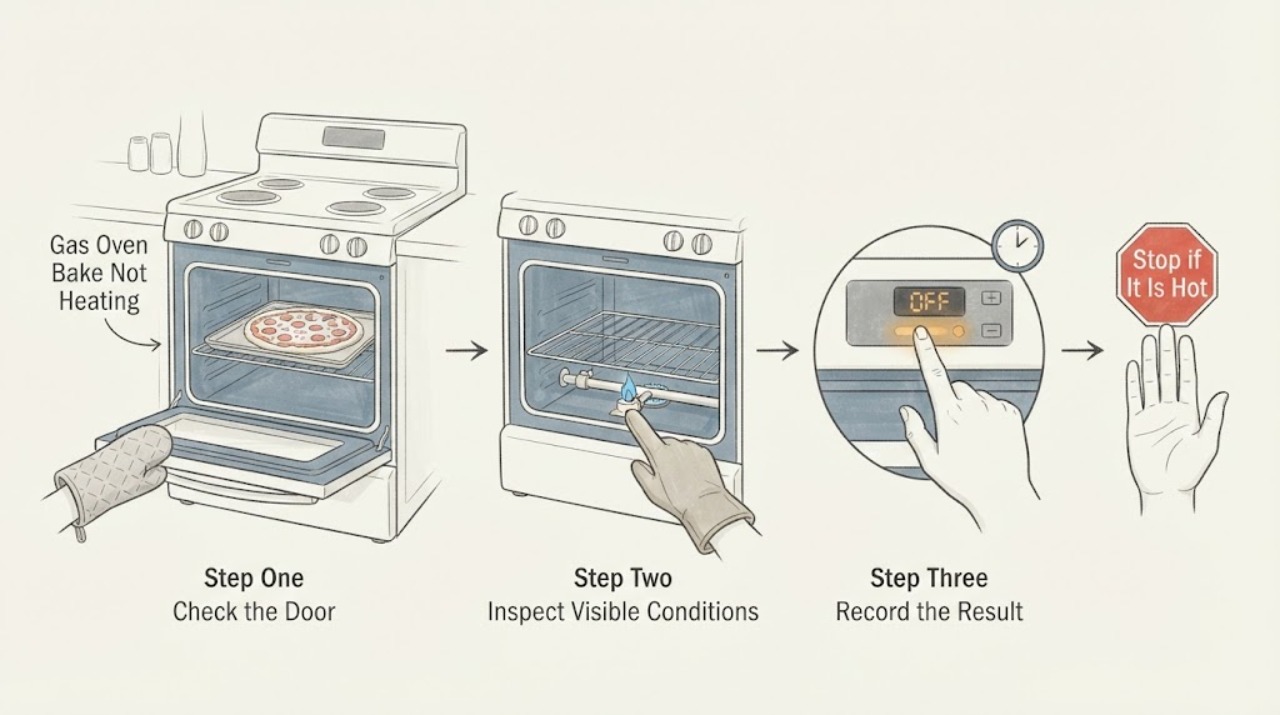
For a Frigidaire FFGF3047LSH gas oven that will not heat for pizza, first separate an unstarted or incomplete Bake cycle from a failed gas ignition. With the cavity empty and the door closed, use the exact model's normal Bake sequence and wait for its full preheat signal; do not judge by a pizza cooking slowly in a loaded oven. From a safe position, observe at most one ordinary Bake start without manually lighting or repeatedly restarting the burner. If the display will not start Bake, check the model-specific control or lock instructions. If the igniter operates but no normal burner flame appears, ignition repeatedly clicks, a flame is abnormal, or any gas odor persists, turn the oven off, leave the area without operating switches, and contact qualified gas-appliance or emergency help from a safe location. A gas smell, smoke, sparking, damaged cord, repeated breaker trip, or visible damage is a stop condition. Do not remove panels, adjust gas components, bypass an igniter or door control, or test live wiring; a qualified technician must distinguish the igniter, valve, control, supply, sensor, and wiring.
Work through in order
Diagnostic checks
Use only checks that match the exact appliance or system and its official guide.
-
Check 1
With the oven cool and empty, confirm the complete model and serial label, then use the FFGF3047LSH manual's normal Bake sequence: select Bake, set the intended temperature, start the cycle, keep the door closed, and wait for the full preheat indication before judging the pizza result.
Expected result: The display accepts Bake and indicates preheat, the cavity warms, and the oven reaches its preheat signal; or the display does not start the cycle and the cavity remains cold.
Next step: If preheat completes, use the manual's rack and bakeware guidance for the pizza. If controls do not respond or a code appears, photograph the message and stop repeated attempts; arrange service if the cycle will not start.
Why this matters
Why: A loaded pizza, early door opening, wrong mode, lockout, or an unstarted cycle can look like no heat. Failure to start Bake after the correct model-specific sequence points to a control, power, or setup issue but does not identify a gas component.
-
Check 2
Check the controls and accessible electrical supply without opening the range: note whether the display is dead, dim, locked, or showing a fault, and look for a tripped breaker, damaged cord, scorching, smoke, or water near the receptacle. Reset a breaker only once when there is no damage and it is safe to do so.
Expected result: The display is dead or locked, a breaker is tripped, the cord or receptacle is damaged, the breaker trips again, or the controls appear normal while Bake still produces no heat.
Next step: Leave the range off and use a qualified electrician or appliance technician for damage, uncertainty, or a second trip. If the display is locked or reports a fault, use only the exact manual; do not remove the control panel or probe live wiring.
Why this matters
Why: The control and ignition system need electrical power even though the range uses gas for oven heat. A single supply interruption can prevent a cycle, but a repeated trip or visible damage is an electrical hazard and not a DIY oven-heating diagnosis.
-
Check 3
If there is no gas odor, smoke, sparking, or other hazard, observe one ordinary Bake start from a safe position with the door closed; listen and look only for the expected ignition sequence and a stable normal burner flame. Do not manually light the burner, bypass an igniter, reach into the oven, or restart it repeatedly.
Expected result: The igniter operates and a stable normal flame appears; the igniter or clicking is present but no flame appears; ignition is delayed or repeatedly fails; or the flame is abnormal.
Next step: If there is no normal flame or ignition fails, turn the oven off and arrange qualified gas-appliance service. For a persistent gas odor, leave immediately without operating switches and contact gas-emergency or emergency help from a safe location; do not retry the ignition.
Why this matters
Why: A successful single start shows that this attempt ignited, not that every ignition component is healthy. Clicking or an igniter without a normal flame leaves several possible causes, including gas supply, valve, igniter, control, or wiring, which cannot be isolated safely from the outside.
-
Check 4
When there is no gas odor or other hazard, check whether a surface burner operates normally during ordinary use, without changing gas settings or attempting to repair it, and record whether the other burners and the oven share the same supply symptom.
Expected result: Surface burners operate normally while the oven fails to ignite, or multiple surface burners also fail, burn weakly, click continuously, or show an abnormal flame.
Next step: Turn all controls off and arrange qualified gas-appliance service for an oven-only ignition failure or any multi-burner symptom. If gas odor, an abnormal flame, smoke, or sparking appears, stop using the range and leave the area safely.
Why this matters
Why: Normal surface burners make a whole-house or range-wide supply problem less obvious but do not prove the oven ignition path is good. Multiple burner symptoms make supply, installation, or regulator concerns more relevant than an isolated oven conclusion.
-
Check 5
After the range is completely cool, inspect the door closure and visible gasket from outside and confirm that no rack, pan, foil, or debris prevents the door from closing normally; do not pull the gasket, remove the door, or use heat to reshape it.
Expected result: The door closes evenly and the visible gasket is continuous, or the gasket is torn, detached, flattened, missing, or blocked by an obstruction.
Next step: Remove only a loose visible obstruction. If the seal or door is damaged, stop temperature-critical cooking and arrange model-specific service; do not compensate by repeatedly raising the temperature.
Why this matters
Why: A poor seal can make an oven run cool or cook unevenly, but it cannot by itself prove that Bake has no ignition. A sound seal shifts attention back to the start sequence, gas ignition, supply, and service diagnosis.
-
Check 6
Record the result of the full empty-oven preheat and the pizza symptom separately: note whether the cavity stays cold, warms slowly, reaches temperature but cooks unevenly, or produces a code, gas odor, smoke, or burning smell. Do not use a pizza as a repeated diagnostic load.
Expected result: The cavity never warms, warms but does not reach the set point, reaches preheat but the pizza remains uneven, or an alarm or unsafe sign appears.
Next step: Give the technician the mode, preheat response, food result, code photo, and any safe surface-burner observation. Stop using the range for gas odor, smoke, sparking, burning smell, damaged cord, repeated breaker trip, or an abnormal flame.
Why this matters
Why: No heat, slow heat, and poor cooking after preheat are different service findings. Frigidaire notes that preheat, rack placement, bakeware, and model-specific calibration affect cooking results; an alarm or unsafe sign takes priority over cooking performance.
Use your observations
Decision map
Find the observation that best matches what you see, then follow the next safe action.
-
PATH 01Next step
What you see
Bake starts correctly, the empty cavity reaches its preheat signal, the door seals, and no gas or electrical warning appears.
Do this next
Use the model manual's pizza rack and bakeware guidance, keep the door closed during preheat, and monitor the next normal bake without repeatedly changing settings.
Why this path and its safety boundary
Why it matters: The original no-heat complaint may have been an incomplete preheat, early cooking judgment, rack or bakeware issue, or a one-time setup problem rather than a failed ignition part.
-
PATH 02Next step
What you see
The display will not start Bake, is locked, is dead, or a breaker trips again after one safe reset.
Do this next
Leave the range off and provide the exact model, display message, and supply observation to qualified appliance or electrical service. Do not open the control area or test live voltage.
Why this path and its safety boundary
Why it matters: The control or electrical supply is preventing a reliable heating test; a gas diagnosis should not continue until that issue is addressed.
-
PATH 03Next step
What you see
The oven ignites normally once but later warms slowly or cooks unevenly, with a sound door seal and no gas odor.
Do this next
Document the full preheat result and food pattern, then follow only model-specific calibration guidance once. Arrange service if the temperature remains wrong or ignition becomes unreliable.
Why this path and its safety boundary
Why it matters: A single successful ignition does not prove stable temperature control; preheat practice, rack/bakeware, sensing, control, or intermittent ignition may still be involved.
-
PATH 04Next step
What you see
The igniter or clicking occurs but no normal flame appears, ignition repeatedly fails, multiple surface burners are abnormal, or the flame is unstable.
Do this next
Turn all controls off and arrange qualified gas-appliance service. Do not manually light, adjust gas components, bypass safety controls, or repeat the test.
Why this path and its safety boundary
Why it matters: This is a gas-ignition or supply symptom, not enough evidence to name an igniter, valve, control, or other part from outside.
-
PATH 05Next step
What you see
A persistent gas odor, smoke, sparking, burning smell, damaged cord, water near electrical parts, repeated breaker trip, or other immediate hazard is present.
Do this next
Stop using the range, leave the area without operating switches or creating flames, and contact local gas-emergency, fire, or electrical help from a safe location.
Why this path and its safety boundary
Why it matters: The priority is life safety and preventing fire or gas exposure, not completing the pizza or troubleshooting the Bake system.
Helpful context
Understand the symptom
The FFGF3047LSH suffix identifies a gas range, but the complete model and serial label still matter: Frigidaire uses model-specific manuals and controls, and the public gas-range articles do not replace that manual. A pizza that is pale after a short or loaded preheat is not the same finding as a cavity that stays cold after a correctly started empty Bake cycle. Record the exact label and what the display, igniter, flame, and other burners do before asking for service.
A visible igniter glow or clicking sound cannot safely identify the failed part. Gas supply, the ignition sequence, the safety valve, the control, wiring, and sensing can produce similar symptoms. Frigidaire's public range guidance supports external setup and preheat checks, while internal gas and electrical diagnosis belongs to qualified service.
Because dinner is time-sensitive, protect the food plan rather than extending an unsafe test. Stop immediately for a persistent gas odor, abnormal flame, smoke, sparking, burning smell, damaged cord, or repeated electrical trip. Never try to light the oven by hand or continue cycling it to make a pizza.
When checks do not resolve it
Need a professional?
Use qualified appliance or gas service for no flame, repeated ignition failure, a persistent no-heat condition, or a recurring control fault. Use emergency gas, fire, or electrical help for persistent gas odor, smoke, sparking, damaged wiring, or repeated breaker trips.
Common questions
FAQ
Can I tell that the igniter is bad because I hear clicking or see it glow?
No. Clicking or a visible ignition attempt only describes part of one sequence. Gas supply, the valve, control, wiring, sensing, and the igniter can produce overlapping symptoms. Do not continue cycling the burner or replace a part from appearance alone.
Why does my pizza stay undercooked if Bake appears to start?
First confirm an empty, closed-door preheat completes. A loaded oven, early door opening, rack or bakeware choice, poor door seal, calibration issue, or an intermittent heating problem can affect cooking. Record whether the cavity reaches its preheat signal and arrange service if it does not.
What should I do if I smell gas while testing Bake?
Turn the oven off if it is safe to do so, do not create flames or operate electrical switches, leave the area, and contact local gas-emergency or emergency help from a safe location. Do not retry ignition or open the range.
Read the exact guide
Official sources
- Oven - Is Not Hot EnoughFrigidaire · Official Frigidaire oven guidance for poor heating results. The article is labeled for electric range and wall ovens, so it is used only for the general gasket/service boundary, not gas ignition or an exact component claim.
- How To Fix Gas Burner That Won't Light or HeatFrigidaire · Official Frigidaire gas cooktop/gas-range support article. It supports the gas-ignition safety boundary and does not establish an exact oven-part diagnosis.
- Oven - Is too HotFrigidaire · Official Frigidaire range-oven guidance: fully preheat, keep the oven empty and the door closed, and use model-specific rack, bakeware, and calibration instructions.
- What To Do If Your Gas Range Won't StartFrigidaire · Official Frigidaire gas-range support article. It routes model-specific controls and manuals rather than proving a particular FFGF3047LSH component fault.
Community feedback
Share a repair observation
Share a plain-text repair observation. Accepted observations are published automatically; this page may take a moment to update.