
On this page
Start here
Quick answer
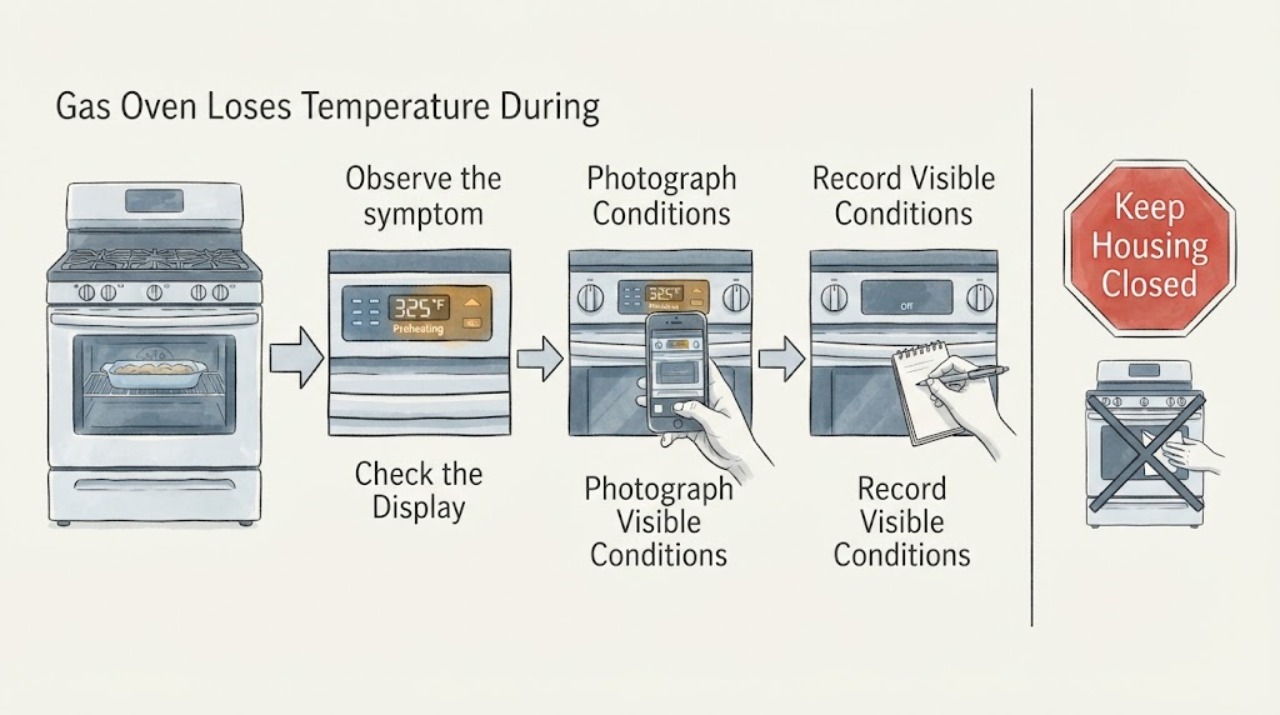
A Frigidaire FPGF3081KFM gas oven that seems to lose heat late in a long bake should not be diagnosed from one cold spot or from a single burner sound. First verify the rating-label model, the selected mode, the set temperature, the timer or automatic shutoff, door-opening history, and whether the temperature actually recovers after a normal cycle. Frigidaire's related gas-range manual says to preheat before loading, keep the oven vent unobstructed, and use the model's temperature-adjustment instructions; its product-support page identifies the closely named FPGF3081KF family and links the gas-range manual, so confirm that the final suffix on the appliance is really KFM before applying model-specific controls. Record only safe, already-observed temperatures and stop using the oven for temperature-critical cooking if it repeatedly drops and does not recover, repeatedly tries to ignite, smells of gas, makes a boom, shows an abnormal flame, smokes, or overheats. Do not manually light the burner, adjust a valve or regulator, remove the bottom panel, or perform live tests.
Before you begin
Safety first
- Do not manually light the oven, adjust a gas valve or regulator, remove the oven bottom or other panels, bypass an ignition or door safety, perform live electrical/gas tests, or continue long cooking after gas odor, boom, abnormal flame, smoke, or runaway heat.
Work through in order
Diagnostic checks
Use only checks that match the exact appliance or system and its official guide.
-
Check 1
Triage safety before collecting any more information. If there is a gas odor, ignition boom, abnormal or unstable flame, smoke, scorching, an unusually hot control area, or temperature that is running away rather than merely drifting, cancel or turn the oven off if that can be done without approaching a hazard. Leave the area for gas odor and use the local gas or emergency process from a safe location.
Expected result: No hazard is present and the issue is only a temperature complaint, or a gas/electrical/fire warning is present.
Next step: Continue only with cool, external, non-invasive checks when no hazard is present. For a hazard, keep the range off and arrange qualified gas-appliance or emergency help; do not attempt manual lighting or repeated restarts.
Stop if: Do not operate switches in a gas-filled area, relight the oven, open panels, or keep cooking to see whether the symptom returns.
Why this matters
Why: A no-hazard temperature complaint can be documented without trying to reproduce it for hours. A gas odor, boom, abnormal flame, smoke, or runaway heat changes the task from troubleshooting to immediate safe shutdown and professional response.
-
Check 2
Read and photograph the full rating-label model and serial information while the range is cool. Frigidaire says a range/stove model number is commonly along the interior oven side trim, on the left-side panel, or on the front frame of the storage drawer; compare the label with the assigned FPGF3081KFM string and the official page headed FPGF3081KF.
Expected result: The label exactly says FPGF3081KFM, says FPGF3081KF or another suffix, or cannot be read without moving or opening the appliance.
Next step: Use the exact label and serial information for the owner's manual and service request. If the label is inaccessible or inconsistent, stop at family-level safe guidance and ask a qualified provider to identify the platform.
Stop if: Do not pull the range out, remove a drawer or panel, or infer the missing suffix from a parts listing.
Why this matters
Why: The final suffix controls which manual and button behavior apply. A closely named page is not proof that a different suffix has identical temperature controls, fuel setup, or parts.
-
Check 3
Reconstruct the event from an existing bake rather than scheduling a long test. Record the selected mode, set temperature, displayed preheat indication, start and stop times, timer or delay settings, approximate door openings, rack/load changes, and when the oven first seemed cool. Note whether it recovered after the door was closed or whether the food and cavity stayed cool.
Expected result: The temperature concern follows door openings or a timer/automatic shutoff, occurs only in one mode, or persists with the door closed and no timer event.
Next step: Give the timeline to service and avoid extending or repeating a hazardous or unsuccessful cook. If there was no hazard and the oven is otherwise usable, compare only an already-observed ordinary Bake event against the exact manual, not a prolonged reproduction.
Stop if: Do not leave food cooking unattended, run repeated long sessions, or use a calibration change to conceal an unresolved drop.
Why this matters
Why: A door-open/load/mode or timed event changes heat demand and can explain a one-off dip. A repeatable drop with a closed door and no timer event is a stronger service clue, but it still does not identify a particular gas or control component.
-
Check 4
From outside the appliance and only when cool, check that the oven door closes squarely, the gasket is not torn, detached, flattened, or visibly displaced, the oven vent area is unobstructed, and cookware is not touching the door, side, or back of the cavity. Do not pull or rub the gasket and do not remove the bottom panel.
Expected result: The gasket or closure is visibly compromised, the vent is blocked, cookware restricts circulation, or the accessible seal and vent look normal.
Next step: Remove only a loose, visible obstruction without force and use the rack/load guidance in the exact manual. If the gasket, door alignment, or vent structure is damaged or uncertain, stop temperature-critical cooking and request model-specific service.
Stop if: Do not bend the door, remove the gasket, line the oven bottom, block vents, or open panels to inspect the burner.
Why this matters
Why: Heat loss or restricted airflow can make cooking look inconsistent without proving a burner or control failure. A sound visible seal and clear vent do not rule out a gas ignition, supply, sensing, or control problem.
-
Check 5
If a thermometer reading was already taken during a safe, supervised use, write down the instrument type, placement, setpoint, reading, time, door-open events, and whether the reading recovered. Use the log to compare the same mode and rack arrangement on separate observations; do not create a multi-hour test solely to obtain a number.
Expected result: The reading returns toward the setpoint after a door-open event, remains substantially low with the door closed, varies only by mode/load, or the instrument placement and timing are unknown.
Next step: Treat the log as a service clue, not a component diagnosis. If the oven repeatedly fails to recover with a closed door, stop long cooking and provide the timeline and exact model label to qualified service.
Stop if: Do not use a calibration offset to mask a persistent gas or temperature-control symptom, place a thermometer where it can contact a flame, or open the door repeatedly to chase readings.
Why this matters
Why: Recovery after a known heat-loss event is different from a persistent closed-door failure. An isolated or poorly documented reading cannot distinguish normal cycling, cookware/load effects, calibration, gas supply, ignition, sensing, or controls.
-
Check 6
Check the user-visible controls once against the confirmed model manual: ordinary Bake versus Convection or a specialty mode, the displayed set temperature, the timer/delay state, and any lockout or error message. Frigidaire's linked guide describes Bake, timed bake, PowerPlus preheat, and temperature adjustment as separate functions, so do not assume that a timed or specialty mode behaves like an uninterrupted standard Bake.
Expected result: A timer has ended, a different mode is selected, a lockout/error is shown, or the intended Bake mode and setting are already confirmed.
Next step: Correct only an obvious user-setting error using the exact manual and record the change. If the controls are correct or the error returns, stop relying on setting changes and arrange service.
Stop if: Do not enter undocumented diagnostics, repeatedly cycle the controls, alter calibration to hide the symptom, or bypass a lockout.
Why this matters
Why: A control-state difference can account for a late stop or different cooking result without naming an internal fault. If the same confirmed mode repeatedly loses temperature with no timer event, the control-state explanation is less likely and professional diagnosis becomes more useful.
-
Check 7
Prepare a service handoff instead of testing gas components. Provide the complete rating-label model/serial, fuel type if shown, the mode and setpoint, the time into the cook when the drop occurred, safe temperature readings, door/timer history, any visible seal or vent issue, and any ignition sound, odor, flame, smoke, or error observation.
Expected result: The oven is stable after a correct setup and the issue was a one-time door/timer/load event, or the drop is repeatable, unexplained, or associated with ignition or gas symptoms.
Next step: Use qualified Frigidaire/gas-appliance service for persistent loss of temperature or ignition concerns; use qualified electrical help for supply or repeated breaker concerns. Keep the oven off if any hazard occurred.
Stop if: Do not adjust the gas valve or regulator, light the burner manually, remove the oven bottom, measure live voltage, or continue long cooking while waiting for service.
Why this matters
Why: A complete timeline lets the qualified provider distinguish setup and heat-loss conditions from a gas ignition, supply, sensing, or control investigation. The symptom alone cannot select a safe replacement part.
Use your observations
Decision map
Find the observation that best matches what you see, then follow the next safe action.
-
PATH 01Next step
What you see
The temperature dip follows door opening, a large load/rack change, or a timer/automatic shutoff, then recovers with the door closed and the intended mode still active.
Do this next
Use the exact manual's preheat, rack, mode, and timer guidance, minimize door openings, and keep a short record. Do not extend cooking solely to prove the point.
Why this path and its safety boundary
Why it matters: The pattern is more compatible with a heat-loss or control-state event than with proof of a failed gas part. It is a different decision from a closed-door, no-timer temperature failure.
-
PATH 02Next step
What you see
The oven reaches preheat but repeatedly falls well below the intended temperature during a closed-door, same-mode session with no timer event and does not recover.
Do this next
Stop temperature-critical and extended cooking, preserve the event log, and request qualified gas-appliance service with the exact rating-label identity. Do not order a part from the timing pattern.
Why this path and its safety boundary
Why it matters: This is the independent long-session branch: persistence and failure to recover are more significant than one preheat result, but they do not identify the igniter, gas valve, regulator, sensor, or control board from observation alone.
-
PATH 03Next step
What you see
The issue occurs only in a specialty, convection, delayed, or timed mode, or the controls show a mode/lockout/error state that was not previously recognized.
Do this next
Confirm the full suffix and follow only the corresponding manual's user-visible mode and timer instructions once. If ordinary Bake also fails or the state returns, stop and arrange service.
Why this path and its safety boundary
Why it matters: The mode or timer branch is unresolved; the symptom is not yet evidence that the gas heating system cannot hold temperature in ordinary Bake.
-
PATH 04Next step
What you see
The gasket is visibly damaged, the door does not close squarely, the vent is obstructed, or cookware restricts the documented circulation space.
Do this next
Correct only an obvious external obstruction when cool; do not remove or reshape the gasket. Request model-specific service for a damaged seal, door alignment, or vent structure and reassess only after it is safely restored.
Why this path and its safety boundary
Why it matters: Heat loss or airflow restriction is a plausible first correction, but it does not prove that the gas control and ignition system are healthy.
-
PATH 05Safety boundary
What you see
There is gas odor, a boom, repeated failed ignition, an abnormal flame, smoke, scorching, an unusually hot area, or runaway temperature.
Do this next
Stop using the range. For gas odor, leave the area and contact the gas supplier or emergency service from a safe location; otherwise keep the oven off and arrange qualified appliance service. Do not attempt manual lighting or further tests.
Why this path and its safety boundary
Why it matters: This is an urgent gas, fire, or electrical-safety branch, not a normal long-session temperature variation.
Safety stop: No relighting, repeated restart, panel removal, valve/regulator adjustment, or live measurement.
Helpful context
Understand the symptom
The important distinction for this topic is timing. A long bake can expose a different decision than a normal preheat: did the oven merely lose heat when the door was opened, reach a timer or automatic shutoff state, or change mode, or did it fail to recover while the door stayed closed? A temperature log and the recovery pattern are more useful than guessing an igniter, valve, sensor, or control board from the symptom alone.
There is also an identity limitation. Frigidaire's official product page opened for this older range is headed FPGF3081KF, while the task label is FPGF3081KFM. Treat the page and linked gas-range guide as a closely named family reference for safe operating boundaries, but photograph the rating label and ask the provider to confirm the complete suffix before using any model-specific control sequence or ordering a part.
When checks do not resolve it
Need a professional?
Call qualified gas-appliance service for a repeatable closed-door temperature drop, repeated ignition failure, abnormal flame, or an unresolved model/platform mismatch. Use qualified electrical help for supply, cord, receptacle, or breaker concerns.
Safety scope: Do not manually light the oven, adjust a gas valve or regulator, remove the oven bottom or other panels, bypass an ignition or door safety, perform live electrical/gas tests, or continue long cooking after gas odor, boom, abnormal flame, smoke, or runaway heat.
Have this ready
- Provide the rating-label model and serial (including whether the suffix is FPGF3081KFM or FPGF3081KF), fuel type, selected mode, setpoint, preheat indication, timer/delay state, time and pattern of the temperature drop, safe thermometer readings with placement and times, door-opening/load history, gasket/vent observations, and any odor, boom, flame, smoke, or error details.
Common questions
FAQ
Is a temperature dip late in a long bake automatically a failed igniter or gas valve?
No. First separate door opening, load or mode changes, timer/automatic shutoff, and recovery behavior from a repeatable closed-door temperature loss. The observed timing can guide service, but it cannot safely identify an igniter, valve, regulator, sensor, or control board by itself.
Can I calibrate this Frigidaire oven to make up for the drop?
Only the exact model manual should define whether and how user temperature adjustment is available, and calibration should not be used to hide a persistent heating or ignition fault. If the oven repeatedly drops during a closed-door session, stop extended cooking and have it assessed.
How should I document the temperature without running the oven for hours?
Use readings that already occurred during a safe, supervised use. Record the setpoint, mode, time, thermometer placement, reading, door openings, timer state, and whether the temperature recovered. Do not create a prolonged test or repeatedly open the door just to collect numbers.
Why does the model suffix matter here?
Frigidaire's opened product-support page is headed FPGF3081KF, while the assigned identity is FPGF3081KFM. Those labels are closely related but are not interchangeable proof of identical controls or parts. Photograph the rating plate and let the provider confirm the complete suffix before using model-specific instructions.
What should I do if I smell gas or hear a boom?
Stop using the range. Do not try to light the appliance or operate switches in the area; leave for a safe location and contact the gas supplier or emergency service according to local instructions. Do not restart the oven until a qualified professional has assessed it.
Read the exact guide
Official sources
- How do I use my display or controls?Frigidaire · Opened official Frigidaire guidance applying to ranges, cooktops, and ovens. It explicitly says products vary by model and directs users to the Owner's Manual for temperature settings, timers, and lock features.
- Oven - Is Not Hot EnoughFrigidaire · Opened official Frigidaire owner-support guidance; its Applies to section is electric range and wall ovens, so it is used only for the general heat-loss/gasket and service-boundary observation, not for gas ignition diagnosis or an exact KFM conclusion.
- 316901202_C_en.p65 — Frigidaire Gas Range Use & Care GuideFrigidaire / Electrolux Home Products · Official PDF linked from the opened FPGF3081KF product-support page. It is used for family-level gas-range safety and operating behavior, including model variation caveats; the complete rating-label suffix remains the authority for exact controls.
- Where can I find my model and serial number?Frigidaire · Opened official Frigidaire identification guidance. It applies to all appliances and specifies common range/stove label locations; it is used only to obtain the complete identity before model-specific troubleshooting.
- Product Support: Frigidaire Professional 30'' Freestanding Gas Range Stainless Steel-FPGF3081KFFrigidaire · Opened official Frigidaire Canada product-support page headed FPGF3081KF. It is used to verify the closely named gas-range family, show the linked manuals, and flag that the task's trailing M suffix must be confirmed on the rating label; it is not treated as proof that every KFM control or part is identical.
- Oven - Is too HotFrigidaire · Opened official Frigidaire owner-support guidance for range ovens. It is used for full preheat, keeping the door closed during preheat, and referring to the exact Use & Care manual for any calibration; it does not define an internal gas fault for the assigned model.
Community feedback
Share a repair observation
Share a plain-text repair observation. Accepted observations are published automatically; this page may take a moment to update.