
On this page
Start here
Quick answer
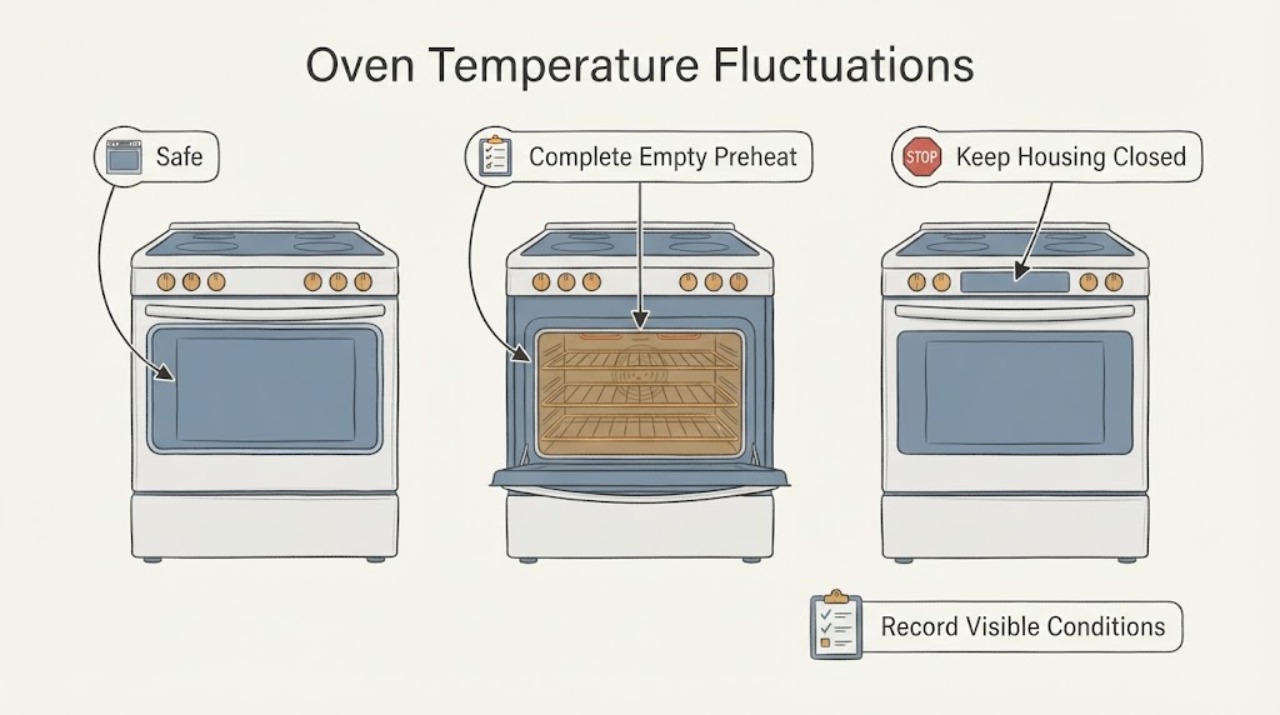
First separate normal heat cycling and an unreliable cooking setup from a real temperature fault. Frigidaire says proper preheating helps an oven reach and maintain its set temperature: preheat the empty oven with the door closed, allow the full preheat indication, and account for rack position and bakeware. Check the visible door gasket without pulling or rubbing it; a torn, detached or missing gasket can lose heat. If the oven still gives inconsistent results after the documented setup checks, temperature calibration may be needed, but Frigidaire says calibration instructions vary by model and belong in the exact Use and Care manual. Do not infer a failed sensor or control board, measure live voltage, or use the oven when it reports an over-temperature alarm, smoke, burning odor or unsafe heating; turn it off, let it cool when the official guidance calls for that, and arrange qualified service.
Before you begin
Safety first
- Limit owner checks to recording the pattern, completing a normal empty preheat, following documented rack and bakeware guidance, and visually inspecting a cool accessible gasket. Do not open the oven, touch energized wiring, measure live voltage, alter a gas component, bypass a safety control, reshape a gasket with heat, or copy calibration keys or offsets from another model.
Work through in order
Diagnostic checks
Use only checks that match the exact appliance or system and its official guide.
-
Check 1
Record the set temperature, preheat duration, ready indication, rack position, bakeware, food load, and whether the display shows a code; note whether the result is consistently high, consistently low, or changes between otherwise comparable runs.
Expected result: The variation follows preheat timing, rack or bakeware changes, a repeatable temperature offset, or an error/alarm.
Next step: Use the setup, gasket, calibration or alarm branch that matches the observation; do not name a component from the word fluctuation.
Why this matters
Why: Frigidaire treats preheat, rack placement and bakeware as contributors to cooking results, while an alarm requires its own model-scoped response.
-
Check 2
For a comparison bake, set the requested function and temperature with the cavity empty, keep the door closed, and wait for the full preheat signal before placing food inside.
Expected result: The oven reaches the ready signal and the result improves, or the same temperature problem remains after a complete preheat.
Next step: Keep the documented preheat routine and check rack/bakeware. If the repeatable problem remains, inspect the visible gasket and find the exact manual.
Why this matters
Why: Frigidaire says complete preheating helps the oven reach and maintain temperature; improvement points to setup or timing rather than proving an internal failure.
-
Check 3
Compare the rack position and cookware with the food-specific recommendations in the exact Frigidaire Owner's Manual, especially when using multiple racks or a different pan material.
Expected result: The result changes when the rack or bakeware is corrected, or it remains inconsistent with the documented setup.
Next step: Use the documented rack and pan arrangement for future tests. If the problem persists, inspect the gasket and use only model-specific calibration or service.
Why this matters
Why: Frigidaire says rack placement and bakeware can affect results even when temperature and preheat are correct; a persistent change across controlled setups needs further scope.
-
Check 4
When the oven is completely cool, visually inspect the accessible door gasket for a tear, worn section, detachment or missing piece without rubbing, pulling or reshaping it.
Expected result: The gasket is visibly compromised, or it appears continuous and seated.
Next step: Keep use limited and arrange model-matched service for a damaged gasket. If it looks intact, continue only to the exact-manual calibration or service branch.
Why this matters
Why: Frigidaire says a compromised gasket can lose heat; an intact visible gasket does not prove the heating system is sound.
-
Check 5
Read the complete model number from the appliance and use only that model's Frigidaire Use and Care manual to determine whether temperature calibration is provided and how it is performed.
Expected result: The exact manual provides a calibration procedure, or no applicable procedure can be confirmed.
Next step: Follow the exact manual only if the procedure matches the appliance. If no procedure is confirmed or the problem persists, arrange service instead of guessing an offset.
Why this matters
Why: Frigidaire says calibration instructions vary by model; a generic key sequence or offset cannot be safely transferred between ovens.
-
Check 6
If F10 or another over-temperature condition appears, turn the oven off and allow it to cool as Frigidaire directs; do not repeat a high-heat test or open the cabinet.
Expected result: The alarm clears after cooling, returns, or is accompanied by smoke, burning odor, uncontrolled heating or a gas smell.
Next step: Keep the oven off and arrange qualified service. A gas smell requires leaving the area and contacting the appropriate emergency or gas-safety service without operating electrical switches.
Why this matters
Why: Frigidaire describes F10 on standard range and wall ovens as higher-than-normal temperature and treats persistence as a support issue; added smoke, odor or gas risk raises the stop-use urgency.
Use your observations
Decision map
Find the observation that best matches what you see, then follow the next safe action.
-
PATH 01Next step
What you see
The oven was tested before the ready indication, with the door opened repeatedly, or with a changed rack or pan.
Do this next
Repeat only a controlled, empty preheat with the door closed and the manual's rack and bakeware guidance; do not adjust a calibration offset yet.
Why this path and its safety boundary
Why it matters: Frigidaire says preheat, rack placement and bakeware can change cooking results, so the test does not yet isolate a temperature fault.
-
PATH 02Next step
What you see
A complete preheat and the documented rack/bakeware setup are followed, but the result remains consistently high or low and the visible gasket is intact.
Do this next
Use the exact model's Use and Care manual for any supported calibration procedure; if none is confirmed or the issue persists, arrange Frigidaire or qualified service.
Why this path and its safety boundary
Why it matters: The setup checks no longer explain the repeatable result, but the public guidance still does not identify a failed sensor, element, control or other part.
-
PATH 03Next step
What you see
The door gasket is torn, worn, detached or missing.
Do this next
Stop trying to compensate with calibration, avoid pulling or rubbing the gasket, and arrange model-matched service or a documented replacement path.
Why this path and its safety boundary
Why it matters: Frigidaire says a compromised gasket can allow heat to escape from the cavity.
-
PATH 04Next step
What you see
The display shows F10 on a standard range oven or wall oven, or the oven rises above the set temperature in an uncontrolled way.
Do this next
Turn the oven off and let it cool. Keep it out of use and contact support if the alert returns; do not reproduce the event or open the cabinet.
Why this path and its safety boundary
Why it matters: Frigidaire identifies F10 as a higher-than-normal temperature safety alert.
-
PATH 05Next step
What you see
Smoke, burning or electrical odor, visible damage, liquid near controls, or a gas smell accompanies the temperature complaint.
Do this next
Stop using the oven. If safe, isolate power without touching wet equipment; for gas odor leave the area and contact emergency or gas-safety service from a safe location. Arrange qualified appliance service.
Why this path and its safety boundary
Why it matters: This is an immediate safety boundary rather than a baking-calibration problem.
Helpful context
Understand the symptom
Confirm that the fluctuation is real
An element or burner cycling while the oven maintains heat is not the same as a measured temperature fault. Record the set temperature, whether the problem appears during preheat or after the ready signal, the food and bakeware used, rack position, and whether the display shows an error. Frigidaire's guidance treats preheat, rack position and bakeware as part of the cooking result, so the phrase temperature fluctuation alone does not identify a failed sensor or control.
Use a complete, empty preheat
For a normal bake comparison, arrange the rack before starting, leave the cavity empty, keep the door closed and wait for the oven's full preheat indication. Frigidaire says proper preheating helps the oven reach and maintain temperature and may take up to 20 minutes. Do not keep opening the door to watch the temperature or place food in before the ready indication.
Check rack position and bakeware
Use the rack position and bakeware guidance in the exact Owner's Manual for the food being prepared. Frigidaire says rack placement and cookware can affect results even when preheat and temperature are correct, especially when baking on more than one rack. A result that changes with pan material, load or rack position is not by itself proof of a heating component failure.
Inspect the door gasket without disturbing it
With the oven cool, look around the visible gasket for a tear, worn section, detachment or missing portion. Frigidaire says a compromised gasket can allow heat loss and advises avoiding rubbing or pulling it. Do not pry the gasket out, reshape it with heat, or continue relying on calibration to compensate for a visibly compromised seal.
Use calibration only from the exact manual
If the oven still produces consistent high or low results after complete preheat, correct rack and bakeware use, and a sound visible gasket, locate the full model number and read that model's Use and Care manual. Frigidaire says calibration instructions vary by model. Do not apply a key sequence or offset from another Frigidaire oven, and do not treat calibration as a substitute for service when the oven is overheating or shows an alarm.
Stop for an over-temperature or unsafe event
If the display shows F10 on a standard range oven or wall oven, Frigidaire describes it as higher-than-normal temperature and directs the owner to turn the oven off and let it cool; persistent faults require support. Smoke, a burning or electrical odor, visible damage, an uncontrolled heat rise or a gas smell is a stop-use condition. Do not repeat a high-heat test, open the cabinet, bypass a safety control or perform live electrical checks.
When checks do not resolve it
Need a professional?
Use Frigidaire support or a qualified servicer for a persistent temperature fault, damaged gasket, recurring over-temperature alarm, unknown model-specific calibration, smoke, odor, uncontrolled heating or any suspected internal sensor, element or control issue.
Safety scope: Limit owner checks to recording the pattern, completing a normal empty preheat, following documented rack and bakeware guidance, and visually inspecting a cool accessible gasket. Do not open the oven, touch energized wiring, measure live voltage, alter a gas component, bypass a safety control, reshape a gasket with heat, or copy calibration keys or offsets from another model.
Common questions
FAQ
Are temperature swings during oven operation always a failure?
No. Frigidaire says proper preheating, rack placement and bakeware affect results, and a controlled comparison should wait for the full preheat indication. A repeatable problem after those checks needs the exact manual or service rather than a guessed component diagnosis.
Can I calibrate a Frigidaire oven with instructions from another model?
No. Frigidaire says temperature-calibration instructions vary by model. Use the complete model number and its Use and Care manual; if the procedure cannot be confirmed, arrange service instead of guessing an offset.
What should I do if my Frigidaire oven shows F10?
For standard range ovens and wall ovens, Frigidaire describes F10 as higher-than-normal temperature. Turn the oven off and let it cool, then contact support if the issue persists. Do not repeat a high-heat test or open the oven cabinet.
Read the exact guide
Official sources
- Oven - Is Not Hot EnoughFrigidaire · Official Frigidaire guidance for an oven that cannot reach or maintain heat; used for visible gasket scope, power/install-service boundary and model-specific calibration routing. The article's electrical scope is retained; no live electrical test is suggested.
- How do I improve my baking results with my Frigidaire range? Ex. My oven appears to be too hot or I have uneven temperatures.Frigidaire · Used narrowly for rack position, bakeware and the instruction to review the exact Owner's Manual when baking performance is uneven; it is not used as model-specific repair evidence.
- Oven - Is too HotFrigidaire · Official Frigidaire guidance for overheating or inconsistent oven results; used for preheat, closed-door, rack, bakeware and model-specific calibration guidance.
- Oven Error Codes and Alarms GuideFrigidaire · Used only for the explicitly displayed F10 branch on standard range ovens and wall ovens; no code is assigned when the task supplies none.
Community feedback
Share a repair observation
Share a plain-text repair observation. Accepted observations are published automatically; this page may take a moment to update.