
On this page
Start here
Quick answer
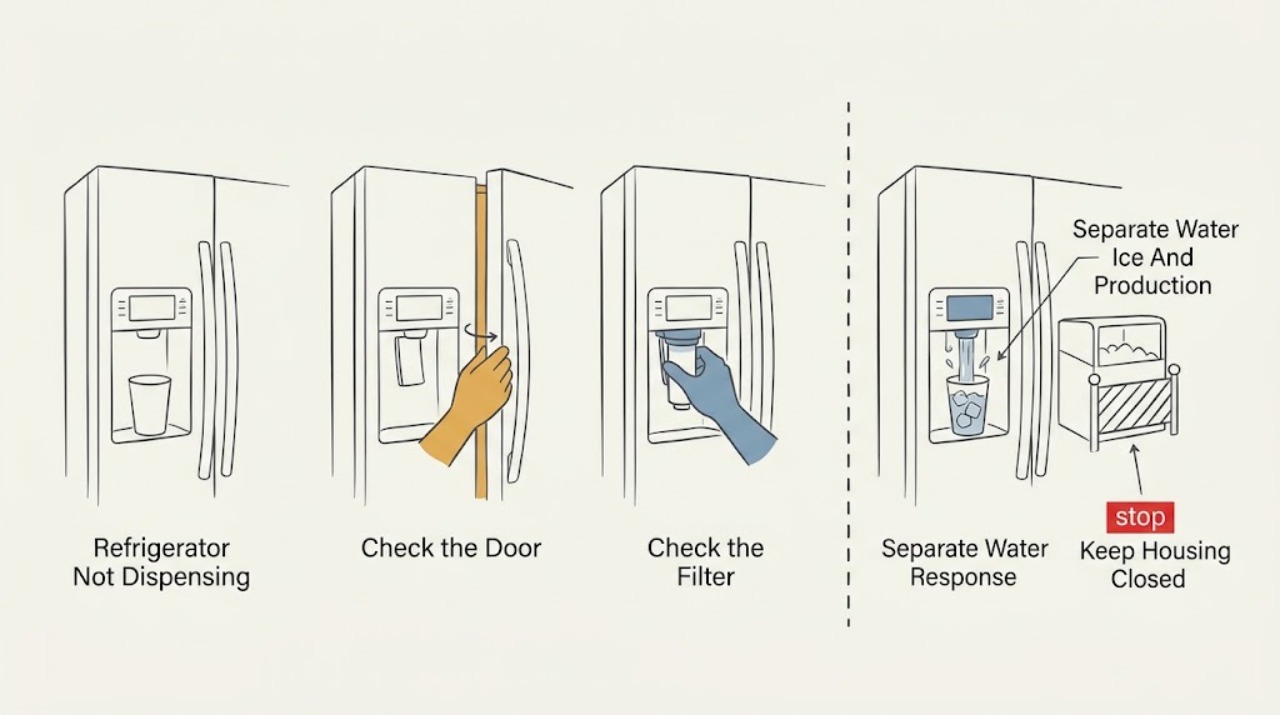
Use the symptom to choose the path: test water and ice separately, then ask whether the ice maker is still producing ice. A locked display or incompletely closed door can block both water and ice. For no or slow water, confirm the household water supply is on, the filter is seated correctly and not cracked or frozen, and whether a recently installed filter needs priming and purging; Frigidaire also says an overdue or clogged filter can stop flow. For no ice, confirm that ice is actually in the bin, the door is fully closed, the paddle was not held continuously long enough to trigger its protective shutoff, and the bin or chute is not jammed with fused ice. If the bin is empty because the ice maker is not making new ice, this is an ice-making or water-supply branch rather than only a dispenser branch. Remove and thaw an ice bin only as the exact model instructions permit, keep hands away from the auger, and do not force it. Water near electrical parts, a leak, repeated breaker or control failure, a damaged dispenser, or an internal valve, motor, wiring, or ice-maker fault requires qualified service.
Before you begin
Safety first
- The owner may make brief normal dispenser requests, check the display lock and door closure, inspect an accessible supply line, follow the exact filter and priming instructions, and remove an ice bin only as the model guide permits. Qualified personnel must handle internal water valves, tubing, door wiring, dispenser motors, controls, ice-maker mechanisms, rear covers, and live testing.
Work through in order
Diagnostic checks
Use only checks that match the exact appliance or system and its official guide.
-
Check 1
On a refrigerator that has both functions, select water and press the dispenser paddle briefly, then select ice and press it briefly. Check the ice bin before trying ice, and note whether the ice maker is producing new ice. Keep the door closed while testing ice and do not put fingers into the chute or auger area.
Expected result: Water works but ice does not; ice works but water does not; neither works; the bin contains ice; or the bin is empty and no new ice is being made.
Next step: Follow the water, ice-dispenser, or ice-maker branch that matches the observation. If both functions fail, start with the shared lock, door, power, and water-supply checks.
Stop if: Do not hold the paddle for a prolonged test, reach into moving parts, or dismantle the dispenser.
Why this matters
Why: One-function operation localizes the next check to that water or ice path. A bin full of ice with no delivery suggests the bin, chute, auger, door, lock, or dispenser drive. An empty bin with no new ice is primarily an ice-making or water-supply symptom, not proof of a dispenser motor failure.
-
Check 2
Check the dispenser display for a lock indication and use only the model's normal unlock control. Close every refrigerator door fully, then make one brief water or ice request. If the paddle had been held continuously, release it and allow the dispenser to reset before trying again.
Expected result: The display was locked; a door was not fully closed; the paddle had been held continuously; or the lock, door, and paddle state were already normal.
Next step: Unlock or close the door and make one normal request. If the same function still fails, do not keep cycling the paddle; continue with filter/supply or bin/auger checks.
Stop if: Do not defeat a door switch, hold the paddle down continuously, or open the dispenser housing.
Why this matters
Why: Frigidaire says a locked display blocks both water and ice, a completely closed door is required for ice dispensing, and a built-in shutoff stops the dispenser after three minutes of continuous use to protect the motor. If these conditions are normal but the function remains dead, move to the dedicated water or ice path.
-
Check 3
For no or slow water, verify from an accessible position that the refrigerator has power and the household water supply is turned on. Inspect only the visible supply line for a kink, then use the exact model guide to confirm the water filter is fully seated and is not cracked or frozen. If the filter was recently installed, follow Frigidaire's priming and purging procedure rather than repeatedly pressing the paddle.
Expected result: The supply is off or the line is kinked; the filter is loose, cracked, frozen, clogged, or overdue; the filter was just changed; or supply, filter, and priming appear correct but no water comes out.
Next step: Correct only an accessible supply state or reinstall/replace the exact model's filter as directed. If the filter is cracked, leaking, or the internal path remains blocked, stop and arrange qualified service; do not disconnect tubing behind the refrigerator to test flow.
Stop if: Do not use an unverified cartridge, bypass a filter safety requirement, pull on water tubing, or work on a wet connection near electrical parts.
Why this matters
Why: An off supply, restricted line, incorrectly installed/damaged filter, or air after a filter change can explain no or slow water. A correct filter and supply with persistent no flow shifts concern to an internal water path, valve, tubing, door connection, or control and cannot be proven by a user-side reset.
-
Check 4
For no ice with a bin that contains ice, stop the dispenser and follow the exact model guide to remove the ice bin. Look for cubes fused together, frost or ice in the chute, an obstruction between the ice maker and bin, or a bin that is not seated. Thaw and dry the bin only as the Frigidaire guidance permits, avoid rotating the auger while removing or replacing the bin, and never reach into the chute while the dispenser can run.
Expected result: Ice is clumped or frozen around the auger; the chute is blocked; the bin is mis-seated; the auger is misaligned; or the bin and chute are clear and correctly installed.
Next step: Clean, dry, realign, and reinstall only as the exact guide directs, then make one brief test. If the bin is clear but the motor is silent, stalls, grinds, or trips a control, arrange service.
Stop if: Do not force the auger, chip ice with a sharp tool, reach into a moving chute, or open the dispenser motor housing.
Why this matters
Why: Fused ice, a blocked chute, or a mis-seated/misaligned bin can prevent delivery even when the ice maker is producing. Frigidaire warns that an accidentally rotated auger may need model-specific realignment, and an incorrectly aligned auger can also prevent the door from closing. A clear, correctly seated bin with no auger response points toward the dispenser drive or control.
-
Check 5
If the ice bin is empty, check whether the ice-maker control is enabled for the exact model and whether the refrigerator has had time to make ice after installation, a power event, or a temperature change. Confirm the water supply and filter branch first; do not treat an empty bin as a jam. Record whether any new cubes appear in the bin after the model's normal production interval.
Expected result: New cubes are being made but not delivered; no cubes are made; the refrigerator was recently installed or filtered; or the water supply is restricted.
Next step: Use the exact ice-maker and refrigerator guide for settings and wait times. If production remains absent after the documented supply and setup checks, arrange qualified service rather than replacing dispenser parts.
Stop if: Do not force an ice-maker harvest cycle, jumper a thermostat or switch, or access fill-valve wiring.
Why this matters
Why: New cubes with no delivery returns the problem to the bin, chute, auger, door, or dispenser path. No new cubes shifts the problem to the ice maker's enable state, freezer conditions, water supply, fill system, or internal control. A new installation or filter change can require priming and several cycles before normal output.
-
Check 6
Stop dispensing and inspect only the accessible dispenser area, filter housing, floor, and visible water line for a leak, crack, frost, wet electrical area, or damage. If the refrigerator has an electrical smell, repeated control failure, a stuck or grinding motor, water near electrical components, or a damaged door/dispenser, isolate power and water only from a safe accessible point and arrange service.
Expected result: There is no visible hazard and the issue remains a normal water/ice symptom; or there is a leak, wet electrical area, damaged filter/housing, grinding motor, damaged door, or repeated electrical/control failure.
Next step: Keep the refrigerator's dispenser out of use and arrange qualified appliance service for any hazard or persistent failure. Give the technician the water-versus-ice result, bin/production state, lock/door state, filter history, and leak observations.
Stop if: Do not remove rear covers, disconnect internal tubing, probe valves, bypass door or dispenser switches, or perform live electrical tests.
Why this matters
Why: A visible obstruction can be handled only within the model's owner instructions. Water intrusion, internal valve or tubing failure, dispenser motor/control faults, and door wiring or interlock concerns exceed safe user diagnosis and can worsen with repeated tests.
Use your observations
Decision map
Find the observation that best matches what you see, then follow the next safe action.
-
PATH 01Safety boundary
What you see
Neither water nor ice dispenses on a refrigerator that has both functions.
Do this next
Check the display lock, fully close doors, verify accessible power and water supply, and inspect the filter seating. Persistent failure after those checks needs service.
Why this path and its safety boundary
Why it matters: A shared lock state, door state, power event, or water-supply problem is more likely than two independent dispenser parts. Frigidaire specifically says a locked display blocks both water and ice.
Safety stop: Do not bypass a door switch or repeatedly operate the paddle.
-
PATH 02Safety boundary
What you see
Ice can be dispensed, but water is absent or slow.
Do this next
Verify supply and filter conditions using the exact model guide. After a new filter, prime and purge. Escalate persistent no flow or any leak near electrical parts.
Why this path and its safety boundary
Why it matters: The ice-bin/auger path can operate, so focus on the water supply, filter seating/condition, filter priming, and water path. A cracked or frozen filter can block flow or cause a leak.
Safety stop: Do not pull internal tubing or test a valve live.
-
PATH 03Safety boundary
What you see
Water dispenses and the bin contains ice, but ice will not come through the door.
Do this next
Power-safe handling only: inspect and clean the bin/chute per the exact guide, avoid rotating or forcing the auger, and arrange service if a clear bin still produces no drive or produces grinding.
Why this path and its safety boundary
Why it matters: The ice maker may be fine; fused ice, a blocked chute, a mis-seated bin, an auger alignment issue, the door state, lock, or dispenser motor is more likely.
Safety stop: Do not reach into the chute, chip ice with a sharp object, or open the motor housing.
-
PATH 04Safety boundary
What you see
The ice bin is empty and no new cubes are being made.
Do this next
Check the exact ice-maker setting, water/filter supply, and installation or recent-filter context. If the maker still produces no ice after the documented wait and checks, arrange service.
Why this path and its safety boundary
Why it matters: This is an ice-making branch. An enabled state, freezer condition, water supply/filter, priming state, fill path, or ice-maker control can be involved; replacing the dispenser auger would not address the absence of ice.
Safety stop: Do not force a harvest cycle or access the fill valve or internal wiring.
-
PATH 05Safety boundary
What you see
Both selections are blocked, ice fails only with a door not fully closed, or the dispenser stopped after a long paddle press.
Do this next
Unlock the display, close the doors, release the paddle, and make one brief request. If the state returns or the dispenser remains dead, arrange service without bypassing the interlock.
Why this path and its safety boundary
Why it matters: This pattern matches a user-interface, door, or protective shutoff state rather than proving a failed valve or motor.
Safety stop: Do not defeat the lock, door switch, or continuous-use protection.
-
PATH 06Safety boundary
What you see
Water leaks, the filter housing is cracked, the motor grinds or stalls, the door/dispenser is damaged, or electrical/control symptoms repeat.
Do this next
Stop using the affected dispenser, isolate water or power only from a safe accessible control, and arrange qualified appliance service.
Why this path and its safety boundary
Why it matters: A water-path, internal valve, tubing, dispenser drive, door wiring, or control fault is more likely and is not safe to isolate by repeated dispensing or cabinet access.
Safety stop: Do not remove rear covers, disconnect internal lines, probe a valve, or live-test wiring.
Helpful context
Understand the symptom
First identify what is not dispensing
A dispenser that gives water but not ice has a different next check from one that gives neither. Test the water selection and ice selection separately, without holding the paddle continuously. Then look in the ice bin: if it is empty because no new ice is being made, troubleshoot ice production and water supply rather than repeatedly pressing the dispenser. This page applies only to a Frigidaire refrigerator model that actually has the relevant dispenser; an appliance without a dispenser has a different failure path.
Water flow is a filter-and-supply branch
Frigidaire's water guidance puts the display lock, filter seating, filter condition, household water supply, and priming state ahead of internal diagnosis. A newly installed filter can leave air in the lines; an incorrectly installed, cracked, frozen, clogged, or overdue filter can reduce or stop flow. Use the exact refrigerator guide for the filter type and replacement procedure, and do not substitute a bypass or cartridge based only on appearance.
Ice dispensing and ice making are not the same fault
If the ice maker is producing ice but the door will not deliver it, concentrate on the bin, chute, auger, door closure, lock state, and the dispenser's protective shutoff. Frigidaire says infrequent use, temperature changes, or a power outage can allow ice to melt and refreeze around the auger. If the bin stays empty and the ice maker is not refilling, move to the ice-maker branch; do not buy an auger or dispenser motor until the production and supply symptoms are separated.
Safety boundary
Stop conditions
- Stop dispensing for a leak, cracked filter or housing, water near electrical parts, electrical smell, repeated breaker/control failure, damaged door/dispenser, grinding or seized motor, or any exposed wiring.
- Do not bypass a display lock, door switch, ice-maker control, or dispenser protection; do not hold the paddle continuously to force operation.
- Do not remove rear covers, disconnect internal tubing, probe a water valve, access wiring, or perform live electrical tests; internal valves, motors, controls, and ice-maker repairs require qualified service.
- Remove or thaw an ice bin only under the exact model instructions; keep hands and tools out of the chute and do not force or rotate the auger.
Only after diagnosis
Potential parts
- water filter cartridge
Consider only when the exact model guide identifies the filter as overdue, clogged, cracked, frozen, or incorrectly seated and the filter path matches the symptom.
Filter type and fit vary by refrigerator model; verify the complete model and Frigidaire's fit information before ordering. - ice-bin or auger assembly
Consider only after the bin has ice, the chute is clear, the bin is seated/aligned, and qualified diagnosis identifies a damaged or non-driven auger assembly.
Bin and auger geometry varies by refrigerator architecture; do not order from a no-ice or empty-bin symptom alone.
When checks do not resolve it
Need a professional?
Arrange qualified appliance service when water and ice remain unavailable after the accessible lock, door, power, supply, filter, priming, and bin checks; when an ice maker produces no cubes after the model's documented setup period; or when the dispenser motor, valve, control, door wiring, or tubing is suspected. Stop immediately for leaks, water near electrical parts, repeated electrical failure, a damaged dispenser or door, grinding, smoke, or exposed wiring.
Safety scope: The owner may make brief normal dispenser requests, check the display lock and door closure, inspect an accessible supply line, follow the exact filter and priming instructions, and remove an ice bin only as the model guide permits. Qualified personnel must handle internal water valves, tubing, door wiring, dispenser motors, controls, ice-maker mechanisms, rear covers, and live testing.
Common questions
FAQ
Why do neither water nor ice dispense from my Frigidaire refrigerator?
Check the display lock, fully close the doors, and verify accessible power, household water supply, and filter seating. A locked display can block both water and ice. If both remain unavailable after the model's safe checks, arrange service rather than bypassing a door or dispenser control.
What if my Frigidaire refrigerator dispenses water but not ice?
Check whether the ice bin actually contains ice and whether the ice maker is still producing new cubes. If the bin is full, inspect for clumped ice, a blocked chute, a mis-seated bin, or auger alignment under the exact model instructions. If the bin is empty because no ice is being made, use the ice-maker and supply branch instead.
Can a Frigidaire water filter stop the dispenser?
Yes. Frigidaire says a filter that is incorrectly seated, clogged, cracked, frozen, or overdue can cause slow or absent water flow. A recently installed filter can also leave air in the lines, so follow the official priming and purging procedure. Confirm the exact filter for the model before replacing it.
Why is there ice in the bin but nothing comes out?
The ice may be fused around the auger, blocked in the chute, or the bin may be mis-seated or misaligned. Frigidaire advises removing and drying the bin under the model instructions and avoiding auger rotation during removal or replacement. Do not force ice or reach into a moving dispenser; a clear bin with no drive needs service.
Does a newly installed Frigidaire refrigerator need a water-dispenser purge?
Frigidaire says air can remain in new plumbing and cause uneven water flow or empty ice-maker cycles. Prime and purge with the official pitcher-and-paddle procedure, and use the exact model guide for the required discard amount. If flow remains absent, stop and arrange service.
When should I stop troubleshooting a Frigidaire refrigerator dispenser?
Stop for a leak, cracked filter or housing, water near electrical parts, damaged door or dispenser, grinding or seized motor, repeated electrical/control failure, or exposed wiring. Do not remove rear covers, disconnect internal tubing, probe a valve, or bypass a door or dispenser switch; arrange qualified service.
Read the exact guide
Official sources
- Refrigerators - No WaterFrigidaire Owner Center · Applies to Frigidaire refrigerators with a water dispenser; model-specific filter and water-line arrangements still govern.
- What should I do if my ice maker is not making enough ice in my refrigerator?Frigidaire Owner Center · Applies to Frigidaire refrigerators with an ice maker; exact freezer controls and production features vary by model.
- What should I do if the dispenser on my refrigerator is not dispensing ice?Frigidaire Owner Center · Applies to Frigidaire refrigerators, including French-door, side-by-side, and top-freezer models with an ice dispenser.
- Refrigerator Prime and Purge GuideFrigidaire Owner Center · Applies after installation or a new water filter on Frigidaire refrigerators with a water dispenser and ice maker.
- Refrigerators - Auger FixFrigidaire Owner Center · Applies only to Frigidaire refrigerator configurations covered by the auger-fix procedure; use the exact model guide before attempting it.
- What should I do if the dispenser on my refrigerator is not dispensing water?Frigidaire Owner Center · Applies to Frigidaire refrigerators, including French-door, side-by-side, and top-freezer models with a water dispenser.
Community feedback
Share a repair observation
Share a plain-text repair observation. Accepted observations are published automatically; this page may take a moment to update.