
On this page
Start here
Quick answer
A Frigidaire refrigerator does not have one universal user-accessible drain layout, so first identify where the water is visible: inside under drawers or on a shelf, at the bottom of the cabinet, under the appliance, or on the floor behind it. A brief drip or running-water sound during an automatic defrost cycle can be normal because Frigidaire describes water entering a non-removable drain pan; visible water that does not stay contained is a separate symptom. Check that doors close and the gasket seals, because warm air and frost can send meltwater to the bottom. For a refrigerator with an ice maker or dispenser, inspect only visible water connections, the filter housing, and the floor around the appliance for a supply leak. Dry the area, protect nearby electrical parts, and follow the exact model manual for any accessible pan or drain opening. Do not poke a hidden tube, use compressed air, pour chemicals, remove an evaporator cover, or make a live test. If water repeatedly returns, comes from behind a panel, reaches wiring or an outlet, or is accompanied by frost, a damaged seal, or a cooling problem, leave the refrigerator out of service as needed and arrange qualified model-specific service.
Before you begin
Safety first
- Do not remove covers, chip or heat frost, probe or flush a hidden drain, use chemicals or compressed air, disconnect pressurized tubing, live-test wiring, or restore power to wet electrical parts.
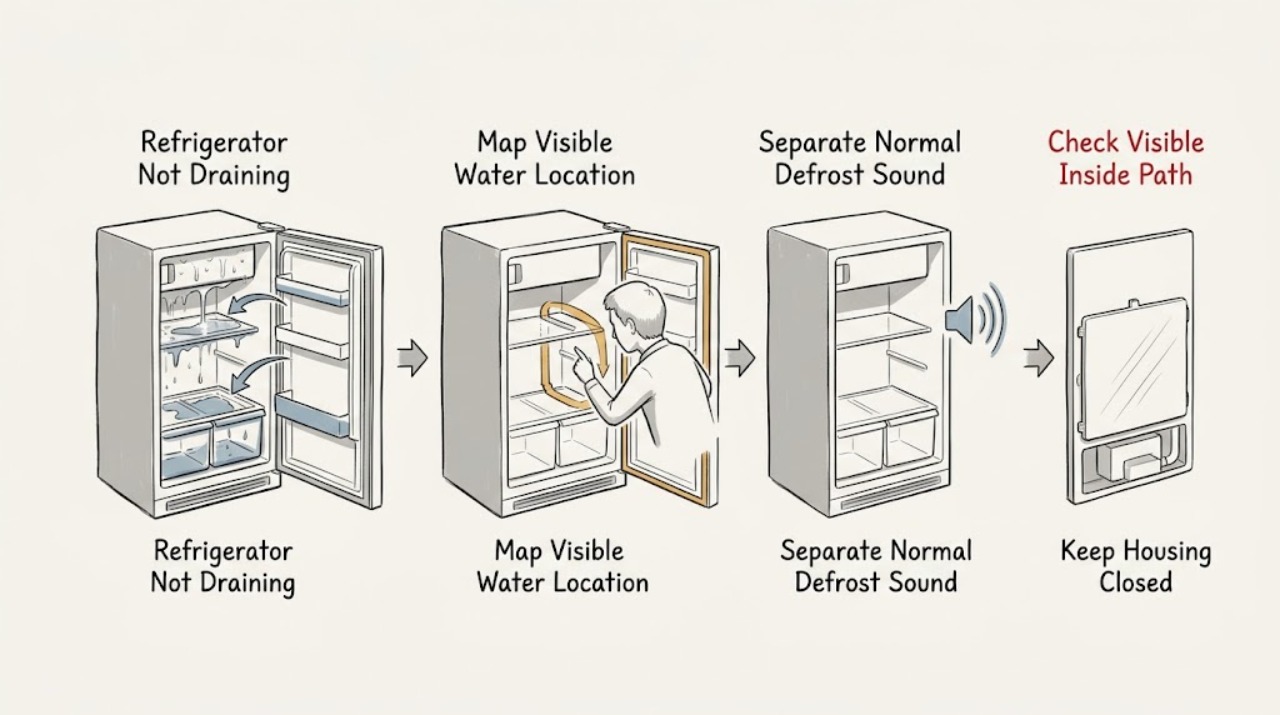
Work through in order
Diagnostic checks
Use only checks that match the exact appliance or system and its official guide.
-
Check 1
With the refrigerator and nearby dispenser functions off, wipe the visible water and identify the first wet location: under a crisper or shelf, at the cabinet bottom, under the appliance, at a rear water connection, or near the door or ice-maker area. Note whether the water appears only during defrost or while the unit is idle.
Expected result: The water is inside under food drawers, outside on the floor, at a visible water connection, or there is only a brief defrost drip sound with no pool.
Next step: Follow the matching branch and photograph the first wet point. Do not pull panels or move the appliance through water merely to search for a hidden tube.
Stop if: Stop immediately if water is near a lamp, control, plug, outlet, wiring, or other electrical part, or if there is smoke, burning odor, sparking, heat, or a repeated trip.
Why this matters
Why: The location separates a visible condensation/defrost path from an external supply leak or a normal defrost-pan sound. A sound without escaping water does not establish a blocked drain.
-
Check 2
Listen only from outside the cabinet for a brief dripping or running-water sound during an automatic defrost period, while checking whether water remains contained. Do not open a panel to watch the defrost assembly.
Expected result: There is a brief sound with no visible water, or there is a recurring pool, overflow, or wet cabinet despite the sound stopping.
Next step: Monitor a contained sound without dismantling the appliance. For a recurring pool or overflow, continue with door/frost and visible supply checks, then arrange service if the source is not accessible.
Stop if: Do not remove the non-removable pan, insert a tool into a drain opening, use chemicals or compressed air, or reach near a defrost heater or fan.
Why this matters
Why: Frigidaire describes water entering a non-removable drain pan during defrost as a possible normal sound. A visible pool or overflow is not explained by sound alone and needs a model-specific path.
-
Check 3
For water inside under drawers or on a shelf, remove only food and an easily removable drawer as the exact manual shows, then wipe and inspect the visible floor, seams, and accessible drain opening if the manual identifies one. Do not probe beyond what is plainly accessible.
Expected result: Water is confined to a visible surface, returns from an inaccessible seam or opening, is accompanied by frost, or the visible interior is dry after wiping.
Next step: Clean only the accessible area using the manual's method and keep food away from standing water. If water returns or access requires a panel, stop and request model-specific diagnosis.
Stop if: Do not pour water into a drain, insert wires, needles, or tools, remove liners, chip frost, or apply direct heat.
Why this matters
Why: A visible surface or frost pattern can be documented without claiming a hidden tube is blocked. Water returning from behind a liner or panel requires service; a dry cabinet shifts attention to an external supply path or an intermittent defrost event.
-
Check 4
Inspect that the refrigerator and freezer doors close fully and that the visible gasket has no food obstruction, gap, warp, crack, or heavy frost around its edge. Check visible vents for blocked food placement without removing a cover.
Expected result: A door does not seal, frost is concentrated at the door or a cold-air path, vents are blocked, or the visible seal and airflow look normal.
Next step: Remove only an accessible obstruction and clean the gasket as the manual permits. Arrange service for a damaged seal, recurring frost, or frost behind an inaccessible cover.
Stop if: Do not force a gasket, chip ice, use a heat gun or hair dryer, or remove an evaporator or fan cover.
Why this matters
Why: Frigidaire connects poor sealing, very low settings, and blocked airflow with frost; frost can later melt or redirect water to the cabinet bottom. A normal visible seal does not rule out an internal drain or defrost fault.
-
Check 5
Only for a refrigerator with an ice maker or water dispenser, inspect visible water lines, filter housing, valve area, and the floor behind the appliance with a dry paper towel; do not disconnect tubing or pull a built-in refrigerator out through standing water.
Expected result: A visible connection or filter area is wet, the floor is wet behind the unit, there is no water-supply feature, or all accessible connections are dry.
Next step: Stop the water supply at its accessible shut-off only if it can be done safely, wipe up water, and arrange installation or appliance service for a wet connection. Do not tighten unknown fittings or replace a filter without model-specific instructions.
Stop if: Do not disconnect pressurized tubing, handle water near energized parts, or continue using the appliance when a supply leak reaches the electrical area.
Why this matters
Why: Frigidaire distinguishes water leaking from outside connections or the water valve from inside frost and filter-related leaks. A wet supply path is not a refrigerator drain blockage, and dry visible connections do not rule out a concealed fitting or internal fault.
-
Check 6
If water returns after the visible surface, door-seal, frost, and accessible supply checks, record the model, first wet location, timing, defrost relationship, ice/dispenser configuration, frost pattern, and any electrical symptom for service.
Expected result: The water stops after an accessible correction, returns with no visible source, overflows at the cabinet bottom, or enters behind a panel or electrical area.
Next step: Arrange qualified Frigidaire or appliance service and leave the refrigerator off when water is near electrical components. Provide the exact model and the documented location rather than asking for a generic drain repair.
Stop if: Do not open panels, make live measurements, force defrost, use chemicals or compressed air, or improvise a drain path.
Why this matters
Why: Recovery after clearing a visible obstruction or correcting a seal supports an external cause. Persistent or concealed water makes an internal drain, pan, defrost, liner, or supply fault more likely, but the observation cannot identify a safe replacement part.
Use your observations
Decision map
Find the observation that best matches what you see, then follow the next safe action.
-
PATH 01Safety boundary
What you see
A brief dripping or running-water sound occurs during defrost but no water escapes into the cabinet or onto the floor.
Do this next
Monitor without dismantling the appliance. Reclassify the problem if a pool, overflow, frost, or floor leak appears.
Why this path and its safety boundary
Why it matters: Frigidaire describes water entering a non-removable drain pan during defrost as a possible normal sound, so there is no observable evidence of a drain failure yet.
Safety stop: Do not remove the pan or probe a hidden drain.
-
PATH 02Safety boundary
What you see
Water pools under drawers or at the cabinet bottom, especially after visible frost, a door that did not seal, or food blocking a vent.
Do this next
Correct only an accessible door or food obstruction and follow the manual for visible cleanup; arrange service when water returns or access requires a cover.
Why this path and its safety boundary
Why it matters: Warm-air entry, frost and meltwater, or blocked airflow is more likely than a water-supply leak, but an inaccessible drain or defrost fault remains possible.
Safety stop: Do not chip frost, apply direct heat, or insert anything into a hidden drain.
-
PATH 03Safety boundary
What you see
Water starts at a visible filter housing, water line, valve area, or the floor behind a refrigerator with an ice maker or dispenser.
Do this next
Stop the accessible water supply if safe, keep water away from electrical parts, and arrange installation or appliance service; do not disconnect tubing or guess at a fitting.
Why this path and its safety boundary
Why it matters: A supply-side leak is more likely than condensate that is not draining.
Safety stop: Stop using the appliance for water near wiring, outlets, plugs, controls, or lamps.
-
PATH 04Safety boundary
What you see
The cabinet is dry but water is on the floor, under a built-in unit, or entering from a wall or cabinet above; no visible refrigerator drain path is wet.
Do this next
Document the path, keep water away from the refrigerator's electrical parts, and have the installer, plumber, or qualified technician trace the upstream source.
Why this path and its safety boundary
Why it matters: The refrigerator may only be the lowest visible point, and a building, supply, or neighboring-appliance leak is more likely than an internal drain problem.
Safety stop: Do not move a heavy or built-in refrigerator through water or work around an energized wet outlet.
-
PATH 05Safety boundary
What you see
Water repeatedly returns with normal door sealing and clear accessible surfaces, or begins behind a liner, pan, cover, control, or other inaccessible area.
Do this next
Leave the refrigerator out of service as needed and arrange qualified model-specific service with the exact wet location and timing.
Why this path and its safety boundary
Why it matters: An internal drain, pan, defrost, liner, or control-area fault becomes more likely, but there is no safe universal hidden-tube procedure for an unspecified model.
Safety stop: Do not open panels, live-test components, use chemicals or compressed air, or improvise a drain outlet.
Helpful context
Understand the symptom
“Not draining” is a symptom, not a universal refrigerator part
Refrigerators normally collect some condensate and defrost water, but the accessible arrangement differs by model. A sound of water during defrost is not the same as water pooling inside or reaching the floor. Record the first visible wet point, whether it occurs during defrost or after a door has been open, whether the unit has a water dispenser or ice maker, and whether frost is visible before attempting any cleanup.
Start with the visible destination of the water
Water under a crisper, on a shelf, at the cabinet bottom, or on the floor behind the refrigerator does not identify the same cause. Frigidaire's leak guidance directs owners to distinguish outside water connections, inside filter or ice-maker areas, and water associated with frost. Trace only the visible path with the appliance safe and dry; do not assume that a wet floor means a blocked hidden drain.
Defrost sounds can be normal while a pool is not
Frigidaire describes a non-removable drain pan that can receive water during an automatic defrost cycle. That supports a normal explanation for a brief dripping or running-water sound when no water escapes the cabinet. A recurring pool, overflowing pan, water under food drawers, or water on the floor needs a location-based inspection and, when the accessible checks do not resolve it, model-specific service; this page does not prescribe a generic hidden-tube cleaning method.
Keep water and electrical work separate
Switch the refrigerator and nearby dispenser functions off before wiping visible water. If water reaches a lamp, control, wiring, plug, or outlet, do not restore power to see whether it dries. Do not remove covers, chip frost, apply direct heat, probe a drain heater, use compressed air, or bypass a door switch. Stop and arrange qualified help for persistent water, active leakage, a burning odor, smoke, sparks, damaged insulation, or repeated electrical trips.
When checks do not resolve it
Need a professional?
Arrange qualified Frigidaire or appliance service for recurring pooling, overflow, concealed water, frost that returns, a damaged door seal, a wet supply connection that cannot be safely corrected, or any diagnosis requiring internal access. Stop using the refrigerator immediately for water near controls, lamps, wiring, plugs, or outlets, or for smoke, burning odor, sparks, unusual heat, damaged insulation, or repeated electrical trips.
Safety scope: Do not remove covers, chip or heat frost, probe or flush a hidden drain, use chemicals or compressed air, disconnect pressurized tubing, live-test wiring, or restore power to wet electrical parts.
Have this ready
- Exact model, first wet location, whether the unit has an ice maker or dispenser, timing relative to defrost or door opening, frost and gasket observations, visible supply-line result, and any electrical symptom.
Common questions
FAQ
Is it normal to hear water dripping inside a Frigidaire refrigerator?
A brief dripping or running-water sound during automatic defrost can be normal because Frigidaire describes water entering a non-removable drain pan. Visible water pooling inside or reaching the floor is different and needs a location-based check.
Where should I look when water pools under my refrigerator drawers?
Record the first wet point, then check the visible drawer floor, frost pattern, door seal, and accessible airflow path without removing panels. Frigidaire links frost with poor sealing, very low settings, and blocked airflow; recurring water behind a liner or from an inaccessible opening needs service.
Can I unclog a Frigidaire refrigerator drain with a wire or compressed air?
Not as a generic procedure. Drain layouts and access differ by model, and pushing a tool or air into a hidden tube can damage the liner or redirect water toward electrical parts. Use only a clearly documented accessible check in the exact manual and arrange qualified service otherwise.
Read the exact guide
Official sources
- Refrigerators / Freezer - Frost Build UpFrigidaire · Frigidaire refrigerators
- Refrigerator Water LeaksFrigidaire · Frigidaire refrigerators
- Service & RepairFrigidaire · Frigidaire appliance service requests and qualified diagnosis
- Refrigerators Noise GuideFrigidaire · All Frigidaire refrigerators
Community feedback
Share a repair observation
Share a plain-text repair observation. Accepted observations are published automatically; this page may take a moment to update.