
On this page
Start here
Quick answer
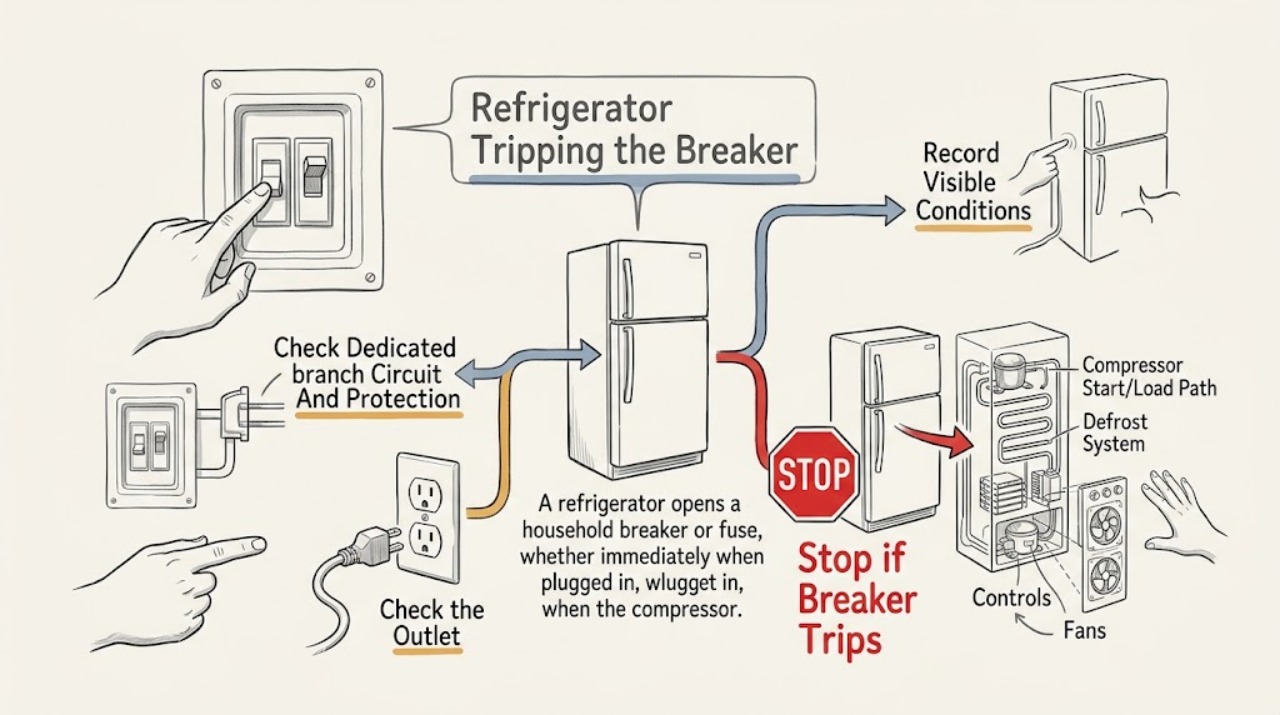
Treat every repeated breaker trip as a stop-use event and do not keep resetting it to see whether the refrigerator starts. First record the timing: immediately when the plug is inserted, when cooling or another function starts, or after the refrigerator has run for a while. From a dry, safe position, check the plug and cord for visible damage, identify whether the outlet is dedicated, and confirm the breaker/fuse rating and grounding arrangement only from the home's accessible panel or installation information. Frigidaire says refrigerators should use an individual, properly grounded 115/120-volt branch circuit with a 15- or 20-amp breaker or time-delay fuse, and recommends checking the outlet with another appliance when the unit has no power. Do not install a larger breaker, defeat protection, use an extension cord, or move a built-in refrigerator while wet. If the trip follows the refrigerator even on a correct dedicated supply, or happens at startup or during operation, an appliance-side start, compressor, defrost, fan, control, or wiring fault is possible and requires qualified service. Do not open panels or perform live electrical tests.
Before you begin
Safety first
- The user may observe the display, plug, cord, dry accessible outlet, household breaker/fuse, circuit labeling, and symptom timing from a safe position. A qualified electrician must handle circuit/protection/receptacle work, and qualified appliance service must handle internal power entry, compressor/start, defrost, fan, control, water-valve, wiring, and live testing.
Work through in order
Diagnostic checks
Use only checks that match the exact appliance or system and its official guide.
-
Check 1
Stop using the refrigerator after a repeated trip. From a dry, safe position, note whether the breaker opens when the plug is inserted, when cooling or another function starts, or after the unit has run for a period. Look only for smoke, burning odor, a hot or damaged cord/plug, water near electrical parts, arcing, or exposed damage.
Expected result: There is smoke, odor, heat, arcing, water near electrical parts, or damage; the trip is immediate; the trip occurs at startup; or the trip occurs later during operation.
Next step: If a hazard is present, isolate power only from a safe location and keep the unit out of service. Otherwise leave the refrigerator unplugged or switched off at its circuit and continue only with dry, accessible supply observations.
Stop if: Do not reset the breaker repeatedly, reconnect to reproduce the timing, touch a hot/damaged cord, or operate with smoke, odor, arcing, water, or exposed damage.
Why this matters
Why: A hazard requires immediate isolation and service. Immediate, startup, and running trips are different symptom patterns, but none identifies a user-replaceable part. A trip after operation can involve a load that appears only after cooling, defrost, fan, or another model feature is active.
-
Check 2
With the refrigerator disconnected and the area dry, identify the refrigerator breaker or fuse and read the home's accessible circuit labeling and installation information. Check whether the refrigerator is on an individual, properly grounded branch circuit and whether other loads share it. Do not change the breaker or fuse rating, open the receptacle, or defeat GFCI or other protection.
Expected result: The circuit is shared or not clearly identified, the breaker/fuse rating does not match the installation information, protection trips with the refrigerator disconnected, or the circuit appears correctly dedicated and protected.
Next step: Have a qualified electrician correct or assess a questionable circuit or protection device. Do not substitute a larger breaker or fuse. If the supply is correct and the refrigerator is the only trigger, keep it disconnected and arrange appliance service.
Stop if: Do not increase breaker capacity, replace a fuse with a larger one, bypass a protective device, share the circuit as a workaround, or perform panel/receptacle work unless qualified and authorized under local requirements.
Why this matters
Why: A shared, incorrectly protected, or household-tripping circuit is an electrical installation problem and does not prove a refrigerator component failure. A correct dedicated circuit that holds without the refrigerator but trips when it is connected shifts suspicion toward the appliance or its cord.
-
Check 3
From outside the appliance, inspect the accessible plug and power cord for cuts, crushed insulation, looseness, discoloration, or heat marks. If the outlet is dry and safely accessible, check it with a small known-good appliance as Frigidaire recommends; do not use the refrigerator's cord as a test lead and do not use an extension cord. Stop if the outlet or cord is damaged.
Expected result: The outlet will not power another appliance, the plug/cord is damaged or hot, the outlet works but the refrigerator trips it, or no external damage is visible.
Next step: Have an electrician assess a failed outlet and leave a damaged cord or refrigerator disconnected. If the outlet and cord are sound but the refrigerator trips the circuit, do not reconnect it for another test; contact qualified appliance service.
Stop if: Do not tape a damaged cord, replace the cord without model-specific service instructions, open the plug or receptacle, or continue plugging in a unit that trips protection.
Why this matters
Why: A failed outlet or damaged cord is an external electrical hazard. A working outlet with the refrigerator as the repeatable trigger makes an appliance-side fault more likely, even if lights or controls previously worked.
-
Check 4
Without deliberately restarting a tripping refrigerator, use the symptom history to classify what was happening at the moment of the trip: immediately on connection, as cooling/compressor sound began, during or after a defrost interval, when an ice maker or dispenser function was used, or after prolonged operation. Record display/light state and any PF or power-failure indication without opening panels.
Expected result: The trip is tied to connection, compressor/cooling startup, defrost or fan operation, an ice-maker/dispenser event, or a delayed/recurring running period.
Next step: Keep the refrigerator out of service and give the timing, model, feature configuration, and PF history to qualified service. A power outage or surge may explain a PF indication, but a recurring trip still requires the circuit and appliance to be assessed.
Stop if: Do not run a deliberate defrost, ice-maker, compressor, or dispenser test, remove a rear cover, bypass a control, or probe wiring.
Why this matters
Why: Connection timing makes the cord, supply entry, or an immediate appliance fault more likely. Startup timing makes a compressor-start or control/load event possible. A later or feature-specific trip can involve defrost, fan, ice-maker, water-valve, or control loads. These are service clues, not permission for live testing.
-
Check 5
Write down the exact model, circuit observations, cord/outlet condition, trip timing, whether the refrigerator has an ice maker or dispenser, recent outage/surge, and any food-temperature impact. If the circuit is correct but the refrigerator causes a trip, or protection trips again after one safe restoration, leave it disconnected and schedule service.
Expected result: An electrician identifies a supply problem, the refrigerator no longer trips after a documented supply correction, the refrigerator alone repeatedly opens a correct circuit, or the cause remains unknown.
Next step: Use a qualified electrician for the branch circuit and qualified Frigidaire/appliance service for a refrigerator-side trip. Keep the water supply closed if a connected unit also leaks, protect food, and provide the technician with the timing record.
Stop if: Do not replace a relay, overload, control, fan, heater, valve, cord, or breaker based only on the trip; do not open panels or perform energized diagnosis.
Why this matters
Why: A corrected household supply can explain the event without identifying an appliance part. A refrigerator that alone repeats the trip on a correct circuit has an appliance-side electrical, motor, control, defrost, fan, or water-feature fault more likely; the symptom is not enough to select a part.
Use your observations
Decision map
Find the observation that best matches what you see, then follow the next safe action.
-
PATH 01Safety boundary
What you see
The breaker or fuse trips even while the refrigerator is disconnected, or the outlet is dead for another known-good appliance.
Do this next
Leave the refrigerator disconnected and have a qualified electrician assess the circuit. Restore or alter protection only through the proper electrical service; do not increase the rating.
Why this path and its safety boundary
Why it matters: The household circuit, receptacle, protection device, or another connected load is more likely than a refrigerator component.
Safety stop: Do not keep resetting protection, open the receptacle or panel, or reconnect the refrigerator to a questionable circuit.
-
PATH 02Safety boundary
What you see
A correctly identified circuit holds without the refrigerator but opens as soon as the refrigerator is plugged in or switched on.
Do this next
Leave the refrigerator disconnected and arrange qualified appliance service; use an electrician if the receptacle or branch circuit is also suspect.
Why this path and its safety boundary
Why it matters: A cord, plug, power-entry, or appliance-side fault that appears as soon as the unit is energized is more likely than a defrost-only event.
Safety stop: Do not reconnect repeatedly, replace the breaker with a larger one, open the rear cover, or inspect energized wiring.
-
PATH 03Safety boundary
What you see
The circuit holds at first but trips as cooling starts or when an ice maker, dispenser, fan, or another model feature begins operating.
Do this next
Do not run another deliberate test. Keep the refrigerator disconnected and provide the technician the feature and timing record for appliance-side diagnosis.
Why this path and its safety boundary
Why it matters: A start/load event involving the compressor, control, fan, water valve, or feature wiring is more likely than a simple outlet failure; the exact component is model-dependent.
Safety stop: Do not bypass the start device, unplug a fan or valve, enter service mode, or perform live measurements.
-
PATH 04Safety boundary
What you see
The refrigerator runs for a while and then trips, or the trip aligns with a defrost interval or recurring cycle rather than initial connection.
Do this next
Leave the unit out of service and arrange qualified diagnosis with the trip interval and model information. Do not keep cycling power to map the event.
Why this path and its safety boundary
Why it matters: A load that appears during operation—such as defrost, fan, compressor, control, or wiring—becomes more likely. Normal compressor/defrost variation does not make a breaker trip acceptable.
Safety stop: Do not force defrost, bypass a thermostat or thermal protector, remove covers, or keep food in an appliance that cannot maintain safe temperature.
-
PATH 05Safety boundary
What you see
There is smoke, burning odor, arcing, a hot/damaged cord, water near electrical parts, or the breaker trips again after one safe restoration.
Do this next
From a safe dry location isolate power if possible, keep people away from the appliance, and contact qualified appliance service or an electrician as appropriate. Address food safety separately.
Why this path and its safety boundary
Why it matters: The refrigerator and/or circuit is unsafe to continue operating; repeated resets can conceal a fault and increase risk.
Safety stop: Do not touch exposed parts, reopen a wet area, reproduce the trip, substitute a larger protective device, or attempt repair.
Helpful context
Understand the symptom
When the breaker trips is the first useful clue
A trip as soon as the plug is connected is different from a trip when the compressor starts or after several hours of cooling. Record whether lights or the display come on, whether the trip happens with the refrigerator unplugged, and whether a recent outage or surge preceded it. This timing narrows the branch without proving which internal part is at fault.
Verify the supply without changing its protection
Frigidaire specifies an individual, grounded branch circuit for a refrigerator and gives the model installation information priority. Check only the accessible plug, cord, outlet, and panel indications. Never increase the breaker size, defeat a GFCI or other protective device, share the refrigerator circuit as a workaround, or use a damaged cord to keep the appliance running.
Startup and running trips need professional diagnosis
If the correct circuit holds until cooling, defrost, a fan, or an ice-maker/water function begins, the refrigerator may have an appliance-side load or wiring fault. Frigidaire notes that compressor and defrost behavior varies by model. Do not remove the rear cover or attempt to measure or repair energized components; leave the refrigerator disconnected and give the service technician the exact timing and configuration.
Safety boundary
Stop conditions
- Stop using the refrigerator for smoke, burning odor, arcing, a hot or damaged cord/plug, water near electrical parts, exposed damage, or any breaker/fuse that trips again.
- Do not repeatedly reset protection, plug the refrigerator into another questionable circuit, use an extension cord, or share a circuit as a workaround.
- Never install a larger breaker or fuse, defeat GFCI or other protection, alter grounding, or change the branch-circuit rating to keep the refrigerator running.
- Do not open the rear/control/compressor area, perform live electrical tests, bypass a thermal protector or control, or deliberately run a defrost, compressor, fan, ice-maker, or dispenser test.
- If the correct external supply does not hold with the refrigerator connected, leave it disconnected and arrange qualified electrical or appliance service.
Only after diagnosis
Potential parts
- compressor start or overload assembly
Consider this only if qualified diagnosis finds that a correctly supplied refrigerator trips at compressor startup; trip timing alone cannot distinguish a start device from the compressor, control, or wiring.
Confirm the exact model and service diagnosis before ordering. Do not replace or test this assembly while energized. - defrost, fan, control, or water-feature electrical assembly
Consider one of these categories only when the trip is tied to the corresponding model feature or running interval and a qualified technician has isolated the appliance-side circuit.
Refrigerator configurations differ. Verify the exact model, feature set, and manufacturer fit information; never select a part from breaker timing alone.
When checks do not resolve it
Need a professional?
Safety scope: The user may observe the display, plug, cord, dry accessible outlet, household breaker/fuse, circuit labeling, and symptom timing from a safe position. A qualified electrician must handle circuit/protection/receptacle work, and qualified appliance service must handle internal power entry, compressor/start, defrost, fan, control, water-valve, wiring, and live testing.
Common questions
FAQ
Why does my Frigidaire refrigerator keep tripping the breaker?
First note whether it trips when plugged in, when cooling starts, during a feature cycle, or after running. Check the accessible plug, cord, outlet, circuit labeling, and breaker/fuse only from a dry, safe position. Frigidaire specifies an individual, properly grounded branch circuit; if the circuit is correct but the refrigerator alone keeps tripping it, leave the appliance disconnected and call qualified service.
What circuit should a Frigidaire refrigerator use?
Frigidaire's no-power guidance specifies an individual, properly grounded 115- or 120-volt branch circuit with a 15- or 20-amp circuit breaker or time-delay fuse. Follow the exact installation guide and local electrical requirements. Do not change to a larger breaker or share the circuit as a workaround.
Should I keep resetting the breaker to see if the refrigerator starts?
No. Repeated trips are a stop-use signal. Record the timing and leave the refrigerator disconnected; a qualified electrician can assess the circuit and qualified appliance service can assess a refrigerator-side fault. A PF indication may reflect an outage or surge, but it does not make a recurring trip safe.
What if the breaker trips only when the compressor starts?
That timing makes a compressor-start, control, or wiring/load issue more likely than a simple dead outlet, but it does not identify the part. Do not deliberately repeat the start or open the rear cover. Keep the unit disconnected and provide the exact timing and model to qualified appliance service.
Can I replace the breaker with a larger one so the refrigerator stops tripping?
No. Never increase a breaker or fuse rating to keep a refrigerator running. Frigidaire's specified circuit rating and local electrical requirements must be respected; an electrician should correct a circuit problem, and appliance service should diagnose a refrigerator that trips a correct circuit.
Read the exact guide
Official sources
- Refrigerator Error Code PF or Power Failure LightFrigidaire · Official Frigidaire Owner Center article labeled Applies to: Refrigerators; PF behavior may vary by model and must be read with its Owner's Manual.
- Refrigerator No PowerFrigidaire · Official Frigidaire Owner Center article labeled Applies to: All refrigerators.
- Refrigerators - Why does my refrigerator run most of the time? Is this normal?Frigidaire · Official Frigidaire Owner Center article labeled Applies to: Refrigerators, French Door Refrigerators, Side by Side Refrigerators, and Top Freezer Refrigerators.
Community feedback
Share a repair observation
Share a plain-text repair observation. Accepted observations are published automatically; this page may take a moment to update.