
On this page
Start here
Quick answer
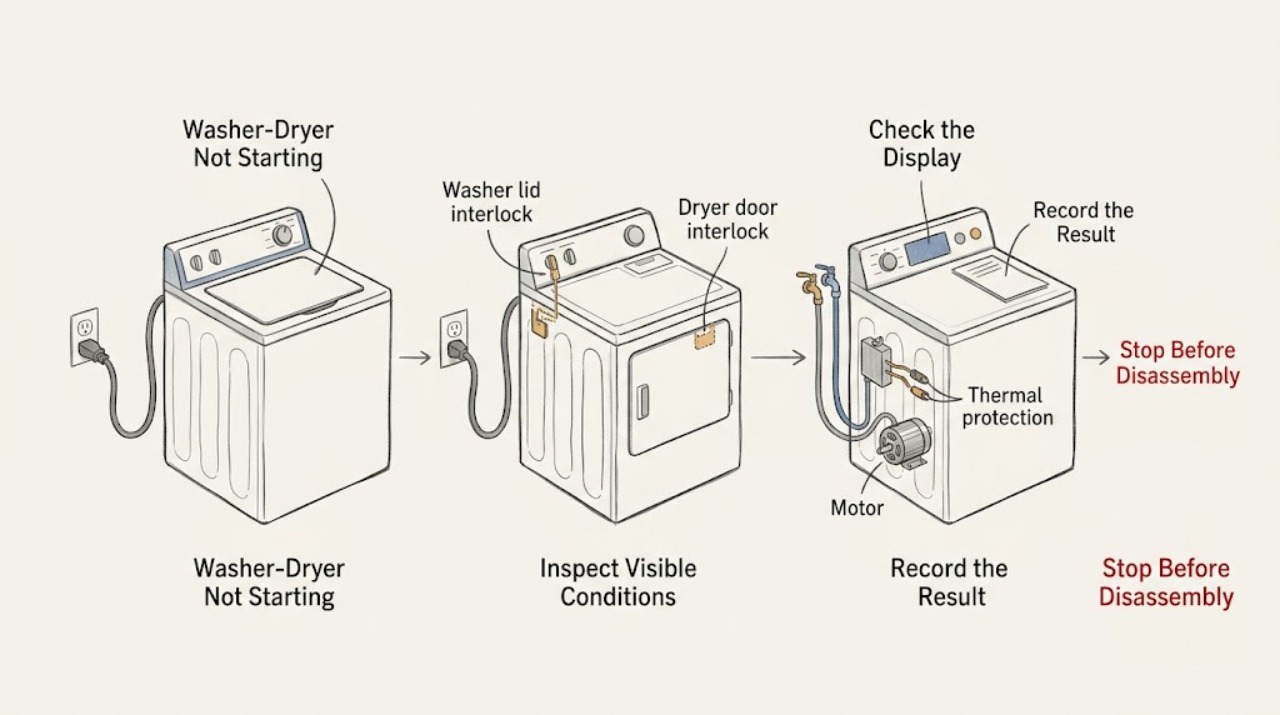
First determine whether the Frigidaire washer-dryer has no power, accepts settings but will not start, or starts and appears to pause. Check the normal user-accessible power source, then close the washer lid or dryer door fully, choose a cycle, and press the correct Start or Start/Pause control. The washer also needs its water supply on, while a dryer may require the start control to be held briefly and the selector to sit in a valid position. A short washer sensing or between-cycle pause can be normal. If the breaker trips again, a door or lid will not lock, the unit has an electrical or burning smell, or it still will not start after these checks, stop and arrange qualified service.
Work through in order
Diagnostic checks
Use only checks that match the exact appliance or system and its official guide.
-
Check 1
Before restarting either section, look for smoke, sparking, a burning-electrical smell, a damaged cord or outlet, water near electrical connections, or a drum/tub that cannot stop safely. Keep hands out of the drum or tub and do not move the unit through water.
Expected result: A safety symptom, visible electrical damage, uncontrolled water, or a mechanical obstruction is present.
Next step: Stop using the washer-dryer and isolate power only if it can be done without approaching danger. Arrange qualified appliance/electrical service; do not open the cabinet or bypass the lid/door interlock.
Why this matters
Why: The appliance should not be repeatedly energized or forced to start; the immediate issue exceeds a user-level cycle check.
-
Check 2
With no immediate hazard, identify whether the washer, dryer, or both fail. Note whether the display or indicators are blank, the controls respond but the cycle does not begin, the washer lid or dryer door clicks/locks, or the dryer drum or washer tub briefly moves and then pauses.
Expected result: Only the washer fails, only the dryer fails, both are dead, or a selected cycle appears to pause after starting.
Next step: Follow the matching power, washer, dryer, or pause branch below; do not diagnose a washer lid issue from dryer behavior or vice versa.
Why this matters
Why: A shared no-power symptom points toward the supply or common control; a single-section symptom points toward that section's door/lid, controls, water, motor, or thermal path. A brief sensing pause may be normal for the washer.
-
Check 3
If the display and indicators for the affected section are blank, check that the power cord fits tightly in the normal wall outlet and look for a tripped household breaker or fuse. The laundry center should use its intended circuit; do not use an extension cord, increase a fuse rating, remove a panel, or probe the outlet with exposed wiring.
Expected result: The display returns after a safe user-level power correction, the breaker trips again, the outlet has no power, or both sections remain blank.
Next step: If the breaker trips again or the outlet/circuit is abnormal, leave the unit off and arrange a qualified electrician or appliance technician. If power returns, continue with the appropriate washer or dryer start check once.
Why this matters
Why: A restored display suggests an interruption; a repeated trip or persistent blank unit points to a supply, wiring, or internal control fault.
-
Check 4
For the washer, verify the hot and cold water faucets are on, choose a valid wash cycle and options, close the lid completely, and press START/PAUSE as described by the exact model. Do not force the lid or reach inside if the lock has engaged.
Expected result: The lid locks and sensing begins, the unit beeps twice or refuses to lock, water does not begin after the normal sensing phase, or no response occurs.
Next step: If the lid will not lock, the washer repeatedly beeps, or the cycle never progresses after its normal sensing/pause behavior, cancel the attempt and arrange service. Do not bypass the lid lock or disassemble the lid area.
Why this matters
Why: Frigidaire says the washer will not start with the lid open and that water supply must be on; a brief sensing period or pause can occur before filling. Failure to lock or continued no response points toward an interlock, control, water-supply, or internal fault.
-
Check 5
For the dryer, close the door fully, place the cycle selector in a valid start position, select an appropriate setting, and press or turn Start for the model's required engagement time. Check the power connection and breaker only from the user-accessible position; do not open the dryer cabinet.
Expected result: The drum starts, the door does not register closed, the selector is between positions, Start does not engage, or the breaker trips.
Next step: Correct only the door, selector, or Start operation once. If the door is closed but not recognized, Start still does not engage, or the breaker trips again, stop and arrange authorized dryer service or qualified electrical service.
Why this matters
Why: Frigidaire lists a door that is open, a selector not quite at the start position, an unengaged Start control, loose power, and a tripped breaker as dryer no-start causes.
-
Check 6
If the washer initially responded, observe whether it is in the first load-sensing period or the normal pause between wash and spin. Keep the lid closed and do not interrupt the cycle repeatedly; for a dryer that stopped after running, allow the motor to cool only as the manual and Frigidaire guidance permit, without opening the cabinet.
Expected result: The washer resumes after sensing or a normal pause, the dryer resumes after cooling and a smaller load, or either section remains stopped.
Next step: If normal operation does not return, cancel the cycle and arrange service. Do not replace a thermal device, defeat an interlock, or reach into a stopped-but-energized appliance.
Why this matters
Why: Frigidaire describes washer sensing and between-phase pauses as normal, while a dryer motor can stop from overheating or a thermal limiter condition. Persistent stopping is not corrected by repeatedly pressing Start.
-
Check 7
Stop troubleshooting when the power correction does not restore the unit, a breaker trips again, the washer lid or dryer door will not lock or register closed, the washer has no water after the supply check, the dryer motor stops again, or either section has a safety symptom.
Expected result: The no-start or repeated-stop condition persists after the applicable non-invasive checks.
Next step: Keep the affected section out of service and arrange a qualified Frigidaire appliance technician. Provide the exact model, washer/dryer section, display behavior, lid/door result, water-supply state, breaker result, and whether the cycle sensed, paused, or stopped.
Why this matters
Why: The remaining causes may include a lid/door switch, lock assembly, control board, timer, inlet valve, motor, thermal limiter, wiring, or supply fault requiring model-specific testing.
Use your observations
Decision map
Find the observation that best matches what you see, then follow the next safe action.
-
PATH 01Next step
What you see
Smoke, sparking, burning smell, water near electricity, damaged cord/outlet, or an unsafe moving drum/tub is present
Do this next
Stop immediately, keep the appliance off, and arrange qualified appliance/electrical service. Do not touch wet electrical parts, open the cabinet, or bypass a safety interlock.
-
PATH 02Next step
What you see
The display and indicators for both washer and dryer are blank
Do this next
Check the normal cord, outlet, fuse, or breaker once if dry and safe. A repeated trip or persistent blank unit requires qualified electrical or appliance service.
-
PATH 03Next step
What you see
The washer will not start or beeps because the lid will not close and lock
Do this next
Remove only an accessible obstruction, close the lid fully, and press START/PAUSE once. If the lock still does not engage, stop and arrange service; never bypass the lid lock.
-
PATH 04Next step
What you see
The washer controls respond but no filling begins
Do this next
Verify the hot and cold faucets are on and the hoses are not visibly kinked, following the model manual. Allow the normal sensing period; if water still does not enter or a connection leaks, stop and arrange service.
-
PATH 05Next step
What you see
The washer starts but appears quiet during load sensing or between wash and spin
Do this next
Treat the short sensing or pause as potentially normal and keep the lid closed. If it does not resume after the model's normal phase, cancel and arrange service.
-
PATH 06Next step
What you see
The dryer will not start with a closed door
Do this next
Confirm the selector is in a valid position and engage Start as the model requires. If the door is not recognized, the button does not engage, or the breaker trips, stop and arrange service.
-
PATH 07Next step
What you see
The dryer stopped after running and remains unresponsive
Do this next
Allow the motor to cool and reduce an overloaded load only as the model guidance permits. If it stops again or a thermal protection condition is suspected, arrange service; do not replace or bypass the thermal limiter yourself.
Helpful context
Understand the symptom
Treat the washer and dryer sections as separate start paths
A stacked laundry center shares a cabinet and power connection, but the washer and dryer can fail at different controls. For the washer, the lid must lock and the water supply must be available. For the dryer, the door, cycle selector, temperature choice, and Start control matter. Record which half fails, whether any lights or display appear, and whether the other half still works.
A quiet washer is not always a no-start condition
Frigidaire says many laundry centers spend the first part of a washer cycle sensing the load, so water may not enter immediately. A pause can also occur between wash and spin. Wait only through the normal behavior described for the exact model; if the lid never locks, no cycle indicator appears, or the unit remains stopped beyond that phase, use the no-start branch.
Do not bypass an interlock or open the cabinet
The lid and door interlocks are safety controls. Do not hold them closed by hand, bypass them, reach into a moving drum, remove the rear panel, or test live wiring. A repeated breaker trip, burning smell, water near electricity, or a damaged cord is a stop condition, not a reason to keep pressing Start.
Only after diagnosis
Potential parts
- washer lid-lock or dryer door-switch assembly
Consider only when qualified testing confirms that the lid or door is correctly positioned but its safety switch or lock signal is not reaching the control.
Confirm the exact Frigidaire model and washer/dryer section before ordering; interlock parts require correct installation and safety testing. - electronic control or timer assembly
Consider only after power, door/lid, water, and user-control checks pass and a technician confirms the control or timer is not issuing the start command.
Match the exact model and revision; do not infer compatibility from a visually similar laundry center. - washer water inlet valve
Consider only when the washer starts its command but qualified testing finds correct faucet and hose conditions with a failed inlet valve or valve circuit.
Verify exact model, inlet configuration, and approved water-system fit before professional replacement. - dryer motor or thermal limiter
Consider only when a dryer repeatedly stops or will not start and qualified testing identifies motor overheating, thermal protection, or the associated circuit as the cause.
Thermal and motor components are exact-model and safety-critical; diagnosis and installation require a qualified technician.
When checks do not resolve it
Need a professional?
Arrange qualified Frigidaire service when the washer or dryer remains unresponsive after the normal power, door/lid, control, and water checks; the washer lid or dryer door will not lock or register closed; a dryer stops again after cooling; or a breaker trips again. Stop immediately for smoke, sparking, burning smell, water near electrical connections, damaged wiring, or an unsafe mechanical condition.
Common questions
FAQ
Why does my Frigidaire washer-dryer have power but not start?
Check that the selected cycle is valid, the washer lid or dryer door is fully closed, and the correct Start or Start/Pause control is engaged. The washer also needs water available, while a dryer may require the start control to be held briefly. If the controls respond but the unit still will not start, arrange service.
Is a Frigidaire washer pause after pressing Start normal?
Often, yes. Frigidaire says many laundry centers spend the first part of a washer cycle sensing the load and may pause between wash and spin. Keep the lid closed and allow the normal phase; a cycle that never progresses or a lid that will not lock needs service.
What should I check if the washer lid will not lock?
Make sure the lid is fully down and no accessible item is preventing closure, then press START/PAUSE once. If the washer still beeps, refuses to lock, or will not start, do not bypass the interlock; arrange qualified service.
Why does my Frigidaire dryer not start when the door is closed?
Confirm the selector is in a valid cycle position, the door is fully closed, Start is engaged as required by the model, and the power source is normal. A door that is not recognized, a start control that does not engage, or a breaker that trips again requires service.
Can an overloaded Frigidaire dryer fail to start?
An overloaded dryer can overheat its motor and stop operating. Frigidaire advises allowing the motor to cool and reducing the load; if the problem returns or thermal protection is suspected, contact an authorized service provider instead of replacing or bypassing the protection yourself.
Read the exact guide
Official sources
- What should I do if my Frigidaire Laundry Center is not starting?Frigidaire · Official Frigidaire support for Laundry Centers; exact model instructions take precedence.
- What should I do if my dryer does not start?Frigidaire · Official Frigidaire dryer support; use only for the dryer section and verify the exact model's controls.
- Laundry Centers - How do I use my display or select cycles on my Frigidaire Laundry Center?Frigidaire · Official Frigidaire Laundry Center control guidance; use the exact Owner's Manual for model-specific labels.
- Laundry Water Supply GuideFrigidaire · Official Frigidaire guidance for front- and top-loading washers, including the washer section of applicable Laundry Centers.
- What should I do if the washer on my Laundry Center beeps twice and won't start?Frigidaire · Official Frigidaire guidance for Laundry Center washers; apply only to the matching washer configuration.
- What should I do if my dryer stops operating?Frigidaire · Official Frigidaire dryer support for a dryer that stops operating; exact model instructions control.
Community feedback
Share a repair observation
Share a plain-text repair observation. Accepted observations are published automatically; this page may take a moment to update.