
On this page
Start here
Quick answer
First identify whether your Kenmore appliance is a stacked laundry center, a washer-dryer combo, or separate washer and dryer units; the start conditions differ by model. Record the full model number and use Kenmore's official manual lookup, which requires the model to find the correct owner documentation. Then check only external conditions: the plug and accessible breaker, the door or lid and lock area, the selected cycle and Start control, and the water taps and visible inlet hoses. Do not bypass a door or lid lock, open a pump or filter with trapped water, test live voltage, or remove cabinet panels. If the display stays dead with a working circuit, the door will not lock, the machine leaks, the motor stops or overheats, the breaker trips again, or it still will not start after the model-approved checks, stop and arrange qualified service.
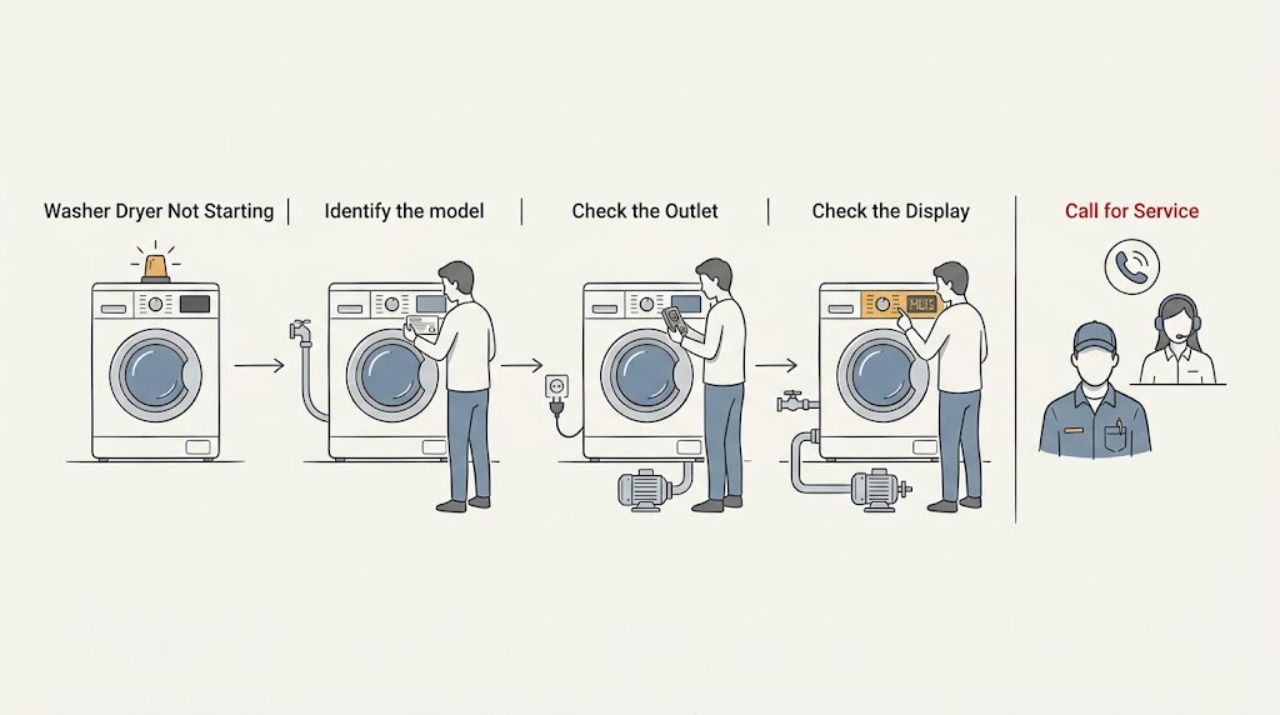
Work through in order
Diagnostic checks
Use only checks that match the exact appliance or system and its official guide.
-
Identify the model and the unit that will not start
Record the complete Kenmore model number and determine whether the symptom is on a washer-dryer combo, a stacked laundry center, the washer section, or the dryer section. Photograph any display, lock icon, blinking lights, or remaining-time message. Use Kenmore's official manual lookup to select the matching owner documentation.
Expected result: The model and affected section are clear, the display shows a control-lock or door message, or the model cannot be identified.
Next step: Read the matching manual's not-starting, controls, and safety sections. If the model cannot be identified, keep the appliance off if it contains water or presents a hazard and contact Kenmore support or a qualified servicer with the label details.
Why this matters
Why: The correct model determines the start control, lock behavior, water requirements, and permitted reset steps. An unknown model makes a generic sequence or part diagnosis unreliable.
-
Check the plug, outlet, and accessible breaker
From a dry position, confirm the appliance plug is firmly seated in the intended outlet and the supply switch is on. Check the accessible household breaker or fuse once. Do not use an extension cord in place of the required appliance supply, open the outlet, increase fuse capacity, or repeatedly reset a breaker that trips.
Expected result: The plug or supply switch was loose or off, the outlet is dead, the breaker is open, the display is still dead with power present, or the controls light normally.
Next step: Restore only a loose plug or switched-off supply and try one manual-approved start. If the outlet is dead or the breaker trips again, leave the appliance disconnected and arrange qualified electrical service. If power is normal, continue with the door, controls, and water checks.
Why this matters
Why: A disconnected supply can make either section appear not to start. A dead or repeatedly tripping circuit is an electrical issue. A lit display with no cycle start shifts attention to the lock, controls, water, or model-specific start conditions.
-
Check the door or lid and the control-lock state
Remove any garment caught in the door seal or lid opening and close the door or lid firmly without slamming it. Check the manual for the control-lock indicator and its exact user release method. Do not pull a locked door open or bypass, bridge, or dismantle the lock switch.
Expected result: The door or lid was not fully closed, the lock indicator is active, the door or lid cannot close or lock, or the lock appears normal but the cycle still will not start.
Next step: Correct only an accessible obstruction or the manual-approved control-lock setting and try one start. If the lock will not engage, remains locked, or the message returns, leave the machine off and arrange service.
Why this matters
Why: A washer or dryer may refuse to start until the door or lid is closed and the interlock is satisfied. A persistent lock failure with a clear opening points to the lock, alignment, wiring, or control and is not a safe bypass situation.
-
Verify the cycle, Start control, and washer water supply
Select a valid cycle and use the Start or Pause control exactly as the model manual specifies. If the washer section will not start, confirm the accessible hot and cold water taps are open and inspect the visible inlet hoses for a kink or crush. Do not disconnect a pressurized hose or remove an inlet screen unless the manual gives that procedure and the machine is safely isolated.
Expected result: The selector was between cycles, Start was not engaged, a control lock or delay is active, a water tap is closed, an inlet hose is kinked, or all external conditions are normal.
Next step: Make one model-approved control or tap correction and run one test without a load if the manual permits. If the washer still will not start, a hose leaks, or water is present around the appliance, shut off the taps if safe and arrange qualified service.
Why this matters
Why: The appliance may be waiting for a valid cycle, a delayed start to be cancelled, a control lock to be released, a closed door or lid, or water to become available. A normal external supply with a no-start condition points to a sensing, valve, lock, or control fault.
-
Separate a trapped-water or overloaded-motor condition
Look for standing water in the washer drum and listen only from outside for a motor that hums, stops, or has recently overheated. Do not open a pump filter or drain hose with trapped or hot water, and do not reach into the drum or drive. If the dryer section stopped after a large load, allow it to cool only for the period stated in the exact manual before one reduced-load retest.
Expected result: Water remains in the drum, the machine hums without starting, the motor stops or overheats, the dryer restarts after the manual-approved cool-down, or the no-start condition persists.
Next step: Keep the appliance disconnected if water, heat, or a motor fault is present and arrange service. If a cool-down and reduced load restores the dryer once, monitor it; if the symptom returns, stop using it and request qualified service.
Why this matters
Why: Trapped water can require a model-specific drain procedure before a washer will proceed. A hum, repeated stop, or overheating can involve the pump, motor, belt, control, or thermal protection and cannot be confirmed safely from sound alone.
-
Stop and escalate persistent or hazardous no-start symptoms
After the model-approved external checks, record the display, lock state, power result, water state, remaining water, and whether the washer or dryer section was affected. Stop immediately for smoke, burning smell, shock, a hot or damaged cable, visible arcing, an active leak, or a breaker that trips again. Do not test live voltage. Do not remove cabinet panels, bypass an interlock, or order a part from the symptom alone.
Expected result: The appliance starts after one safe correction, remains dead with a working supply, will not lock, leaks, repeatedly stops, or remains unable to start.
Next step: Monitor only a normal test cycle without a hazard. Otherwise isolate power and water only from a safe position, keep clear, and arrange qualified Kenmore appliance service. Provide the model number and all observations.
Why this matters
Why: Recovery after one external correction supports an operating condition. Persistent no-start, a lock failure, trapped water, repeated stop, or electrical and water hazards require model-specific professional diagnosis.
Use your observations
Decision map
Find the observation that best matches what you see, then follow the next safe action.
-
PATH 01Safety boundary
What you see
The model cannot be identified or the appliance type is unclear.
Do this next
Do not use a generic reset or code sequence. Record the label details and use Kenmore's manual lookup or support resources before troubleshooting further.
Why this path and its safety boundary
Safety stop: True
-
PATH 02Next step
What you see
The plug, supply switch, outlet, or accessible breaker was the cause and the controls now power up.
Do this next
Try one manual-approved start. If the breaker trips again or the display dies, stop and arrange qualified electrical or appliance service.
-
PATH 03Next step
What you see
The door or lid was not fully closed or a documented control lock or delay was active, and the lock now engages.
Do this next
Run one appropriate test cycle. If the lock fails, stays engaged, or the no-start symptom returns, stop and request service without bypassing the interlock.
-
PATH 04Next step
What you see
The washer section has a closed tap or visibly kinked inlet hose, without a leak.
Do this next
Correct only the accessible tap or hose routing issue allowed by the manual, then test once. If filling still fails, arrange service for the inlet, valve, pressure sensing, or control system.
-
PATH 05Safety boundary
What you see
Water remains in the drum, the motor hums or overheats, the appliance repeatedly stops, or the no-start condition persists after safe checks.
Do this next
Keep the appliance disconnected and arrange qualified service. Do not open a pump filter with trapped water, access the drive, or bypass thermal or door protection.
Why this path and its safety boundary
Safety stop: True
-
PATH 06Safety boundary
What you see
There is smoke, burning smell, shock, visible arcing, a hot or damaged cable, an active leak near electrical parts, or a breaker that trips again.
Do this next
Stop immediately, isolate power or water only from a safe position, keep clear, and contact the appropriate emergency or qualified service provider. Do not restart the appliance.
Why this path and its safety boundary
Safety stop: True
Helpful context
Understand the symptom
Identify the laundry configuration before troubleshooting
Kenmore uses the brand across washers, dryers, stacked laundry centers, and washer-dryer combinations. A no-start symptom can mean the washer is waiting for a lock or water supply, while a dryer may be waiting for a closed door or a different start control. Find the complete model number and use the matching Kenmore manual before interpreting an indicator or error message.
Keep water and power risks separate
A machine that will not start may still contain water. Keep the area dry, do not open a filter or hose connection with trapped or hot water, and do not test live wiring. If there is a leak, burning smell, shock, smoke, a hot cable, or repeated breaker trip, stop immediately and isolate the appliance only from a safe position.
A manual lookup is part of the diagnosis
Kenmore's official manual page covers laundry appliances and asks for the model number. Use that manual for the exact control-lock sequence, Start timing, door or lid behavior, water requirements, and any safe drain procedure. Do not substitute a manual for a similar-looking model.
When checks do not resolve it
Need a professional?
A technician is required for persistent no-start, failed door or lid locking, trapped-water or pump symptoms, motor or thermal-protection faults, control failures, recurring leaks, and electrical or gas-dryer hazards.
Common questions
FAQ
What should I check first if my Kenmore washer-dryer will not start?
Identify the exact model and affected section, then check the plug, outlet and accessible breaker, the closed door or lid, the cycle and Start control, and the washer water taps. Use the model manual for the exact sequence.
Why does my Kenmore washer-dryer have power but not start?
The machine may be waiting for a closed and locked door or lid, a valid cycle, control-lock release, water supply, or a model-specific start action. If those external conditions are correct and it still will not start, arrange service.
Can I bypass the Kenmore washer or dryer door lock?
No. Do not bypass or dismantle the lock. Remove only an accessible obstruction and use the manual-approved control procedure; a recurring lock failure requires qualified service.
Should I open the pump filter if my Kenmore washer-dryer will not start?
Not while water may be trapped or hot. Keep the appliance disconnected and use only the exact manual procedure; if water remains, there is a leak, or the no-start symptom returns, arrange service.
Read the exact guide
Official sources
- Customer CareKenmore · Escalating unresolved washer-dryer no-start, electrical, water, or safety problems to Kenmore repair and support resources
- Laundry Appliances | Washers & Dryers | KenmoreKenmore · Recognizing that Kenmore laundry products include separate washer and dryer sections and different control configurations
- Kenmore ManualsKenmore · Finding the correct washer, dryer, or combination-appliance manual before interpreting start controls, lock indicators, water requirements, or safe reset procedures
Community feedback
Share a repair observation
Share a plain-text repair observation. Accepted observations are published automatically; this page may take a moment to update.