
On this page
Start here
Quick answer
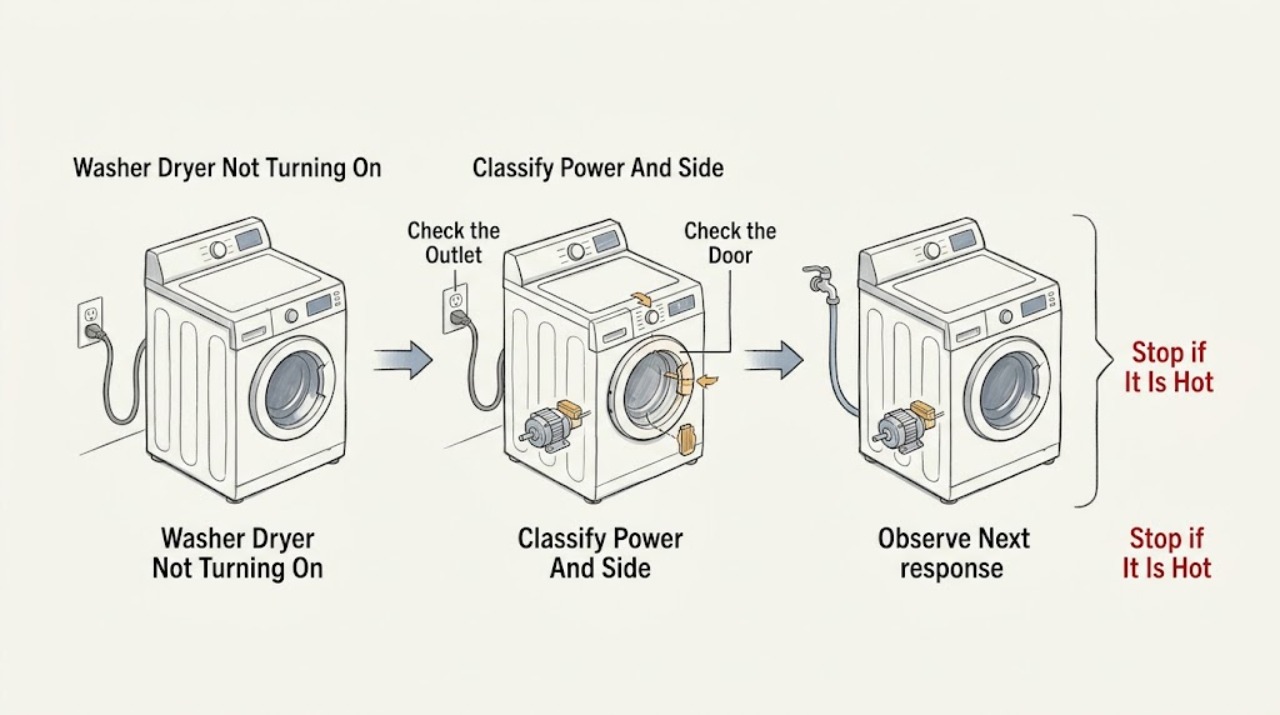
First distinguish a Frigidaire Laundry Center with no display or power from one that has power but will not begin a washer or dryer cycle. Check that the cord fits tightly in the wall outlet, the unit has the required dedicated supply, the control is not paused or delayed, the washer lid and dryer door are fully closed, and Start or Start/Pause was pressed after selecting a cycle. For the washer, confirm the water faucets are on; a cycle can also spend its first couple of minutes sensing the load before water enters. For the dryer, verify the selector is at the start of a cycle and do not use an extension cord. If the circuit trips again, the cord or outlet is damaged, the unit smells hot or burned, the lid or door will not lock, or a reset and these external checks do not restore operation, stop and arrange qualified appliance or electrical service rather than opening the cabinet.
Work through in order
Diagnostic checks
Use only checks that match the exact appliance or system and its official guide.
-
Check 1
Observe the Laundry Center from a safe position and identify whether the washer, dryer, or both have a display or indicator, then press no controls while noting whether the unit is completely dark or powered but idle.
Expected result: Record no power to both sides, power to only one side, a powered panel that ignores Start, a washer that beeps or waits, or a dryer that shows no response after a cycle selection.
Next step: Use the safe power check first, then follow the washer or dryer branch that matches the affected side; do not open the console to look for a fuse or loose wire.
Stop if: Stop for smoke, burning odor, sparking, a hot plug or outlet, melted insulation, water near electrical parts, or a damaged power cord.
Why this matters
Why: A whole-unit dark condition points to the supply, cord, outlet, or shared control path. A single-side or powered-but-idle condition moves the diagnosis to that side’s lid or door, cycle, lock, water, delay, or motor path.
-
Check 2
From a dry, safe position, check that the power cord fits tightly in the wall outlet, that the outlet and household supply are available, and that the Laundry Center is on the dedicated circuit described by the installation instructions; do not use an extension cord.
Expected result: Power returns after a plainly loose connection or control state is corrected, the outlet or circuit is dead, the breaker trips again, or the outlet seems stable while the Laundry Center remains dark.
Next step: Follow safe household procedure for one clearly identified protective-device trip without changing its rating; stop repeated reset attempts and arrange electrical or appliance service when the cause is unknown or the device trips again.
Stop if: Do not probe the outlet, replace a fuse with a larger one, bypass the circuit, use a multi-plug or extension cord, or pull the cord by its cable.
Why this matters
Why: A corrected connection or control state supports an external supply issue. A dead or overloaded circuit can prevent both washer and dryer operation and needs a qualified electrician. A stable outlet with a dark unit points toward the appliance cord, input, or control path.
-
Check 3
On the affected side, cancel any visible pause or delay, select a normal cycle, and close the washer lid or dryer door firmly before pressing Start or Start/Pause as the model requires; do not force the lock.
Expected result: The cycle starts, the control beeps or refuses to start, the lid or door is visibly ajar, the lock does not engage, or the unit turns itself off after sitting without Start.
Next step: Remove only a visible obstruction, make the selection again, and press Start. Arrange service for a door or lid that cannot close or lock after the visible check.
Stop if: Do not defeat the lid or door lock, insert an object to hold it closed, pry the door, or open the cabinet around the lock.
Why this matters
Why: Frigidaire says a washer will not operate with an improperly closed lid and that an unstarted washer can turn off after remaining idle; the Laundry Center also will not start with the washer lid or dryer door open. A lock that does not engage is a safety or alignment issue, not a reason to bypass it.
-
Check 4
For the washer side, verify that both hot and cold water faucets are on, the inlet hoses are not kinked or reversed, and the unit is level; after pressing Start, wait through the model’s initial load-sensing period before concluding that it is not starting.
Expected result: The washer begins filling, remains silent during sensing, shows no water entry, has a closed lid but does not respond, or the hoses, faucets, or level are incorrect.
Next step: Correct only plainly closed faucets, kinked hoses, or an obvious level issue, then try one cycle. Arrange service for no response with power and water available, a failed lock, or an internal inlet or control fault.
Stop if: Do not disconnect pressurized hoses to reach an internal screen, over-tighten connections, bypass a lid lock, or continue if a hose or valve leaks near electrical parts.
Why this matters
Why: Frigidaire says water must be available for the washer to function and that many Laundry Centers spend the first 2 minutes sensing the load before water enters. No fill after the expected sensing period can involve water supply, inlet screens, control, or lock rather than a dead power source.
-
Check 5
For the dryer side, confirm the selector is slightly into a valid cycle, hold Start for the model’s required engagement time, keep the door fully closed, and remove an excessive load; if the dryer stopped after heavy use, let it cool before one further normal attempt.
Expected result: The dryer starts after the selector or Start control is corrected, the door remains open or will not lock, the drum is overfilled, the motor had stopped hot, or the unit remains unresponsive after cooling and a smaller load.
Next step: Use a normal smaller load only after the door and power checks are sound. Arrange service if the dryer remains off, the motor or thermal protection is implicated, or the door lock does not engage.
Stop if: Do not bypass the thermal limiter, run without the door or lint protections, reach into a moving drum, or open the dryer cabinet.
Why this matters
Why: Frigidaire identifies the selector position, Start control, closed door, power, circuit protection, overload, motor overheating, and thermal limiter as distinct no-start or stop causes. A dryer that remains dead after load reduction and cooling may need service rather than a reset of an internal safety component.
-
Check 6
After one safe correction on the affected side, run one supervised normal cycle with the washer lid or dryer door closed and record whether the control responds, the washer begins filling, or the dryer begins tumbling.
Expected result: The cycle starts normally, the control remains lit but the machine stays idle, the unit loses power again, the protective device trips, or the washer and dryer show different responses.
Next step: Stop owner troubleshooting and arrange qualified appliance or electrical service; provide the model and serial information, affected side, power and water observations, selected cycle, door or lid behavior, and each check performed.
Stop if: Do not keep resetting, repeatedly starting a hot or damaged machine, or operate after smoke, burning odor, sparking, leakage near electrical parts, or exposed wiring.
Why this matters
Why: A repeatable start after a correct setting, closure, power, water, or load correction supports that external condition. Persistent no-start, an all-unit failure, a second protective trip, or a side-specific lock or motor symptom requires internal diagnosis.
Use your observations
Decision map
Find the observation that best matches what you see, then follow the next safe action.
-
PATH 01Safety boundary
What you see
The washer and dryer are dark or unresponsive, the cord or outlet is loose or dead, or a protective device trips.
Do this next
Check only the visible connection and household supply; stop repeated reset attempts and arrange qualified electrical or appliance service when power is absent or unstable.
Why this path and its safety boundary
Why it matters: A shared supply, dedicated-circuit, cord, or input problem is more likely than two independent cycle settings.
Safety stop: Stop immediately for smoke, burning odor, sparking, a hot plug or outlet, melted insulation, water near electrical parts, or damaged wiring.
-
PATH 02Safety boundary
What you see
The washer controls light, but it does not start after a cycle is selected and Start is pressed.
Do this next
Close the lid, cancel unintended delay, verify both water faucets, press Start again, and allow the initial sensing period; arrange service for persistent no response.
Why this path and its safety boundary
Why it matters: An unclosed lid, delay or pause, missing water, leveling issue, or washer control or lock problem is possible.
Safety stop: Do not bypass the lid lock, disconnect an inlet hose under pressure, or open the console.
-
PATH 03Safety boundary
What you see
The dryer controls light, but the drum does not start after the selector, Start control, and closed door are checked.
Do this next
Use a valid cycle, hold Start as specified, reduce the load, and allow a hot motor to cool once; arrange service if it remains off or the thermal limiter is implicated.
Why this path and its safety boundary
Why it matters: Selector engagement, door lock, overload, motor heat protection, or a dryer control fault is possible.
Safety stop: Do not bypass a thermal limiter or door safety, reach into the drum, or open the dryer cabinet.
-
PATH 04Safety boundary
What you see
The washer lid or dryer door appears closed but will not latch, lock, or register as closed.
Do this next
Remove only a visible obstruction and close it normally; stop and arrange model-specific service if the lock still fails.
Why this path and its safety boundary
Why it matters: The machine’s safety interlock may be preventing operation, or an obstruction or alignment problem may remain.
Safety stop: Do not hold the lock closed with an object, pry the door or lid, remove the latch, or run with the interlock defeated.
-
PATH 05Safety boundary
What you see
The washer has started but is quiet, does not fill immediately, or appears to pause between stages.
Do this next
Keep the lid closed and observe the model’s normal sensing or pause period; escalate if it never progresses with water available and stable power.
Why this path and its safety boundary
Why it matters: Frigidaire says many Laundry Centers spend the first 2 minutes sensing load size and can pause between wash and spin; silence alone does not prove no power.
Safety stop: Do not repeatedly cancel and restart, open a locked lid by force, or move hoses while the cycle is active.
-
PATH 06Safety boundary
What you see
Power, cycle controls, closure, water and load checks are correct, but one side or both sides still will not turn on.
Do this next
Stop owner troubleshooting and arrange qualified appliance service with the affected side and recorded observations.
Why this path and its safety boundary
Why it matters: A lock, motor, thermal limiter, input, control, or other internal fault needs model-specific diagnosis.
Safety stop: Do not open the cabinet, probe live wiring, bypass safety devices, or replace internal parts by trial.
Helpful context
Understand the symptom
Decide whether the Laundry Center is dead or simply not starting a cycle
No display, no indicator, and no response from either the washer or dryer points first to power, the control state, or the shared installation. A lit control panel with no washer action can be a closed-lid, water-supply, delay, pause, or Start issue; a dryer can similarly wait for a correctly positioned selector, a closed door, and a held Start control. A cycle that has already begun but is quiet for a short period is not the same as a unit that never powers on.
Use the washer and dryer branches separately
The washer side needs both water valves available and a properly closed lid, while the dryer side needs a fully closed door, a selected cycle, and its own motor and heat-safety conditions. In a stacked or combined Laundry Center, one side can show a power or control symptom while the other remains available. Do not assume that a washer water issue explains a completely dark dryer control, or that a dryer motor issue explains a washer that never receives power.
Stop before internal electrical or lock work
Frigidaire’s public guidance keeps the owner checks at the cord, outlet, controls, doors or lid, water supply, load, level, and visible installation. A failed lid or door lock, thermal limiter, motor, wiring, or main control requires model-specific service. Repeated breaker resets, bypassing a lock, opening the cabinet, or testing live terminals can turn a no-start complaint into an electrical or mechanical hazard.
Safety boundary
Stop conditions
- Stop immediately for smoke, burning odor, sparking, a hot or damaged plug or outlet, melted insulation, water near electrical parts, exposed wiring, or a repeated protective-device trip.
- Do not repeatedly reset a breaker or fuse, use an extension cord or multi-plug, change a protective-device rating, or bypass the Laundry Center’s dedicated circuit.
- Do not defeat the washer lid or dryer door lock, hold an interlock closed with an object, pry the door or lid, or operate with damaged hinges or latches.
- Do not bypass a dryer thermal limiter, probe live terminals, open the console or cabinet, or reach into a moving or hot drum.
- Stop a water check if a hose leaks, a connection is pressurized, or water approaches electrical parts; arrange qualified service instead.
Only after diagnosis
Potential parts
- washer lid or dryer door lock
Consider this only when the correct cycle, power, and closure are verified but a qualified diagnosis confirms that the safety interlock does not register closed.
Confirm the exact Laundry Center model and manufacturer fit information before ordering; never bypass the lock. - washer water inlet valve
Consider this only when power, lid closure, open faucets, and hose routing are correct but a qualified diagnosis finds no water entry from a failed inlet component.
Confirm the exact model and valve arrangement before replacement; water and electrical access should be handled by qualified service. - dryer motor or thermal limiter
Consider this only when the dryer remains off after a correct cycle, closed door, stable power, smaller load, and cooling period, and a qualified technician identifies motor or thermal protection failure.
Confirm the exact model and service specifications before any replacement; do not bypass thermal protection.
When checks do not resolve it
Need a professional?
Arrange qualified appliance service when the Laundry Center remains dark after safe supply checks, the washer or dryer lock will not register closed, a powered side will not start after the correct controls and load or water checks, or a motor or thermal protection fault is suspected. Use qualified electrical service for the outlet, cord, circuit, or wiring. Stop immediately for smoke, burning odor, sparking, a hot plug or outlet, melted insulation, water near electrical parts, or a repeated protective-device trip.
Common questions
FAQ
Why is my Frigidaire washer dryer completely dead?
Check the cord and wall outlet, household protection, and the Laundry Center’s dedicated circuit from a safe position. If both washer and dryer remain dark or the circuit trips again, arrange qualified electrical or appliance service rather than opening the cabinet.
Why does my Frigidaire Laundry Center have power but not start?
Check the selected cycle, Start or Start/Pause control, washer lid or dryer door closure, pause or delay state, and—on the washer side—the water supply. A lock that does not register closed needs service, not a bypass.
Why does my Frigidaire washer not start filling right away?
Frigidaire says most Laundry Centers spend the first 2 minutes sensing load size before water enters. Keep the lid closed and verify both water faucets and inlet hoses; no fill after the sensing period needs further diagnosis.
Why will my Frigidaire dryer not turn on?
Check the selector position, hold Start for the required engagement, close the dryer door fully, and verify the cord and circuit. If it stopped after an overloaded or hot cycle, reduce the load and allow the motor to cool once; persistent failure needs service.
Can a closed lid or door keep a Frigidaire washer dryer from starting?
Yes. Frigidaire states that the washer will not operate when its lid is not closed properly and that the Laundry Center will not start with the washer lid or dryer door open. Clear only visible obstructions and arrange service if the lock does not engage.
When should I stop troubleshooting a Frigidaire washer dryer?
Stop for smoke, burning odor, sparking, a hot or damaged cord or outlet, water near electrical parts, repeated protective trips, a failed lid or door lock, or any need to open the cabinet or bypass a safety device. Arrange qualified appliance or electrical service.
Read the exact guide
Official sources
- What should I do if my washer does not start?Frigidaire · Frigidaire washers and the washer side of compatible Laundry Centers
- What should I do if my dryer stops operating?Frigidaire · Frigidaire dryers that stop after starting or after a heavy load
- What should I do if my Frigidaire Laundry Center is not starting?Frigidaire · Frigidaire Laundry Centers combining washer and dryer functions
- What should I do if my dryer does not start?Frigidaire · Frigidaire dryers and the dryer side of compatible Laundry Centers
- Laundry Water Supply GuideFrigidaire · Frigidaire front-load and top-load washer water supply
Community feedback
Share a repair observation
Share a plain-text repair observation. Accepted observations are published automatically; this page may take a moment to update.