
On this page
Start here
Quick answer
When a Frigidaire washing machine displays an error, photograph and write down the complete code or message before clearing it, along with whether the washer is top-load, front-load, or part of a laundry center. Frigidaire assigns different meanings to different models and codes: its support pages describe E1 as slow or absent water fill, E2 as slow or incomplete draining on certain top-load washers, F2 as excess or unsuitable detergent on washers, and CL as a top-load control-lock/lid condition. Use the exact model manual for the code, perform only the listed external check, and stop if water is leaking, the tub cannot drain, the lid or door will not lock safely, the code returns, or the remedy requires opening the cabinet. An unlisted or recurring code needs qualified appliance service.
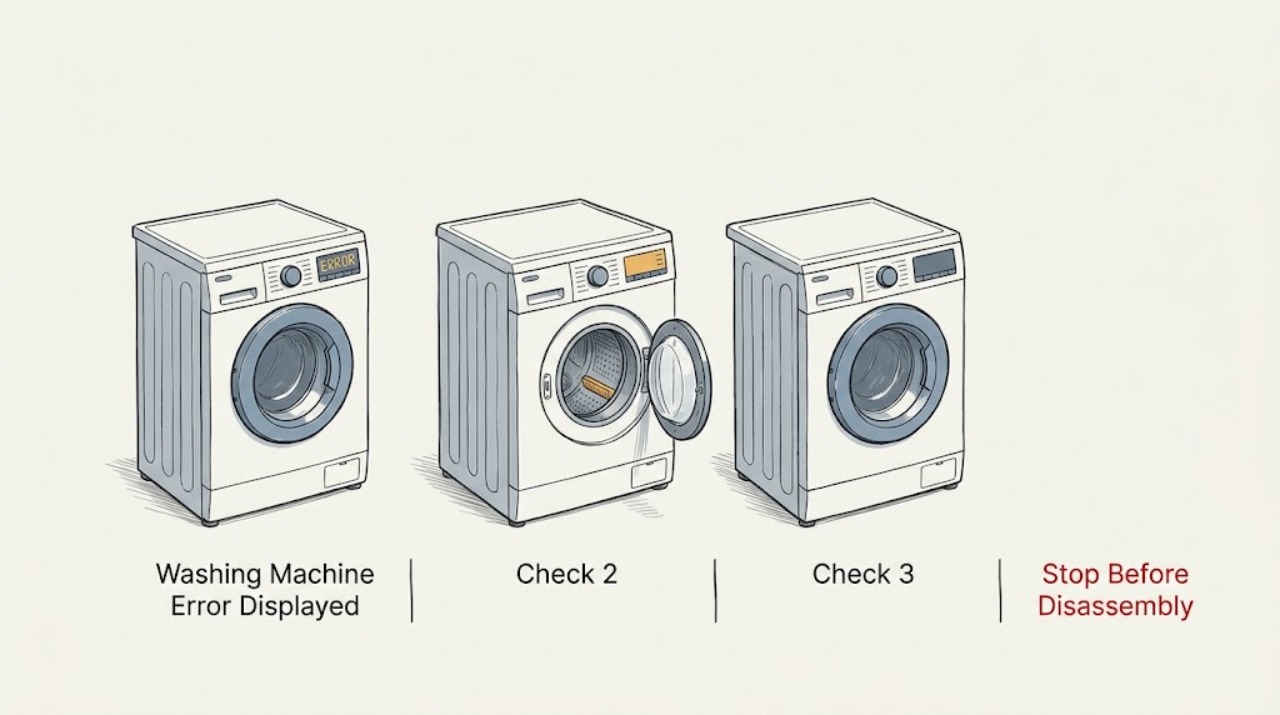
Work through in order
Diagnostic checks
Use only checks that match the exact appliance or system and its official guide.
-
Check 1
Stop the cycle without reaching into the tub, photograph the complete display, and record every letter, digit, symbol, flashing light, beep, and the point in the cycle where it appeared.
Expected result: The display is a recognizable code or message; only lights or beeps are present; the code changes; or the display is blank while the washer is still stopped.
Next step: Write down the model number and whether the washer is top-load, front-load, or a laundry center, then use that exact owner's manual or the matching Frigidaire support article. Do not clear a recurring code before recording it.
Stop if: Stop and keep the washer off for smoke, burning smell, active water leakage, a damaged cord, uncontrolled movement, or any need to reach into a moving or water-filled tub.
Why this matters
Why: A complete code and its timing are needed because Frigidaire documents different meanings for different washer families. A normal alert, such as a lid prompt or balance message, is not the same decision as a persistent fault code.
-
Check 2
Match the code to the exact Frigidaire model manual before trying a reset or part replacement; compare the code characters, washer type, and the listed symptom rather than relying on a generic code list.
Expected result: The code and washer type match a model-specific instruction; the code is listed with a different symptom; or the code is absent from the manual.
Next step: Follow only the matching external check in the manual. For an unlisted, contradictory, or recurring code, preserve the evidence and arrange qualified service instead of guessing at a control, pump, lock, or valve.
Stop if: Do not open the cabinet, bypass a lid or door lock, or replace a component based on a code alone.
Why this matters
Why: The same letter or number can lead to different checks across top-load, front-load, and laundry-center designs. An absent or mismatched code is not evidence for a particular failed component.
-
Check 3
If the exact top-load guidance identifies E1, check from outside that the hot and cold faucets are fully open, inlet hoses are not kinked, and the accessible supply screens are not visibly blocked; follow the manual's water-isolation procedure before any hose work.
Expected result: Water supply is open and clear; a faucet is closed; a hose is kinked; screens appear obstructed; or the washer shows E1 despite normal external supply conditions.
Next step: Correct only an obvious faucet or hose-position issue, then run the manual-approved test once. If E1 returns, water leaks, or supply work is not safely accessible, stop and book service.
Stop if: Stop for a leaking connection, damaged hose, inaccessible screen, wet electrical area, or any need to open the washer cabinet.
Why this matters
Why: Frigidaire describes E1 on certain top-load washers as water not entering or entering too slowly. A normal external supply check makes an internal inlet or sensing fault more likely, but does not identify a part by itself.
-
Check 4
If the exact top-load guidance identifies E2, observe whether water remains in the tub and inspect the visible drain hose for a kink or obvious external obstruction without pulling it from the standpipe or reaching into the pump area.
Expected result: The tub drains normally; water remains; the hose is kinked; the standpipe arrangement is visibly abnormal; or the error returns after the external path is corrected.
Next step: Straighten only an accessible kink and follow the manual's drain test once. If water remains, the hose is blocked internally, or E2 returns, stop the cycle and arrange service rather than opening the pump area.
Stop if: Do not reach into standing water, remove pump covers, or continue a cycle that is leaking or unable to drain.
Why this matters
Why: Frigidaire describes E2 on certain top-load washers as water taking too long to drain or not draining. A clear external path does not prove that the internal pump or control is good.
-
Check 5
If the matching Frigidaire page identifies F2, check the detergent label and recent dose, confirm the product is high-efficiency detergent when the model requires it, and look for visible suds or overflow while the washer is stopped.
Expected result: There is excess foam or overflow; the detergent is not the model-recommended type; the dose was excessive; or F2 appears with no suds or after the documented cleaning cycle.
Next step: Use the manual-approved detergent amount and run the documented empty cleaning cycle once if safe. Stop for overflow, water near controls, or a returning code and arrange service.
Stop if: Do not continue washing through overflow, add chemicals to suppress foam, or open the cabinet to inspect the pump or sensor.
Why this matters
Why: Frigidaire states that F2 on applicable front-loading washers indicates too much or the wrong type of soap and may cause suds to leak or overflow. A no-suds recurrence needs model-specific diagnosis rather than more detergent changes.
-
Check 6
If the display is CL on an applicable top-load washer, confirm the lid is fully closed and use only the model's documented Control Lock deactivation sequence; do not force the lid or bypass the lock.
Expected result: The lid closes and the control lock clears; the lid remains open or misaligned; the code remains after the documented sequence; or the lid cannot lock safely.
Next step: If the exact sequence does not clear CL, stop and schedule service. Do not run the washer with the lid or lock defeated.
Stop if: Stop for a broken hinge, damaged lid, failed latch, exposed wiring, or any request to bypass the lid lock.
Why this matters
Why: Frigidaire describes CL in this context as a lid-open condition while Control Lock is active. A lid or lock that cannot close is a safety boundary, not a reason to defeat the interlock.
-
Check 7
After one model-approved external correction, run the shortest manual-approved test while observing water entry, draining, foam, lid/door locking, unusual sound, and the display.
Expected result: The washer completes the test with no code; the same code returns; a different code appears; or a leak, overflow, lock problem, or unusual movement occurs.
Next step: Stop after the first failed or unsafe test and provide service with the exact code, model, cycle, water level, load, photos, and external checks already attempted.
Stop if: Do not repeatedly reset, continue an unsafe cycle, or diagnose internal parts from the display alone.
Why this matters
Why: A single successful test can indicate a transient operating condition, but recurrence or a new symptom means the underlying cause remains unresolved. A different code is new diagnostic evidence, not permission to repeat every reset.
Use your observations
Decision map
Find the observation that best matches what you see, then follow the next safe action.
-
PATH 01Safety boundary
What you see
The code matches an exact Frigidaire page and the listed external condition is visible, such as a closed faucet, kinked hose, excess suds, or an open lid with Control Lock.
Do this next
Perform the one documented external correction and one manual-approved test. If the code returns, stop and arrange service.
Why this path and its safety boundary
Why it matters: A model-supported user correction may be appropriate, but the code still does not prove a failed component.
Safety stop: Do not bypass a lock, open the cabinet, or keep cycling through the error.
-
PATH 02Safety boundary
What you see
E1 appears on an applicable top-load washer and faucets, hoses, and visible supply conditions are normal.
Do this next
Stop troubleshooting and schedule qualified appliance service.
Why this path and its safety boundary
Why it matters: The external supply path did not explain the slow or absent fill; an internal inlet, sensing, or control issue remains possible but is not proven.
Safety stop: Do not open the cabinet or replace an inlet component based only on E1.
-
PATH 03Safety boundary
What you see
E2 appears and the visible drain hose is not kinked, or water remains in the tub.
Do this next
Keep the washer stopped and arrange service; protect the area from water until the tub is safely emptied by the appropriate procedure.
Why this path and its safety boundary
Why it matters: The external drain check did not resolve the documented slow or incomplete drain condition.
Safety stop: Do not reach into standing water or remove internal drain components.
-
PATH 04Safety boundary
What you see
F2 appears with excess suds or overflow.
Do this next
Stop the cycle, follow the exact manual's safe cleanup or empty-cycle instruction once, and service the washer if overflow or F2 returns.
Why this path and its safety boundary
Why it matters: The documented detergent condition is plausible, but overflow can damage the appliance and surrounding area.
Safety stop: Do not continue operation while foam or water is escaping toward controls or flooring.
-
PATH 05Safety boundary
What you see
CL remains after the exact Control Lock sequence, or the lid cannot close and lock normally.
Do this next
Keep the washer off and arrange qualified service.
Why this path and its safety boundary
Why it matters: The lid/lock safety condition is unresolved and the washer should not be operated with the interlock defeated.
Safety stop: Never tape, hold, or bypass the lid lock.
-
PATH 06Safety boundary
What you see
The code is unlisted, contradictory to the model, returns after one documented correction, or is accompanied by a leak, smoke, burning smell, abnormal movement, or damaged cord.
Do this next
Keep the washer stopped and arrange qualified appliance service with the recorded code, model, timing, and observations.
Why this path and its safety boundary
Why it matters: The condition is outside safe generic troubleshooting and may involve an internal or safety-critical fault.
Safety stop: Do not keep resetting or open the washer to identify the part yourself.
Helpful context
Understand the symptom
The code is the starting point, not the diagnosis
A Frigidaire washer display can report a condition that needs a simple user check, such as a lid, water supply, drain path, detergent, or load issue. The same-looking display behavior can vary by washer family, so record the exact characters and model before choosing a remedy. Do not substitute a code meaning from another Frigidaire model.
Use only external, model-approved checks
Keep the washer stopped if water is escaping, the lid or door cannot close or lock, the tub is full and cannot drain, or the display returns immediately. External checks such as confirming a faucet, straightening an accessible hose, correcting detergent use, or redistributing a load are different from opening the cabinet or testing internal parts.
When the code does not match
Frigidaire's washer support pages point users to the owner manual and service when a listed procedure does not resolve the condition. Preserve the display, model information, water level, load, and any visible leak or sound so a technician can distinguish a one-time operating condition from a fault that needs testing.
Safety boundary
Stop conditions
- Stop for active leakage, overflow, water near controls, smoke, burning smell, a damaged cord, uncontrolled movement, or a lid/door that cannot lock safely.
- Do not reach into a moving or water-filled tub, bypass a lid or door interlock, open the cabinet, or replace internal parts based on a code alone.
- Stop after one documented model-approved correction if the code returns, a different code appears, or the washer develops a new unsafe symptom.
Only after diagnosis
Potential parts
- washer inlet hose or inlet screen
Consider only after the exact manual or qualified diagnosis confirms a supply-side restriction or damaged hose; E1 alone does not identify this part.
Confirm the exact model, connection type, and manufacturer's fit information before selection. - washer lid or door lock assembly
Consider only after qualified diagnosis confirms a failed lock or damaged lid/door hardware; never bypass the interlock.
Confirm exact model and lock design before selection; compatibility cannot be inferred from CL or another display code.
When checks do not resolve it
Need a professional?
Call for an unlisted or recurring code, unresolved fill or drain error, persistent suds, unresolved lock message, or any symptom requiring cabinet access.
Have this ready
- Exact model number and washer type
- Complete displayed code or message and a photo
- Cycle, load, water level, and when the code appeared
- Visible water, suds, hose, lid/door, cord, or movement observations
- The single model-approved external correction attempted
Common questions
FAQ
What should I do first when my Frigidaire washer displays an error?
Record the complete code, photograph it, note the model and washer type, and identify when it appeared in the cycle. Then use the matching Frigidaire manual or support article rather than a generic code list.
What does E1 mean on a Frigidaire washing machine?
On the applicable top-load washer support page, E1 means water is not entering or is filling too slowly. Check the documented external supply conditions, such as open faucets and kinked hoses, and arrange service if the code remains.
What does E2 mean on a Frigidaire washer?
On the applicable top-load washer support page, E2 means water is taking too long to drain or is not draining properly. Check only the documented visible drain conditions and stop if water remains or the code returns.
What does F2 mean on a Frigidaire washer?
Frigidaire describes F2 on the applicable washer page as too much or the wrong type of detergent, often with suds leaking or overflowing. Correct detergent use only as the manual directs, and service recurring or unsafe overflow.
When should I stop troubleshooting a Frigidaire washer error?
Stop for leakage, overflow, smoke, burning smell, damaged electrical parts, an unsafe lid or door lock, standing water, an unlisted or recurring code, or any need to open the cabinet or bypass an interlock. Arrange qualified service with the code and model details.
Read the exact guide
Official sources
- Why does my Frigidaire Laundry Center beep or have blinking lights?Frigidaire · Applicable to Frigidaire laundry centers; use the exact model manual for other washer designs.
- Top Loading Washer - displaying Error Code E1 long fill timeFrigidaire · Applicable to the top-loading washer family covered by the support article.
- How To Use Your Washer: Alarms & CodesFrigidaire · General Frigidaire washer guidance; the exact model manual controls code interpretation.
- Laundry top loading washer displaying Error Code E2 water takes too long to drain.Frigidaire · Applicable to the top-loading washer family covered by the support article.
- Washer Displaying Error Code F2 too many suds or suds overflowing.Frigidaire · Applicable to washers covered by the support article, especially the front-loading context stated there.
- Laundry top loading washer displaying Error Code CL lid opened more than 20 seconds with control lock activated.Frigidaire · Applicable to top-loading laundry washers covered by the support article.
Community feedback
Share a repair observation
Share a plain-text repair observation. Accepted observations are published automatically; this page may take a moment to update.