
On this page
Start here
Quick answer
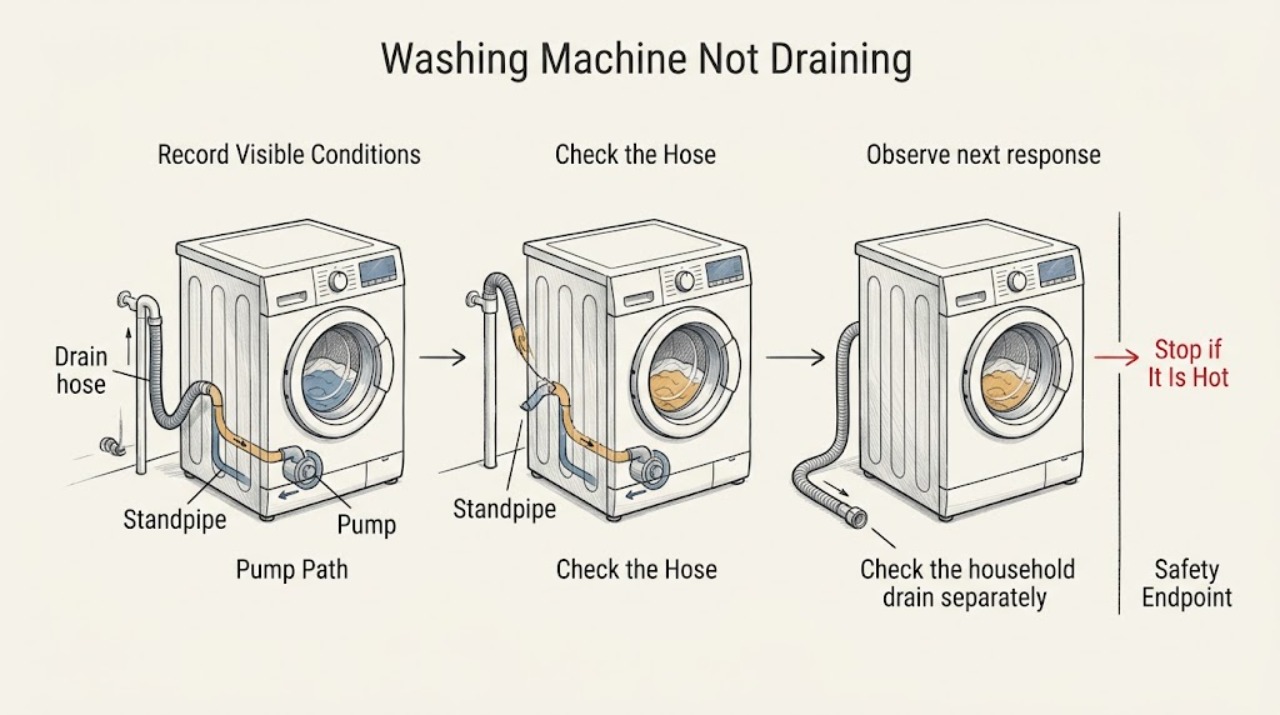
If a Frigidaire washing machine leaves water in the tub, first stop the cycle and identify whether it is a top-load washer, front-load washer, or laundry center. On a Frigidaire top-load model, inspect the visible drain hose for a kink, a clogged hose or household drain, a hose pushed too tightly into the standpipe, or a sealed standpipe connection that cannot admit air. Check that the standpipe height and placement match the model instructions, and avoid overfilling the detergent dispenser. If the display shows E2, Frigidaire describes it as water taking too long to drain and lists the breaker, standpipe, closed lid, and kinked or clogged drain hose as checks. Do not open a pump filter or hose with hot or contaminated water unless the exact manual gives a safe procedure. If the hose and household drain are clear but water remains, the cycle repeatedly stops, or there is a leak, leave the washer off and arrange qualified service.
Work through in order
Diagnostic checks
Use only checks that match the exact appliance or system and its official guide.
-
Stop safely and record the water and display state
Press Pause or Cancel using the normal washer controls and keep hands away from the water. Note whether the tub contains standing water, whether the water is hot or dirty, whether the washer is still agitating or spinning, and whether a code such as E2 is displayed. Photograph the display before a reset if it is safe to do so.
Expected result: Water remains with no movement, the washer is still in a cycle, the water appears hot or contaminated, a drain code is shown, or the tub is empty but the cycle did not complete.
Next step: Keep the washer off while checking external drain conditions. For an active leak, hot water, electrical symptom, or moving tub that cannot stop normally, stop and arrange service.
Stop if: Do not reach into standing water, force the lid or door, restart repeatedly over a leak, or disconnect hoses while the water may be hot or the tub is moving.
Why this matters
Why: The next check differs if the washer is still running, has retained water, or has recorded a drain-time fault. Hot or contaminated water raises the spill and burn boundary; an empty tub with a failed completion may point toward controls or sensing rather than a physical blockage.
-
Inspect the visible drain hose and standpipe
From outside the appliance, trace the drain hose from the washer to the household standpipe or drain. Look for a sharp kink, crushing, a hose pushed too deeply or tightly into the standpipe, a completely sealed taped connection, or a blocked standpipe. If the washer was recently moved, compare the hose placement with the exact installation instructions before moving the appliance again.
Expected result: The hose is kinked or crushed, the standpipe is visibly blocked, the hose is tightly sealed or inserted, the installation appears recently changed, or the external path looks open and correctly placed.
Next step: Straighten only a visible hose kink, clear an accessible household-drain obstruction without opening the washer, and restore only the hose placement permitted by the model instructions. If the path is clear or the installation cannot be verified, continue to the next observation and prepare for service.
Stop if: Do not pull hard on a connected hose, dismantle plumbing inside a wall, seal the standpipe airtight, or move a water-filled washer by yourself.
Why this matters
Why: A restricted hose or household drain can prevent water flow. Frigidaire says a standpipe needs an air path and gives model-specific limits for hose fit and height; recently moved units can have an installation problem rather than a failed washer component.
-
Check the household drain separately
When the washer is off and there is no active leak, inspect the standpipe opening and nearby household drain for a visible blockage or backup. Do not pour chemicals into the washer or disconnect the appliance hose to test a drain that may overflow. If another fixture drains slowly or backs up, record that symptom as a plumbing issue.
Expected result: The standpipe or nearby drain backs up, another fixture has the same problem, the opening is clear, or the washer hose is the only affected path.
Next step: Stop using the washer and arrange plumbing service for a shared backup or overflow risk. If the household drain is clear, continue with the washer's hose fit, cycle, and detergent checks.
Stop if: Do not continue draining into an overflowing standpipe, use caustic drain cleaner as a washer repair, or place hands into contaminated backup water.
Why this matters
Why: A shared backup points toward household plumbing rather than a washer-only fault. A clear household drain keeps the washer hose, pump path, cycle state, or detergent branch in consideration.
-
Check the cycle, lid, and E2 branch
If the display shows E2 or the washer stopped before spin, record the code and confirm the lid or door is fully closed without forcing it. On a top-load model, use the normal Start or Pause control only after the external path is safe and the lid closes correctly. For a laundry center, follow the exact model's pause, cancel, and drain controls.
Expected result: E2 clears and the washer drains, the lid or door was not detected closed, the code returns, or the cycle remains stuck with water present.
Next step: If the washer drains normally, monitor the next cycle. If E2 returns, the lid or door does not register, or water remains, leave the washer off and arrange qualified service rather than repeatedly restarting it.
Stop if: Do not bypass a lid or door interlock, force the lid or door, or keep restarting a cycle that leaves water in the tub.
Why this matters
Why: Frigidaire defines E2 as a drain-time problem and notes that a top-load washer will not spin unless the lid is closed. A returning code after a clear external path means the fault is not resolved by the visible cycle state.
-
Review detergent amount and recent installation changes
Check the detergent dispenser and recent load history. Note whether detergent exceeded the dispenser's maximum line, whether unusually heavy suds were present, and whether the washer was installed or moved recently. Do not add more detergent or run a full load while the drain symptom is unresolved.
Expected result: The dispenser was overfilled, heavy suds were present, the washer was installed or moved within the recent service period, or detergent and installation look normal.
Next step: Correct only the dispenser amount for a future cycle and follow the exact manual's cleaning or suds guidance. Contact the installer for a recent installation issue; otherwise continue to service if the drain remains blocked.
Stop if: Do not disassemble the dispenser, pour chemicals into the tub, or use another full load to force a washer that still contains water to drain.
Why this matters
Why: Frigidaire says too much detergent can prevent proper draining and directs recently installed or moved units back to the installer. Normal detergent use and stable installation make a restriction or internal drain fault more likely.
-
Use the exact manual before any pump or filter access
If the external hose, household drain, cycle state, lid or door, and detergent checks are normal, locate the exact model manual and read its user-accessible drain, pump-filter, or residual-water procedure. Photograph the model number and record whether the pump hums, is silent, or trips power only if these observations can be made without opening the washer or touching water.
Expected result: The manual documents a safe user-accessible procedure, no such procedure is provided, water cannot be contained safely, or the washer still does not drain after the documented procedure.
Next step: Follow only the exact manual procedure with the washer isolated as instructed. If access is not documented, water is hot or contaminated, the procedure fails, or the pump needs internal testing, leave the washer off and call qualified service.
Stop if: Do not open panels, remove a pump, reach through a filter opening, make live electrical measurements, or disconnect a hose without the exact model procedure and safe water containment.
Why this matters
Why: Drain access and filter locations vary by Frigidaire design. An undocumented opening can spill water or expose moving and electrical parts; an unsuccessful model-approved procedure points toward a pump, drain path, sensor, wiring, or control fault.
Use your observations
Decision map
Find the observation that best matches what you see, then follow the next safe action.
-
PATH 01Next step
What you see
The visible drain hose is kinked, crushed, too tightly fitted, or the standpipe is blocked, and the washer has not been damaged.
Do this next
Restore only the hose and standpipe arrangement allowed by the exact manual, clear an accessible household obstruction, and observe one supervised drain attempt.
Why this path and its safety boundary
Why it matters: An external drain-path or installation restriction is the leading cause.
-
PATH 02Next step
What you see
The household standpipe backs up or another fixture drains slowly at the same time.
Do this next
Stop using the washer and arrange plumbing service; do not continue draining into an overflowing standpipe.
Why this path and its safety boundary
Why it matters: A household plumbing restriction is more likely than a washer-only failure.
-
PATH 03Next step
What you see
E2 is displayed, the hose and standpipe are clear, and the lid or door is fully closed.
Do this next
Leave the appliance off and arrange qualified Frigidaire service rather than repeatedly restarting the cycle.
Why this path and its safety boundary
Why it matters: The washer still has a drain-time fault after the main visible checks.
-
PATH 04Next step
What you see
The washer was installed or moved recently, or the hose placement cannot be matched to the installation instructions.
Do this next
Contact the installer or use the exact model installation guidance; do not move a water-filled washer alone.
Why this path and its safety boundary
Why it matters: An installation or hose-routing problem needs to be corrected before diagnosing internal parts.
-
PATH 05Next step
What you see
The dispenser was overfilled or heavy suds were present, but the external drain path is clear.
Do this next
Use the model's detergent guidance for the next cycle and request service if water remains or the symptom repeats.
Why this path and its safety boundary
Why it matters: Excess detergent may have contributed to the slow or incomplete drain.
-
PATH 06Next step
What you see
The hose, standpipe, cycle, lid or door, detergent, and model-approved user procedure are normal, but water still remains.
Do this next
Leave the washer off and provide the model, code, water state, and observations to a qualified technician.
Why this path and its safety boundary
Why it matters: A pump, internal drain path, sensor, wiring, or control fault is possible.
-
PATH 07Next step
What you see
There is an active leak, hot or contaminated water, smoke, burning odor, repeated power trip, or a moving tub that cannot stop normally.
Do this next
Stop the appliance, isolate water or power only when safe, keep clear of wet electrical areas, and obtain qualified service.
Why this path and its safety boundary
Why it matters: This is an immediate water, burn, electrical, or mechanical safety stop.
Helpful context
Understand the symptom
Start with the external drain path
A washer that does not drain can have a restricted hose, a blocked household standpipe, an incorrect hose fit, or a cycle that has not reached its drain or spin stage. Frigidaire's top-load guidance says the standpipe needs an air path and that the hose should not be kinked or fitted too tightly. Check those visible conditions before opening any cover or assuming the pump has failed.
A code narrows the branch but does not name a part
On a Frigidaire top-load washer, E2 means water is taking too long to drain. The code does not prove that the pump is defective: a hose restriction, standpipe issue, lid state, power interruption, or household drain blockage can produce the same symptom. Record the code and use the exact model manual before any reset or access procedure.
Safety boundary
Stop conditions
- Never reach into standing water, force the lid or door, or disconnect a hose while the tub is moving or the water may be hot or contaminated.
- Stop immediately for an active leak, flooding, smoke, burning odor, damaged cord, repeated breaker trip, or a washer that cannot stop normally.
- Do not open pump filters, panels, or hoses without the exact model manual and safe residual-water procedure; do not make live electrical measurements.
- Do not use chemical drain cleaner in the washer, bypass the lid or door interlock, or repeatedly restart a cycle that leaves water in the tub.
Only after diagnosis
Potential parts
- drain pump or internal drain-path component
Consider this category only when the hose and household drain are clear, the exact model procedure does not restore draining, and a qualified diagnosis identifies a pump or internal drain-path fault.
Confirm the complete Frigidaire model and manufacturer's fit information before ordering; a washer that does not drain does not prove the pump is defective. - pump filter or debris-filter component
Consider this category only when the exact model has a user-accessible filter and service confirms that it is damaged or cannot seal after a safe cleaning procedure.
Verify the model-specific filter location, seal, and fit information; do not open an undocumented filter with retained water. - water-level sensor or drain-control component
Consider this category only when the external drain path is clear and service diagnosis shows that sensing or control is preventing the washer from completing drain or spin.
Confirm the complete model and technician diagnosis before ordering; an E2 code can result from external restrictions as well as internal faults.
When checks do not resolve it
Need a professional?
Arrange qualified Frigidaire appliance service when the external hose and household drain are clear but water remains, E2 returns, a lid or door state cannot be confirmed, a model-approved drain procedure fails or is unavailable, the pump or wiring needs internal testing, or the washer leaks. Contact the installer for a recently moved or newly installed unit with incorrect hose routing, and use plumbing service for a shared standpipe backup.
Common questions
FAQ
Why is my Frigidaire washing machine leaving water in the tub?
Start with the visible drain hose, standpipe, and household drain. A kink, clog, incorrect hose fit, sealed standpipe, unfinished cycle, excess detergent, or a returning drain code can all change the next step.
What does E2 mean on a Frigidaire top-load washer?
Frigidaire says E2 means water is taking too long to drain or is not draining properly. Check the breaker, standpipe, closed lid, and kinked or clogged drain hose; request service if the code returns.
Can I open the pump filter when my Frigidaire washer is full of water?
Only if the exact model manual documents a safe procedure and the water can be safely contained and is not hot or contaminated. Otherwise leave the washer off and arrange qualified service rather than opening a cover.
Could too much detergent make a Frigidaire washer not drain?
Frigidaire notes that too much detergent can prevent proper draining. Do not fill the dispenser beyond its maximum line, and request service if water remains or the symptom repeats after the external drain path is clear.
When should I call service for a Frigidaire washer that will not drain?
Call when the hose and household drain are clear but water remains, E2 returns, a documented drain procedure fails, the pump needs internal testing, or the washer leaks. Stop immediately for hot or contaminated water, flooding, smoke, burning odor, or repeated power trips.
Read the exact guide
Official sources
- Laundry top loading washer displaying Error Code E2 water takes too long to drain.Frigidaire · Frigidaire top-loading washers displaying E2 or taking too long to drain
- Laundry top loading washer is not draining.Frigidaire · Frigidaire top-loading laundry washers with retained water or an incomplete drain
- What do the display options on your top load washer mean?Frigidaire · Frigidaire top-load washer display options and related drain, start, lid, and code support articles
- Troubleshooting Your Laundry Center Washer Not DrainingFrigidaire · Frigidaire laundry centers; use the exact laundry-center manual for controls and any user-accessible drain procedure
Community feedback
Share a repair observation
Share a plain-text repair observation. Accepted observations are published automatically; this page may take a moment to update.