
On this page
Start here
Quick answer
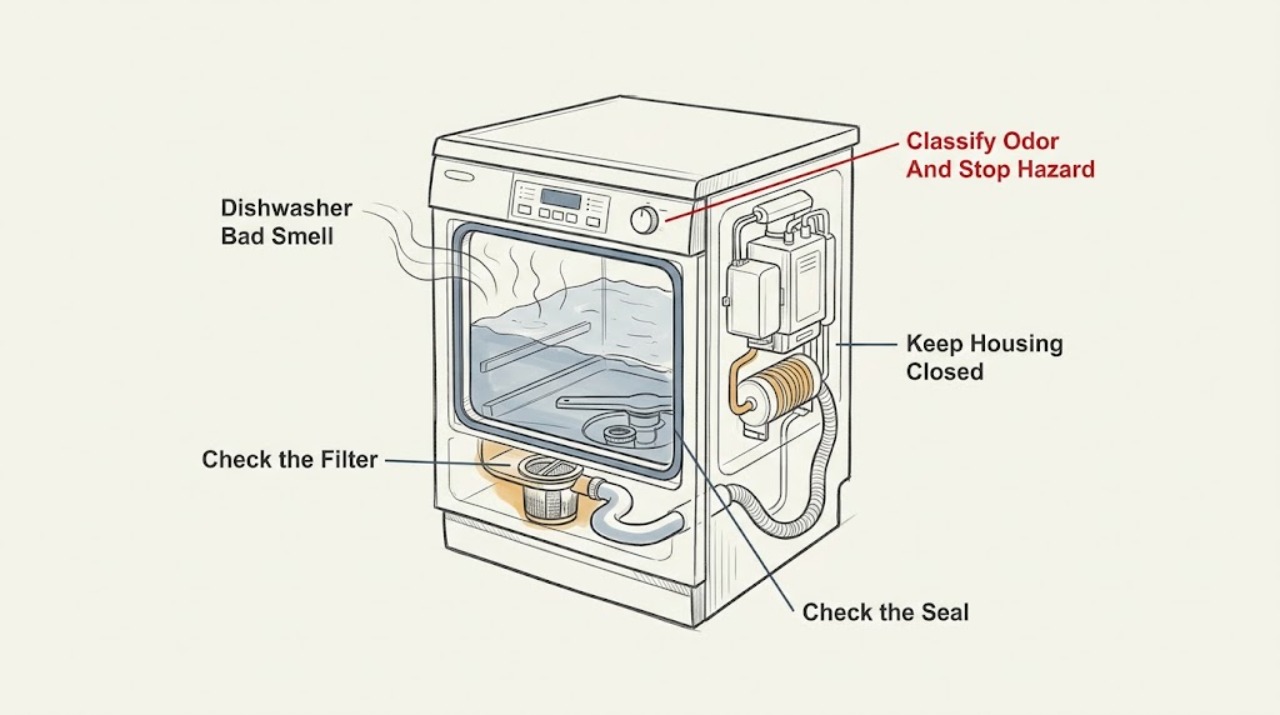
Identify the odor before trying to clean it. A burnt-plastic, electrical, hot-insulation, smoke, or unusually hot odor is a stop-use condition: cancel the cycle if safe, isolate power from a dry safe location, and arrange qualified service. For a stale or food odor, switch the dishwasher off, remove the racks, inspect and clean the filter system exactly as the matching Gaggenau manual shows, and wipe accessible food residue from the door seal. If water remains in the tub or the odor returns after a cycle, an obstructed drain path, drain hose, or pump is more likely than a dirty filter; do not reach into an internal pump or loosen plumbing. An odor that appears when the sink drains or resembles sewage can involve the drain connection or backflow path and needs plumbing/appliance diagnosis. Gaggenau manuals list food debris, food near the door seal, dishes left too long, residual water, and an obstructed drain hose as odor clues, and a newer manual says to leave the door slightly ajar when unused to prevent odors. Do not mix cleaners, use harsh chemicals, run the machine to test a burning smell, or attempt internal electrical work.
Before you begin
Safety first
- The user may identify the odor and timing, isolate power safely for model-approved access, clean the matching manual's removable filters, wipe an accessible door seal, and observe visible water/drain conditions. Qualified service must handle pump covers, internal hoses, heaters, motors, controls, wiring, electrical tests, and installation changes.
Work through in order
Diagnostic checks
Use only checks that match the exact appliance or system and its official guide.
-
Check 1
Stop the cycle and inspect only from outside for smoke, sparks, a burnt-plastic or electrical odor, unusual heat, a hot cord, water near wiring, or a damaged door/seal. If the odor is clearly food, stale water, or drain-like and there is no hazard, note when it appears: before a cycle, after draining, with the door open, or only while the machine is heating.
Expected result: There is a burnt/electrical odor or other hazard; a food or sour odor is present; a sewage/drain odor follows draining; or the odor appears only during operation/heating.
Next step: For smoke, burning, heat, sparks, water near wiring, or a damaged cord/door, isolate power only from a safe dry location and leave the dishwasher off. For a non-burning odor with no hazard, continue with the matching model's filter and seal observations.
Stop if: Do not restart a dishwasher to reproduce a burnt odor, open the electrical compartment, touch wet wiring, or use a cleaner to mask an electrical smell.
Why this matters
Why: A burnt or electrical odor takes priority over filter cleaning and indicates an appliance or installation safety issue. Food odor makes accessible soil more likely. A drain-like odor linked to draining makes residual water or the drain connection more likely. An operation/heating-only odor requires service rather than a user test.
-
Check 2
For a non-hazardous food or stale odor, identify the exact Gaggenau model and follow only its user manual to remove the filter system. On the DF211701-style layout, inspect the coarse, fine, and micro-filter elements, keep foreign objects from falling into the sump, and rinse the filter elements under running water; reinstall them fully with the model's locking/alignment marks.
Expected result: Food residue is on the filter, the under-filter area is visibly soiled, the filter is damaged or will not lock, or the filter and accessible sump area are clean.
Next step: Reinstall a clean, undamaged filter only as the matching manual directs and wipe up accessible residue. If the filter will not seat, the sump has debris that cannot be safely removed, or odor persists, stop cleaning and contact service.
Stop if: Disconnect power before any manual-required filter access; do not reach into the sump, use sharp tools, remove a pump cover, or apply harsh/mixed chemicals.
Why this matters
Why: Residue on the filter or under-filter area can support a food odor and poor drainage. A damaged or unsecured filter can allow debris into the sump and needs model-specific service or replacement. A clean, correctly seated filter makes the door seal, standing-water, drain-hose, or non-food branches more likely.
-
Check 3
With the appliance off, inspect the accessible door seal and the lower door/tub edge for food particles, grease, or a damaged seal. Note whether dirty dishes were left inside for a long time or whether the door has stayed closed while the dishwasher was unused. Wipe the seal with a damp cloth as the matching manual permits, then leave the door slightly ajar during extended storage if the model's instructions allow it.
Expected result: Food is trapped near the seal, the seal is torn or displaced, dishes sat for a long time, the door stayed closed while wet, or the accessible seal is clean and intact.
Next step: Remove only accessible food residue, dry the area, and use the exact manual's storage/door guidance. Arrange service for a damaged seal or odor that returns despite clean accessible surfaces.
Stop if: Do not remove the door seal, bend the door, steam-clean the appliance, or put hands into a wet sump or pump area.
Why this matters
Why: Food near the seal and dishes held too long can create a localized stale odor. Keeping a damp interior closed can allow odor to persist, while a damaged/displaced seal is a service issue rather than a cleaning-only issue. A clean intact seal shifts attention to drainage or an operation-related odor.
-
Check 4
After the program has ended and the appliance is safe to open, observe whether unusual water remains at the bottom and whether the odor appears after draining or when the nearby sink drains. Check only visible, accessible drain-hose routing and the sink connection for an obvious kink, disconnection, or backflow sign; do not detach plumbing or reach into the drain pump.
Expected result: The filter area is blocked, unusual residual water remains, the drain hose/connection is visibly kinked or disconnected, the odor tracks sink drainage, or the tub drains normally with no visible issue.
Next step: Correct only a loose visible routing issue if the exact installation guide clearly allows it; otherwise keep the dishwasher off and arrange qualified appliance or plumbing service. A pump or internal hose obstruction must be handled by qualified personnel.
Stop if: Do not run repeated cycles, pour chemicals into the drain, pry a pump cover, use tools in the drain, detach a hose, or work under a wet appliance.
Why this matters
Why: Residual water plus odor makes the filter/under-filter area, drain hose, pump, or drain connection more likely than a dry food-only source. An odor synchronized with sink drainage raises a plumbing/backflow or connection issue. Normal visible drainage does not rule out an internal pump or intermittent installation fault.
-
Check 5
Record the exact model/E-Nr., odor description, where it is strongest, cycle stage, filter and seal condition, residual-water result, drain/sink timing, recent installation or repair, and any smoke, heat, noise, or error indication. If the smell persists after the matching manual's safe filter/seal care, or appears only during heating or operation, leave the dishwasher off and arrange service.
Expected result: The odor disappears after accessible soil is removed, returns with residual water, returns only during heating/operation, persists with a clean filter and seal, or is accompanied by electrical or water hazards.
Next step: Keep the dishwasher out of service for persistent, operation-related, or hazardous odors and contact Gaggenau authorized service or a qualified appliance technician; use a plumber when the odor is tied to the sink/drain connection.
Stop if: Do not order a pump, heater, seal, hose, or control from odor alone; do not open panels or perform electrical, heating, or internal drain work.
Why this matters
Why: A one-time food residue correction supports a maintenance cause but does not prove every internal path is clear. Recurring standing water points to drainage or pump diagnosis. Heating/operation-only, burnt, or persistent odor makes an electrical, heater, motor, seal, or control issue more likely and is outside user troubleshooting.
Use your observations
Decision map
Find the observation that best matches what you see, then follow the next safe action.
-
PATH 01Safety boundary
What you see
The smell is burnt plastic, hot insulation, electrical, or chemical-hot and appears during operation, with smoke, heat, sparks, or a hot cord/door area.
Do this next
Stop the cycle if safe, isolate power from a dry safe location, keep the dishwasher off, and contact qualified Gaggenau service. If the household circuit or grounding is suspect, involve a qualified electrician.
Why this path and its safety boundary
Why it matters: An electrical, heater, motor, control, or installation fault is more likely than food residue; the appliance may be unsafe.
Safety stop: Do not run another cycle, open the cabinet, touch wet wiring, bypass protection, or try to identify the hot component.
-
PATH 02Safety boundary
What you see
The odor is stale, sour, or food-like, no unusual heat or smoke is present, and residue is found on the filter, under-filter area, lower tub, or door seal.
Do this next
Use the matching Gaggenau manual to clean and reinstall the filter and wipe the accessible seal; remove only accessible residue. If the smell returns, move to the residual-water/drain branch rather than adding stronger chemicals.
Why this path and its safety boundary
Why it matters: Food soil in the filtration or seal area is more likely than an electrical fault, provided the filter is intact and the appliance drains normally.
Safety stop: Do not use sharp tools, mixed cleaners, steam, or a pump-cover procedure copied from another model.
-
PATH 03Safety boundary
What you see
The odor is strongest after the cycle, unusual water remains in the tub, or the smell returns when drainage occurs; the filter may be blocked or the visible hose/connection abnormal.
Do this next
Clean only the model-approved filter and inspect visible routing. Keep the dishwasher off and call qualified service for internal pump/hose work or a plumber for a sink/drain connection or backflow issue.
Why this path and its safety boundary
Why it matters: A blocked filter/under-filter area, drain hose, pump, or drain connection is more likely than a dry residue-only source.
Safety stop: Do not run repeated flush cycles, detach plumbing, pour drain chemicals, or reach into the pump.
-
PATH 04Safety boundary
What you see
The odor is stale rather than burnt, dishes sat inside for a long time, or the door stayed closed while the interior was damp; the filter and drain observations are otherwise normal.
Do this next
Remove accessible food soil, wipe the seal, allow the interior to dry, and leave the door slightly ajar during an unused period only if the matching manual permits it. Escalate if the odor returns.
Why this path and its safety boundary
Why it matters: Retained food/moisture and the door-seal area are more likely than a failed electrical part.
Safety stop: Do not force the door, remove the seal, or use heat or harsh chemicals to dry the tub.
-
PATH 05Safety boundary
What you see
The filter and accessible seal are clean and correctly installed, the dishwasher drains normally, but the smell persists, occurs only during heating/operation, or requires access behind a panel or pump cover.
Do this next
Leave the dishwasher off and arrange Gaggenau authorized service or qualified appliance diagnosis. Supply the model/E-Nr. and odor timing rather than attempting a cross-model repair.
Why this path and its safety boundary
Why it matters: An internal drain, pump, hose, heater, motor, wiring, control, or installation fault is more likely; the odor alone cannot select a part.
Safety stop: Do not open panels, remove a pump cover, perform electrical/heater tests, or order internal parts from the smell alone.
Helpful context
Understand the symptom
Odor type changes the safe next step
Food or sour residue odor usually points to soil, the filter area, door seal, dishes held too long, or water left after a cycle. A sewage-like odor that follows draining points toward the drain connection or standing water. A burnt, electrical, or hot-plastic smell is not a cleaning problem: stop using the dishwasher and arrange service. Do not run another cycle to find out which kind it is.
Use the matching Gaggenau manual for filter access
Gaggenau dishwashers have model-specific filter and pump layouts. The DF211701 manual shows a removable filter system and accessible filter cleaning, while the older DF241761 guide lists the filter system and drain hose in its odor troubleshooting table. Match the E-Nr. or model before removing anything; a procedure from one series is not permission to remove a pump cover on another.
Residual water is a drain decision, not a parts diagnosis
If water remains after the program, note whether it is a small normal-looking amount or an unusual pool and whether the odor returns after draining. A filter or under-filter blockage, drain hose obstruction, pump, or installation connection may be involved. The user boundary is the matching manual's filter care and visible inspection; internal pump, hose, electrical, and plumbing work belongs to qualified service.
Safety boundary
Stop conditions
- Stop using the dishwasher for burnt/electrical odor, smoke, sparks, unusual heat, a hot cord, water near wiring, or a damaged door/seal.
- Disconnect power only from a safe dry location before model-approved filter access; do not touch wet wiring or move a wet built-in appliance forcefully.
- Do not run another cycle to reproduce a burning smell, use harsh or mixed chemicals, steam-clean, or pour drain cleaner into the appliance.
- Do not reach into the sump or drain pump, pry a pump cover, detach plumbing, remove panels, or perform live electrical/heater work as a user step.
- If a matching manual's safe filter/seal care does not resolve a non-burning odor, or if residual water recurs, arrange qualified service rather than selecting a part from odor alone.
When checks do not resolve it
Need a professional?
Safety scope: The user may identify the odor and timing, isolate power safely for model-approved access, clean the matching manual's removable filters, wipe an accessible door seal, and observe visible water/drain conditions. Qualified service must handle pump covers, internal hoses, heaters, motors, controls, wiring, electrical tests, and installation changes.
Common questions
FAQ
Why does my Gaggenau dishwasher smell like food or sour water?
Start with the exact model's filter system, under-filter area, lower tub, and door seal. Gaggenau manuals list food debris, particles near the seal, dishes left too long, residual water, and an obstructed drain hose as odor causes. Clean only the model-approved removable filters and accessible seal; persistent odor or standing water needs service.
What does a burnt or electrical smell from a Gaggenau dishwasher mean?
Treat it as a safety fault, not a cleaning issue. Stop the cycle if safe, isolate power from a dry safe location, and leave the dishwasher off. Do not run another test or open the cabinet; Gaggenau's safety guidance requires qualified service for electrical and repair work.
Can standing water cause a bad dishwasher smell?
Yes, unusual residual water can keep food soil and drain odor in the appliance. Check the matching manual's removable filter and note whether the water remains after the program. If the filter is clean but water or odor returns, the drain hose, pump, or connection needs qualified diagnosis; do not reach into the pump or detach plumbing.
Should I leave the Gaggenau dishwasher door open to prevent odor?
For the DF211701 manual, Gaggenau says to leave the door slightly ajar when the appliance is not going to be used for a while to prevent unpleasant odors. Confirm the same instruction in your exact model manual, and do not leave the door open where it creates a trip or child-safety hazard.
Can I clean the drain pump myself to remove the smell?
Do not assume that a pump-cover procedure applies to your Gaggenau model. Some official manuals include model-specific pump access, but the pump can contain sharp debris and requires power isolation. If the filter and visible checks do not resolve residual water or odor, use qualified service rather than copying another model's procedure.
Read the exact guide
Official sources
- Use and Care Manual DF211701Gaggenau · Official Gaggenau-hosted DF211701 manual; filter and pump layout and procedures are specific to this model family.
- 9000825296.pdf — Gaggenau Use and Care ManualGaggenau · Official Gaggenau-hosted DF241761 manual; its control and access procedures are model-family specific.
Community feedback
Share a repair observation
Share a plain-text repair observation. Accepted observations are published automatically; this page may take a moment to update.