
On this page
Start here
Quick answer
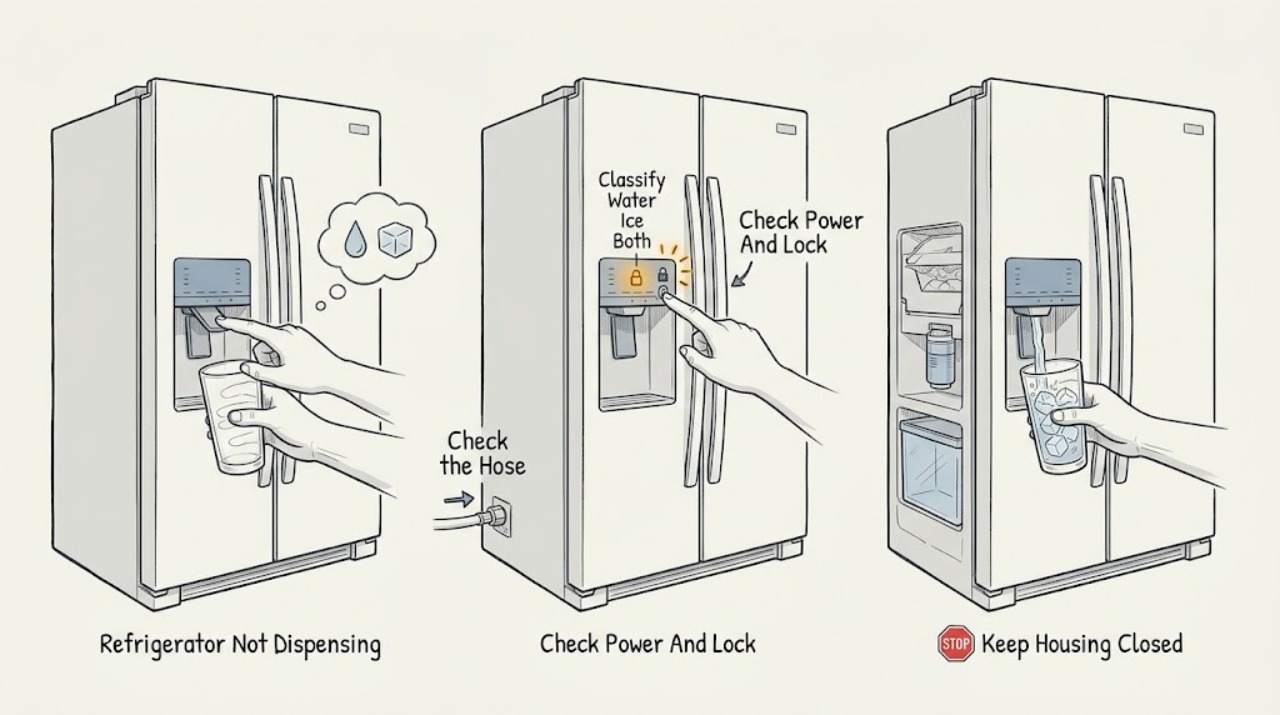
First identify what is not dispensing: water, ice, or both. From outside the Gaggenau refrigerator, check that the display and appliance have power, the dispenser or child lock is not active, the drinking-water shut-off is open, and the hose is not visibly kinked. If the water dispenser was newly connected or a filter was just installed, air in the water circuit or a model-specific fill time can delay output; use the exact manual rather than holding the control indefinitely. For an ice-only failure, check that ice production is enabled, the freezer has reached its set temperature, and the ice container is fully inserted; if ice cubes are frozen together, follow the exact model's safe container procedure without reaching under moving parts. A blocked filter, low water pressure, or a connection that is not watertight can also affect dispensing. If water is leaking, close the accessible shut-off valve immediately. If the dispenser remains dead with stable power and water, the ice maker has no power, the hose is damaged, or water reaches an electrical area, stop and arrange qualified Gaggenau service. Do not remove panels, disconnect pressurized lines, or substitute a part without the complete E-Nr.
Before you begin
Safety first
- This article covers classifying water versus ice, checking power and lock state, observing an accessible water supply/hose, using the E-Nr-specific filter and container guidance, and containing leaks. Internal valves, pumps, water lines, filters under pressure, ice-maker mechanisms, electrical areas, and panel access require qualified service.
Work through in order
Diagnostic checks
Use only checks that match the exact appliance or system and its official guide.
-
Check 1
Test only the control that is safe and dry, and record whether water, ice, or both fail. Note whether the display and interior light work, whether the dispenser control responds, whether a lock icon is shown, whether the ice maker is producing ice, and the complete E-Nr/model from the rating plate.
Expected result: Water works but ice does not; ice works but water does not; neither works; the display or control is locked; or the appliance has no power.
Next step: Follow the matching branch below and the E-Nr-specific manual. Photograph any display message before clearing it.
Stop if: Do not keep operating a wet dispenser or reach into the ice maker to see whether it cycles.
Why this matters
Why: Water-only and ice-only failures use different paths. Both failing makes shared power, lock, water supply, or model-specific control more likely. A dark display selects a power diagnosis rather than a filter or ice-bin diagnosis.
-
Check 2
If both water and ice controls are inactive, check from outside that the refrigerator has power and that the dispenser or child lock is not enabled. Use the exact model's display instructions to unlock the control; do not remove a panel or try to defeat a lock mechanically.
Expected result: The display is dark; the child lock icon is shown; unlocking restores the controls; the display is lit but both outputs remain inactive; or power trips when the dispenser is used.
Next step: Check the accessible supply and use the exact manual's unlock procedure once. If the display remains dark, the breaker trips, or both outputs stay inactive, leave the appliance off as appropriate and call qualified service.
Stop if: Stop for smoke, burning smell, sparking, a hot or damaged cord, water at electrical parts, or repeated breaker trips. Do not keep resetting the circuit.
Why this matters
Why: Gaggenau manuals identify locked dispenser controls and lost power as separate causes. If unlocking restores output, the lock was the immediate cause. Stable power with both outputs inactive points toward water supply, control, or internal service; a power trip is an electrical safety symptom.
-
Check 3
For a water-only or both-output failure, verify from outside that the drinking-water supply is available and the accessible shut-off valve is open. Look for a visible kink or damage in the accessible hose without pulling the integrated appliance or loosening a fitting.
Expected result: The shut-off is closed; no water reaches the appliance; the hose is kinked; the hose or connection is damaged or wet; or the external supply appears normal.
Next step: Open the valve only when there is no leak and the exact installation guidance supports it; otherwise keep it closed. For a kinked or damaged hose, call service or a qualified installer rather than disconnecting it.
Stop if: Do not disconnect water lines, move a built-in unit, loosen a pressurized fitting, or restore water to a visibly damaged connection.
Why this matters
Why: Gaggenau identifies no water supply, a closed valve, and a kinked hose as causes of a non-functioning water dispenser or ice maker. A wet, damaged, or non-watertight connection is a leak and service condition, not a reason to increase pressure or tighten parts blindly.
-
Check 4
If water output is weak, intermittent, or absent after a new connection or filter change, record the filter work and use the exact manual for filter seating, filter type, and water-system priming. On models with a water tank, allow the documented fill period; on models with a direct connection, do not invent a tank procedure.
Expected result: Air bubbles appear; the water tank is newly filling; the filter is blocked, incorrectly seated, frozen, cracked, or under pressure; water output is reduced; or the filter and supply are normal.
Next step: Follow only the E-Nr-specific priming or filter procedure. Stop if a filter will not release normally, water leaks around it, or output remains absent after the documented procedure, and arrange service.
Stop if: Do not remove a filter under pressure, force the filter cap, disconnect the water circuit, or continue dispensing water onto an electrical area.
Why this matters
Why: Gaggenau manuals identify air after connection or filter installation, low water pressure, and a blocked filter as causes of reduced or abnormal output. One opened model documents a first-use tank fill period, while other families use a different path; this timing is not universal.
-
Check 5
For an ice-only failure, confirm from the exact manual that ice production is switched on, the freezer has reached its set temperature, and the ice container is fully inserted. Look through the accessible dispenser opening for cubes frozen together; if the manual permits removing the container, use both hands and keep fingers away from the ice-maker mechanism.
Expected result: Ice production is off; the freezer is too warm; the container is not fully seated; cubes are frozen together or blocking the dispenser; the dispenser child lock is active; or none of these conditions is present.
Next step: Correct only an obvious accessible setting or container position according to the matching manual. Remove loose, fused cubes only as the manual allows; if the mechanism remains blocked or the ice maker does not function, keep testing to a minimum and call service.
Stop if: Never reach into or underneath moving ice-maker parts, use a sharp tool to chip ice, force a heavy full container, or remove the ice maker.
Why this matters
Why: Gaggenau troubleshooting identifies each of these as a separate ice-dispenser or ice-maker path. A blockage or container position can stop delivery without proving that the ice maker has no power. A fully seated container with no blockage and no ice production points toward water supply, freezer condition, or service.
-
Check 6
If dispensing stops only after repeated or prolonged use, note whether the output returns after the model-documented pause. One Gaggenau manual says its water dispenser stops after continuous dispensing and after several consecutive uses, with a wait before trying again; use that only when the manual matches your E-Nr.
Expected result: Output returns after the documented pause; output never begins; only water stops while ice works; or the dispenser stops with a leak, abnormal noise, or power symptom.
Next step: Follow the matching manual once. If normal short dispensing still fails, return to the water/ice branch and arrange service for a persistent fault.
Stop if: Do not hold the control indefinitely, defeat a timeout, or continue if water is leaking or electrical symptoms appear.
Why this matters
Why: A documented pause can be a protective operating behavior, not a failed dispenser. If output never begins or the symptom occurs with normal short use, supply, filter, lock, control, or internal faults are more likely. Water, ice, and dispenser mechanisms can have separate paths.
-
Check 7
If water is leaking from the connection, hose, filter area, dispenser cavity, ice container area, or an inaccessible panel, close the accessible shut-off valve and leave it closed. Record whether the leak stops, where it first appeared, whether the appliance is integrated, and whether water reached electrical parts.
Expected result: Flow stops with the valve closed; water continues; the hose or connection is damaged; the leak is inside the cabinet; or water reached an outlet, cord, control, or wiring.
Next step: Keep water off and arrange qualified Gaggenau service. If water reached electrical parts, isolate power only from a safe dry location and obtain electrical safety assistance before restoring it.
Stop if: Do not restore water to reproduce the leak, remove panels, disconnect a hose, or touch wet electrical parts.
Why this matters
Why: A leak that stops at the valve is within the appliance water circuit or its connection. Gaggenau directs service for damaged hoses and defective water pipes; water near electricity makes dispensing and normal operation unsafe.
Use your observations
Decision map
Find the observation that best matches what you see, then follow the next safe action.
-
PATH 01Safety boundary
What you see
Ice works, but the water dispenser does not produce water or produces only a weak/intermittent stream.
Do this next
Check the accessible supply, lock, visible hose, and exact model's filter/priming instructions. Call service for persistent no output, a damaged line, or water near electrical parts.
Why this path and its safety boundary
Why it matters: Water supply, shut-off, hose, filter, air, water tank, lock, or dispenser control is more likely than an ice-maker fault.
Safety stop: Do not remove a pressurized filter or disconnect the water line.
-
PATH 02Safety boundary
What you see
Water works, but ice is not produced or the ice dispenser does not deliver cubes.
Do this next
Check the exact model's ice setting, container, and accessible dispenser opening. Keep hands out of the mechanism and call service if production or delivery remains absent.
Why this path and its safety boundary
Why it matters: Ice production setting, freezer temperature, ice-container seating, fused cubes, fill-level sensing, water supply, or ice-maker service is more likely than a water-dispenser fault.
Safety stop: Do not force the auger, chip ice with a sharp tool, or reach under the ice maker.
-
PATH 03Safety boundary
What you see
Neither water nor ice dispenses, the display or controls are inactive, or a lock icon is shown.
Do this next
Check power and the exact model's lock state from outside. Then verify the accessible water supply if there is no leak. Escalate if both outputs remain inactive.
Why this path and its safety boundary
Why it matters: Shared power, child lock, water supply, or model-specific control is more likely than two independent dispenser mechanisms failing at once.
Safety stop: Stop for any electrical symptom or water near electrical parts; do not keep resetting power.
-
PATH 04Safety boundary
What you see
The problem began after installation, reconnection, or filter replacement, and water output is weak, bubbly, or delayed.
Do this next
Use only the E-Nr-specific priming and filter procedure. Stop for a leak or filter that will not seat and call service.
Why this path and its safety boundary
Why it matters: Air, a model-specific tank fill, a filter seating/blockage, or a changed supply condition is more likely than an unexplained dispenser control failure.
Safety stop: Do not remove a filter under pressure or force a connection.
-
PATH 05Safety boundary
What you see
Water leaks from a hose, connection, filter area, dispenser cavity, ice-maker housing, or inaccessible cabinet area, or the source cannot be contained safely.
Do this next
Close the shut-off valve, isolate power only from a safe dry location if necessary, and arrange qualified Gaggenau service.
Why this path and its safety boundary
Why it matters: A water-path or connection fault is more likely than a simple lock or setting issue; an active leak takes priority over dispensing tests.
Safety stop: Do not restore water, operate the dispenser, remove panels, or handle wet electrical parts.
Helpful context
Understand the symptom
Start by choosing water, ice, or both
“Not dispensing” describes several different paths. Water-only failure points toward supply, filter, air, lock, or water-dispenser controls. Ice-only failure points toward ice production, freezer temperature, container position, frozen cubes, or the ice-maker water path. If both fail, begin with power, child lock, water supply, and the exact E-Nr manual before blaming a valve or pump.
Gaggenau models do not share one dispenser sequence
Gaggenau manuals for different built-in refrigerator and freezer families show different controls, filters, containers, and water systems. The manual portal asks for the appliance number or E-Nr. Use that identity to confirm whether your appliance has a water tank, particle filter, water filter, external shut-off, ice dispenser, or child lock; do not copy a button sequence from another model.
Contain leaks before trying to restore dispensing
A no-dispense complaint can coexist with a leaking connection or filter. If water is escaping, close the accessible shut-off valve and keep it closed while you identify the location. Water near the outlet, cord, controls, or wiring changes this from a dispensing diagnosis to an immediate safety and service issue.
Safety boundary
Stop conditions
- Close the water shut-off and stop dispensing for an active leak, a damaged or non-watertight hose/connection, water inside an inaccessible area, or water near an outlet, cord, control, or wiring.
- Do not remove panels, move an integrated refrigerator, disconnect a pressurized water line, remove a filter under pressure, or substitute a hose, valve, filter housing, or dispenser part without E-Nr-specific service guidance.
- Never reach into or underneath moving ice-maker parts, force a heavy ice container, chip ice with sharp tools, or defeat the child lock or dispenser control.
- If power and water are stable, the lock is off, the exact manual's settings and filter/container checks are satisfied, and dispensing still fails, leave the appliance off as appropriate and arrange qualified Gaggenau service.
When checks do not resolve it
Need a professional?
Arrange qualified Gaggenau service when water or ice remains unavailable after the E-Nr-specific external checks, the ice maker has no power, a hose or connection is damaged, a leak returns, a filter will not seat or release normally, the dispenser is locked by an unresolved control fault, or diagnosis would require internal valves, pumps, sensors, water lines, electrical parts, or panel access.
Safety scope: This article covers classifying water versus ice, checking power and lock state, observing an accessible water supply/hose, using the E-Nr-specific filter and container guidance, and containing leaks. Internal valves, pumps, water lines, filters under pressure, ice-maker mechanisms, electrical areas, and panel access require qualified service.
Common questions
FAQ
Why is my Gaggenau refrigerator not dispensing water?
First confirm that the appliance and display have power, the dispenser lock is off, and the accessible water supply and shut-off are available. Check for a visible hose kink and use the exact E-Nr manual for filter seating and priming after a connection or filter change. If water remains absent or a leak is visible, close the shut-off and call service.
Why does my Gaggenau ice dispenser not work when the refrigerator makes ice?
Check the dispenser child lock, cubes frozen together in the opening or container, and whether the ice container is fully seated. A container or dispenser blockage can stop delivery even when ice production works. Use both hands for a heavy container and keep fingers away from the mechanism; call service if the path remains blocked.
Can a Gaggenau water filter stop the dispenser?
Yes, on applicable models a blocked or incorrectly installed filter can reduce or stop water output, and a new filter can introduce air. The exact filter type and removal procedure vary by E-Nr. Do not remove a filter under pressure or force it; use the matching manual and call service for leakage or persistent no output.
How long should I wait after connecting a Gaggenau refrigerator before dispensing?
The timing depends on the model and whether it uses a tank or direct connection. Gaggenau manuals document air after connection and model-specific first-use or water-tank behavior, while ice production also depends on freezer temperature. Use the exact E-Nr manual; do not apply one model's timing to another.
What should I do if water is leaking while the Gaggenau dispenser is not working?
Close the accessible water shut-off immediately and stop dispensing. Keep water away from electrical parts. Gaggenau manuals identify non-watertight connections, damaged hoses, and internal water-pipe faults as service conditions; do not restore water or remove panels to find the leak.
When should I call Gaggenau service for a refrigerator dispenser?
Call service for an internal or recurring leak, a damaged hose or connection, water near electrical parts, a dispenser with stable power and supply that remains inactive, an ice maker without power, or a mechanism that needs panel removal or a pressurized-line test. Provide the E-Nr, dispenser type, photos, and the checks already completed.
Read the exact guide
Official sources
- Use and Care Manual RVB477790 | Gaggenau, Manuel d'utilisation RVB477790 | Gaggenau, Manual del usuario RVB477790 | GaggenauGaggenau · Official Gaggenau use-and-care manual for the named RVB477790 model; water and ice procedures are model-specific.
- Operating instructionsGaggenau · Official Gaggenau operating instructions for the covered refrigerator/freezer family; exact water connection and valve details remain E-Nr-specific.
- Downloads | GaggenauGaggenau · Official Gaggenau owner-support portal; the E-Nr is required to select the manual for a specific refrigerator or freezer.
- Gaggenau User manual RF463304 RF463305 RF463505 FreezeGaggenau · Official Gaggenau user manual for the named RF model family; controls, tank behavior, and dispenser path must not be generalized to another E-Nr.
Community feedback
Share a repair observation
Share a plain-text repair observation. Accepted observations are published automatically; this page may take a moment to update.