
On this page
Start here
Quick answer
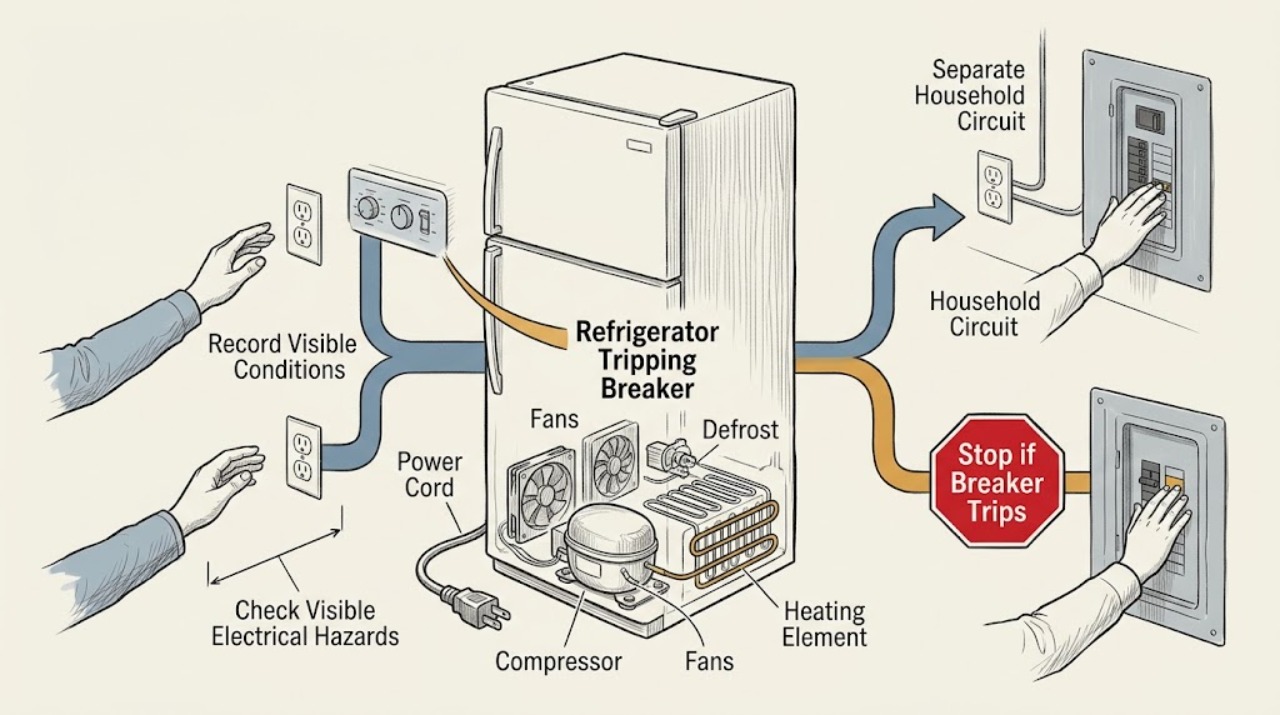
Stop resetting the breaker to see whether the refrigerator will keep running. From a dry, safe position, note whether the trip happens when the plug is connected, when the refrigerator starts, after it has run for a while, or only when other loads are used. Inspect only the visible plug, cord, outlet, and surrounding floor for heat, scorching, damage, moisture, or a burning smell; leave the refrigerator off for any hazard. Gaggenau manuals direct owners to check the fuse or breaker and whether other appliances work after a power failure, but they also warn not to operate a damaged appliance and to leave repairs to trained specialists. If the circuit remains on and there is no hazard, confirm only the accessible power connection and obtain the exact E-Nr from Gaggenau's manual lookup. A breaker that trips again, a hot or damaged outlet/cord, smoke, sparks, water near electrical parts, or a refrigerator that trips the circuit by itself is a stop-use condition. Do not use an extension cord, bypass protection, pull out a built-in unit, open panels, test live wiring, add refrigerant, or order a compressor or board from the symptom alone.
Before you begin
Safety first
- The user may stop operation, record timing, inspect visible dry external conditions, observe other household loads from a safe position, obtain the E-Nr, protect food, and use model-authorized owner controls that do not require dismantling. Circuit testing, outlet repair, built-in removal, live electrical work, control/compressor/defrost access, wiring, refrigerant, and sealed-system work belong to qualified professionals.
Work through in order
Diagnostic checks
Use only checks that match the exact appliance or system and its official guide.
-
Check 1
Stop operating the refrigerator and record the exact event without repeatedly resetting protection: whether the breaker trips as the plug is connected, when cooling starts, after a delay, during a defrost or ice event if the model has one, or only when another load runs. Record whether the display, interior light, or temperature indication was active immediately before the trip.
Expected result: The trip is immediate, start-related, delayed, load-dependent, or unrelated to a visible refrigerator event; the refrigerator is all dark or still has lights/display; or the timing is unknown.
Next step: Use the timing and exact model as service evidence. If the event is unknown, do not reproduce it; proceed only with the safe visual and circuit checks below.
Stop if: Do not keep the breaker engaged to observe the next cycle, repeatedly reconnect the plug, or use a guessed test sequence.
Why this matters
Why: Timing separates a circuit/load handoff from a refrigerator start or running symptom, but it cannot identify a compressor, fan, heater, control, or wiring fault safely. A light or display does not prove that every internal load is safe.
-
Check 2
From a dry, safe position, inspect only the visible plug, power cord, receptacle face, accessible switch, and floor or cabinet area around the refrigerator. Look for scorching, melted plastic, looseness, exposed conductor, moisture, water ingress, unusual heat, smoke, or a burning or chemical smell. Do not move a built-in refrigerator or remove a cover.
Expected result: The cord or plug is damaged or hot, the receptacle is discolored or hot, moisture is present, the area smells burnt, smoke or sparks occurred, or the visible electrical path appears normal.
Next step: For any hazard, keep the refrigerator off and isolate power only from a safe dry position if necessary; arrange qualified appliance or electrical service. If no hazard is visible, continue with a non-invasive circuit check without deliberately reproducing the trip.
Stop if: Do not touch wet electrical parts, open the receptacle, tape a damaged cord, smell closely at vents, or operate a damaged appliance.
Why this matters
Why: Damage, heat, moisture, smoke, sparks, or odor makes continued energizing unsafe and may involve the household installation or appliance. A normal-looking exterior does not clear hidden wiring or internal loads.
-
Check 3
If there is no visible hazard and the refrigerator is safely off, note whether the same breaker protects other outlets or appliances. From a dry position, check whether ordinary room lighting or another safe appliance works after the power event, as Gaggenau manuals advise for distinguishing a power failure. Do not add a high-load appliance, use an extension cord, or keep resetting the breaker.
Expected result: The room or other appliances are also without power; the breaker will not stay on; only the refrigerator circuit trips; or the household supply is stable while the refrigerator remains disconnected.
Next step: Arrange qualified electrical service for a circuit or breaker problem. If the household supply is stable, retain the refrigerator off and use the E-Nr and timing record for appliance service; do not reconnect solely to confirm the pattern.
Stop if: Do not change breaker or fuse ratings, bypass a residual-current device, share an unapproved outlet, or run the refrigerator from an extension cord or multiple socket strip.
Why this matters
Why: A wider outage or breaker that will not hold belongs to an electrical-supply branch. A trip limited to the refrigerator circuit increases concern about the refrigerator circuit, receptacle, cord, or appliance, but still does not identify an internal part.
-
Check 4
Read the exact E-Nr/model from the rating label or paperwork without dismantling the refrigerator and open the matching Gaggenau manual. If the breaker has remained on and the visible connection is dry and undamaged, note whether the refrigerator is completely dark or whether lights/display remain active; do not treat either state as permission for internal testing.
Expected result: The E-Nr is known and the refrigerator is dark, the E-Nr is known and the display works, or the model cannot be identified without moving or opening the appliance.
Next step: Provide the E-Nr, display state, breaker timing, and visible inspection to Gaggenau or qualified service. Use only model-authorized instructions that do not require a cover, live measurement, or bypass.
Stop if: Do not infer the model from the fascia, enter a service mode, pull out the refrigerator, or remove a control or compressor cover.
Why this matters
Why: The E-Nr determines the correct control, self-test, alarm, and installation information. An all-dark unit after a trip can have lost supply or internal power; a lit unit can still trip when a high-load component starts. An inaccessible label is a service task, not a reason to move a built-in unit.
-
Check 5
Keep the refrigerator off if the breaker trip recurs or the supply is uncertain, and protect perishable food in a safe cold location while arranging service. Note any loss of cooling, frost, water, unusual noise, or display alarm without opening panels or trying to identify a part by sound.
Expected result: Food is warming, the refrigerator is still cold, the freezer temperature alarm appears, moisture or frost is present, or another symptom accompanies the trip.
Next step: Minimize door opening, move or discard food according to the exact manual and local food-safety guidance, and arrange appliance service. Do not restart to preserve food if the breaker or refrigerator is unsafe.
Stop if: Do not use heat, flame, refrigerant, live testing, or improvised wiring to restore cooling; do not consume food that has been held at an unsafe temperature.
Why this matters
Why: Loss of cooling or an alarm increases urgency because food quality can deteriorate during a power failure. Gaggenau documents that power failure raises appliance temperature and reduces frozen-food storage quality; a combined symptom gives the technician useful context but not a safe part diagnosis.
-
Check 6
Prepare the service handoff with the exact model/E-Nr, breaker or residual-device behavior, trip timing, room-load observations, visible cord/outlet condition, display state, food-temperature impact, and any smell, heat, moisture, noise, or alarm. Do not perform another energized trial merely to make the technician's diagnosis easier.
Expected result: The trip is repeatable, the refrigerator remains dead, the circuit is abnormal, the trip has not returned, or a hazard was observed.
Next step: Arrange qualified Gaggenau appliance service and qualified electrical service when the circuit or receptacle is implicated. Keep the appliance isolated until the responsible professional clears it.
Stop if: Do not bypass protective devices, open the sealed system, replace a compressor/control part based on the symptom alone, or continue operation after a safety warning.
Why this matters
Why: A repeat trip or hazard requires the refrigerator to remain off. A single event without hazard may be documented as a power event, but recurrence or a dead refrigerator still requires model-specific diagnosis; normal operation after one event does not prove the fault is gone.
Use your observations
Decision map
Find the observation that best matches what you see, then follow the next safe action.
-
PATH 01Safety boundary
What you see
Room lighting or other safe appliances also lose power, or the breaker will not remain on even with the refrigerator disconnected.
Do this next
Keep the refrigerator disconnected and arrange qualified electrical service. Do not increase the protective rating or keep resetting the breaker.
Why this path and its safety boundary
Why it matters: The household circuit, protective device, or supply is the first service boundary; the refrigerator cannot be blamed from this observation.
Safety stop: Stop for heat, smoke, sparking, a damaged receptacle, or exposed wiring and keep people away from the hazard.
-
PATH 02Safety boundary
What you see
The trip is limited to the refrigerator circuit, especially when the refrigerator is connected or begins operating, while the rest of the household supply is stable.
Do this next
Leave the refrigerator off and arrange qualified appliance service; involve an electrician if the circuit or receptacle also shows abnormal behavior.
Why this path and its safety boundary
Why it matters: The receptacle, cord, appliance input, or an internal load may be involved. Trip timing can guide service but cannot identify a compressor, fan, defrost, control, or wiring part safely.
Safety stop: Do not reconnect repeatedly, run an extension cord, bypass the protective device, or perform live measurements.
-
PATH 03Safety boundary
What you see
The cord or outlet is hot or damaged, moisture is near electrical parts, or there was smoke, sparking, scorching, or a burning smell.
Do this next
Keep the refrigerator off, isolate power only from a safe dry position if necessary, and arrange qualified appliance or electrical service.
Why this path and its safety boundary
Why it matters: Continued energizing presents an electrical or fire risk regardless of whether the refrigerator still cools.
Safety stop: Do not touch wet electrical parts, open the rear or control area, sniff closely, or restart to reproduce the event.
-
PATH 04Safety boundary
What you see
There was one trip after a broader power event, no visible hazard is present, the circuit remains stable, and the refrigerator has no continuing abnormal symptom.
Do this next
Record the event and exact E-Nr, use the matching manual, and monitor without deliberate stress testing. Arrange service if it trips again, becomes warm, or shows an alarm.
Why this path and its safety boundary
Why it matters: A transient household event is possible, but a temporary recovery does not prove that the appliance is safe or that an internal fault will not recur.
Safety stop: Do not repeatedly cycle power or leave the appliance operating unattended after an unexplained trip.
-
PATH 05Safety boundary
What you see
The breaker trips again, the refrigerator loses cooling, a temperature alarm appears, or the trip is accompanied by unusual noise, water, odor, or heat.
Do this next
Keep the refrigerator off, minimize door opening, protect perishable food, and arrange prompt qualified appliance service plus electrical service if indicated.
Why this path and its safety boundary
Why it matters: The problem is no longer a simple power-outage observation. An internal appliance fault or a combined installation fault needs professional diagnosis, and food may be at risk.
Safety stop: Do not use a larger fuse, bypass a breaker, open refrigeration tubing or panels, or restart for another test.
Helpful context
Understand the symptom
A repeated trip is a safety signal, not a reset challenge
Leave the refrigerator off after a second trip or any sign of heat, damage, moisture, smoke, sparking, or burning odor. Do not hold the breaker on while watching the refrigerator, use a larger fuse, or substitute an extension cord. Gaggenau says a damaged appliance or cord must not be operated and that the appliance may need to be unplugged or isolated at the fuse box before service. If the refrigerator is built in, do not pull it forward to reach a hidden connection.
First separate the circuit from the refrigerator
A breaker can trip because of the household circuit, another load, the receptacle, the cord, or the refrigerator. The trip timing is useful evidence: immediately on connection, at compressor start, after several minutes, during a cooling or defrost event, or only when another appliance runs. Timing narrows the handoff but does not identify a safe replacement part. Record the exact model/E-Nr, breaker type if known, and what else was operating; Gaggenau's official manual page is the source for the matching instructions.
A working display does not clear the power circuit
Lights or a display may work before a compressor, fan, heater, or other load starts. Conversely, an all-dark refrigerator after a trip may reflect the circuit, plug, control, or internal power path. Do not interpret a temporary restart as proof that the refrigerator is safe: a repeat trip or abnormal heat moves directly to service.
Safety boundary
Stop conditions
- Do not repeatedly reset or hold on a tripping breaker, change fuse or breaker ratings, or bypass a residual-current device.
- Do not use an extension cord, multiple socket strip, improvised adapter, or unapproved external switching device.
- Do not open the outlet, plug, control panel, rear cover, compressor compartment, sealed system, or wiring, and do not perform live measurements.
- Do not pull out a built-in refrigerator or disconnect water, electrical, or refrigerant connections to reach the source.
- Stop for smoke, sparking, burning odor, abnormal heat, hot or damaged cord/outlet, water near electrical parts, or repeated breaker trips.
When checks do not resolve it
Need a professional?
Arrange qualified service after a repeated breaker trip, a trip limited to the refrigerator circuit, a verified supply with a dead refrigerator, or any trip accompanied by loss of cooling, alarm, water, unusual noise, heat, or odor. Stop immediately for smoke, sparks, burning smell, hot or damaged cord/outlet, moisture near electrical parts, or a breaker that trips again; isolate power only from a safe dry position and do not pull out a built-in refrigerator.
Safety scope: The user may stop operation, record timing, inspect visible dry external conditions, observe other household loads from a safe position, obtain the E-Nr, protect food, and use model-authorized owner controls that do not require dismantling. Circuit testing, outlet repair, built-in removal, live electrical work, control/compressor/defrost access, wiring, refrigerant, and sealed-system work belong to qualified professionals.
Common questions
FAQ
Why does my Gaggenau refrigerator keep tripping the breaker?
The symptom can come from the household circuit, receptacle, cord, appliance input, or an internal load such as a compressor, fan, defrost circuit, control, or wiring. Trip timing and whether other room loads also lose power help separate those branches, but they do not identify a safe replacement part. Stop repeated resets and arrange qualified appliance or electrical diagnosis.
Should I reset the breaker for my Gaggenau refrigerator?
Do not repeatedly reset it. If there is heat, scorching, moisture, smoke, sparking, burning odor, cord or outlet damage, or a second trip, leave the refrigerator off and isolate power only from a safe dry position. If there is no hazard, record the event and have the circuit and appliance checked rather than deliberately reproducing the trip.
What if the refrigerator display still works after the breaker trips?
A display or interior light shows that some functions have power; it does not clear the compressor, fan, defrost, control, wiring, or appliance input. Do not run an energized test to find which load trips the circuit. Keep the timing and display state for service, especially if the trip recurs when cooling starts.
Can a normal refrigerator sound cause the breaker to trip?
Gaggenau identifies hum, bubbling, buzzing, gurgling, clicking, and similar sounds as possible motor, fan, refrigerant, switch, or solenoid operation on an RC 200 manual. Those sounds alone are not proof of a fault and do not explain a breaker trip; an electrical trip or abnormal heat needs separate safety and service evaluation.
What should I do with food while a tripping refrigerator is off?
Keep the refrigerator door closed as much as possible and move perishable food to a safe cold location. Gaggenau says a power failure raises the appliance temperature and reduces frozen-food storage quality, so use the exact model guidance and local food-safety rules before consuming food that has warmed or thawed.
When does a Gaggenau refrigerator breaker trip require service?
Arrange service after any repeated trip, a trip limited to the refrigerator circuit, a dead refrigerator with a verified supply, or a trip with loss of cooling, alarm, water, unusual noise, heat, or odor. Stop immediately for smoke, sparks, burning smell, hot or damaged electrical parts, moisture near electricity, or repeated protection trips.
Read the exact guide
Official sources
- Gaggenau User manual RC 200Gaggenau · Supports the distinction between normal motor/fan/refrigerant/switch sounds and an electrical trip, plus power-failure food handling, for RC 200; it does not diagnose breaker causes.
- Gaggenau User manual RC 282Gaggenau · Supports the same broad damaged-appliance, cord, breaker isolation, electronics, and specialist-repair safety boundary for RC 282; model-specific operation must be checked separately.
- Downloads | GaggenauGaggenau · Supports obtaining the exact refrigerator manual by appliance number/E-Nr; it does not prove any one model's breaker, control, or internal fault behavior.
- Gaggenau User manual RB 289Gaggenau · Supports the damaged-appliance, cord, circuit-breaker isolation, food-protection, and specialist-repair boundaries for the RB 289 family; exact controls and installation vary by E-Nr.
Community feedback
Share a repair observation
Share a plain-text repair observation. Accepted observations are published automatically; this page may take a moment to update.