
On this page
Start here
Quick answer
Treat a GE Artistry refrigerator as a bottom-freezer design first: identify whether the upper fresh-food door or the lower freezer drawer/door is failing, then remove the obstruction rather than forcing it. Check for a tall package, open bin, heavy door item, ice behind the freezer door, shipping material, an overfilled or unseated lower basket, and a gasket that has pulled out of its groove. GE says the door should close on its own when the refrigerator is correctly leveled; the Artistry manual says its leveling legs stabilize the cabinet and its troubleshooting table lists leveling legs for a door or drawer that does not close by itself. Clean and dry a visibly dirty gasket with the model-approved method, and use the exact manual before making any adjustment. A torn gasket, broken hinge, uneven door that remains after safe loading and leveling checks, a cabinet that rocks, or a door that binds against cabinetry needs service. Keep the door closed as far as possible to protect food. Do not force the door, remove a hinge, pull out the refrigerator, bypass a door switch, use heat on the gasket, or order a hinge or gasket without the exact model.
Before you begin
Safety first
- The user may remove visible food or ice obstructions, close bins, check the lower basket and accessible gasket seating, clean accessible gasket surfaces with the model-approved method, observe cabinet stability, and follow model-authorized leveling instructions. Hinge, door-stop, slide, cabinet, built-in removal, water-line, electrical, and unsupported-door work belong to qualified service.
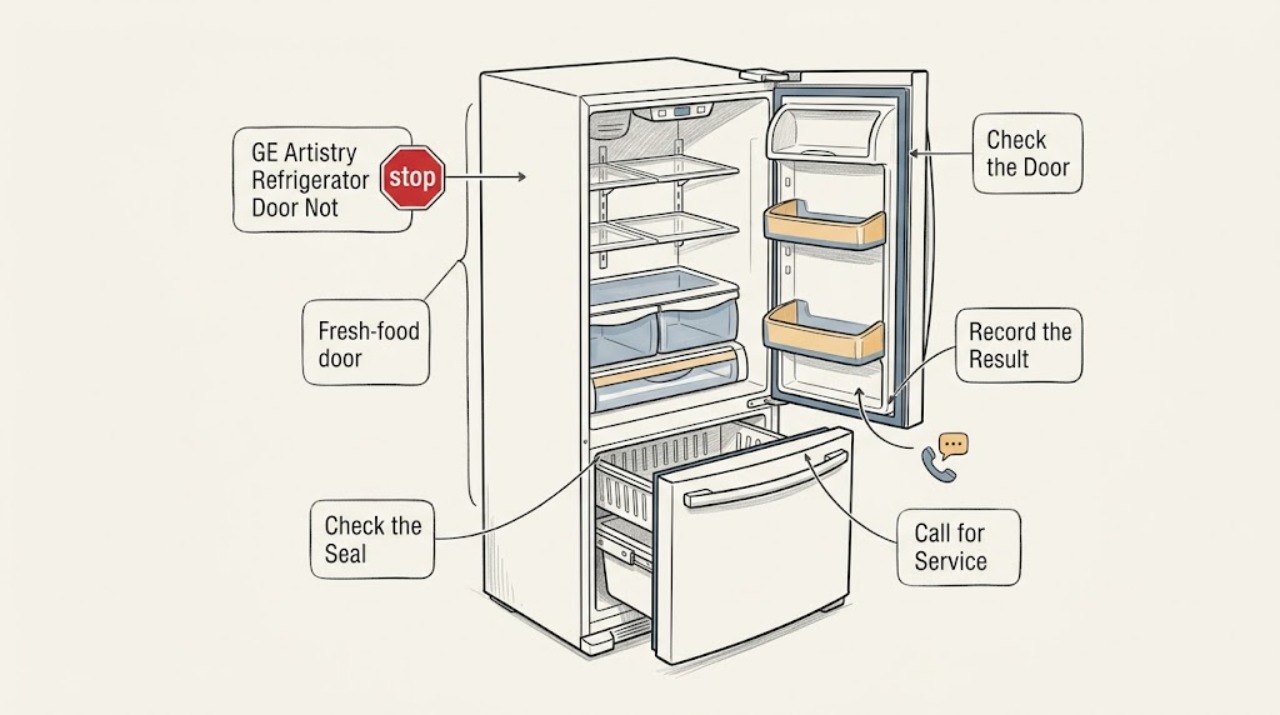
Work through in order
Diagnostic checks
Use only checks that match the exact appliance or system and its official guide.
-
Check 1
Record the exact model from the refrigerator label or paperwork without moving the cabinet, and identify the failing part: upper fresh-food door, lower freezer drawer/door, or both. Note whether the problem started after loading food, cleaning, moving the refrigerator, reversing a door, or removing and replacing the freezer basket.
Expected result: The upper door is blocked, the lower freezer drawer/door is blocked or skewed, both doors show a gap, the cabinet rocks, or the exact model is unknown.
Next step: Follow only the branch matching the affected door or drawer. If the label cannot be read without moving or dismantling the refrigerator, stop at model-specific service rather than guessing the mechanism.
Stop if: Do not infer the model from the finish, remove the door to find its label, or start with hinge screws.
Why this matters
Why: The Artistry line is a bottom-freezer family, but door and drawer details vary by model. A model number is needed for the correct gasket, hinge, basket, door-stop, leveling, and installation instructions; a single obstructed door follows a different path from a cabinet-wide alignment problem.
-
Check 2
With the fresh-food door open, check the shelves, drawers, door bins, and tall containers for anything projecting into the closing path. Close every bin and drawer, move heavy door items so they cannot fall forward, and check the upper and lower corners for packaging or a small ice piece. Make only visible loading changes; do not force the door against an obstruction.
Expected result: A package, open bin, drawer, heavy item, ice piece, or shipping material is found; the door closes after removal; or the empty door still stops short or leaves a gap.
Next step: Rearrange or remove the obstruction and check the seal around the closed door. If the door still binds, drops, or remains uneven, do not force it; continue to the gasket and cabinet checks.
Stop if: Do not pry the door, bend shelves or bins, remove hinges, or keep food pressing against a door that cannot seal.
Why this matters
Why: A door that closes after the visible obstruction is removed is a loading problem, not proof of a hinge or gasket failure. A persistent gap with an empty path moves to gasket and level/alignment checks.
-
Check 3
For the lower freezer drawer or door, remove only packages that visibly prevent closure, check that the lower basket is not filled above its rim or jammed, and verify that the basket is seated in its slides as the model manual permits. Check for shipping material and for a gasket that is fully seated in its groove and contacts the frame evenly around the perimeter.
Expected result: A package, overfilled basket, unseated basket, shipping material, loose gasket, uneven gasket contact, or no visible obstruction is found.
Next step: Correct only the visible load or reseat the basket exactly as the manual describes; press a loose gasket into its groove only if the exact model permits it. Stop and arrange service for a torn gasket, damaged slide, drawer that drops, or a gap that remains.
Stop if: Do not reach into an inaccessible slide mechanism, remove the drawer front, cut the gasket, or use heat or tools to reshape it.
Why this matters
Why: The lower freezer assembly can remain skewed or unsealed when a package blocks it, the basket is not seated, or the gasket is out of its groove. Even contact around the frame supports a seal; a torn gasket or persistent uneven gap needs a model-specific adjustment or service path.
-
Check 4
With the door or drawer open, inspect the visible gasket for dirt, folds, tears, pulled sections, or a section outside its retaining groove. Clean accessible gasket surfaces with the method allowed by the owner manual, rinse if instructed, and dry them. Close the empty door gently and compare the gasket-to-cabinet contact around the top, bottom, hinge side, and handle side.
Expected result: The gasket is dirty but intact, is loose from its groove, remains folded or damaged, contacts unevenly, or seals evenly after cleaning and reseating.
Next step: Use only the exact model's gasket-adjustment guidance for a loose section. Arrange service for a damaged gasket, persistent uneven contact, or a door that still will not close; do not order a generic replacement.
Stop if: Do not use a heat gun, solvent, petroleum product, bleach, ammonia, adhesive, or sharp tool on the gasket, and do not remove a hinge to improve contact.
Why this matters
Why: A clean, seated, evenly contacting gasket can restore closure when residue or a pulled section caused drag. Cuts, tears, persistent deformation, or uneven contact after safe cleaning suggest gasket fit, door alignment, or hinge trouble rather than a loading issue.
-
Check 5
With the appliance stable and the door path empty, observe whether the door or drawer closes on its own from a partially open position and whether the cabinet rocks. GE says an improperly leveled refrigerator may not shut on its own; the Artistry manual identifies leveling legs as stabilizers and lists them for a door or drawer that does not close by itself. Use the exact model's leveling instructions only if the adjustment is owner-authorized and does not require moving the appliance.
Expected result: The cabinet rocks, the front is not correctly leveled, the door closes by itself after leveling, the door remains uneven, or the hinge side drops or binds.
Next step: Make only the model-authorized leveling adjustment and recheck closure once. Arrange service for broken or loose hinges, a twisted cabinet, built-in alignment, or persistent misalignment.
Stop if: Do not remove the base grille, door, hinge, stop, handle, or drawer unless the exact manual and a qualified person authorize the work; never work under an unsupported appliance.
Why this matters
Why: A stable, correctly leveled cabinet can restore the intended self-closing behavior. A door that remains uneven, drops, binds against cabinetry, or has a damaged hinge is a mechanical service issue; do not convert it into a generic gasket problem.
-
Check 6
After only the applicable visible correction, close the door gently and check that the gasket contacts evenly without holding the door by hand. Keep openings brief and note whether frost, condensation, a door alarm, warming food, or recurring closure failure appears. Record the model, affected door, gap location, and what changed for service.
Expected result: The door seals and remains closed; it closes but frost or condensation returns; it cannot latch or stay closed; or the hinge, cabinet, gasket, water line, or wiring appears damaged.
Next step: Arrange qualified GE appliance service for persistent gaps, damaged mechanical parts, recurring frost or moisture, or a door that cannot remain closed. Move or protect perishable food if the compartment is warming.
Stop if: Do not prop the door shut, bypass a door or light switch, operate with exposed wiring or a damaged water line, or keep using a door that cannot seal.
Why this matters
Why: Stable closure after a load, gasket, or level correction supports an external cause. Recurrent frost or moisture indicates an imperfect seal, while a door that drops, cannot latch, or exposes damage requires service and may compromise food temperature.
Use your observations
Decision map
Find the observation that best matches what you see, then follow the next safe action.
-
PATH 01Safety boundary
What you see
A package, open bin, heavy door item, small ice piece, shipping material, or overfilled basket prevents the door or freezer drawer from reaching the frame.
Do this next
Remove or rearrange the visible obstruction, close bins and baskets, and make one gentle closure check.
Why this path and its safety boundary
Why it matters: The closure failure is most consistent with a visible loading or installation-material obstruction, not a proven hinge or gasket defect.
Safety stop: Do not force the door, bend the bin, or operate while the obstruction prevents a seal.
-
PATH 02Safety boundary
What you see
The door path is clear, but the gasket is dirty, folded, loose from its groove, torn, or not contacting the frame evenly.
Do this next
Clean and dry the accessible gasket with the approved method and reseat only a permitted loose section. Arrange service if damage or uneven contact remains.
Why this path and its safety boundary
Why it matters: The seal is a likely contributor to drag or a persistent gap. A loose intact section may be owner-correctable only under the exact model guidance; a torn or persistently uneven gasket needs service or a model-matched part.
Safety stop: Do not use heat, solvent, adhesive, sharp tools, or a generic gasket, and do not remove the hinge.
-
PATH 03Safety boundary
What you see
The load path and gasket appear intact, but the cabinet rocks, the door does not self-close from a partial opening, or the door is uneven.
Do this next
Follow the exact manual's owner-authorized leveling procedure once if the appliance can remain stable; arrange service for persistent unevenness, built-in alignment, or a cabinet that cannot be safely adjusted.
Why this path and its safety boundary
Why it matters: Leveling or alignment is more likely than an obstruction. The Artistry manual identifies leveling legs for stability and door/drawer self-closing behavior, but the adjustment remains model-specific.
Safety stop: Do not work under an unsupported refrigerator, pull it out by the door, or remove hinges, drawer slides, or door stops.
-
PATH 04Safety boundary
What you see
The door drops, scrapes, binds against cabinetry, has a broken hinge or door stop, the drawer slides are damaged, or the cabinet remains misaligned after safe external checks.
Do this next
Keep the door closed as far as possible and arrange qualified GE appliance service with the model and photos or a description of the gap and movement.
Why this path and its safety boundary
Why it matters: A mechanical or installation fault is more likely and cannot be corrected safely by changing the gasket or forcing the door.
Safety stop: Do not remove hinges, lift the door, pull out the built-in unit, or operate with a door that cannot remain supported and sealed.
-
PATH 05Safety boundary
What you see
The door appears closed but frost, condensation, a door alarm, or warming food returns, or the gap persists after the visible load, gasket, and level checks.
Do this next
Arrange service, minimize door opening, and protect perishable food in a safe cold location while the seal is evaluated.
Why this path and its safety boundary
Why it matters: The refrigerator may not be maintaining a reliable seal. Continued warm-air entry can affect temperature and food quality, and the remaining cause may be a gasket, hinge, alignment, or cabinet issue.
Safety stop: Do not tape or prop the door, bypass the door alarm or switch, or continue using a damaged or leaking appliance.
Helpful context
Understand the symptom
Start with the Artistry bottom-freezer layout
GE's Artistry Series includes a bottom-freezer refrigerator, and the official Artistry material identifies ABE20EGEBS and ABE20EGEWS examples. The exact task model is not supplied, so use the page to separate the fresh-food door from the lower freezer drawer or door, then confirm the model's manual before adjusting anything. A door can look closed while a bin, basket, gasket, hinge, or cabinet level leaves a gap or prevents a seal.
Remove the obstruction before blaming the hinge
An item protruding from a shelf, an open door bin, a heavy item falling forward, a small ice cube, shipping foam, or a lower freezer basket that is not seated can stop closure. GE's support guidance treats these as separate door-blocking checks. If the door closes after the visible load is corrected, do not replace a hinge or gasket; if the gap remains with an empty path, continue to gasket and level checks.
Keep door and hinge work within the owner boundary
Only remove visible food or ice and inspect or clean an accessible gasket using the exact model's instructions. Do not remove hinges, door stops, handles, drawer slides, panels, or the cabinet to make the door fit. Do not use a heat gun or high heat on the gasket, force a warped door, or operate with a door that cannot seal. If the cabinet rocks, the hinge is damaged, the door drops, the gasket is torn, or a water line or wiring is exposed, arrange service.
Safety boundary
Stop conditions
- Do not force, tape, prop, or hold the door or drawer shut, and do not bypass a door, light, or alarm switch.
- Do not remove hinges, door stops, handles, drawer fronts, slides, panels, or the cabinet to correct alignment.
- Do not pull out a built-in or unstable refrigerator, work under an unsupported door, or use heat, solvent, adhesive, or sharp tools on a gasket.
- Do not order a hinge, gasket, slide, or other part without confirming the exact model and the diagnostic result.
- Stop for exposed wiring, a damaged water line, a cabinet or door that may fall, or a seal failure accompanied by warming food or repeated alarm.
When checks do not resolve it
Need a professional?
Arrange service when the door remains uneven or unsealed after visible loading, gasket, and model-authorized leveling checks; when a hinge, door stop, basket slide, cabinet, water line, or wiring is damaged; or when frost, condensation, a door alarm, or warming food returns. Keep the door closed as far as possible and protect perishable food if temperature is rising.
Safety scope: The user may remove visible food or ice obstructions, close bins, check the lower basket and accessible gasket seating, clean accessible gasket surfaces with the model-approved method, observe cabinet stability, and follow model-authorized leveling instructions. Hinge, door-stop, slide, cabinet, built-in removal, water-line, electrical, and unsupported-door work belong to qualified service.
Common questions
FAQ
What should I check first when a GE Artistry refrigerator door will not close?
Identify whether the upper fresh-food door or lower freezer drawer is affected, then clear packages, open bins, heavy door items, ice pieces, shipping material, and an overfilled or unseated lower basket. GE identifies these visible checks before leveling, gasket, and hinge service checks.
Why will the lower freezer drawer on my GE Artistry refrigerator not seal?
A package may block it, the lower basket may not be seated, shipping material may remain, or the gasket may be out of its groove or contact the frame unevenly. Correct only visible loading or seating issues allowed by the exact manual; arrange service for a damaged gasket, slide, hinge, or persistent gap.
Can leveling fix a GE Artistry refrigerator door that does not close by itself?
It can when the cabinet is unstable or not correctly leveled. GE says an improperly leveled refrigerator may not shut on its own, and the Artistry-linked manual lists leveling legs for a door or drawer that does not close by itself. Use the exact model's adjustment instructions and stop if the cabinet is unstable or the door remains uneven.
How do I clean a GE Artistry refrigerator door gasket?
Clean only the accessible gasket with the exact manual-approved method. GE's general care guidance uses warm water and baking soda, followed by rinsing and drying, and warns against petroleum distillates, detergent, bleach, ammonia, and dishwasher cleaning of plastic parts. Do not use heat or solvent to reshape the gasket.
When does a door that will not close need service?
Arrange service when the hinge, door stop, drawer slide, cabinet, or gasket is damaged; the door drops or binds; the refrigerator rocks; the gap remains after visible loading, gasket, and model-authorized leveling checks; or frost, condensation, a door alarm, or warming food returns. A broken hinge is a GE-identified service condition.
Read the exact guide
Official sources
- Refrigerator, Freezer and Standalone Ice Maker - Care and Cleaning of Interior and GasketGE Appliances · Supports safe accessible gasket cleaning and cleaner restrictions; it does not establish a replacement gasket or hinge fit for an Artistry model.
- Owner's Manual and Installation InstructionsGE Appliances · Supports bottom-freezer basket/drawer, loading, leveling-leg, gasket, door and service boundaries for the linked manual family; exact Artistry model features must be confirmed before adjustment.
- Refrigerator - Door Will Not CloseGE Appliances · Supports visible obstruction, bin, heavy-item, ice, leveling, shipping-material, and broken-hinge branches; it is general GE guidance and not a substitute for the exact Artistry manual.
- Refrigerator - Easy to Remove GasketGE Appliances · Supports checking that an applicable easy-remove gasket is fully pushed into its groove and seals evenly; the exact Artistry model must determine whether this gasket design applies.
- GE Unveils First Line of Appliances Designed by a Millennial for MillennialsGE Appliances Pressroom · Confirms that the Artistry Series included a bottom-freezer refrigerator and lists ABE20EGEBS and ABE20EGEWS; it does not establish every model's door adjustment procedure.
- User Manual & Care for ABE20EGEBS | GE AppliancesGE Appliances · Confirms an Artistry bottom-freezer refrigerator model and provides the official owner-manual link; exact task model is not supplied.
- Bottom Freezer Refrigerator - Freezer Drawer Not Sealing ProperlyGE Appliances · Supports package, shipping-material, lower-basket seating, gasket groove, and even frame-contact checks relevant to a bottom-freezer layout; exact Artistry adjustment remains model-specific.
Community feedback
Share a repair observation
Share a plain-text repair observation. Accepted observations are published automatically; this page may take a moment to update.