
On this page
Start here
Quick answer
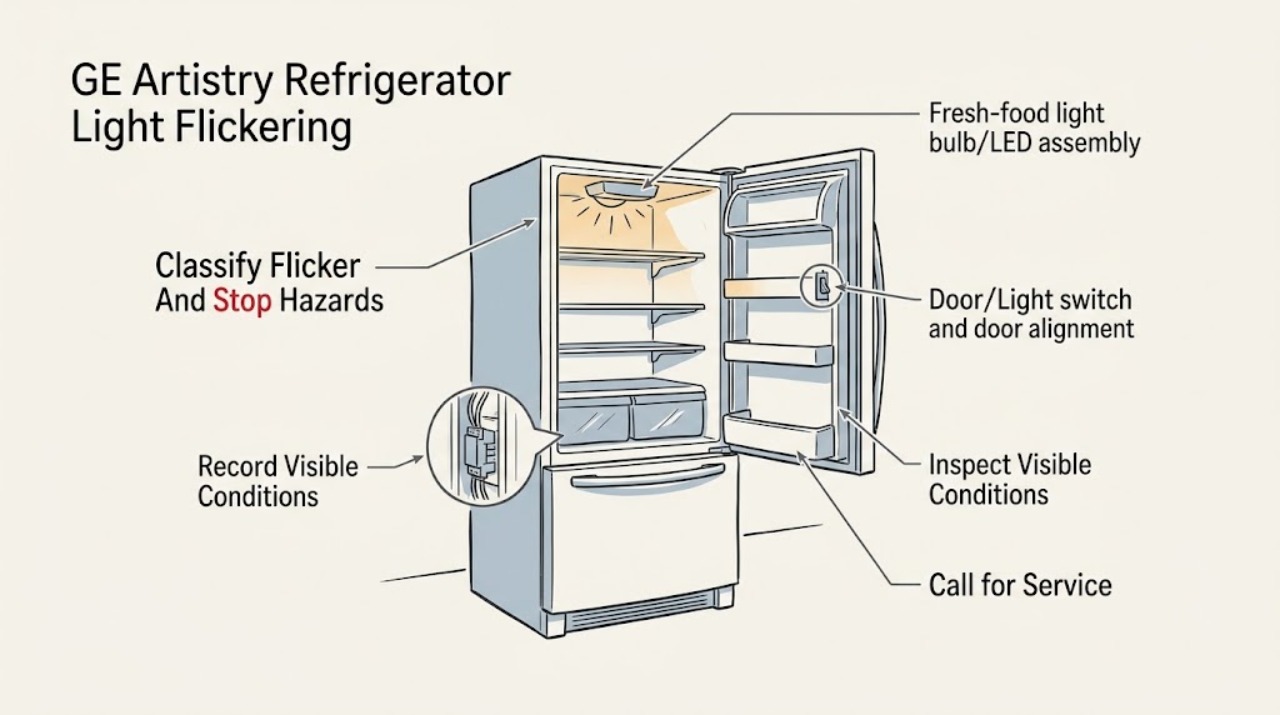
First record whether the flicker affects one interior light, several lights, the dispenser light, or the control display, and whether it starts as the door moves or stays open. Confirm the complete model number because GE Artistry models differ: GE's ABE21DGKBS Artistry product page specifies LED lighting, while GE's general guidance says some older refrigerator designs use replaceable bulbs and many newer designs use LED boards. With the refrigerator in a safe, dry condition, close the door slowly and observe whether the light goes out when the opening is about 1 inch; a misaligned door can leave a light on, but a flicker that follows door movement is not proof of a failed switch. Do not repeatedly cycle power, probe the light socket, bypass the door switch, or remove an LED panel. If the exact manual identifies a user-replaceable bulb, disconnect refrigerator power before replacing it with the same size and type. GE says LED light assemblies require authorized service. Stop and arrange service for flickering across multiple compartments, a flicker with display/cooling changes, a hot socket or cord, burning odor, sparking, moisture, exposed wiring, or a light that remains abnormal after the model-specific external checks.
Before you begin
Safety first
- The user may observe light behavior, door closure, and visible lens condition. A user-replaceable bulb may be changed only when the exact manual permits it and power is disconnected. Qualified service must handle LED assemblies, sockets, door switches, harnesses, control boards, internal wiring, live tests, and electrical or moisture hazards.
Work through in order
Diagnostic checks
Use only checks that match the exact appliance or system and its official guide.
-
Check 1
Keep the refrigerator operating normally only if there is no hazard, and record which light flickers: fresh-food interior, freezer, dispenser, a single lamp, or multiple locations. Note whether the control display, cooling, compressor sound, or other functions change at the same time. Stop from a dry, safe position if there is smoke, burning odor, sparking, heat, moisture at electrical parts, or exposed wiring.
Expected result: Only one light flickers, several lights flicker together, the display also resets or dims, the flicker follows door movement, or an electrical/heat/water hazard is present.
Next step: For a hazard, leave the refrigerator out of service and arrange qualified appliance or electrical help. Otherwise continue with the model and door-position observations without removing anything.
Stop if: Do not open the light housing, probe a socket, repeatedly cycle power, or keep operating a hot, wet, scorched, or sparking light circuit.
Why this matters
Why: A single light and a whole-lighting or control symptom do not identify the same fault. A hazard is a stop-use condition rather than a lamp-selection problem.
-
Check 2
Read the complete model number from the refrigerator's accessible label or paperwork without removing trim, moving the appliance, or opening electrical covers. Compare it with the GE Owner Center and exact owner's manual, and record whether the manual calls the lighting an LED assembly, light column, or replaceable bulb.
Expected result: The model is legible and the manual identifies LED lighting, a user-replaceable bulb, or a different arrangement; or the model cannot be safely identified.
Next step: Follow only the matching model branch. If the label is missing or the manual cannot be matched, provide the model and symptom to GE service rather than ordering a part by appearance.
Stop if: Do not remove trim or panels to find a label and do not assume every Artistry refrigerator uses the same lamp.
Why this matters
Why: GE's ABE21DGKBS Artistry product page specifies LED lighting, but GE states that lamp type and location vary by model. A generic Artistry label cannot establish a compatible bulb or LED assembly.
-
Check 3
With the refrigerator otherwise safe, open and close the fresh-food and freezer doors slowly from outside. Observe whether the light changes at one repeatable door angle, whether it goes out as the opening approaches about 1 inch, and whether the door closes, seals, and aligns normally. Do not press or bypass the light switch.
Expected result: The flicker follows door movement, the light stays on with a nearly closed or misaligned door, the door does not seal, or the flicker is unchanged by door position.
Next step: Remove only an obvious container blocking closure and confirm the door gasket is not visibly folded or obstructed. If alignment, switch actuation, or sealing remains abnormal, arrange service; if door position has no effect, continue to the lamp-type branch.
Stop if: Do not bend the switch, adjust hinges, remove a door, or test switch continuity.
Why this matters
Why: GE says a misaligned door can keep the light on and describes the normal light-out behavior on most models. A repeatable door-angle symptom makes door alignment or switch actuation worth professional/model-specific evaluation, but does not prove which component failed.
-
Check 4
Only when the exact Artistry manual explicitly identifies a user-replaceable bulb, disconnect refrigerator power, let the bulb cool, and inspect the accessible bulb and shield for visible darkening, looseness, cracking, or the wrong lamp type. Replace only with the same size and type specified by that manual, then reinstall the shield before restoring power.
Expected result: The manual confirms a bulb, the bulb is visibly failed or incorrect, the bulb and holder look sound, or the manual identifies an LED assembly instead.
Next step: Correct only a confirmed bulb mismatch or failure using the exact manual. If flicker persists, stop lamp work and arrange model-specific service.
Stop if: Do not touch a lamp while energized, install a higher-wattage or guessed bulb, use foil or improvised contacts, or dismantle a sealed holder.
Why this matters
Why: GE says bulb size and type vary and must match the original. A sound bulb with continued flicker shifts attention to the holder, switch, wiring, or control; an LED designation shifts replacement to service.
-
Check 5
If the model uses an LED panel, LED column, or individual LED assembly, inspect only the visible lens for condensation, impact, or contamination and record whether one module or several modules flicker. Do not remove the panel, disconnect a harness, or make voltage measurements.
Expected result: One LED module flickers while others remain steady, several interior sections flicker together, the lens is wet/damaged, or the entire light system and controls are abnormal.
Next step: Keep the refrigerator in normal use only if there is no hazard and cooling remains normal; arrange GE-authorized service for persistent flicker, moisture, or multiple-module symptoms.
Stop if: Do not pry off an LED lens, bypass a door switch, jumper a harness, or perform live electrical testing.
Why this matters
Why: GE says LED assemblies require authorized service. One-module and system-wide symptoms can guide the technician's model-specific diagnosis, but neither identifies a compatible module or control board for a model-less Artistry page.
-
Check 6
If the flicker began after a power interruption or service event and there is no hazard, record any display code or reset behavior. Use one model-approved power reset only if the exact manual or GE guidance supports it, disconnecting from a dry, safe position; do not repeatedly cycle the refrigerator or enter diagnostic mode.
Expected result: The flicker clears after the documented reset, a code or display fault returns, the display also flickers, or the light symptom remains unchanged.
Next step: Monitor only a hazard-free refrigerator after a successful model-specific reset. For a recurring code, display fault, or unchanged flicker, leave internal diagnosis to qualified service and provide the model and timing.
Stop if: Do not reset repeatedly, change wiring, access a control board, or restore power after water or electrical damage.
Why this matters
Why: GE notes that some refrigerator control codes can clear after a short power disconnect but also says persistent cases may require service. A recurring light/control symptom is not proof of a bulb failure.
-
Check 7
Arrange service when the flicker persists after the safe model and door-position checks, affects multiple compartments, involves a light assembly, or coincides with cooling/control changes. Keep the refrigerator out of service for smoke, burning odor, sparking, unusual heat, moisture at electrical parts, exposed wiring, or a damaged cord/outlet.
Expected result: The symptom has stopped after a model-confirmed bulb correction or one documented reset with no hazard, or it remains abnormal or unsafe.
Next step: Provide the complete model, light location, door-angle behavior, bulb/LED designation, display state, and hazard history to GE-authorized or qualified appliance service. Use a qualified electrician for a damaged or repeatedly tripping house circuit.
Stop if: Do not remove panels, perform energized tests, bypass protection, or order an internal light/control part from a generic search.
Why this matters
Why: A corrected external condition can be monitored. Persistent or hazardous symptoms may involve a switch, LED assembly, harness, control, or power path that GE's public guidance does not identify safely without the exact model and inspection.
Use your observations
Decision map
Find the observation that best matches what you see, then follow the next safe action.
-
PATH 01Safety boundary
What you see
One interior light flickers only as a refrigerator door moves or approaches the nearly closed position, and the door is visibly misaligned or does not seal normally.
Do this next
Remove only an obvious obstruction to closure and arrange model-specific service if the door, gasket, or switch actuation remains abnormal. Do not infer a switch part without the model.
Why this path and its safety boundary
Why it matters: Door alignment or light-switch actuation becomes more likely than a whole-appliance power fault. GE says a misaligned door can leave the light on and describes light-out behavior near a 1-inch opening on most models.
Safety stop: Do not bend, bypass, or electrically test the door switch or adjust hinges as a light test.
-
PATH 02Safety boundary
What you see
The exact Artistry manual identifies a replaceable bulb and the flicker is confined to that bulb, with no heat, moisture, sparking, or control symptom.
Do this next
Disconnect power, let the bulb cool, and follow only the exact manual's replacement instruction and lamp specification. If the new correct bulb flickers, arrange service.
Why this path and its safety boundary
Why it matters: A failed, loose, darkened, or wrong-type bulb is a reasonable user-level possibility, but GE says size and type vary by model.
Safety stop: Do not install a guessed bulb, touch an energized socket, or repair contacts with foil or improvised material.
-
PATH 03Safety boundary
What you see
The model is documented as using an LED panel/assembly, and one light module flickers while other refrigerator functions remain normal.
Do this next
Leave the assembly closed, record the compartment and pattern, and arrange authorized GE service rather than ordering a universal LED module.
Why this path and its safety boundary
Why it matters: The symptom is consistent with a light-assembly or its model-specific connection needing diagnosis, but GE states LED replacement requires authorized service.
Safety stop: Do not pry off the LED panel, unplug an internal harness, or perform live measurements.
-
PATH 04Safety boundary
What you see
Several interior lights, the dispenser light, or the control display flicker together, or the refrigerator also resets, stops cooling, or shows a code.
Do this next
Record the exact code and timing, perform at most one model-approved reset if safe, and arrange qualified service if the symptom returns or cooling is affected.
Why this path and its safety boundary
Why it matters: A shared control or power-path issue is more likely than one burned-out lamp. GE's error-code guidance treats recurring or unlisted control faults as service matters.
Safety stop: Do not repeatedly unplug the refrigerator, enter diagnostic mode, open controls, or probe wiring.
-
PATH 05Safety boundary
What you see
The flicker is accompanied by a hot socket/cord, smoke, burning odor, sparking, water or condensation inside a light assembly, exposed wiring, or a repeated breaker trip.
Do this next
Keep clear, isolate power only from a dry safe position, leave the refrigerator out of service, and contact qualified appliance service or an electrician as appropriate.
Why this path and its safety boundary
Why it matters: This is an immediate stop-use condition. The priority is shock and fire prevention, not identifying a bulb or LED part.
Safety stop: Do not touch wet or hot electrical parts, restore power to reproduce the flicker, or remove covers.
Helpful context
Understand the symptom
A flickering light is a symptom, not a part number
GE Artistry is a product family rather than one electrical lighting layout. The official ABE21DGKBS page identifies a bottom-freezer Artistry refrigerator with LED lighting, while GE's general lighting article says some refrigerators still use consumer-replaceable incandescent bulbs and others use LED boards or assemblies. Record the exact model before ordering a bulb, LED module, switch, or control. A light that flickers only while the door is moving leads to a different observation path from several compartments flickering together.
Use the door position to separate the visible symptom
With hands dry, open the refrigerator only far enough to observe the light. GE says that on most models the light should go out when the door is reduced to about a 1-inch opening and that a misaligned door can keep it on. Note whether the flicker follows a particular door angle, whether the door closes and seals normally, and whether the freezer light or controls behave the same way. This is an external observation; it does not authorize pressing, bypassing, or electrically testing a door switch.
Disconnect power before any lamp work
If a bulb replacement is explicitly allowed by the exact manual, disconnect the refrigerator from power before touching the lamp or shield and let a hot bulb cool. GE warns that setting a control to OFF does not necessarily remove power from the light circuit. LED assemblies, light columns, wiring, switches, and controls should be left to authorized or qualified service. Do not restore power to a wet, scorched, sparking, or damaged appliance just to reproduce the flicker.
When checks do not resolve it
Need a professional?
Call GE-authorized or qualified appliance service for persistent flicker, an LED assembly, a door-switch/alignment fault that remains after visible checks, multiple lights or controls flickering, or a recurring display code. Stop immediately for smoke, burning odor, sparking, unusual heat, moisture at electrical parts, exposed wiring, a damaged cord/outlet, or repeated electrical trips.
Safety scope: The user may observe light behavior, door closure, and visible lens condition. A user-replaceable bulb may be changed only when the exact manual permits it and power is disconnected. Qualified service must handle LED assemblies, sockets, door switches, harnesses, control boards, internal wiring, live tests, and electrical or moisture hazards.
Have this ready
- Complete model number, refrigerator configuration, affected compartment/light, whether the symptom follows door movement, door/gasket alignment observation, bulb versus LED designation from the manual, display/code behavior, power interruption history, and any photo taken without opening the appliance. Do not recreate a hazardous symptom.
Common questions
FAQ
Why is one light on my GE Artistry refrigerator flickering when I move the door?
Observe whether the light changes at one door angle and whether it goes out as the door nears a 1-inch opening. GE says a misaligned door can leave the light on, but the observation does not prove a failed switch. Remove only an obvious closure obstruction and arrange model-specific service if the behavior continues; do not bypass or test the switch.
Does every GE Artistry refrigerator use the same LED light?
No universal lamp should be assumed. GE's ABE21DGKBS Artistry page specifies LED lighting, while GE says lamp type and location vary by model and some older designs use replaceable bulbs. Use the complete model and exact manual before ordering anything.
Can I replace a flickering LED light in a GE Artistry refrigerator myself?
GE says LED light assemblies require an authorized service technician. Do not pry off the panel, disconnect an internal harness, or measure the light circuit. A user replacement is limited to a bulb only when the exact model manual explicitly allows it.
Will turning the refrigerator control to OFF make the light circuit safe?
Not necessarily. GE says the refrigerator must be disconnected from power before lamp replacement and warns that setting a control to OFF does not remove power from the light circuit. Disconnect power from a dry, safe position and follow the exact manual.
What if the interior lights and display flicker together?
Treat that as more than a single-lamp symptom. Record any code and timing, use at most one model-approved reset if safe, and arrange qualified service if the symptom returns or cooling changes. Do not repeatedly cycle power or open the control area.
Read the exact guide
Official sources
- Refrigerator - Error, Fault or Function CodesGE Appliances · Supports only model-conditional handling of display codes and a limited short power reset; it does not identify the cause of a light flicker.
- Refrigerator - Selecting Appropriate Light BulbsGE Appliances · Supports only model-conditional bulb/LED decisions; bulb size, wattage, and replacement access vary by model.
- User Manual & Care for ABE21DGKBS | GE AppliancesGE Appliances · Supports model identity, the existence of an exact owner manual and model support path, and model-specific maintenance; the page does not identify a universal flicker repair.
- GE Artistry™ Series ENERGY STAR® 21.0 Cu. Ft. Bottom Freezer Refrigerator - ABE21DGKBS - GE AppliancesGE Appliances · Confirms this Artistry model is a bottom-freezer refrigerator with LED lighting; it does not establish a universal Artistry lamp part or diagnose flicker.
- Refrigerator - Not Cooling EnoughGE Appliances · Supports the external observation that the light should go out near a 1-inch door opening on most models and that door misalignment can leave it on; it does not diagnose a flicker component.
- Refrigerator - Interior LED LightingGE Appliances · Applies to GE refrigerators with LED panels or individual LED assemblies; exact quantity and location vary by model.
Community feedback
Share a repair observation
Share a plain-text repair observation. Accepted observations are published automatically; this page may take a moment to update.