
On this page
Start here
Quick answer
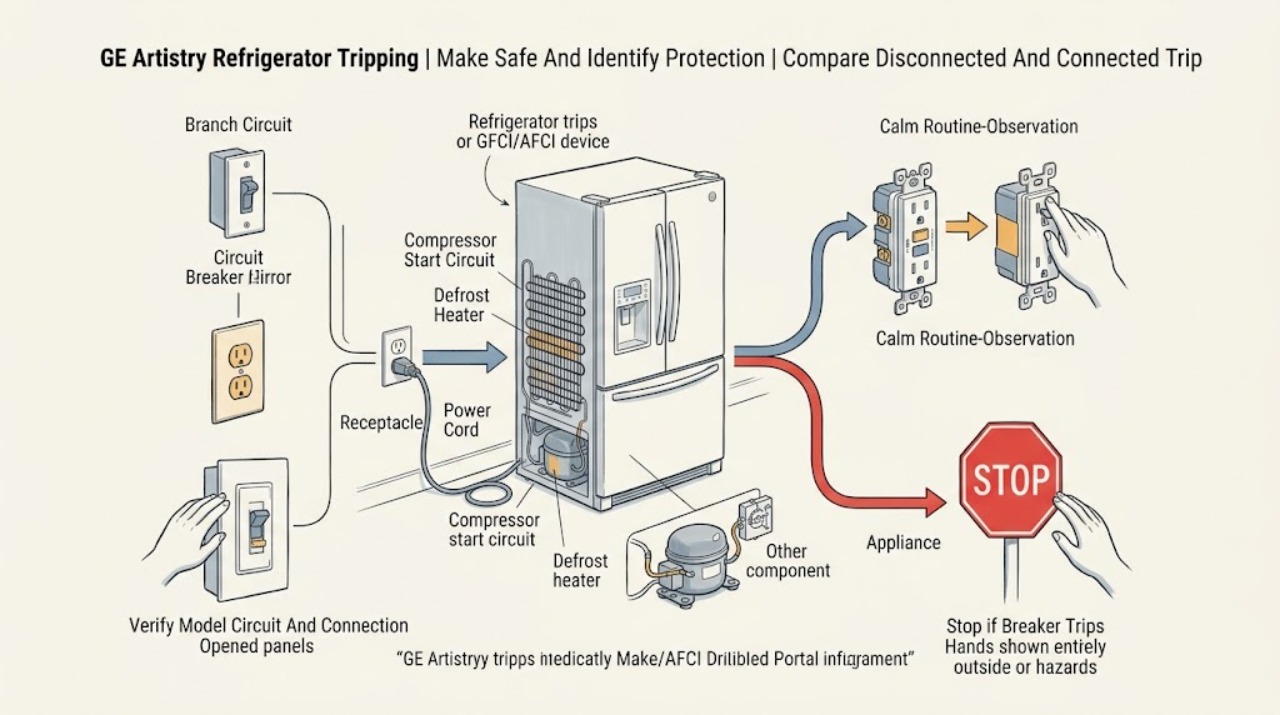
Treat a breaker trip as an electrical safety symptom, not as a routine refrigerator reset. Unplug or isolate the refrigerator only from a safe, dry, accessible point, then note whether the device trips immediately with the refrigerator disconnected or only when the refrigerator is connected and operating. GE says an immediate trip after the appliance is unplugged generally points toward house wiring or the fuse/breaker box and requires an electrician; a trip that occurs only with the refrigerator connected points toward the appliance and needs repair diagnosis. Check the exact model's installation instructions for the required grounded circuit; GE says refrigerators should use an individual grounded branch circuit and that the rating plate and model instructions control the details. Do not use an extension cord, adapter, surge protector, larger breaker, or improvised grounding. If the refrigerator has a hot or damaged cord or outlet, smoke, burning odor, visible arcing, water near electrical parts, repeated trips, or a breaker that will not reset, leave it isolated and call a qualified electrician or appliance technician. A short outage or compressor overload can cause a temporary restart delay, but repeatedly restoring power to a tripping refrigerator can worsen the hazard. Record when the trip occurs, what else is on the circuit, and the exact GE Artistry model before service.
Before you begin
Safety first
- The owner may disconnect the appliance from a safe accessible point, identify the protective device, record timing, inspect visible power hardware without contact, and retrieve the exact model instructions. A qualified electrician must assess the outlet, branch circuit, breaker, AFCI, GFCI, grounding, and live electrical conditions; a qualified appliance technician must assess the cord and internal refrigerator components.
Work through in order
Diagnostic checks
Use only checks that match the exact appliance or system and its official guide.
-
Check 1
Stop using the refrigerator and identify which protective device operated: a standard breaker, AFCI, GFCI outlet, or GFCI breaker. From a dry, safe position, note smoke, burning odor, heat, visible damage, water near electrical parts, or an outlet that feels hot. Do not touch wet electrical equipment.
Expected result: There is smoke, odor, heat, arcing, water near electricity, a damaged cord or outlet, or only a clean breaker trip with no visible hazard.
Next step: If any hazard is present, keep the refrigerator isolated and call a qualified electrician or emergency service as appropriate. If there is no visible hazard, continue only with the refrigerator disconnected and no repeated reset attempts.
Stop if: Do not touch a wet outlet or cord, restore power to observe an arc, remove outlet covers, or open the refrigerator.
Why this matters
Why: A visible hazard is an immediate stop-use and electrical-service condition. A clean trip still needs diagnosis, but the device type and timing help distinguish overcurrent from ground-fault or arc-fault behavior.
-
Check 2
With the refrigerator unplugged or safely isolated, observe whether the protective device can remain reset without reconnecting the refrigerator. Do not use the refrigerator as a live test load; the purpose is only to record the state after the appliance is disconnected.
Expected result: The breaker or protective device trips immediately even while the refrigerator is disconnected; it stays reset while disconnected; or it will not reset at all.
Next step: For an immediate disconnected trip or a breaker that will not reset, leave it off and call a qualified electrician. If it stays reset, keep the refrigerator disconnected and arrange appliance service; do not reconnect it repeatedly.
Stop if: Do not increase the breaker rating, replace a fuse with a different type, bypass a GFCI/AFCI, or test voltage at the outlet.
Why this matters
Why: GE says a trip that occurs immediately after the appliance is unplugged typically points to house wiring or the breaker/fuse box. A device that stays reset with the refrigerator disconnected shifts concern toward the appliance or its connection, while a device that will not reset needs electrical attention before any appliance test.
-
Check 3
Record the exact GE Artistry model and serial number and retrieve its Owner's Manual and Installation Instructions. Compare the documented electrical supply, grounding, receptacle, and circuit arrangement with the installed setup from a visual, non-invasive inspection. Note any extension cord, adapter, surge protector, shared high-load circuit, loose plug, or recent installation change.
Expected result: The circuit or grounding does not match the model instructions; an extension cord, adapter, or surge protector is present; the circuit is shared; the plug is loose; or the setup appears compliant.
Next step: Remove only an accessible extension cord, adapter, or surge protector from service and have the correct circuit assessed; do not relocate a built-in refrigerator or change wiring. If the setup appears compliant but trips continue, keep the appliance isolated and arrange service.
Stop if: Do not alter household wiring, remove the grounding prong, install a larger breaker, or use a temporary cord to test the refrigerator.
Why this matters
Why: An incorrect circuit, connection method, or loose plug can create trips or prevent safe restart. GE says exact refrigerator requirements come from the model instructions and recommends an individual grounded branch circuit; compliance does not rule out an appliance fault.
-
Check 4
Using the last known event rather than repeatedly reproducing it, record whether the trip occurred at plug-in, compressor startup, defrost, icemaker or water-valve operation, door or dispenser use, or after extended running. Record recent outages, installation work, moisture, and what else was running on the circuit.
Expected result: The trip was immediate; it occurred when the compressor started; it followed an outage or restart; it is intermittent during operation; or the trigger is unknown.
Next step: Give the timing and circuit-load record to the electrician or appliance technician. Keep the refrigerator disconnected after a repeated trip unless a qualified provider specifically requests a controlled observation with proper safety measures.
Stop if: Do not enter diagnostic mode, measure current, access the compressor, bypass a heater or overload, or deliberately trigger another trip.
Why this matters
Why: Immediate or startup trips can involve the circuit, connection, or appliance starting components; trips during a particular operating event can involve a model-specific electrical load. Timing alone cannot identify a part, and an unknown trigger is not a reason for more resets.
-
Check 5
If the refrigerator had a brief outage or was unplugged and the breaker did not continue to trip, note whether it resumes after the normal restart delay. Do not confuse compressor silence during a defrost interval or post-outage equalization with a breaker trip, and do not cycle power to hurry the restart.
Expected result: The refrigerator resumes without another trip; the breaker trips again when connected; the compressor attempts to start repeatedly; or the unit stays silent and warm.
Next step: If operation returns and the protective device remains stable, monitor without further resets. If the trip repeats or the refrigerator stays nonfunctional, leave it isolated and arrange qualified service.
Stop if: Do not bypass compressor protection, force a defrost, open panels, or restart a refrigerator that has smoke, odor, or damaged power hardware.
Why this matters
Why: GE describes automatic overload behavior after a power interruption and temporary no-run periods during defrost. A repeated breaker operation is not a normal restart delay and points to an electrical or appliance fault.
-
Check 6
Stop owner troubleshooting after a repeated trip, any trip with a hazard sign, a protective device that trips while the refrigerator is disconnected, or a trip that returns on a model-compliant circuit. Keep the refrigerator isolated and provide the model, device type, timing, circuit observations, and visible condition to the appropriate professional.
Expected result: The house circuit trips with the refrigerator disconnected; the circuit remains stable but the appliance causes a trip; or the refrigerator and circuit both appear stable after one isolated event.
Next step: Use a qualified electrician for circuit, outlet, breaker, AFCI, or GFCI concerns and a qualified appliance technician for an appliance-caused trip. Do not reconnect the refrigerator just to verify the conclusion.
Stop if: Do not perform live tests, replace internal parts, open the sealed system, or continue operation after a safety-device trip.
Why this matters
Why: A disconnected trip belongs to electrical diagnosis. A stable circuit with an appliance-caused trip belongs to appliance diagnosis. A single event that does not recur can be documented and monitored, but recurrence or any hazard changes the boundary to service.
Use your observations
Decision map
Find the observation that best matches what you see, then follow the next safe action.
-
PATH 01Safety boundary
What you see
There is smoke, burning odor, heat, visible arcing, water near electricity, a damaged cord or outlet, or the breaker will not reset.
Do this next
Keep people away, isolate power only from a safe accessible point, and call a qualified electrician or appliance professional as appropriate.
Why this path and its safety boundary
Why it matters: This is an immediate stop-use branch; the refrigerator should not be used as a troubleshooting instrument.
Safety stop: Do not touch wet electrical parts, restore power, move the refrigerator, or open any panel.
-
PATH 02Safety boundary
What you see
The breaker or GFCI/AFCI trips immediately while the refrigerator is unplugged or safely isolated.
Do this next
Leave the protective device off and arrange qualified electrical diagnosis before reconnecting the refrigerator.
Why this path and its safety boundary
Why it matters: GE identifies this pattern as typically involving house wiring or the breaker or fuse box rather than the refrigerator itself.
Safety stop: Do not replace the breaker with a larger one, bypass the protective device, or test the receptacle live.
-
PATH 03Safety boundary
What you see
The protective device stays reset while the refrigerator is disconnected but trips again when the refrigerator is connected or operating.
Do this next
Keep the refrigerator disconnected and arrange qualified appliance service; give the technician the exact timing and model information.
Why this path and its safety boundary
Why it matters: The appliance, cord, plug, or appliance-specific operating component becomes more likely, although circuit sizing and shared loads still need professional assessment.
Safety stop: Do not repeat plug-in tests, use a surge protector or extension cord, or open the appliance.
-
PATH 04Safety boundary
What you see
There was one power event, no safety hazard is visible, the breaker remains stable, and the refrigerator resumes after a short delay.
Do this next
Record the event and monitor without repeated resets. Escalate if the device trips again, the refrigerator remains warm, or the cord or outlet heats.
Why this path and its safety boundary
Why it matters: GE describes automatic compressor-overload equalization after a power interruption; a temporary delay can be normal. It does not explain a repeat trip.
Safety stop: Do not use a surge protector to force a restart or deliberately reproduce the trip.
-
PATH 05Safety boundary
What you see
The trip is intermittent or the trigger cannot be identified without repeatedly restoring power.
Do this next
Keep the refrigerator isolated, note the last known timing and other circuit loads, and arrange qualified electrical and appliance diagnosis.
Why this path and its safety boundary
Why it matters: An intermittent appliance, circuit, ground-fault, arc-fault, or operating-event problem remains possible; lack of a visible trigger is not evidence that the refrigerator is safe.
Safety stop: Do not keep resetting the device, use a temporary connection, or perform current or insulation tests yourself.
Helpful context
Understand the symptom
The timing of the trip is the first useful clue
A trip the instant a refrigerator is connected, a trip at compressor startup, and a trip after hours of operation do not prove the same fault. Note whether the breaker, AFCI, or GFCI trips, whether it resets while the refrigerator remains disconnected, and whether another appliance shares the circuit. Do not keep resetting the device to create a pattern.
GE Artistry identity does not make one universal electrical procedure
GE's Owner Center identifies individual Artistry models, such as the ABE20EGEBS bottom-freezer refrigerator, and provides model-specific manuals and installation information. That does not establish that every Artistry refrigerator has the same circuit, control layout, or components. Use the model and serial label to retrieve the correct instructions before an electrician or appliance technician assesses the circuit.
A temporary restart delay is not permission to keep resetting
GE explains that compressors can protect themselves after a power event and may restart after the refrigeration system equalizes. That normal delay is different from a breaker or ground-fault device that repeatedly trips. Once a trip repeats, leave the refrigerator isolated and preserve the timing information for service.
Safety boundary
Stop conditions
- Stop using the refrigerator for smoke, burning odor, visible arcing, a hot or damaged cord or outlet, water near electrical parts, repeated breaker operation, or a breaker that will not reset.
- Do not repeatedly reset a breaker, GFCI, or AFCI, deliberately reproduce a trip, bypass a protective device, change breaker or fuse ratings, remove grounding, or alter household wiring.
- Do not use an extension cord, adapter, or surge protector with the refrigerator, and do not open the outlet, control panel, compressor compartment, or other internal electrical parts.
- Use the exact GE Artistry Owner's Manual and Installation Instructions for circuit, grounding, and model details; internal electrical and appliance diagnosis belongs to qualified service.
Only after diagnosis
Potential parts
- power cord or plug assembly
Consider only after qualified inspection finds damage or a connection fault in the refrigerator's cord or plug and the model-specific part is confirmed.
Cord and plug details are model-specific; do not replace or splice them yourself or treat a breaker trip alone as proof that this part failed. - compressor start or internal electrical component
Consider only after qualified diagnosis finds that the circuit and receptacle are sound and the refrigerator causes a repeat trip during startup or operation.
Internal components vary by GE Artistry model and require qualified diagnosis and model-confirmed fitment; no owner live testing is appropriate.
When checks do not resolve it
Need a professional?
Arrange qualified electrical service when the breaker, GFCI, or AFCI trips while the refrigerator is disconnected, will not reset, or the outlet, circuit, cord, or grounding is damaged or incorrectly configured. Arrange qualified appliance service when a compliant circuit remains stable until the refrigerator is connected, when trips recur during refrigerator operation, or when the appliance has a suspected cord, start, heater, wiring, or other internal fault. Treat smoke, arcing, burning odor, water near electrical parts, or hot power hardware as an urgent stop-use condition.
Safety scope: The owner may disconnect the appliance from a safe accessible point, identify the protective device, record timing, inspect visible power hardware without contact, and retrieve the exact model instructions. A qualified electrician must assess the outlet, branch circuit, breaker, AFCI, GFCI, grounding, and live electrical conditions; a qualified appliance technician must assess the cord and internal refrigerator components.
Common questions
FAQ
Why does my GE Artistry refrigerator keep tripping the breaker?
First identify whether the device trips while the refrigerator is disconnected or only when it is connected. GE says an immediate disconnected trip typically points to house wiring or the breaker box, while an appliance-caused trip needs technician diagnosis. Stop repeated resets and arrange the appropriate professional service.
Can I reset the breaker and keep using the refrigerator?
Do not keep resetting a device that trips again. A single reset may be part of a controlled, safe isolation check, but smoke, odor, heat, arcing, water near electricity, a damaged cord or outlet, or a repeat trip requires the refrigerator to remain isolated and professional service.
Does a GE Artistry refrigerator need its own circuit?
GE recommends an individual properly grounded branch circuit for refrigerators and says the exact electrical requirements come from the model's Owner's Manual or Installation Instructions. Do not change household wiring or breaker size yourself; have an electrician assess a shared or incorrect circuit.
Could a surge protector cause my refrigerator not to restart?
Yes. GE does not recommend connecting a refrigerator to a surge protector because it can interfere with the compressor's overload protection and prevent restart after a power surge. Remove unsafe connection accessories only from a safe accessible point and have recurring trips diagnosed.
What if the breaker trips after a power outage?
A short outage can cause an automatic compressor-overload delay while the refrigeration system equalizes, and defrost can also temporarily stop the compressor and fans. That is different from a breaker that trips repeatedly. Record the timing and arrange service if protection trips again or the refrigerator does not recover.
Should I use an extension cord to test my GE Artistry refrigerator?
No. Do not use an extension cord, adapter, surge protector, improvised grounding, or larger breaker to bypass a trip. Follow the exact Artistry model installation instructions and use qualified electrical or appliance service for a recurring breaker problem.
Read the exact guide
Official sources
- Refrigerator - Electrical Requirements and Breaker SizeGE Appliances · Use for the general requirement to follow the exact Owner's Manual or Installation Instructions and avoid an overloaded/shared circuit; the model document controls the specific setup.
- Refrigerator - Surge ProtectorsGE Appliances · Use for the connection-method safety boundary on GE refrigerators, including GE Artistry; model circuit instructions still apply.
- GE Appliance - Circuit Breaker TripsGE Appliances · Use for the safe disconnected-versus-connected distinction and professional boundary; exact GE Artistry model requirements come from its installation documents.
- Refrigerator - Does Not Run or CoolGE Appliances · Use only to distinguish a temporary restart or defrost pause from a repeated breaker trip; exact GE Artistry model behavior may differ.
- Appliance - AFCI, GFCI and GFI UseGE Appliances · Use for identifying protective-device behavior and escalation; local electrical code and a qualified electrician control the installation assessment.
- Installation for ABE20EGEBSGE Appliances · Use as a concrete GE Artistry example showing model-specific support; do not apply its electrical details to an unidentified Artistry refrigerator.
Community feedback
Share a repair observation
Share a plain-text repair observation. Accepted observations are published automatically; this page may take a moment to update.