
On this page
Start here
Quick answer
First remove the common external obstruction: a tray, pizza box, tall container, open bin, heavy door item, or ice behind the ice bin can hold a refrigerator door open. GE Appliances also says that a refrigerator that is not level may not shut on its own, and a broken hinge requires service. Inspect the gasket around the entire door for dirt, folding, twisting, or a section that is not contacting the cabinet; clean only the accessible seal using the care method in the exact Owner's Manual. Do not force the door or adjust hinges, rollers, leveling legs, or a built-in installation without model-specific instructions. If the door appears closed but the refrigerator light stays on, GE notes that on most models the light should go out as the door nearly closes and that a misaligned door can leave the light on and affect cooling. A door stop is part of the hinge system; GE says Café models use a slightly smaller fixed stop angle and it cannot be adjusted, so do not bend or modify it to gain clearance. If the door is sagging, the hinge or cabinet is damaged, the gasket will not seal after accessible cleaning and clearance checks, the door reopens, or food temperature/moisture is rising, arrange qualified service. Keep the door closed as much as possible, protect food if cooling is compromised, and stop immediately for cracked glass, sharp damaged hardware, an unstable cabinet, or any work that requires removing panels or loading a hinge.
Before you begin
Safety first
- The user may remove accessible obstructions, close bins, clean an intact gasket according to the manual, observe closure/light behavior, and identify the model. Qualified personnel or the installer must handle door removal, hinge/stop alignment, hidden installation hardware, switches, wiring, cabinet damage, and any electrical or structural repair.
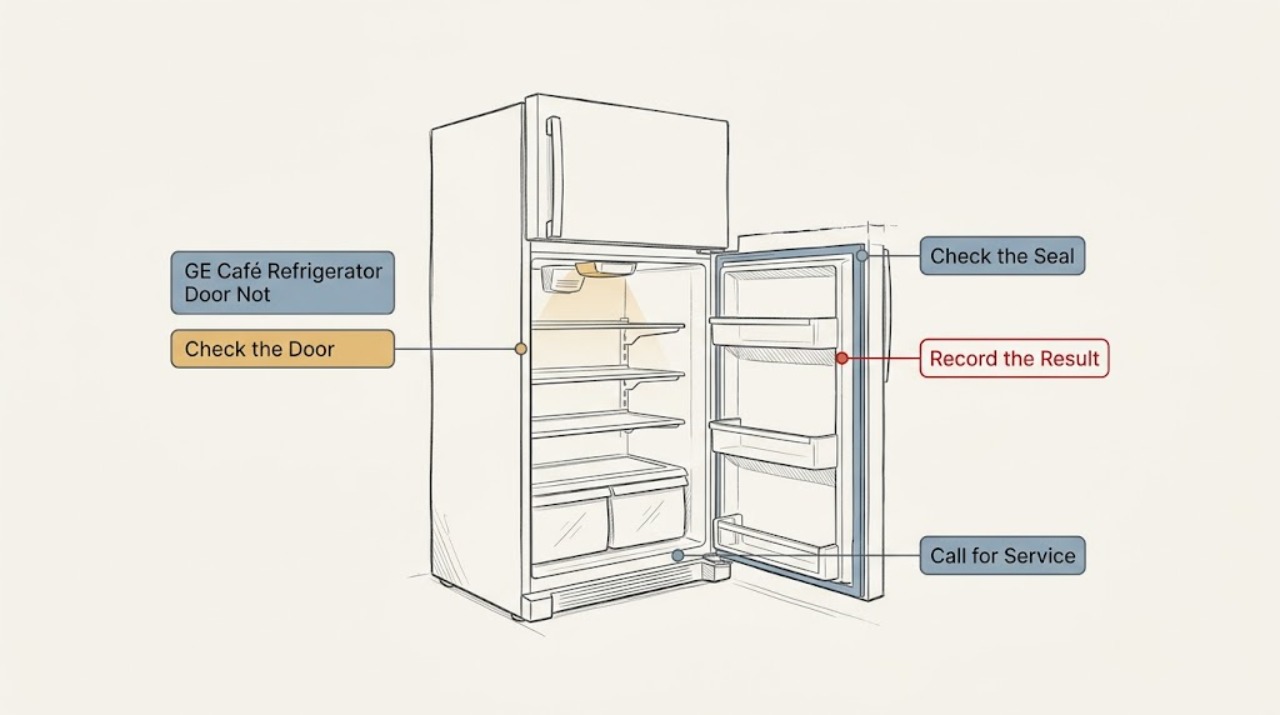
Work through in order
Diagnostic checks
Use only checks that match the exact appliance or system and its official guide.
-
Check 1
Support the door by its handle or safe outer edge while inspecting it, keep fingers away from hinge and closing gaps, and minimize the time the refrigerator remains open. If the door is unstable, the glass or cabinet is cracked, or stored food has warmed, stop handling it and move food only as needed for safe storage.
Expected result: The door is stable and closes without force; it drops or swings unexpectedly; the glass/cabinet is damaged; or the compartment temperature is rising.
Next step: Continue only with a stable, undamaged door. Arrange service for a damaged or unstable door, and follow food-safety guidance when the refrigerator cannot maintain temperature.
Stop if: Do not hold a heavy door open by the hinge, lift the door, or reach into a closing gap while inspecting it.
Why this matters
Why: A stable door can be checked for accessible obstructions. A sagging or damaged door can overload hinges and compromise the gasket; rising temperature makes the problem more than cosmetic.
-
Check 2
Inspect the door edge, shelves, drawers, door bins, ice-bin area, and cabinet front for projecting packages, trays, pizza boxes, an open bin, a heavy item falling forward, or a loose ice cube. Close each bin and rearrange or remove only the accessible obstruction.
Expected result: The door closes after one item is removed; a bin remains proud of its track; an ice cube is behind or beside the ice bin; or nothing touches the door.
Next step: Close the door gently after clearing the obstruction and check the gasket contact. Do not use force to overcome an item that cannot be removed safely or that indicates a drawer/hinge problem.
Stop if: Do not chip ice with a sharp tool, overpack the door, or force a drawer or bin past its track.
Why this matters
Why: A repeatable obstruction explains a door that stops at the same point and does not require hinge diagnosis. No obstruction shifts attention to gasket, level, alignment, hinge, or installation.
-
Check 3
With the door open, inspect the full gasket for dirt, a folded or twisted section, tears, hardening, or a corner that rolls inward. Wipe accessible dirt using the exact model's care instructions, then close the door without forcing it and look for a continuous gasket contact around the cabinet.
Expected result: The gasket is dirty but intact; it folds or rolls over; there is a visible gap; the gasket is torn/hardened; or it contacts evenly.
Next step: Clean an intact gasket and recheck closure. Arrange service for a damaged seal, persistent gap, door sag, or a gasket that needs replacement or reshaping beyond the manual's user instructions.
Stop if: Do not heat, stretch, glue, cut, lubricate with an unapproved product, or pull the gasket from its channel.
Why this matters
Why: A dirty or folded seal can restrict closure or leak air, while a tear, hardening, or persistent gap indicates a sealing or alignment problem. Even contact does not rule out a hinge or level issue if the door still reopens.
-
Check 4
From a safe position, open the door partway and observe whether it closes smoothly on its own or remains open. Look for a cabinet that rocks, a door that sits visibly low, or a gap that changes when the door is lifted; consult the exact Owner's Manual before touching leveling legs or rollers.
Expected result: The door self-closes smoothly; it remains open from a partial opening; the cabinet is visibly out of level; or the door sags/changes position when lifted.
Next step: Use only the model-specific leveling procedure if it is explicitly a user adjustment. Call service or the installer for a sagging door, built-in alignment, cabinet movement, or a hinge that appears damaged.
Stop if: Do not lift the door to align it, loosen hinge bolts, remove trim, or adjust rollers while the door is loaded.
Why this matters
Why: GE says improper leveling can prevent self-closing, while sag or movement points more toward hinge/alignment hardware. Built-in and model-specific leveling arrangements must not be guessed.
-
Check 5
After a gentle closure, slowly reduce the door opening and observe from outside whether the interior light goes out as expected for the model. Check the temperature display, visible condensation/frost, and whether warm air or moisture has accumulated; do not defeat the door switch or leave the door open for a prolonged test.
Expected result: The light goes out and temperature is normal; the light stays on; condensation/frost or warmth is present; or the door appears closed but the gap remains.
Next step: Correct only an identified obstruction or gasket issue. If the light stays on, the door gap remains, or temperature does not recover, arrange service and keep openings brief.
Stop if: Do not tape down or bypass the door switch, remove the light assembly, or access wiring to test it.
Why this matters
Why: GE notes that a misaligned door can leave the light on and affect cooling, while incomplete closure admits warm/humid air. A light that remains on or temperature that remains abnormal suggests a closure, switch, gasket, or cooling issue needing model-specific diagnosis.
-
Check 6
Observe the door's opening stop and lower hinge only from the outside. If the door opens unusually far, hits a wall/cabinet, or the stop appears bent, compare only with the exact model documentation; do not bend, remove, or relocate the stop.
Expected result: The door stops normally; it opens to the wall or cabinet; the stop or lower hinge is visibly damaged; or the stop is being considered as a closure adjustment.
Next step: Protect surrounding cabinetry and arrange service for a damaged or abnormal stop/hinge. For a normal stop, return to obstruction, gasket, level, and closure checks.
Stop if: Do not remove the hinge cover, load the hinge, bend the stop, or modify the door swing.
Why this matters
Why: GE says the door stop is located in the lower hinge system and cannot be adjusted; its Café models use a slightly smaller fixed angle. A damaged stop or hinge is a service issue, not a reason to change the angle.
-
Check 7
Record the complete GE Café model/serial, door style, the exact point where closure stops, obstruction/gasket/level observations, light behavior, temperature symptoms, and any prior installation or repair. Use the model support page and Owner's Manual before requesting parts or an adjustment.
Expected result: The door closes after a clear obstruction; the gasket remains open; the door sags or hinge is damaged; the light stays on; or cooling/moisture symptoms persist.
Next step: Arrange GE Appliances/Café or qualified refrigerator service for persistent gaps, damage, light/cooling effects, or any internal adjustment. Provide the record rather than ordering a generic hinge or gasket.
Stop if: Do not remove the door, hinge, gasket, switch, trim, or wiring, and do not buy a part without exact model fit confirmation.
Why this matters
Why: A resolved obstruction is different from a failed seal, hinge, switch, or alignment. The model and door architecture determine whether a hinge, leveling, gasket, or control procedure is appropriate.
Use your observations
Decision map
Find the observation that best matches what you see, then follow the next safe action.
-
PATH 01Safety boundary
What you see
The door stops at a repeatable point and a package, tray, open bin, heavy door item, or ice cube is touching or projecting into the closure path.
Do this next
Remove or rearrange the accessible item, close bins, and check the gasket. If closure remains poor after the path is clear, continue to the seal/level branch.
Why this path and its safety boundary
Why it matters: The obstruction is the most direct explanation and does not establish a hinge or gasket failure.
Safety stop: Do not force the door, chip ice with a sharp tool, or overload the door bins.
-
PATH 02Safety boundary
What you see
The gasket is dirty, folded, twisted, torn, hardened, or leaves a visible gap after the door is closed.
Do this next
Clean an intact seal according to the manual and recheck contact. Arrange service for damage, persistent gap, or a seal that will not sit correctly.
Why this path and its safety boundary
Why it matters: The seal can prevent proper closure or admit warm/humid air; a damaged gasket may need model-specific service rather than an improvised repair.
Safety stop: Do not heat, glue, stretch, cut, or pull the gasket out.
-
PATH 03Safety boundary
What you see
The path is clear and gasket is intact, but the door remains open from a partial opening, sits low, or changes position when lifted; the cabinet may be out of level.
Do this next
Use a documented model-specific leveling procedure only if the manual permits it. Otherwise call the installer or qualified service for alignment and hinge work.
Why this path and its safety boundary
Why it matters: GE identifies leveling as a self-closing factor, while sag or lift movement makes hinge/alignment hardware more concerning.
Safety stop: Do not loosen hinges or lift/remove a loaded door.
-
PATH 04Safety boundary
What you see
The door seems closed but the interior light remains on, condensation/frost is increasing, or refrigerator temperature is rising.
Do this next
Keep openings brief, correct only visible closure causes, and call service if the light remains on or temperatures do not recover.
Why this path and its safety boundary
Why it matters: A misaligned door or incomplete gasket contact can leave the light on and admit warm/humid air. This is now a cooling and food-preservation concern, not just door feel.
Safety stop: Do not tape or bypass the door switch or leave the door open to repeat the light test.
-
PATH 05Safety boundary
What you see
The hinge is bent/broken, the door is unstable, the lower stop is damaged, the cabinet is cracked, or the door opens into surrounding cabinetry.
Do this next
Stop using the door more than necessary and arrange qualified service or installer assistance. Provide photos and the exact model.
Why this path and its safety boundary
Why it matters: GE states a broken hinge requires service and that the Café door stop is a fixed hinge-system component. Structural or alignment work can injure the user or damage the cabinet.
Safety stop: Do not bend the stop, remove hinge hardware, prop a damaged door, or load it with heavy items.
-
PATH 06Safety boundary
What you see
The refrigerator is built-in/counter-depth with hidden or unusual hinges, or the model and door architecture cannot be confirmed.
Do this next
Record the model/serial and contact GE Appliances/Café support or the installer. Continue only with clearing obvious accessible obstructions and cleaning an intact gasket.
Why this path and its safety boundary
Why it matters: Generic leveling, hinge, and gasket instructions may not apply to the installation. The exact Owner's Manual and installation instructions are needed before any adjustment.
Safety stop: Do not pull out the appliance, remove trim, or copy a hinge procedure from another GE refrigerator.
Helpful context
Understand the symptom
Find the obstruction before changing the door
Open the door slowly and look at the front edge of every shelf, drawer, bin, and package. GE specifically calls out projecting food, improperly closed bins, heavy door items, and a small ice cube as things that can prevent closure. Clear the object and close the door gently; do not treat resistance as proof that a hinge needs adjustment.
Seal, alignment, and level are connected
A door can appear nearly closed while its gasket leaks on one corner. GE links incomplete closure with warm/humid air and says leveling helps the door close properly. A dirty, folded, or damaged gasket, a sagging door, or a cabinet that is out of level should be separated by observation; do not compensate for a bent hinge by forcing the door or modifying the fixed door stop.
A closure problem can become a cooling problem
GE says that on most models the interior light should go out as the door opening becomes small, and that a misaligned door can leave the light on and affect refrigerator temperature. Frost, condensation, or a warm cabinet after a door has been left ajar is a reason to protect food and call service if temperature does not recover after the closure issue is corrected.
Safety boundary
Stop conditions
- Stop for a cracked cabinet or glass, unstable/sagging door, bent or broken hinge, damaged lower stop, sharp hardware, water near electrical parts, smoke, or a hot/damaged cord; arrange qualified service.
- Do not lift or remove a refrigerator door, loosen hinge hardware, remove trim or panels, bypass the door/light switch, or modify the fixed door stop.
- Do not force a door against packages, bins, drawers, ice, or a gasket, and do not chip ice with a knife or other sharp tool.
- Do not heat, glue, stretch, cut, or pull out a door gasket; use only model-specific care instructions.
- Do not order a hinge, gasket, switch, roller, or leveling part without confirming exact model fit and architecture.
When checks do not resolve it
Need a professional?
Safety scope: The user may remove accessible obstructions, close bins, clean an intact gasket according to the manual, observe closure/light behavior, and identify the model. Qualified personnel or the installer must handle door removal, hinge/stop alignment, hidden installation hardware, switches, wiring, cabinet damage, and any electrical or structural repair.
Common questions
FAQ
What is the first thing to check when my GE Café refrigerator door will not close?
Look for a projecting package, open bin, heavy door item, tray, drawer, or ice cube in the closure path. GE Appliances lists these before leveling or hinge service. Clear only accessible obstructions and close the door gently.
Can an unlevel GE Café refrigerator keep the door from closing?
Yes. GE says improper leveling can prevent a refrigerator door from shutting on its own. Because Café installations and door architectures vary, use only the exact model's leveling instructions; call the installer or service for built-in or sagging-door alignment.
What if the GE Café refrigerator door looks closed but the light stays on?
GE notes that on most models the interior light should go out as the door nearly closes, and a misaligned door can leave it on and affect cooling. Check for a gap, gasket problem, or obstruction without bypassing the switch; arrange service if it remains on or the cabinet warms.
Can I adjust the door stop on a GE Café refrigerator?
No. GE says the door stop is part of the lower hinge system and cannot be adjusted; Café models use a slightly smaller fixed stop angle. Do not bend, remove, or relocate it to solve a closure problem.
When does a GE Café refrigerator door problem need service?
Call for a broken or sagging hinge, unstable or cracked door/cabinet, persistent gasket gap after accessible cleaning and clearance checks, a light that stays on, rising temperature or moisture, or any adjustment requiring door removal, hinge loading, wiring access, or built-in installation work.
Read the exact guide
Official sources
- Refrigerator - Not Cooling EnoughGE Appliances · Applies to GE refrigerator cooling symptoms and supports model-specific checks for door closure, gasket, interior light, airflow, and service.
- User Manual & Care for CYE22TSHSSGE Appliances · Used only to verify the GE Café refrigerator product identity and to support the need for model-specific documentation; the CYE22TSHSS manual is not a universal Café procedure.
- Refrigerator - Interior MoistureGE Appliances · Applies to GE refrigerator moisture symptoms and supports the relationship between incomplete closure, warm/humid air, food obstruction, and leveling.
- Refrigerator - Door Stop / Door SwingGE Appliances · Applies to GE refrigerator door-stop information; it specifically states the Café stop is slightly less than the general 150-degree setting and cannot be adjusted.
- Refrigerator - Door Will Not CloseGE Appliances · Applies to GE refrigerator door-closure symptoms and identifies common accessible obstructions, leveling context, and hinge service; exact Café architecture remains model-specific.
- Refrigerator and Freezer Troubleshooting and SupportGE Appliances · Applies to GE refrigerator support and reinforces using model-specific support for Café appliances.
Community feedback
Share a repair observation
Share a plain-text repair observation. Accepted observations are published automatically; this page may take a moment to update.