
On this page
Start here
Quick answer
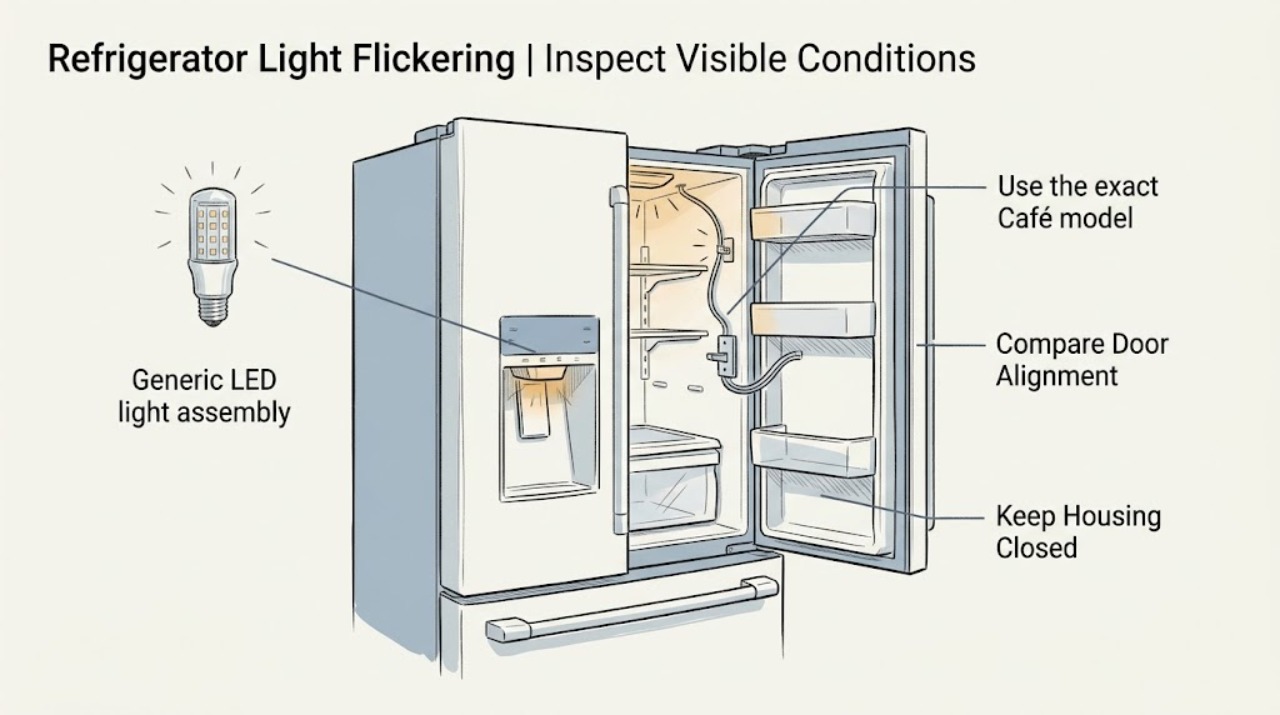
Start by recording which GE Café light flickers: an interior light wall or individual LED, a dispenser lamp, or a temperature-controlled-drawer light. GE's Café Owner Center is model-specific, and GE says many newer refrigerators use LED assemblies that require an authorized service technician; some older models instead use a replaceable bulb whose size and type must match the original. With the refrigerator unplugged, inspect only the visible light cover, bulb shape, door or drawer closure, and any moisture or physical damage. Do not touch a lamp socket while the door is open, flex a door harness, remove an LED board, or probe the light circuit. If the refrigerator's display or several lights flicker together, the outlet or appliance supply is unstable, the plug is hot, there is a burning smell, or the light remains intermittent after one safe power reset permitted by the model manual, stop using it and arrange qualified refrigerator service or electrical diagnosis.
Before you begin
Safety first
- The owner may identify the model and light location, inspect visible covers and closure alignment with power disconnected, and replace only a documented bulb with the exact specified type. An authorized appliance technician must assess LED assemblies, sockets, switches, door harnesses, controls, and internal wiring; a qualified electrician must assess household supply and protective devices.
Work through in order
Diagnostic checks
Use only checks that match the exact appliance or system and its official guide.
-
Check 1
From a dry position, identify the exact GE Café model and record which light flickers: fresh-food or freezer interior, LED light wall, dispenser, or temperature-controlled drawer. Note whether the refrigerator display, compressor operation, or more than one light changes at the same time. Look for smoke, burning odor, heat, water, discoloration, or a damaged cord or plug.
Expected result: Only one light flickers, a whole light group flickers, the display or other refrigerator functions also reset, or an electrical or moisture hazard is visible.
Next step: If any hazard or multi-function power instability is present, stop using the refrigerator and arrange qualified electrical or appliance service. Otherwise continue by identifying the light type and model instructions.
Stop if: Do not touch wet or hot electrical hardware, repeatedly open the door to provoke a flicker, or move the refrigerator to reach hidden wiring.
Why this matters
Why: A single light localizes the symptom to that lamp, assembly, closure switch, or local connection; several functions changing together raises concern about appliance supply or controls. Heat, odor, water, or damage is a stop-use condition.
-
Check 2
Use the exact Café model manual or Owner Center page to determine whether the affected lamp is an LED assembly, an individual bulb, a dispenser lamp, or a drawer light. Inspect only the visible shape and cover from outside the light circuit; do not remove a cover unless the manual explicitly identifies it as owner-accessible and the refrigerator is unplugged.
Expected result: The model documents an LED panel or individual LED, a bulb-shaped lamp, a dispenser light, or a drawer light that is not described as consumer-replaceable.
Next step: For an LED, non-replaceable drawer light, or unclear configuration, stop at identification and arrange service. For a documented bulb-style lamp, follow only the manual's unplugged replacement procedure and exact lamp specification.
Stop if: Do not substitute an LED or bulb, add a second lamp, remove an LED board, or expose the socket while energized.
Why this matters
Why: GE says LED assemblies need authorized service, while bulb type and wattage vary by model. GE also says some drawer LEDs are not consumer-replaceable, so a flicker does not justify installing a generic bulb or board.
-
Check 3
With power disconnected and the refrigerator otherwise undisturbed, inspect the visible door, drawer, and light-cover alignment. Slowly close the relevant door or drawer once and note whether the flicker tracks the opening angle, closure, a loose cover, condensation, or physical contact. Do not flex the door, press a hidden switch, or pull a harness.
Expected result: The light changes only near a particular door position, flickers when a drawer moves, remains unstable with the door stationary, or shows moisture or a damaged cover.
Next step: Correct only an obvious, external obstruction and follow the manual for door or drawer alignment. If the light still flickers, keep power disconnected and arrange service; do not attempt to access the switch or wiring.
Stop if: Do not tape a switch, bend a hinge, remove trim to reach wiring, or operate with water inside a light housing.
Why this matters
Why: A position-dependent symptom makes door/drawer closure or the local switch/connection more relevant; a stationary flicker makes the lamp assembly or power/control path more likely. Moisture or damage requires service rather than adjustment.
-
Check 4
For a documented bulb-style lamp only, compare the installed bulb with the exact model's specified size and type while the refrigerator is unplugged. For an LED or dispenser/drawer assembly, inspect only for visible cracking, scorching, loose trim, or moisture and leave replacement to service.
Expected result: The bulb is the wrong type or visibly damaged, the lamp is an LED assembly, the dispenser has an LED rather than a bulb, or no visible lamp fault is found.
Next step: Replace a documented bulb only with a model-confirmed equivalent after power is disconnected. For LED, dispenser LED, or unclear lamps, arrange an authorized technician and provide the model and location.
Stop if: Do not install a higher-wattage bulb, use a generic board, splice a lamp lead, or restore power with a loose socket or wet cover.
Why this matters
Why: GE says bulb size and type vary and must match the original; many LED and dispenser LED assemblies are service parts. No visible defect does not rule out a driver, switch, harness, or control fault.
-
Check 5
If the refrigerator's dispenser panel or several lights are affected, record whether the symptom began after installation, door removal, a power event, or a control reset. From a safe external point, confirm the plug is seated and the outlet or accessible GFCI is not visibly damaged; do not test the outlet with exposed probes.
Expected result: The flicker began after installation or door work, the dispenser and interior lights change together, the display also resets, or only one local lamp is affected.
Next step: For post-installation or multi-function symptoms, have the installation and wiring assessed by the installer or a qualified technician. If only one lamp is affected, return to the lamp-type service boundary instead of opening the door wiring.
Stop if: Do not remove a hinge cover, reconnect a door harness, open an outlet, or use a live meter test.
Why this matters
Why: GE notes that door wiring harness connection can matter after doors are removed and that a power cycle can correct some dispenser-control lockups. A broader synchronized flicker can involve supply or controls rather than one lamp.
-
Check 6
If there is no hazard and the model manual permits an external reset, disconnect refrigerator power once for the manual's interval, then restore it and observe without repeatedly opening the door or cycling power. Record whether the same light flicker returns, the display resets, or the appliance's protective device operates.
Expected result: The light is stable after the reset, the flicker returns immediately, several controls remain unstable, or a breaker/GFCI trips.
Next step: If the flicker returns or any protection device operates, leave the refrigerator isolated as appropriate and arrange qualified appliance or electrical service. Provide the model, lamp location, light type, timing, and reset result.
Stop if: Do not repeatedly cycle power, increase a breaker rating, bypass a GFCI, or continue using a flickering light with odor, heat, moisture, or damaged hardware.
Why this matters
Why: A one-time recovery may indicate a transient control state, but recurrence points to the lamp assembly, switch, wiring, or supply. A tripping protective device is an electrical diagnosis condition, not a reason to reset again.
Use your observations
Decision map
Find the observation that best matches what you see, then follow the next safe action.
-
PATH 01Next step
What you see
Only one interior, dispenser, or drawer light flickers while the refrigerator otherwise operates normally.
Do this next
Identify the exact model and use the correct LED-service or bulb-replacement path. Do not install a generic lamp or board from the symptom alone.
Why this path and its safety boundary
Why it matters: A local lamp, driver, socket, or closure signal is more likely than a whole-appliance supply failure. GE requires service for many LED assemblies and some drawer lights.
-
PATH 02Next step
What you see
The flicker follows a door or drawer position or appears when the door is nearly closed.
Do this next
Remove only a visible obstruction and follow the exact manual for alignment. Escalate a persistent position-dependent flicker to appliance service.
Why this path and its safety boundary
Why it matters: Closure alignment or the local light-switch signal is more relevant, but a hidden switch or harness cannot be safely diagnosed by flexing or bypassing it.
-
PATH 03Next step
What you see
The interior lights, dispenser panel, and display flicker or reset together.
Do this next
Stop repeated testing and arrange qualified electrical or appliance diagnosis. Do not remove hinge covers or inspect live wiring.
Why this path and its safety boundary
Why it matters: A common supply, control, or door-wiring issue is more likely than one failed lamp. GE directs post-installation door harness concerns to the model installation instructions and persistent dispenser power problems to service.
-
PATH 04Next step
What you see
The refrigerator uses an LED panel or individual LED assembly and the flicker persists.
Do this next
Keep the appliance in service only if there is no hazard and the refrigerator otherwise operates normally, but arrange authorized diagnosis for the recurring flicker. Stop immediately for heat, odor, water, or damage.
Why this path and its safety boundary
Why it matters: GE says LED assembly replacement requires an authorized service technician; the symptom does not establish whether the LED, driver, switch, or control is at fault.
-
PATH 05Next step
What you see
A single safe reset restores stable lighting and no other symptom returns.
Do this next
Monitor without repeated resets if stable. For recurrence or a trip, isolate the refrigerator as appropriate and arrange qualified service.
Why this path and its safety boundary
Why it matters: A transient control state is possible after one recovery, but recurrence is evidence of an unresolved electrical or lamp-path fault.
Helpful context
Understand the symptom
A flickering light is a symptom, not a universal bulb diagnosis
GE Café refrigerators are sold in multiple configurations. A flicker from one LED assembly, a dispenser lamp, a drawer light, and several lights at once can involve different visible paths. Begin with the exact model and the light's location; the Café Owner Center manual controls the part and procedure.
LED assemblies and bulbs have different service boundaries
GE says many newer refrigerators use LED boards or individual LED assemblies and that replacement requires an authorized technician. A bulb-shaped lamp may be consumer-replaceable on some models, but GE still requires the same original size and type and power disconnected before access. A Café label alone does not identify which arrangement your model has.
Do not turn an intermittent-light symptom into a live electrical test
You can document when and where the flicker occurs and inspect visible closure or moisture conditions with the appliance in a safe state. Do not open the light housing, expose a socket, pull a door harness, or measure the light circuit. If a plug, outlet, cord, or multiple refrigerator functions are unstable, involve a qualified electrician or appliance technician.
Safety boundary
Stop conditions
- Stop using the refrigerator for smoke, burning odor, unusual heat, visible arcing, water in a light housing, a hot or damaged plug or outlet, or synchronized power instability.
- Do not touch a lamp socket with the door open, remove an LED board, flex or reconnect a door harness, open an outlet, or perform live light-circuit tests.
- Do not substitute a bulb or LED assembly, install a higher-wattage lamp, bypass a door or light switch, or repeatedly reset a breaker or GFCI.
- Use the exact GE Café model Owner's Manual and Owner Center for lamp type, drawer or dispenser construction, alignment, and service instructions; recurring LED or unclear-light flicker requires qualified service.
Only after diagnosis
Potential parts
- interior LED light assembly or light board
Consider only after the exact model confirms LED construction and an authorized technician diagnoses the local assembly or driver as the cause of the recurring flicker.
GE says LED assemblies require service; confirm the exact Café model and fitment rather than substituting a generic board. - model-specified refrigerator light bulb
Consider only when the exact manual identifies a consumer-replaceable bulb and inspection finds the original bulb wrong, damaged, or intermittent.
Bulb size, type, voltage, and wattage vary by model; disconnect power before access and match the original specification. - door or drawer light switch, harness, or control component
Consider only after qualified diagnosis links a position-dependent or synchronized flicker to the model's switch, harness, or control path rather than the lamp itself.
These are safety- and model-specific components; do not flex, splice, bypass, or replace them from the flicker symptom alone.
When checks do not resolve it
Need a professional?
Arrange qualified refrigerator service when an LED panel, individual LED, dispenser LED, drawer light, socket, switch, or wiring is suspected; when a documented bulb replacement does not restore stable light; or when the flicker returns after one model-approved reset. Arrange qualified electrical diagnosis when the outlet, cord, plug, breaker, or GFCI is hot, damaged, unstable, or repeatedly operates. Treat smoke, burning odor, arcing, water near electrical parts, and synchronized refrigerator power loss as immediate stop-use conditions.
Safety scope: The owner may identify the model and light location, inspect visible covers and closure alignment with power disconnected, and replace only a documented bulb with the exact specified type. An authorized appliance technician must assess LED assemblies, sockets, switches, door harnesses, controls, and internal wiring; a qualified electrician must assess household supply and protective devices.
Common questions
FAQ
Why is my GE Café refrigerator interior light flickering?
First identify whether the light is an LED panel, individual LED, or bulb-style lamp and whether only one light flickers. GE says LED assemblies require authorized service, while bulb type varies by model. Check visible door or drawer alignment with power disconnected, then arrange service for a recurring flicker rather than opening the light circuit.
Can I replace a GE Café refrigerator LED light myself?
GE says LED light assemblies in refrigerators require an authorized service technician. Do not remove the LED panel, substitute a generic board, or probe the circuit. Confirm the exact model first so the technician can identify the correct assembly.
Could a GE Café refrigerator door cause the light to flicker?
A flicker that changes with door or drawer position makes closure alignment or the local switch signal worth documenting, but it does not prove a switch or harness fault. Remove only a visible obstruction and leave hidden switch or wiring work to service.
What bulb should I use in a GE Café refrigerator?
Use the exact model Owner's Manual or parts information. GE says refrigerator bulb size and type vary and the replacement must match the original; many newer models use LED assemblies instead of consumer-replaceable bulbs. Disconnect power before accessing a bulb socket.
What if the GE Café refrigerator display and lights flicker together?
Synchronized flicker points toward a common supply, control, or door-wiring issue rather than one lamp. If the symptom began after installation or door removal, provide that history to the installer or technician. Do not remove hinge covers or test live wiring; stop for heat, odor, damage, or a tripping breaker.
Read the exact guide
Official sources
- Refrigerator - Interior LED LightingGE Appliances · Use for LED construction and the authorized-service boundary; exact Café model construction must be confirmed in its manual.
- Refrigerator - No Power to the DispenserGE Appliances · Use for synchronized dispenser or control symptoms and post-installation door-harness context; it does not identify a flickering lamp part.
- Refrigerator - Selecting Appropriate Light BulbsGE Appliances · Use for bulb-style lamps and the warning to disconnect power before access; model documentation controls the exact replacement.
- Refrigerator - Electronic Temperature Controlled Drawer with Colored/White LED LightsGE Appliances · Use only when the flickering light is in a temperature-controlled drawer on a model with this feature.
- Refrigerator - Dispenser Lamp ReplacementGE Appliances · Use for a flickering dispenser light only after the exact model establishes whether it has a bulb or LED.
- Troubleshooting for CWE23SP2MS1GE Appliances · Use as an example of the Café Owner Center model/manual path, not as a universal light specification for every GE Café refrigerator.
Community feedback
Share a repair observation
Share a plain-text repair observation. Accepted observations are published automatically; this page may take a moment to update.