
On this page
Start here
Quick answer
First identify what is not dispensing: chilled water, cubed/crushed ice, Café hot water, or the entire dispenser control panel. Confirm the complete model because GE Café configurations differ; some have external water/ice controls, some have Precise Fill, and some Café models have a separate hot-water/Keurig path. Check that the refrigerator has power, the dispenser controls are unlocked, the house water shutoff is open, doors are fully closed, and the model's water filter is correctly seated. After a new installation or filter change, GE says the reservoir and lines may need several minutes of dispensing to fill and purge air; stop if the area leaks. For no or slow water, use the exact model's filter/bypass-plug procedure only when the supplied plug and instructions apply. For no ice, check the ice-maker setting, a clumped bucket, and an accessible chute jam without putting hands or metal tools into the chute. On Café models with a Keurig hot-water feature, use the exact hot-water controls and never dispense hot water through the brewer without a K-Cup when GE's instructions prohibit it. Persistent no-dispense, a frozen or cracked reservoir, an auger/control fault, water near electricity, a hot-water leak, or a panel that remains dead requires qualified service.
Before you begin
Safety first
- The user may check an accessible water shutoff, visible tubing, normal control lock, model-approved filter seating/bypass plug, removable ice bucket, and accessible chute only as the exact manual permits. Qualified service must handle internal water lines, reservoirs, inlet valves, dispenser actuators, auger motors, door harnesses, controls, hot-water systems, live testing, and panel removal. Stop immediately for water near electricity or a hot/electrical hazard.
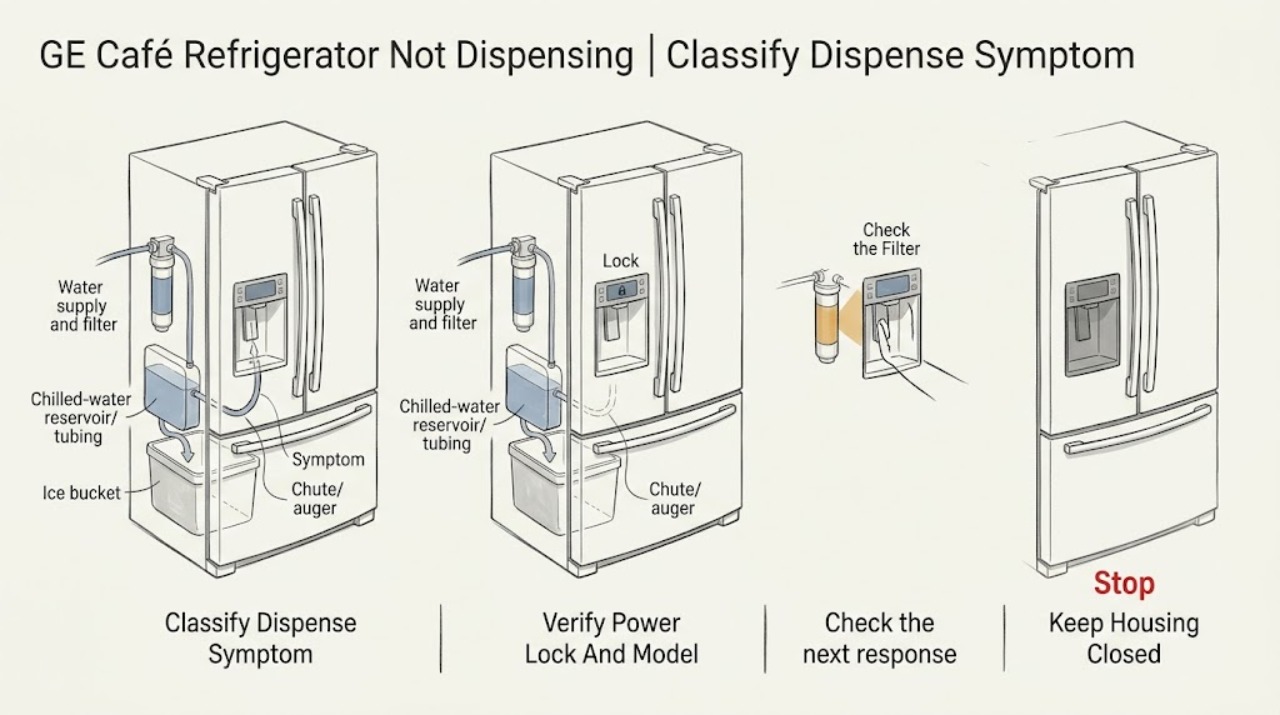
Work through in order
Diagnostic checks
Use only checks that match the exact appliance or system and its official guide.
-
Check 1
From a dry, safe position, identify whether chilled water, cubed ice, crushed ice, Café hot water, or the entire dispenser panel is affected. Note whether the refrigerator lights and cooling remain normal and whether water, frost, a hot stream, smoke, odor, sparking, or a wet cord/outlet is present.
Expected result: Only water fails, only ice fails, hot water fails, the panel is dark/unresponsive, or a safety symptom is present.
Next step: For a hazard, stop dispensing, isolate power only if safe, and arrange qualified service. Otherwise follow the matching water, ice, hot-water, or panel branch.
Stop if: Do not keep pressing a control, reproduce a hot-water leak, or touch wet electrical parts.
Why this matters
Why: Water, ice, hot-water, and control paths use different model-dependent components. A wet electrical area or hot/electrical hazard is a stop-use event, not a filter or reset problem.
-
Check 2
Record the complete Café model number from its accessible label or paperwork. Confirm the refrigerator is powered, the dispenser panel is not locked, and the exact manual identifies the available water, ice, hot-water, and Precise Fill controls. If the refrigerator was newly installed or its doors were removed, note whether the installation instructions require a door wiring harness connection.
Expected result: The panel is dark, the controls are locked, the model has a Precise Fill or Keurig hot-water feature, the refrigerator was recently installed/serviced, or the model and features are clear.
Next step: Unlock or select only the normal model-documented control, and use the exact manual for any feature or wiring location. If the model cannot be identified without moving or opening the appliance, provide that information to service.
Stop if: Do not remove door hinge covers, pull panels, enter undocumented diagnostics, or bridge a harness.
Why this matters
Why: GE says most dispensers have a child lock-out and that a short control reset can help some nonresponsive panels; GE also states that Café hot-water and Precise Fill behavior is model-specific. A removed door can leave its harness disconnected.
-
Check 3
For no or slow chilled water, verify from a dry standing position that the refrigerator's external water shutoff is open and the visible supply line is not kinked. If the model has a water filter, confirm it is the exact model-approved filter and seated as the manual shows; after a recent filter change, expect air in the line and use a safe container for the model's purge instruction.
Expected result: The shutoff is closed, the visible line is kinked, the filter was recently changed or is not seated, water flows slowly, or the supply/filter appears normal.
Next step: Open only an accessible shutoff, correct only a plainly visible kink, or reseat/replace the filter exactly as the model manual allows. Purge air only when there is no leak; otherwise stop and arrange service.
Stop if: Do not disconnect a water line, remove a filter housing, reach behind the refrigerator, or continue dispensing when water is leaking toward electrical parts.
Why this matters
Why: GE identifies a closed supply, air after installation/filter replacement, a clogged filter, and a kinked line as distinct causes of no or slow water. A normal external supply and filter shift attention toward reservoir/tubing or service.
-
Check 4
If the exact model has a supplied water-filter bypass plug and the symptom is no or slow water, follow GE's model-appropriate external comparison: remove the filter, install the supplied bypass plug, and try the dispenser briefly with a container. Do not improvise a plug or leave the filter out unless the manual permits it.
Expected result: Water improves with the supplied bypass plug, remains slow/no-flow with the bypass plug, or the refrigerator has no filter/bypass arrangement.
Next step: Replace the filter only with a model-confirmed compatible filter when the bypass comparison supports it. If flow does not improve, stop user testing and arrange service or qualified plumbing evaluation for the supply path.
Stop if: Do not force a filter, use a different model's bypass plug, open the inlet valve, or perform pressure/voltage tests yourself.
Why this matters
Why: GE says improved flow with the bypass plug points toward a clogged filter; failure with the bypass plug points toward supply pressure, tubing, inlet, reservoir, or another model-specific fault. The result is not a valve or pump diagnosis.
-
Check 5
For no ice, confirm the doors are fully closed and the exact model's ice maker is on. If the ice bucket is user-removable, inspect it for clumped or frozen ice and rinse it only as GE directs. For an accessible chute jam, follow the model instruction and use a wooden utensil from outside the chute; keep hands and metal tools out of the chute.
Expected result: The ice maker is off, doors are not closing, cubes are clumped/frozen, the chute is visibly jammed, the bucket is empty, or ice still does not move after the safe external check.
Next step: Correct only the normal ice-maker setting or accessible clumping/jam. If the bucket refreezes, the ice maker leaks/overfills, the motor does not move, or the bucket is empty, arrange model-specific service.
Stop if: Do not use knives or metal tools, reach into the chute or auger, melt ice with an open flame, or remove protected freezer panels.
Why this matters
Why: GE identifies door closure, bucket clumping, chute jams, and frost/moisture at the auger motor as possible no-ice conditions. An empty bucket may be an ice-making problem rather than a dispensing problem, while recurrence after bucket cleaning may require service.
-
Check 6
If the Café model has Precise Fill or a Keurig K-Cup hot-water system, select the exact model's normal feature and observe the display, nozzle, and container position. For hot water, follow the child-safety control sequence and keep hands out of the stream; if the model uses a brewer path, follow GE's pod requirement exactly.
Expected result: Precise Fill shows a programmed amount but does not flow, hot water is selected at the wrong nozzle, the display is dark/locked, or the brewer is being used without the required K-Cup.
Next step: Correct only the normal model-documented selection, nozzle, container, lock, or pod condition. If the feature still does not dispense or any hot-water leak occurs, stop and arrange service.
Stop if: Do not bypass child safety, dispense hot water through a prohibited path, place hands under a hot stream, or dismantle the brewer/nozzle.
Why this matters
Why: GE says Precise Fill settings and controls vary by model, and Café Keurig refrigerators use separate cold and hot-water paths. GE warns that some Profile/Café-related brewer configurations can leak when hot water is run without a K-Cup.
-
Check 7
If the dispenser panel is nonresponsive and there is no electrical or water hazard, unlock it using the exact manual and perform at most one GE-documented short power reset from a dry, safe position. Record whether the panel, water, and ice functions return; do not repeatedly cycle power.
Expected result: The panel returns after the reset, a display/code returns, controls remain dead, or the panel works but the selected water/ice function remains unavailable.
Next step: Monitor only after a successful hazard-free recovery. For recurring or persistent failure, leave internal diagnosis to qualified service and provide the model, function selected, display state, and filter/supply observations.
Stop if: Do not enter service mode, remove the dispenser panel, bypass a lock, or perform live electrical tests.
Why this matters
Why: GE says a 30-second power reset can restore some dispenser controls, but persistent nonresponse needs service. A working panel with no flow is a water/ice path issue rather than proof of a failed user interface.
Use your observations
Decision map
Find the observation that best matches what you see, then follow the next safe action.
-
PATH 01Safety boundary
What you see
The dispenser display is dark or unresponsive, or it does not dispense water or ice because the controls are locked, while the refrigerator otherwise has power and no hazard is present.
Do this next
Unlock using the exact manual and, if safe, perform one 30-second GE-documented reset. If it stays dead or returns to failure, arrange service with the model and any display code.
Why this path and its safety boundary
Why it matters: A control lock, model-specific panel state, installation harness issue, or transient control lock-up is more likely than a clogged water filter alone.
Safety stop: Do not remove the door panel, bridge the harness, or repeatedly cycle power.
-
PATH 02Safety boundary
What you see
The panel responds and ice may work, but chilled water is absent or slow; the shutoff, visible tubing, filter, installation/air history, and reservoir temperature are relevant observations.
Do this next
Follow the matching external supply/filter/purge check and stop if water leaks. Arrange service for a frozen/cracked reservoir, persistent no flow with the supplied bypass plug, or any internal tubing/valve diagnosis.
Why this path and its safety boundary
Why it matters: GE's water guidance makes supply, filter, trapped air, frozen/cracked reservoir, and door wiring separate possibilities. A bypass improvement implicates the filter path; a frozen or cracked reservoir needs service.
Safety stop: Do not disconnect lines, thaw a hidden tank with heat, or access an inlet valve or harness.
-
PATH 03Safety boundary
What you see
The control responds and water works, but cubed or crushed ice does not dispense; the bucket is empty, clumped, the chute is jammed, or the auger does not move.
Do this next
Use only the model-approved bucket/chute check. If the safe check fails, or ice-making itself is absent, arrange service for the auger, ice maker, chute, or freezer-side diagnosis.
Why this path and its safety boundary
Why it matters: GE identifies closed-door interlock, clumped bucket ice, chute blockage, and frost/moisture around the auger as different paths. If the bucket repeatedly refreezes or the maker leaks/overfills, dispensing is not the underlying problem.
Safety stop: Do not reach into the auger/chute, use sharp tools, or remove freezer panels.
-
PATH 04Safety boundary
What you see
A Café model has Precise Fill or a Keurig hot-water feature and the selected feature does not dispense, dispenses from an unexpected nozzle, or leaks during hot-water/brewer use.
Do this next
Stop hot-water use, let hot surfaces cool, and follow only the exact manual's external selection and pod/nozzle instructions. Arrange service for a recurring leak, no flow after correct selection, or a hot-water control fault.
Why this path and its safety boundary
Why it matters: These are model-specific feature paths. GE says Café hot and cold water use separate nozzles and warns that a prohibited brewer configuration can leak; Precise Fill settings also vary by model.
Safety stop: Do not bypass the child-safety control, run a prohibited brewer path, or open a hot-water system.
-
PATH 05Safety boundary
What you see
The dispenser remains unavailable after the exact external checks, a reservoir is frozen/cracked, a filter bypass does not restore flow, the panel/control fault returns, or water/hot liquid reaches electrical areas.
Do this next
Leave the affected function out of service, isolate power or the water supply only from a dry safe position when necessary, and arrange qualified appliance service; use a plumber for a household supply problem.
Why this path and its safety boundary
Why it matters: The remaining possibilities include an internal tube, inlet valve, reservoir, dispenser actuator, auger motor, control, door harness, or hot-water component that cannot be selected safely from a generic Café symptom.
Safety stop: No panel removal, live testing, line disconnection, internal thawing with heat, or repeated operation to reproduce the fault.
Helpful context
Understand the symptom
Not dispensing is several different symptoms
A Café refrigerator may fail to dispense chilled water, ice, hot water, or all dispenser functions. GE's official material also describes model differences: Precise Fill is offered on select French-door and side-by-side models, and Café refrigerators with the Keurig K-Cup system have separate cold- and hot-water paths. Classify the failed function and record the model before assuming a filter, valve, motor, or control part.
Use external checks in the order that changes the diagnosis
Start with power, control lock, door closure, and the external water shutoff. Then separate water flow from ice movement: a working ice maker with no water at the dispenser points toward the water path, while ice in the bucket that will not move points toward the bucket, chute, or auger path. A filter change, new installation, very cold fresh-food setting, or a Café hot-water mode can change the symptom without identifying an internal failed part.
Keep water, hot surfaces, and electricity separated
Use a dry container and keep hands away from the dispenser stream when hot water is selected. Stop using the dispenser for water near the outlet, cord, controls, or door wiring, or for smoke, burning odor, unusual heat, sparking, or repeated electrical trips; isolate power only from a dry, safe position. Do not pull door panels, disconnect harnesses, probe valves, reach into the ice chute, bypass locks, or perform live tests.
When checks do not resolve it
Need a professional?
Arrange qualified service for persistent no-dispense, a dead or recurring dispenser-control fault, frozen/cracked reservoir, failed flow with the supplied bypass plug, recurring ice jams or ice-maker leaks, or failed Café hot-water/Precise Fill functions. Stop immediately for water near electricity, hot-water leaks, smoke, burning odor, unusual heat, sparking, or repeated trips.
Safety scope: The user may check an accessible water shutoff, visible tubing, normal control lock, model-approved filter seating/bypass plug, removable ice bucket, and accessible chute only as the exact manual permits. Qualified service must handle internal water lines, reservoirs, inlet valves, dispenser actuators, auger motors, door harnesses, controls, hot-water systems, live testing, and panel removal. Stop immediately for water near electricity or a hot/electrical hazard.
Have this ready
- Complete model number, refrigerator configuration, exact function selected, panel/lock state, water-supply and filter history, bypass comparison if applicable, door-closure result, ice-bucket/chute observations, Precise Fill or hot-water mode, display text, and any leak, heat, odor, sparking, or trip symptom. Do not recreate a hazardous fault.
Common questions
FAQ
Why does my GE Café refrigerator dispense ice but no water?
Check the external water shutoff, filter seating or clog, air after installation/filter replacement, and a frozen reservoir or tubing. GE says a filter bypass comparison can help identify a clogged filter when the exact model has a supplied bypass plug. A frozen/cracked reservoir or persistent no flow needs service.
Why does my GE Café refrigerator have no ice from the dispenser?
Confirm the doors are fully closed and the ice maker is on, then inspect the removable bucket for clumped ice and the accessible chute for a jam. GE recommends model-appropriate bucket/chute checks and warns that recurring clumping or an ice-maker leak/overfill requires service.
Can I use the GE Café hot-water dispenser without a K-Cup?
Follow the exact model instructions. GE says Café and Profile Keurig configurations differ and warns that some brewer paths can leak if hot water is dispensed without a K-Cup. Do not bypass the specified pod or child-safety sequence.
What should I do if the Café dispenser control panel is not responding?
Check the model-specific control lock and, if there is no hazard, perform at most one 30-second power reset as GE describes. If the panel remains dead or the problem returns, arrange service instead of removing the panel or testing wiring.
Why does Precise Fill not dispense the amount I selected?
Precise Fill is available only on select models, and GE says its units and controls vary by model. Check the exact manual's selection and container instructions. If the panel responds but no water flows, use the water-supply/filter branch and arrange service for persistent failure.
Read the exact guide
Official sources
- Refrigerator - Not Dispensing IceGE Appliances · Supports only the external door, bucket, chute, and frost/moisture checks described by GE; exact ice-box and auger layout varies by model.
- Refrigerator - Dispenser Water Flow TestGE Appliances · Supports GE's general 20-second flow comparison and supplied bypass-plug logic; do not apply its measurement as a model-specific internal diagnosis.
- Refrigerator - Dual Icemaker Included or OptionalGE Appliances · Supports that refrigerator ice-maker location and optional/dual configuration vary and that Café models have model-specific ice arrangements; it does not diagnose a dispenser motor.
- Refrigerator - Precise FillGE Appliances · Applies only to select side-by-side and French-door models with Precise Fill; values and controls vary by model.
- Refrigerator - Dispenser Control Panel Not WorkingGE Appliances · Supports control lock, 30-second reset, water-supply, filter, door-harness, and service checks; exact buttons are model-specific.
- Refrigerator - No Water from DispenserGE Appliances · Supports external water-supply, air, filter, door-harness, frozen-reservoir, and service branches; exact filter and refrigerator architecture vary by model.
- Refrigerator - Keurig® Brewing System Dispensing Hot WaterGE Appliances · Applies only to Café/related models equipped with the described Keurig system; nozzle location, controls, and pod rules vary by model.
- Refrigerator - Dispenser Not Getting WaterGE Appliances · Supports the ice-maker-works/no-water distinction, frozen tank/tubing, filter, air purge, and model-specific door wiring; not an internal valve diagnosis.
Community feedback
Share a repair observation
Share a plain-text repair observation. Accepted observations are published automatically; this page may take a moment to update.