
On this page
Start here
Quick answer
Treat a tripping breaker as an electrical safety symptom, not a reset routine. First note whether the breaker trips immediately with the refrigerator unplugged, when the refrigerator is connected, or only as a compressor, defrost, or other load starts. If there is smoke, burning odor, water near electricity, a hot or damaged plug, cord, receptacle, or repeated trip, leave the refrigerator off and arrange qualified electrical or appliance service. If the area is dry and there is no visible hazard, disconnect the refrigerator, reset the breaker once from a safe position, and observe whether it holds without the appliance connected. An immediate trip with the refrigerator disconnected points more toward the household circuit or breaker; a trip only after the Café refrigerator is connected points toward the appliance or its cord and needs service. Check the exact model Installation Instructions and rating plate for the required grounded branch circuit and dedicated-circuit guidance; do not use an adapter, remove the grounding prong, or keep reconnecting a unit that trips.
Before you begin
Safety first
- The user may stop operation, make a dry visual inspection, read the exact model rating plate and installation instructions, and perform one safe disconnected breaker or GFCI/AFCI reset when there is no hazard. Electricians must handle the household circuit, receptacle, breaker, grounding, and protection device. Qualified appliance personnel must handle the cord replacement, cabinet access, live measurements, compressor, heater, timer, control, wiring, moisture, and internal repairs.
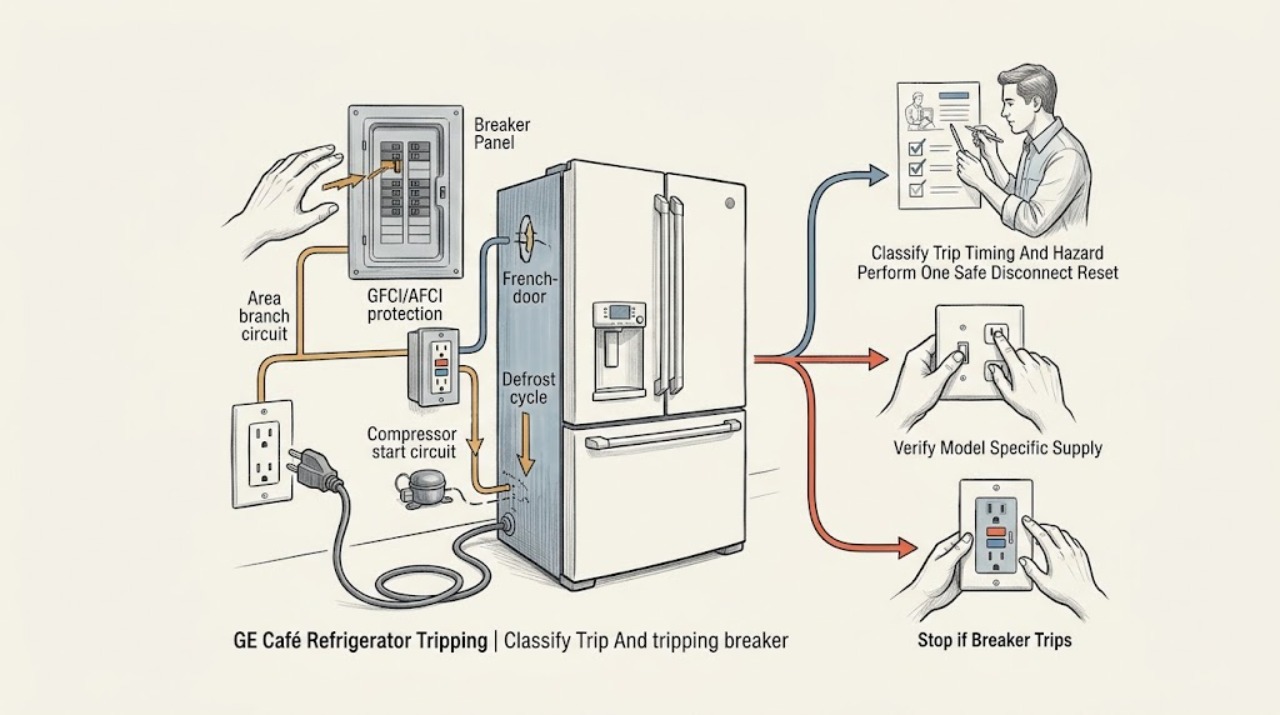
Work through in order
Diagnostic checks
Use only checks that match the exact appliance or system and its official guide.
-
Check 1
Do not touch the refrigerator or breaker if there is smoke, burning odor, water near electricity, sparks, abnormal heat, or visible damage. Otherwise, record whether the breaker trips with the Café refrigerator already unplugged, immediately after it is connected, or only after the refrigerator has been running or cycling.
Expected result: The breaker will not hold with the refrigerator disconnected; it holds disconnected but trips when the plug is connected; it trips only during operation; or there is a visible or sensory hazard.
Next step: Use the household-circuit, appliance-connected, operating-load, or emergency branch that matches the result; keep the refrigerator disconnected when unsafe.
Stop if: Stop immediately for smoke, burning odor, sparks, water near electricity, a hot or damaged connection, exposed wiring, or repeated trips.
Why this matters
Why: An immediate disconnected trip points more toward the household circuit or breaker. A trip tied to the refrigerator points toward its cord, plug, or internal load. A hazard overrides all diagnosis.
-
Check 2
Only from a dry, hazard-free position, unplug the refrigerator without pulling the cord and reset the breaker by turning it fully off and then on once. Do not remove receptacle covers or touch wiring. If the circuit uses GFCI or AFCI protection, use only the normal reset control once and do not bypass it.
Expected result: The breaker stays on with the refrigerator unplugged; it trips immediately even while unplugged; the protection device will not reset; or the plug/receptacle is hot, loose, wet, or damaged.
Next step: Leave the refrigerator disconnected and contact an electrician for a circuit/protection problem. If the circuit holds, do not reconnect a refrigerator that has already caused a trip; arrange appliance service.
Stop if: Do not repeatedly reset, substitute a larger breaker, use an adapter or extension cord, or continue with a hot, wet, loose, or damaged connection.
Why this matters
Why: A stable disconnected circuit makes the refrigerator or its connection more likely when the trip returns after reconnection. An immediate disconnected trip or a protection device that will not reset points to household electrical diagnosis.
-
Check 3
With the refrigerator disconnected, read the Café model's rating plate and Installation Instructions for the required supply, grounding, branch-circuit, and dedicated-circuit information. Inspect only the visible plug, cord, and receptacle for damage; do not test voltage, open the outlet, change the breaker, remove the ground pin, or move a built-in refrigerator.
Expected result: The circuit does not match the model instructions; the refrigerator shares an overloaded circuit; an adapter or extension is in use; the receptacle is ungrounded or damaged; or the documented supply appears correct.
Next step: Have an electrician correct the household installation when it does not match the exact model requirements. If it matches and the refrigerator still trips protection, use qualified appliance service.
Stop if: Do not change breaker size, rewire the receptacle, use an adapter, cut the grounding prong, or use an extension as a workaround.
Why this matters
Why: A mismatched or overloaded household supply can cause protection to trip and must be corrected by an installer or electrician. A correct visible supply does not rule out a cord or internal refrigerator fault.
-
Check 4
Do not reconnect the refrigerator solely to provoke another trip. If a qualified technician or a single prior event already established that the breaker holds disconnected but trips with the refrigerator operating, document whether the event followed connection, compressor startup, defrost, an ice-maker/water event, or another identifiable cycle from the exact manual.
Expected result: The trip is immediate on connection; it occurs after a delay or at compressor startup; it occurs during a documented defrost or water-related cycle; or the timing is inconsistent.
Next step: Keep the refrigerator off and provide the timing, food-temperature impact, display behavior, and exact model to qualified appliance service. Do not perform cabinet-level checks.
Stop if: Stop for odor, heat, smoke, water near electricity, damaged wiring, or another trip; do not repeat the operating test.
Why this matters
Why: The timing can help a technician distinguish cord/input, compressor-start, heater/timer, moisture, control, or wiring paths, but it does not prove a specific component.
-
Check 5
After the one safe disconnect/reset and visible supply check, leave the refrigerator disconnected if it causes another trip or if any hazard is present. Protect perishable food as needed and arrange qualified electrical or appliance service based on whether the circuit trips without the refrigerator or only with it connected.
Expected result: The breaker repeatedly trips with the refrigerator connected; it trips without the refrigerator; the refrigerator remains dead after a stable supply; or the problem does not recur after a single reset and documented correction.
Next step: Give the technician the model, circuit/protection type, trip timing, visible cord and outlet condition, recent installation or power event, and any cooling or water symptoms.
Stop if: Do not keep operating the refrigerator, repeatedly reset protection, or replace internal parts based only on a breaker symptom.
Why this matters
Why: Repeated connected trips require appliance diagnosis; repeated disconnected trips require household electrical diagnosis. A single non-repeat event does not establish that the refrigerator is safe if the cause is unknown.
Use your observations
Decision map
Find the observation that best matches what you see, then follow the next safe action.
-
PATH 01Safety boundary
What you see
The refrigerator is unplugged, but the breaker or GFCI/AFCI trips immediately or will not remain reset.
Do this next
Leave the refrigerator disconnected and have an electrician diagnose the circuit, breaker, receptacle, or protection device.
Why this path and its safety boundary
Why it matters: GE says the house wiring or breaker box is typically implicated when protection trips immediately with the appliance disconnected.
Safety stop: Do not keep resetting, substitute a larger breaker, open the panel, or touch wiring.
-
PATH 02Safety boundary
What you see
The circuit holds with the refrigerator unplugged but trips when the Café refrigerator is connected or turned on.
Do this next
Keep the refrigerator disconnected and arrange qualified appliance service. Have the household circuit verified if its rating or grounding is uncertain.
Why this path and its safety boundary
Why it matters: The refrigerator's cord, plug, input filter, or an internal load is more likely than an isolated disconnected-circuit fault; the symptom does not identify the part.
Safety stop: Do not reconnect repeatedly, use an adapter or extension, or bypass protective devices.
-
PATH 03Safety boundary
What you see
The refrigerator initially runs, then protection trips during compressor startup, defrost, an ice-maker/water event, or another operating cycle.
Do this next
Do not repeat the event. Keep the appliance off and provide the exact model and cycle timing to qualified appliance service.
Why this path and its safety boundary
Why it matters: A cycle-related cord, compressor-start, heater, timer, moisture, control, or wiring condition is possible; an operating timestamp helps service but is not a diagnosis.
Safety stop: Stop immediately for smoke, odor, heat, sparks, water near electricity, or another trip.
-
PATH 04Safety boundary
What you see
The rating plate or Installation Instructions do not match the visible circuit, the refrigerator shares an overloaded circuit, or an adapter/extension is being used.
Do this next
Leave the refrigerator disconnected and have an installer or electrician correct the supply according to the exact model instructions.
Why this path and its safety boundary
Why it matters: The electrical installation may be unsuitable or unsafe; Café model requirements cannot be inferred from another refrigerator.
Safety stop: Do not change the breaker size, rewire the receptacle, cut the ground pin, or use an extension as a workaround.
-
PATH 05Safety boundary
What you see
There is smoke, burning odor, abnormal heat, water near electricity, exposed damage, a hot connection, or repeated trips whose cause is not known.
Do this next
Stop using the refrigerator, isolate power only from a safe dry location, and arrange qualified electrical or appliance service.
Why this path and its safety boundary
Why it matters: This is an immediate electrical or appliance safety boundary, not a user-level component diagnosis.
Safety stop: Do not touch damaged parts, reset repeatedly, open the cabinet, or attempt live testing.
Helpful context
Understand the symptom
The timing of the trip is the key observation
“The breaker keeps tripping” can describe a breaker that will not reset with the refrigerator unplugged, one that trips as soon as the Café refrigerator is connected, or one that trips later when a compressor, defrost heater, or another component operates. Those patterns do not identify the failed part by themselves. Do not repeatedly reset the breaker or use the refrigerator as a test load. Record the exact model and the timing of the trip, then use the model-specific support page and Installation Instructions.
Separate household protection from the refrigerator
GE describes an immediate trip after the refrigerator is unplugged as typically pointing toward the house wiring or breaker box, which is an electrician's job. If the breaker holds with the refrigerator disconnected but trips when the appliance is connected or operating, the appliance cord, plug, or an internal refrigerator component needs qualified diagnosis. A GFCI or AFCI may trip for a ground-leakage or arc-fault signature; a device that continues to trip should not be defeated or bypassed.
Use only model-matched electrical information
GE's general refrigerator guidance describes a properly grounded individual branch circuit and dedicated-circuit recommendation, but the exact Café model's Installation Instructions and rating plate control. Never infer a circuit size, voltage, cord, adapter, or component from another Café refrigerator. The user-level boundary ends at a dry visual inspection, one safe reset, and documenting when the trip occurs; cord replacement, outlet work, cabinet access, live measurements, and internal diagnosis require qualified service.
Safety boundary
Stop conditions
- Stop immediately for smoke, burning odor, sparks, abnormal heat, water near electricity, exposed wiring, or a hot, wet, loose, or damaged plug, cord, receptacle, or breaker.
- Do not repeatedly reset a breaker or GFCI/AFCI, substitute a larger breaker, bypass protective devices, or keep reconnecting a refrigerator that trips.
- Do not use an adapter or extension cord as a workaround, remove the grounding prong, open an outlet or breaker panel, or rewire household supply.
- Do not open the refrigerator cabinet, perform live electrical tests, handle capacitors or compressor wiring, or diagnose heaters, timers, controls, or sealed components.
- If protection trips again after one safe disconnected reset, leave the refrigerator off and arrange qualified electrical or appliance service based on the trip timing.
When checks do not resolve it
Need a professional?
Arrange an electrician when the breaker or GFCI/AFCI trips with the Café refrigerator unplugged, the circuit does not meet the exact model requirements, or the outlet, breaker, or household wiring is damaged or unsuitable. Arrange qualified refrigerator service when the breaker trips only after the appliance is connected or operating, the cord or plug is damaged, the refrigerator trips repeatedly, or an internal compressor, heater, timer, control, moisture, or wiring fault is suspected. Stop immediately for smoke, burning odor, sparks, abnormal heat, water near electricity, exposed wiring, or a hot or damaged connection. Provide the exact model and serial information, installation type, rating-plate requirements, circuit/protection type, trip timing, cord and outlet observations, recent power event, and whether the refrigerator was disconnected when the trip occurred.
Safety scope: The user may stop operation, make a dry visual inspection, read the exact model rating plate and installation instructions, and perform one safe disconnected breaker or GFCI/AFCI reset when there is no hazard. Electricians must handle the household circuit, receptacle, breaker, grounding, and protection device. Qualified appliance personnel must handle the cord replacement, cabinet access, live measurements, compressor, heater, timer, control, wiring, moisture, and internal repairs.
Common questions
FAQ
What should I do first when my GE Café refrigerator trips the breaker?
Stop repeated resets. If the area is dry and there is no smoke, odor, heat, water, or visible damage, unplug the refrigerator and reset the breaker once. If it trips while the refrigerator is disconnected, contact an electrician; if it holds disconnected but trips when the refrigerator is connected, leave the refrigerator off and arrange appliance service.
Is a tripping breaker always caused by the GE Café refrigerator?
No. GE says an immediate trip with the appliance unplugged typically points toward the house wiring or breaker box. A trip that occurs only when the refrigerator is connected or operating makes the refrigerator or its cord more likely, but does not identify a specific component.
Does a GE Café refrigerator need its own circuit?
GE recommends an individual, properly grounded branch circuit and says the exact electrical requirements are in the model's Owner's Manual or Installation Instructions. Use the rating plate and exact model documents; do not assume a circuit size or voltage from another Café refrigerator.
Can I use an adapter or extension cord to stop my refrigerator from tripping?
No. GE warns against adapters and removing the grounding prong and strongly discourages extension cords for refrigeration appliances because of potential safety hazards. Have the household supply evaluated instead.
When should I stop troubleshooting a breaker trip?
Stop immediately for smoke, burning odor, sparks, abnormal heat, water near electricity, exposed wiring, or a hot, wet, loose, or damaged connection. Also stop after another trip following the one safe disconnected reset; leave the refrigerator off and arrange electrical or appliance service based on whether the circuit trips with the refrigerator unplugged.
Read the exact guide
Official sources
- Refrigerator & Freezer - Extension Cord or AdapterGE Appliances · Applies to GE refrigeration appliances; exact Café installation instructions still control the model-specific supply.
- Appliance - AFCI, GFCI and GFI UseGE Appliances · Applies to GE appliances on circuits with these protection devices; local code and the exact installation determine whether such protection is present.
- Refrigerator and Freezer Troubleshooting and SupportGE Appliances · Applies to GE refrigerator families including Café; support procedures and manuals are selected by exact model.
- Refrigerator - Electrical Requirements and Breaker SizeGE Appliances · Applies to GE refrigerators generally; exact Café voltage, circuit, amperage, and installation requirements must come from the model documents.
- User Manual & Care for CDB36LP2RS1GE Appliances · Opened Café built-in bottom-freezer support page used to establish the Café refrigerator family and model-specific support path; the assigned topic does not name one Café model.
- GE Appliance - Resetting Your Circuit BreakerGE Appliances · Applies to GE appliances; the reset is a household protection action, not permission for repeated appliance reconnection.
- GE Appliance - Circuit Breaker TripsGE Appliances · Applies to GE appliances including refrigerators; it provides general trip guidance, while the exact Café model controls installation and component details.
Community feedback
Share a repair observation
Share a plain-text repair observation. Accepted observations are published automatically; this page may take a moment to update.