
On this page
Start here
Quick answer
GE identifies Eterna as a discontinued GE Appliances derivative line whose models carried both the GE and Eterna name; the exact refrigerator model still controls the door design and repair procedure. Start without moving the appliance: remove any package, open bin, heavy door item, or small ice cube that projects into the closing path, and confirm drawers and shelves are fully seated. Check that the door is not sagging and that the visible gasket is clean and contacting the cabinet. GE says an improperly leveled refrigerator may not let the door shut on its own, while a broken hinge requires service. Do not force the door, adjust a hinge, remove the door, or move an older appliance until you have the model and serial information and the matching GE Owner's Manual. If the door remains misaligned, the gasket or hinge is damaged, the cabinet is tipping, or the door cannot stay closed, keep perishable food protected and arrange qualified GE appliance service.
Before you begin
Safety first
- This article covers model identification, external closing-path checks, visible gasket observation and cleaning, cabinet-position observation, and gentle closure testing. Door removal, hinge or cam adjustment, gasket replacement, dispenser wiring, cabinet movement, and structural repair require qualified service.
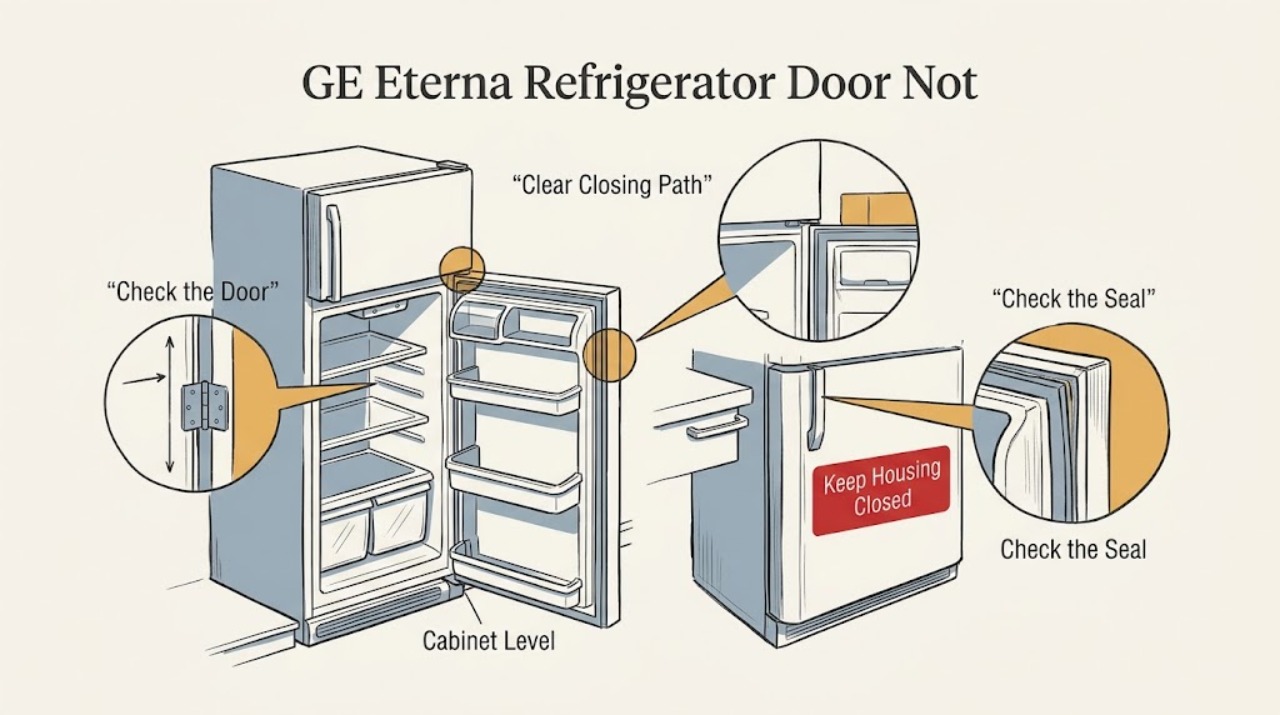
Work through in order
Diagnostic checks
Use only checks that match the exact appliance or system and its official guide.
-
Check 1
Read the model and serial label from the accessible interior or other documented location and note whether the appliance is a top-mount, side-by-side, or another configuration. Confirm the GE and Eterna name on the control panel if present, then retrieve the matching GE Owner's Manual before changing any door hardware.
Expected result: The model is readable; the Eterna marking is present; the model page identifies a specific door configuration; or the label is missing or unreadable.
Next step: Use the exact model documentation for any adjustment or replacement. If the identity cannot be confirmed, limit the work to external obstruction and visible gasket checks and call service for alignment or hardware.
Stop if: Do not infer a compatible hinge, gasket, cam, or door from the Eterna name alone.
Why this matters
Why: GE describes Eterna as a discontinued derivative line, not one universal refrigerator chassis. The model number determines whether the door has a top hinge, center hinge, dispenser wiring, adjustable rollers, or other construction that changes the safe procedure.
-
Check 2
Open the affected door only as far as needed and inspect the closing path from the front. Remove a projecting package, close every bin and drawer, reseat a shelf that is visibly out of position, rearrange a heavy door item that falls forward, and check the bottom edge for a small ice cube or other loose obstruction.
Expected result: A package, open bin, heavy item, shelf, drawer, or ice cube was blocking closure; the door closes after removal; or the door still stops or springs open.
Next step: Close the door gently and verify that it stays shut without hand pressure. If it still fails, leave the door closed as far as possible and continue with visible seal and alignment observations.
Stop if: Do not slam the door, push against a protruding bin, or use a tool to pry out ice at the hinge or seal.
Why this matters
Why: GE lists these external obstructions as common reasons a refrigerator or freezer door will not close. If clearing the path restores closure, hardware is less likely; if not, continue to level, gasket, and hinge checks rather than forcing it.
-
Check 3
With the door open, inspect the visible gasket, cabinet-facing surface, and door frame for food residue, a folded section, a tear, a section pulled out of its channel, or a gap that appears when the door is gently closed. Wipe only accessible residue with a soft damp cloth and dry the gasket; do not remove it.
Expected result: Residue prevents contact; the gasket is folded or displaced; the gasket is torn or hardened; the frame is bent; or the gasket appears to contact evenly but the door still will not close.
Next step: Correct only loose residue or a clearly accessible fold without pulling the gasket from its channel. For damage, a persistent gap, or a door that rubs the frame, arrange qualified service.
Stop if: Do not glue, cut, heat, stretch, or replace the gasket without the exact model procedure; do not operate the refrigerator with a large unsealed gap.
Why this matters
Why: A surface obstruction or displaced seal can prevent a complete close. A torn gasket, bent frame, or persistent gap is a sealing and alignment issue that cannot be identified as a particular part without the model and inspection.
-
Check 4
From the front and side, observe whether the cabinet rocks, leans, or sits unevenly and whether the door closes differently when nearly empty versus loaded. Check only the visible installation position; do not pull the refrigerator out or turn leveling feet unless the exact manual identifies them and the appliance can be handled safely.
Expected result: The cabinet is visibly unlevel or rocks; the door does not shut on its own; the unit is tightly built in; or the cabinet appears stable and level but the door remains low or offset.
Next step: Use the exact model's leveling instructions only when the adjustment is explicitly owner-accessible. Otherwise keep the door supported and arrange service for leveling or alignment.
Stop if: Do not tip, lift, roll, or pull out the refrigerator alone, and do not place objects under the cabinet or door as a permanent fix.
Why this matters
Why: GE says an improperly leveled refrigerator may prevent the door from shutting on its own. A built-in or heavy Eterna refrigerator may require an installer or technician to expose leveling hardware safely; a stable cabinet with a low or offset door makes hinge or door alignment more likely.
-
Check 5
Compare the door reveal to the cabinet and look from the side for sagging, a loose-looking hinge cover, rubbing at the top or bottom, or a door that drops when opened. Keep fingers away from hinge pinch points and do not remove hinge covers or fasteners.
Expected result: The hinge is visibly broken or loose; the door is sagging or rubbing; the door panel is damaged; or no hinge defect is visible.
Next step: Stop hardware troubleshooting and arrange qualified service for a broken, loose, sagging, rubbing, or damaged door. Provide photos and the exact model rather than ordering a generic hinge.
Stop if: Do not loosen hinge bolts, remove the door, support a heavy door with improvised blocks, or work near wiring or a dispenser line.
Why this matters
Why: A broken hinge or altered alignment can prevent the door from closing even after the path and level are correct. GE explicitly states that a broken hinge requires service. An apparently normal hinge does not rule out an internal cam, bracket, or door-support problem.
-
Check 6
After only an external obstruction or residue correction, close the door gently and check that the latch side meets the cabinet evenly, the gasket is not visibly rolled out, and the door stays closed without being held. Do not repeatedly cycle a door that is dropping, scraping, or pinching.
Expected result: The door closes and stays sealed; it closes but immediately rebounds; a corner remains open; the gasket pulls away; or the door cannot reach the frame.
Next step: If closure is not stable, keep openings brief, protect perishable food, and arrange service. Do not attempt to make the door stay shut with tape, weights, or a forced latch.
Stop if: Stop for a cracked door, sharp metal, a pinch hazard, a damaged seal, or a cabinet that shifts when the door moves.
Why this matters
Why: Stable closure after an external correction supports a blocked path or surface issue. Rebound, a corner gap, or a gasket that pulls away points to persistent alignment, level, seal, or hinge trouble and can compromise temperature control.
-
Check 7
If the obstruction, visible cleaning, level observation, and gentle-closure check do not restore a stable seal, stop owner diagnosis. Give GE or a qualified appliance technician the model and serial information, configuration, photos of the gap and hinge side, and the result of each external check.
Expected result: The hinge or frame is damaged; the gasket remains open; the cabinet needs leveling; the door contains a dispenser or wiring; or the door still does not close without a visible cause.
Next step: Keep the refrigerator closed as far as possible and arrange qualified GE appliance service. Do not order or install a part until fitment is confirmed against the complete model.
Stop if: Do not remove the door, disconnect wiring, drill or shim the cabinet, or attempt a hinge repair without the exact service procedure and proper support equipment.
Why this matters
Why: These results require model-specific alignment, hinge, gasket, door-support, dispenser, or cabinet work. The Eterna label alone cannot establish a safe part or procedure, especially for a discontinued line.
Use your observations
Decision map
Find the observation that best matches what you see, then follow the next safe action.
-
PATH 01Safety boundary
What you see
A package, open bin, drawer, heavy door item, shelf, or small ice cube physically prevents the door from reaching the cabinet.
Do this next
Remove or rearrange only the obstruction, then close the door gently. If it still will not stay shut, continue to seal and alignment checks.
Why this path and its safety boundary
Why it matters: An external obstruction is more likely than a broken hinge or gasket.
Safety stop: Do not pry against the door or hinge.
-
PATH 02Safety boundary
What you see
The path is clear, but the gasket is folded, displaced, torn, dirty, or visibly fails to contact the cabinet at a corner.
Do this next
Clean accessible residue or correct a loose fold only if it moves without force. Arrange service for damage, a persistent gap, or a gasket that will not seat.
Why this path and its safety boundary
Why it matters: A gasket or door-frame sealing problem is more likely; the door may appear closed while warm air enters.
Safety stop: Do not cut, glue, heat, or stretch the gasket.
-
PATH 03Safety boundary
What you see
The cabinet rocks or leans, and the door does not shut on its own even though the path and gasket appear clear.
Do this next
Use the matching model instructions only for an owner-accessible adjustment; otherwise have an installer or technician level the appliance.
Why this path and its safety boundary
Why it matters: Improper leveling is more likely. GE specifically identifies leveling as a cause of a door that will not shut on its own.
Safety stop: Do not lift, tip, or roll a heavy or built-in refrigerator alone.
-
PATH 04Safety boundary
What you see
The door sags, rubs, drops, has a broken or loose-looking hinge, or remains offset after the cabinet is stable and the path is clear.
Do this next
Stop hardware work, support the door by keeping it closed, and arrange qualified service with the Eterna model information.
Why this path and its safety boundary
Why it matters: Hinge, door-support, cam, bracket, or frame alignment is more likely; GE says a broken hinge requires service.
Safety stop: Do not loosen hinge fasteners or remove the door.
-
PATH 05Safety boundary
What you see
The door will not close, but no obstruction, gasket, level, or visible hinge cause is established, or the model identity is missing.
Do this next
Retrieve the model documentation if possible; otherwise call qualified GE appliance service and provide photos and the rating-plate information available.
Why this path and its safety boundary
Why it matters: A model-specific door or cabinet issue remains possible. The discontinued Eterna name does not identify a compatible repair part.
Safety stop: Do not use a generic GE hinge or gasket, force the latch, or improvise a permanent shim.
Helpful context
Understand the symptom
Confirm the Eterna identity, then use the model manual
GE says Eterna was a special derivative line marketed through selected dealers and is no longer manufactured. Existing refrigerators can have different top-mount, side-by-side, dispenser, and hinge arrangements. The GE and Eterna name on the control panel helps identify the line, but it does not identify a door part or adjustment. Record the model and serial number before ordering anything or attempting alignment.
Most safe checks are in the closing path
A door can look misaligned when a bin is open, a package projects, a heavy door item falls forward, or a small ice cube is caught at the bottom. Clear these external causes first. If the door still springs back, sits low, or leaves a visible gap, the next possibilities are level, gasket, hinge, or cabinet alignment—not a reason to force it shut.
Treat a damaged seal or hinge as a service boundary
A door that cannot seal can warm the food compartment and make the refrigerator run abnormally. A sagging door or damaged hinge can also create a pinch and drop hazard. Cleaning an accessible gasket is reasonable; removing the door, changing hinge geometry, or replacing a gasket on an unidentified Eterna model should be left to qualified service.
Safety boundary
Stop conditions
- Stop using or repeatedly opening the refrigerator if the door cannot seal, the cabinet tips or shifts, the door drops, a hinge is broken, or the gasket/frame is damaged; protect perishable food and arrange service.
- Do not force, slam, tape, weight, shim, or prop the door closed as a permanent solution, and keep fingers away from hinge pinch points.
- Do not remove the door, loosen hinge fasteners, move a heavy or built-in refrigerator, disconnect dispenser wiring, or replace a gasket, cam, bracket, or hinge without complete model-specific instructions.
- If the closing path is clear and the door still will not stay sealed, stop owner checks and call qualified GE appliance service.
When checks do not resolve it
Need a professional?
Arrange qualified GE appliance service when a GE Eterna refrigerator has a broken or loose-looking hinge, a sagging or rubbing door, a torn or persistent-gap gasket, a bent frame, an unlevel built-in cabinet, an unresolved door gap after external checks, or a missing model identity that prevents safe part selection.
Safety scope: This article covers model identification, external closing-path checks, visible gasket observation and cleaning, cabinet-position observation, and gentle closure testing. Door removal, hinge or cam adjustment, gasket replacement, dispenser wiring, cabinet movement, and structural repair require qualified service.
Common questions
FAQ
What is a GE Eterna refrigerator?
GE says Eterna was a special derivative appliance line produced through selected dealers, with both GE and Eterna names on the control panel. GE also says Eterna models are no longer manufactured, so the complete model and serial information are especially important for the correct manual and service decision.
Why will my GE Eterna refrigerator door not close?
Start with a package, open bin, heavy door item, drawer, shelf, or small ice cube blocking the path. If the path is clear, check visible gasket contact and whether the cabinet is level. A sagging or broken hinge requires qualified service; do not force the door or adjust hardware from a generic guide.
Can an unlevel GE Eterna refrigerator keep the door open?
Yes. GE's door-not-close guidance says an improperly leveled refrigerator may not shut on its own. Observe whether the cabinet rocks or leans, but use the exact model instructions before touching leveling feet and do not move a heavy or built-in appliance alone.
Should I replace the gasket on my GE Eterna refrigerator?
Only after the complete model confirms the correct gasket and procedure. First clean accessible residue and check for a fold or displacement without removing the seal. A torn gasket, persistent corner gap, or bent frame needs model-specific service rather than a generic replacement.
Can I adjust a GE Eterna refrigerator hinge myself?
Do not adjust or remove a hinge without the exact manual, proper door support, and model-specific instructions. GE says a broken hinge requires service. An Eterna badge does not establish which hinge, cam, bracket, or fastener fits your refrigerator.
Where can I find the manual for an older GE Eterna refrigerator?
Use GE Appliances' model-number literature search and the rating plate. GE says its site provides manuals and installation instructions for thousands of older models and explains that model and serial information is found on the appliance label. If the model cannot be read, provide photos and the available identifiers to qualified service.
Read the exact guide
Official sources
- Rating Plate Location on Older RefrigeratorsGE Appliances · Official GE support article for older GE, Profile, and Monogram refrigerators; exact Eterna label location may vary by model.
- GE Appliances - Eterna BrandGE Appliances · Official GE Appliances support page for the Eterna brand; it does not identify a specific refrigerator model or door part.
- GE Appliance - Download a Copy of Your Owner's Manual or Installation InstructionsGE Appliances · Official GE Appliances literature-support page; model number is required to select the applicable instructions.
- Refrigerator - Door Will Not CloseGE Appliances · Official GE refrigerator support article; exact door hardware and adjustments remain model-specific and are not established for every Eterna configuration.
- Explore RefrigeratorsGE Appliances · Official GE refrigerator overview; it is current product information and not a model-specific Eterna repair manual.
Community feedback
Share a repair observation
Share a plain-text repair observation. Accepted observations are published automatically; this page may take a moment to update.