
On this page
Start here
Quick answer
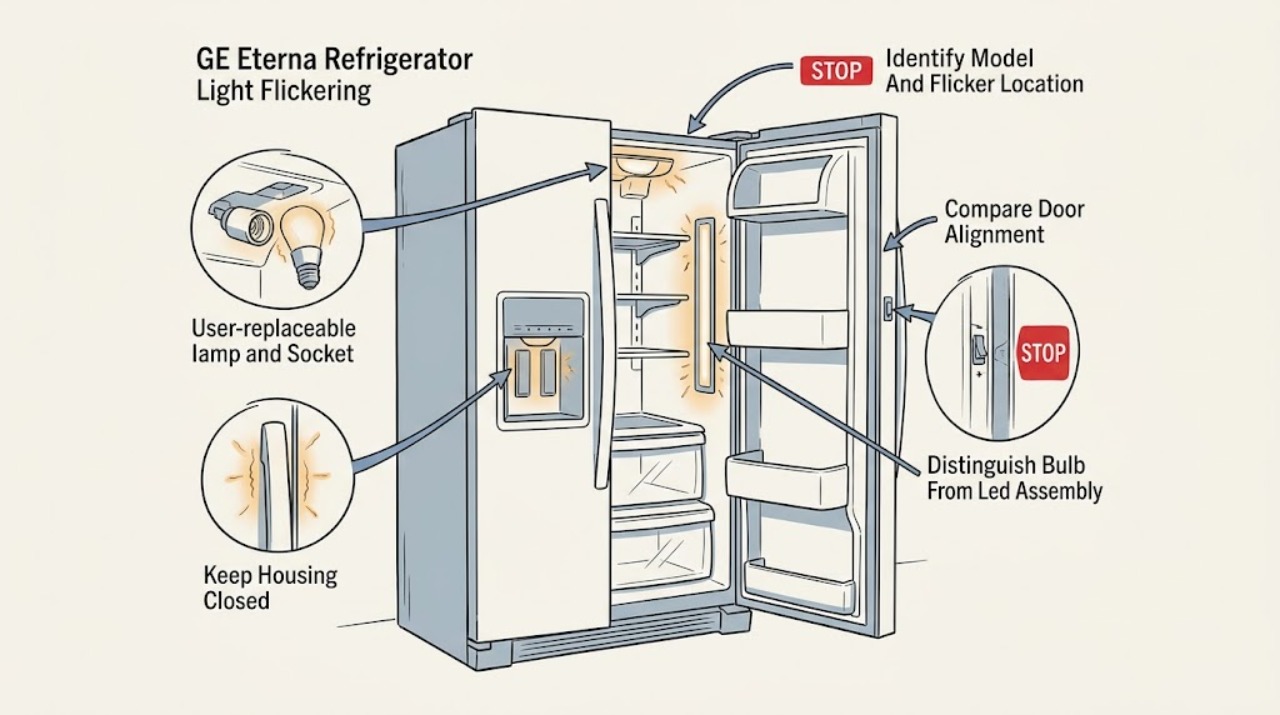
First determine whether one interior lamp, several interior lights, a dispenser light, or the whole refrigerator is flickering, and whether it happens only as the door is nearly closed. GE's Eterna information says the line included different feature mixes, so do not assume a common bulb, LED board, dispenser, or door-switch arrangement. If the light is a model-approved replaceable bulb, disconnect power, let it cool, and use only the same type, size, and rating specified by the exact manual; never test a loose socket while energized. GE says LED columns and individual LED assemblies require authorized service, and an intermittent LED usually is not a bulb to swap. If the light stays on or flickers at the door-closed position, inspect only visible door alignment and gasket seating; a misaligned door can leave the light on and add heat. For an equipped dispenser panel that flickers, one 30-second power disconnect is a reasonable GE-listed reset; service is needed if it returns. Stop for smoke, burning or electrical odor, sparks, a hot or damaged cord or outlet, water near electrical parts, repeated breaker trips, or any diagnosis requiring a cover or live test.
Before you begin
Safety first
- Do not remove light housings, dispenser trim, door wiring, switches, or refrigerator panels; do not probe a socket or perform live measurements; do not defeat a door switch or repeatedly reset a breaker. Stop for smoke, burning or electrical odor, sparks, abnormal heat, a hot or damaged cord or outlet, water near electrical parts, or repeated breaker trips.
Work through in order
Diagnostic checks
Use only checks that match the exact appliance or system and its official guide.
-
Check 1
Read the exact model from the refrigerator label or its GE literature without moving a built-in unit. With the appliance in normal operation, observe whether the flicker is in one fresh-food lamp, one freezer lamp, several interior lights, a dispenser light or panel, or the display and appliance together. Note whether it happens with the door open, nearly closed, during dispensing, or continuously.
Expected result: Only one lamp flickers; several interior lamps flicker together; the light flickers at the almost-closed door position; only the dispenser panel flickers; or lights and controls dim or restart together.
Next step: Continue with the branch matching the observed location and the exact model's manual. If obtaining the model requires pulling the refrigerator or touching a wet area, stop and arrange service.
Stop if: Stop immediately for smoke, burning or electrical odor, sparks, abnormal heat, a hot or damaged cord or outlet, water near electrical parts, or repeated breaker trips.
Why this matters
Why: The affected location selects the branch. One lamp can involve a bulb or its socket, several lights can involve a shared LED or control path, a near-closed symptom points toward the door trigger or alignment, and a whole-appliance symptom is an electrical or control concern. Eterna models do not have one guaranteed feature layout.
-
Check 2
From outside the refrigerator, close the door slowly and watch the light through the narrowing gap. Check only visible gasket seating, door obstruction, and whether the door sits squarely; do not press, tape, or bypass a door switch. Note the point at which the light should go out and whether a door must be lifted or pushed to change the flicker.
Expected result: The light flickers only near closure, remains on after the door is nearly shut, stops when a visible package or gasket obstruction is corrected, or flickers while the door is fully open.
Next step: Remove only a visible door or shelf obstruction and reseat a visibly displaced gasket without tools, then observe once. If the door remains misaligned, the switch is inaccessible, or the light stays on, arrange model-specific service.
Stop if: Do not remove the switch, adjust hinges under load, defeat the switch, or keep using the refrigerator if the light stays on and the cabinet warms.
Why this matters
Why: GE says that on most models the light should go out at about a one-inch opening and that a misaligned door can leave it on. A near-closed flicker makes the door switch, alignment, or gasket path more likely than a failed lamp; a fully open flicker points elsewhere.
-
Check 3
Use the exact GE literature to identify whether the affected light is a threaded or plug-in appliance bulb, an LED bulb shaped like a conventional lamp, an LED column, or an individual LED assembly. If and only if the manual identifies an owner-replaceable lamp, disconnect power, allow it to cool, and inspect the visible bulb for looseness, blackening, or damage; use only the specified replacement type, size, and rating.
Expected result: The manual identifies a user-replaceable bulb; the bulb is damaged or loose; the light is an LED column or individual LED assembly; or the lamp type cannot be identified from the model literature.
Next step: For a permitted bulb, install only the exact manual-specified type after power is disconnected and recheck once. For an LED assembly, damaged socket, or unknown design, leave the light circuit closed and arrange qualified service.
Stop if: Do not touch a lamp while powered, use a higher-wattage substitute, remove an LED housing, or probe the socket with a meter or tool.
Why this matters
Why: GE says bulb type, size, and wattage vary and that older traditional bulbs may be owner-replaceable. GE also says LED columns and individual LED assemblies require authorized service; a flickering LED is not evidence that a generic bulb will fit. An unidentified lamp should be treated as a service question.
-
Check 4
Only if the Eterna configuration has a dispenser, observe whether the flicker is limited to the dispenser lamp or touch panel rather than the refrigerator interior. From a dry, safe position, disconnect refrigerator power once for 30 seconds as GE describes for a dispenser panel that has no power or is not working, then restore power without touching wiring or the panel interior.
Expected result: The dispenser panel returns to normal after the single reset; it continues flickering; the dispenser is not fitted; or interior lights also flicker or controls restart.
Next step: Skip this check when no dispenser is installed. Arrange service if the panel flickers again, the reset does not help, the door wiring is involved, or other controls or lights are affected.
Stop if: Do not remove the dispenser trim, inspect door wiring while energized, bypass controls, or repeatedly cycle power.
Why this matters
Why: A one-time recovery supports a temporary dispenser-control state but does not prove a repaired component. A continuing dispenser flicker needs service, and a non-dispenser Eterna model cannot use this branch. Flickering throughout the appliance is a broader power or control symptom.
-
Check 5
Observe the refrigerator display, interior lights, compressor sound, and cooling after one safe light check. Note whether the flicker coincides with a display reset, compressor stop, temperature change, door remaining open, or a breaker event. Do not repeatedly unplug the unit or reset a breaker to reproduce the symptom.
Expected result: Only the light flickers while cooling remains normal; the display or controls also blink; the refrigerator is warm; the light stays on after the door closes; or a breaker trips or the cord or outlet becomes hot.
Next step: Keep the doors closed as practical and arrange qualified appliance service for a persistent light or any cooling/control symptom. For a confirmed house outlet, cord, or breaker hazard, obtain qualified electrical help.
Stop if: Stop using the refrigerator for smoke, burning or electrical odor, sparks, abnormal heat, water near electrical parts, a damaged cord or outlet, or repeated breaker trips.
Why this matters
Why: An isolated lamp symptom may stay within the lamp, switch, or LED path. A light that stays on can add heat, and GE notes that a misaligned door can affect cooling. A synchronized control, cooling, or electrical symptom is beyond a bulb-only diagnosis.
-
Check 6
After one applicable visible correction or permitted bulb replacement, record the exact model, light location, lamp type, door position, whether a reset was used, whether cooling changed, and whether the flicker returned. Do not open a cover to obtain a final confirmation.
Expected result: The light is stable; it flickers again at the same transition; an LED assembly or internal socket is implicated; several lights or controls are affected; or a safety symptom appears.
Next step: Arrange service with the model and symptom record. Do not order a bulb, LED board, switch, or control until the exact model and diagnostic result are confirmed.
Stop if: Stop immediately for smoke, burning or electrical odor, sparks, abnormal heat, water near electrical parts, damaged power parts, or repeated breaker trips.
Why this matters
Why: A stable result after an exact bulb or visible door correction supports that narrow path but does not identify a universal Eterna part. Recurrence, LED involvement, a shared-light symptom, or internal access indicates a switch, wiring, board, or control diagnosis for a qualified technician.
Use your observations
Decision map
Find the observation that best matches what you see, then follow the next safe action.
-
PATH 01Safety boundary
What you see
The light flickers only as the door approaches closed, remains on with a nearly closed door, or changes when a visible door obstruction or gasket position changes.
Do this next
Correct only a visible obstruction or gasket seating issue and observe once. Arrange service for a persistent transition flicker, an inaccessible switch, or a door that does not align.
Why this path and its safety boundary
Why it matters: The door switch, door alignment, gasket seating, or closure path is more likely than a lamp that is failing while fully open. GE says a misaligned door can leave the light on and affect cooling.
Safety stop: Do not defeat or remove the door switch, adjust a loaded hinge, or continue if the light stays on and the refrigerator warms.
-
PATH 02Safety boundary
What you see
One light flickers while the door is fully open, and the exact manual identifies an owner-replaceable bulb rather than an LED assembly.
Do this next
Disconnect power, let the lamp cool, and follow the exact manual for the specified bulb only. If the flicker returns or the socket is damaged, arrange qualified service.
Why this path and its safety boundary
Why it matters: A loose, damaged, or aging bulb or its socket is more relevant, but GE says the type, size, and rating vary by model. The flicker does not justify using a generic or higher-rated bulb.
Safety stop: Do not touch the socket while powered, use an unverified bulb, or replace a socket or wiring yourself.
-
PATH 03Safety boundary
What you see
The affected light is an LED column or individual LED assembly, several interior LEDs flicker together, or the lamp type cannot be identified from the model literature.
Do this next
Leave the housing closed and arrange qualified GE appliance service with the exact model, affected compartment, and a safe description or recording.
Why this path and its safety boundary
Why it matters: GE says LED light assemblies and columns require authorized service, and Eterna feature mixes vary. A shared flicker may involve the assembly, wiring, switch, or control, none of which can be identified safely by replacing a bulb at random.
Safety stop: Do not remove an LED cover, probe a connector, bypass a switch, or perform a live test.
-
PATH 04Safety boundary
What you see
The Eterna refrigerator has a dispenser and only its lamp or control panel flickers, with no whole-appliance power symptom.
Do this next
Perform the one safe power reset from a dry position, then arrange service if the flicker returns or the panel remains abnormal. Do not open the door trim or inspect wiring.
Why this path and its safety boundary
Why it matters: A temporary dispenser-control state is possible, and GE lists a single 30-second power disconnect for a dispenser panel with no power or function. A recurring flicker needs service; a model without a dispenser cannot use this branch.
Safety stop: Do not repeatedly cycle power, touch a wet dispenser, or continue if the panel is hot, sparking, or associated with an electrical odor.
-
PATH 05Safety boundary
What you see
The light flicker is accompanied by display resets, cooling loss, a breaker trip, a hot or damaged cord or outlet, smoke, burning or electrical odor, sparks, or water near electrical parts.
Do this next
Stop using the refrigerator from a dry, safe position and obtain qualified appliance or electrical service as appropriate. Protect food only if doing so does not require touching a hazard.
Why this path and its safety boundary
Why it matters: This is a broader power, control, or safety symptom rather than a lamp-only diagnosis. Repeated operation or repeated breaker resets can increase risk and can obscure the fault.
Safety stop: Do not touch wet electrical parts, pull a hot plug, bypass protection, open panels, or restart the appliance to reproduce the flicker.
Helpful context
Understand the symptom
Confirm what is flickering before choosing a repair path
GE's official Eterna page describes Eterna as a special retail line with different feature mixes, and says the appliances are no longer manufactured. That makes the model number especially important: an older Eterna refrigerator may use a replaceable lamp, while another GE refrigerator may use an LED column or individual LED assemblies. A flicker limited to one compartment light, a flicker at the door switch, and a flicker on a dispenser panel are different symptoms. Record the exact model and the affected location before ordering a bulb or opening anything.
A door-trigger symptom is different from a failing light assembly
Close the door slowly from outside and note whether the light flickers only near the point where it should turn off, or whether it flickers while the door is fully open. GE says most refrigerator lights should go out when the opening is reduced to about one inch and that a misaligned door can leave the light on. A fully open flicker in one replaceable bulb suggests a lamp or socket path; several LED lights or a flicker tied to controls suggests service rather than a universal bulb replacement.
Do not use the light as a live electrical test point
When the refrigerator door is open, the lamp socket can still be energized. If the exact manual permits a user-replaceable bulb, disconnect power from a dry, safe position and let the lamp cool before touching it. Do not remove an LED housing, probe a socket, defeat a door switch, pull door wiring, or reach behind a dispenser panel. Stop for smoke, an electrical or burning odor, sparks, heat, a damaged cord or outlet, water near electrical parts, or repeated breaker trips.
When checks do not resolve it
Need a professional?
Call qualified appliance service for a flickering LED assembly, recurring flicker after the exact bulb or visible door path is checked, multiple lights or controls flickering, a persistent dispenser-panel symptom, an inaccessible switch or socket, or any light problem with cooling loss. Stop immediately for smoke, burning or electrical odor, sparks, abnormal heat, damaged power parts, water near electrical parts, or repeated breaker trips.
Safety scope: Do not remove light housings, dispenser trim, door wiring, switches, or refrigerator panels; do not probe a socket or perform live measurements; do not defeat a door switch or repeatedly reset a breaker. Stop for smoke, burning or electrical odor, sparks, abnormal heat, a hot or damaged cord or outlet, water near electrical parts, or repeated breaker trips.
Have this ready
- Exact GE Eterna model and serial information, affected compartment or dispenser, whether the lamp is a bulb or LED assembly, door position when it flickers, whether one light or several are affected, any power reset, cooling or display behavior, and a safe recording if available.
Common questions
FAQ
Can I use any refrigerator bulb in a GE Eterna refrigerator?
No. GE says refrigerator lamp type, size, and wattage vary. Use the exact model's literature, and replace a bulb only if that model identifies it as owner-replaceable. Many LED columns and assemblies require service rather than a bulb replacement.
Why does the GE Eterna refrigerator light flicker as I close the door?
A door-switch transition, door alignment, gasket seating, or a visible obstruction is more likely when the flicker occurs only near closure. GE says the light should go out at about a one-inch opening on most models and that a misaligned door can leave it on. Do not defeat the switch; arrange service if the door does not align or the light remains on.
What if the flickering light is an LED panel?
Keep the panel closed. GE says individual LED assemblies and LED columns need authorized service. Record the exact Eterna model and which lights flicker, and do not probe, open, or replace the assembly while powered.
Read the exact guide
Official sources
- Refrigerator - Not Cooling EnoughGE Appliances · GE refrigerator guidance for a light that remains on; exact Eterna door geometry remains model-specific
- GE Appliances - Eterna BrandGE Appliances · Eterna brand identity; it does not establish one universal refrigerator model or light architecture
- Refrigerator - No Power to the DispenserGE Appliances · Only GE refrigerator configurations equipped with a dispenser panel; skip for Eterna models without one
- Refrigerator - Interior LED LightingGE Appliances · GE refrigerator LED columns and individual assemblies; confirm whether the Eterna model uses this design
- Refrigerator - Selecting Appropriate Light BulbsGE Appliances · GE refrigerator light guidance; exact Eterna model literature controls the bulb and procedure
Community feedback
Share a repair observation
Share a plain-text repair observation. Accepted observations are published automatically; this page may take a moment to update.