
On this page
Start here
Quick answer
If a GE Eterna refrigerator trips the breaker, treat the first priority as electrical safety and identify whether the trip is caused by the household circuit or the refrigerator. GE says Eterna was a special GE appliance line, is no longer manufactured, and that Eterna units may still be in homes; the exact model's rating plate and installation instructions are therefore important. Do not keep resetting the breaker or run the refrigerator through an extension cord or adapter. If the breaker trips with the refrigerator disconnected, or the circuit is not the model-required properly grounded dedicated branch circuit, have an electrician diagnose the house wiring. If the breaker holds with the refrigerator disconnected but trips again when the refrigerator is connected, qualified appliance service should diagnose the appliance. Stop immediately for smoke, burning odor, sparks, a hot or damaged plug/cord, water near electrical parts, or a buzzing/overheated receptacle; isolate power only if safe and do not touch damaged or wet equipment.
Before you begin
Safety first
- Do not repeatedly reset the breaker, use a larger breaker, bypass protective devices, use an adapter/extension cord as a fix, remove covers, probe live wiring, test internal components, or reconnect a wet/damaged appliance. Isolate power only when safe.
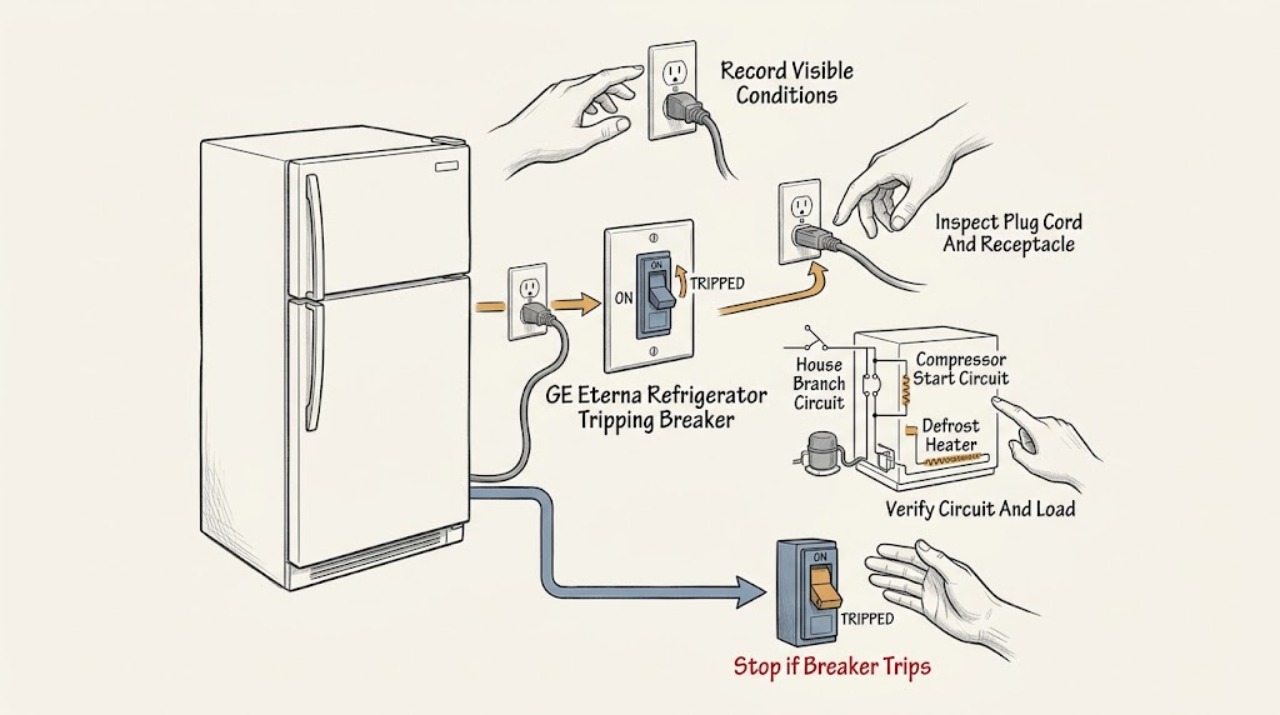
Work through in order
Diagnostic checks
Use only checks that match the exact appliance or system and its official guide.
-
Check 1
From a safe, dry position, record the complete GE Eterna model number, rating-plate electrical information if visible, outlet location, and what was happening when the breaker tripped. Note whether the refrigerator was recently moved, defrosted, cleaned, or exposed to water.
Expected result: The trip is immediate, occurs after a delay or compressor start, follows a recent move/water event, or the model/rating cannot be read safely.
Next step: Use the model's installation instructions for circuit requirements and give the timing and model to an electrician or appliance technician. If the label requires moving the appliance, do not move it solely for diagnosis.
Stop if: Stop and keep power off if there is odor, heat, smoke, sparking, water near electrical parts, or visible cord/receptacle damage.
Why this matters
Why: Timing can distinguish a fault present as soon as power is applied from one that appears when a load starts, but it cannot identify a failed component. Recent water, cord damage, or movement raises the safety priority.
-
Check 2
With the refrigerator not being handled or moved, visually inspect only the accessible plug, cord, and receptacle for scorching, melting, looseness, moisture, fraying, bent pins, or an adapter/extension cord.
Expected result: There is visible heat or damage, moisture, a loose or buzzing receptacle, an adapter/extension cord, or no visible external issue.
Next step: For damage or moisture, keep the unit disconnected if safe and call an electrician or appliance service. For an adapter or extension cord, do not substitute another one; have the correct model installation assessed. If the exterior is normal, continue only with circuit-level identification.
Stop if: Do not touch wet equipment, tape damaged insulation as a repair, tighten a live receptacle, or restore power to see whether damage worsens.
Why this matters
Why: Heat, damage, moisture, and arcing signs are stop-use conditions. An extension cord or adapter adds an installation and safety concern. A visually normal cord does not clear the refrigerator's internal electrical system.
-
Check 3
Have an electrician verify that the outlet is on the individual, properly grounded branch circuit required by the Eterna model's installation instructions and that other appliances are not sharing or overloading it. Do not open the electrical panel or alter wiring yourself.
Expected result: The circuit is shared or incorrectly rated/grounded, another load is involved, or the circuit meets the model requirement but the breaker still trips.
Next step: Correct circuit or receptacle issues through an electrician. If the circuit is compliant, leave internal appliance diagnosis to a qualified technician.
Stop if: Do not install a larger breaker, remove the ground pin, bypass a GFCI/AFCI, or make live measurements.
Why this matters
Why: GE says refrigerator electrical requirements are model-specific and generally call for an individual grounded circuit; a shared or incorrect circuit can cause nuisance trips or unsafe wiring conditions. A compliant circuit shifts suspicion toward the appliance, but does not prove which component failed.
-
Check 4
Only when there is no hazard and an electrician or the exact Eterna instructions say it is safe, disconnect the refrigerator's plug from the receptacle before resetting the breaker once. Keep the refrigerator disconnected while observing whether the breaker remains on; do not repeatedly cycle it.
Expected result: The breaker trips immediately while the refrigerator is disconnected, or it holds while disconnected.
Next step: If it trips disconnected, stop and call an electrician. If it holds, leave the refrigerator disconnected and arrange qualified appliance service rather than plugging it back in repeatedly.
Stop if: Do not perform this separation if the plug, receptacle, floor, or surrounding area is wet or damaged, and do not touch exposed conductors.
Why this matters
Why: GE says an immediate trip with the appliance disconnected is typically a house-wiring or breaker-box issue requiring an electrician; a breaker that holds disconnected makes an appliance-side fault more likely when the refrigerator is reconnected.
-
Check 5
Give the technician the Eterna model, breaker type and timing, circuit/receptacle observations, cord condition, whether the breaker holds with the appliance disconnected, and any recent leak, move, or repair. Keep the refrigerator out of service if reconnecting reproduces the trip.
Expected result: The appliance alone reproduces the trip, the breaker behavior is inconsistent, or the refrigerator remains disconnected without a confirmed hazard source.
Next step: Schedule qualified appliance service and, when the breaker or wiring is implicated, electrician service. Protect perishable food without handling wet or damaged parts.
Stop if: Do not remove covers, test capacitors or compressors, bypass protective devices, or order a part from the breaker symptom alone.
Why this matters
Why: A repeatable appliance-associated trip needs internal diagnosis; GE lists a shorted heater, timer, loose wire, or failed component as possible refrigerator causes, but none can be selected from the symptom alone.
-
Check 6
If smoke, burning or chemical odor, sparks, a hot plug or cord, water near electrical parts, melted insulation, a buzzing/overheated receptacle, or repeated immediate trips occur, stop using the refrigerator and keep people away from the area.
Expected result: A hazard sign is present, or there is no hazard and the breaker has remained stable after the appliance was disconnected.
Next step: Isolate power only if safe without touching wet or damaged equipment, call emergency services for an active fire, and otherwise contact a qualified electrician/appliance technician. Do not restore power for a test.
Stop if: Do not touch smoke-damaged equipment, wet controls, hot plugs, exposed wiring, or a repeatedly tripping breaker.
Why this matters
Why: A hazard requires stop-use and professional electrical/appliance assessment; a stable disconnected circuit is only an observation, not permission to keep reconnecting a suspect refrigerator.
Use your observations
Decision map
Find the observation that best matches what you see, then follow the next safe action.
-
PATH 01Safety boundary
What you see
After the refrigerator is safely disconnected, the breaker trips immediately or will not remain reset.
Do this next
Keep the refrigerator disconnected and have an electrician diagnose the breaker, receptacle, branch wiring, and other connected loads.
Why this path and its safety boundary
Why it matters: GE says this pattern is typically associated with house wiring or the fuse/breaker box, so the branch circuit or breaker is more likely than a refrigerator component.
Safety stop: Do not keep resetting the breaker or install a larger one.
-
PATH 02Safety boundary
What you see
The breaker holds with the GE Eterna refrigerator disconnected but trips again when the refrigerator is connected or starts.
Do this next
Leave the appliance disconnected and arrange qualified appliance service; have an electrician verify the circuit if its rating or grounding is uncertain.
Why this path and its safety boundary
Why it matters: The refrigerator cord or an internal appliance load is more likely, but the result does not distinguish heater, compressor start circuit, wiring, timer, or another component.
Safety stop: Do not reconnect repeatedly, bypass the breaker, or open the rear cover.
-
PATH 03Safety boundary
What you see
The refrigerator shares a branch with high-load appliances, uses an adapter/extension cord, or the outlet is not the model-required grounded individual circuit.
Do this next
Stop using the workaround and have an electrician correct the circuit and receptacle according to the Eterna installation instructions.
Why this path and its safety boundary
Why it matters: An installation or circuit-capacity problem is more likely than a confirmed appliance failure. GE warns against adapters and extension cords and says exact requirements are model-specific.
Safety stop: Do not remove the ground pin, replace the breaker with a higher rating, or continue using a damaged receptacle.
-
PATH 04Safety boundary
What you see
The breaker trips only after a delay, around a compressor/defrost event, or intermittently while the Eterna refrigerator is running.
Do this next
Record the timing without repeated tests, keep the appliance disconnected if it recurs, and have both the circuit and appliance assessed as appropriate.
Why this path and its safety boundary
Why it matters: A load-dependent appliance fault is possible, but timing alone cannot identify a compressor, heater, timer, wire, or control and could also reflect a circuit problem.
Safety stop: Do not use a plug-in tester as proof that internal appliance parts are safe and do not make live measurements.
-
PATH 05Safety boundary
What you see
Smoke, burning/chemical odor, sparks, hot or melted plug/cord, water near electrical parts, buzzing/overheated receptacle, or exposed damage is present.
Do this next
Keep clear, isolate power only if safe, call emergency services for active fire, and otherwise contact a qualified electrician and appliance technician.
Why this path and its safety boundary
Why it matters: This is an immediate stop-use condition; repeated resets or temperature troubleshooting could increase shock or fire risk.
Safety stop: Do not touch the equipment, restore power, or remove panels.
Helpful context
Understand the symptom
Confirm the Eterna model and the trip pattern
GE describes Eterna as a discontinued special GE line rather than a current refrigerator family with one universal wiring layout. Record the model and serial information from the accessible rating label or paperwork, and note whether the trip happens immediately on energizing, after the compressor starts, during a cycle, or only when other loads are running. Do not move a heavy or built-in refrigerator just to reach a label.
Separate a circuit problem from an appliance problem safely
The useful decision is whether the breaker trips while the refrigerator is disconnected or only after the refrigerator is connected. A breaker that trips with the appliance disconnected points toward the branch circuit, receptacle, breaker, or another load and belongs with an electrician. A breaker that holds while disconnected but trips when the Eterna refrigerator is connected points toward the appliance or its cord and belongs with qualified appliance service. This observation does not identify a compressor, heater, timer, wire, or control part.
Stop instead of repeatedly resetting
Do not repeatedly reset a tripping breaker, bypass the breaker, replace it with a larger rating, remove refrigerator panels, probe live wiring, or use an adapter to keep the unit running. GE notes that refrigerators require a properly grounded individual circuit and strongly recommends no extension cord. If smoke, burning odor, sparks, a hot or damaged plug/cord, water near electrical parts, or a buzzing/overheated receptacle is present, keep clear and isolate power only if safe; call qualified electrical or appliance service.
When checks do not resolve it
Need a professional?
Call an electrician when the breaker trips with the refrigerator disconnected, the branch circuit or receptacle is shared, incorrectly grounded, incorrectly rated, hot, loose, or damaged. Call qualified appliance service when the breaker holds disconnected but trips when the GE Eterna refrigerator is connected, and stop immediately for smoke, burning odor, sparks, hot/damaged plug or cord, water near electrical parts, or repeated immediate trips.
Safety scope: Do not repeatedly reset the breaker, use a larger breaker, bypass protective devices, use an adapter/extension cord as a fix, remove covers, probe live wiring, test internal components, or reconnect a wet/damaged appliance. Isolate power only when safe.
Have this ready
- Complete model and serial information, rating-plate requirements, breaker type/rating, trip timing, whether the breaker holds with the refrigerator disconnected, circuit/receptacle and cord observations, other loads, and any smoke, odor, heat, water, or spark symptoms.
Common questions
FAQ
Is GE Eterna still making refrigerators?
GE's official Eterna information says Eterna was a special GE appliance line and is no longer manufactured, although Eterna-branded appliances may still be in homes. Use the exact model number and its documentation for any service or electrical decision.
Can I keep resetting the breaker to see if the refrigerator starts?
No. GE recommends service when a breaker keeps tripping. A single safe separation observation may help an electrician or technician, but repeated resets can worsen a fault and are inappropriate when there is heat, odor, water, sparks, or visible damage.
Should a GE Eterna refrigerator use an extension cord?
GE strongly recommends that refrigeration appliances not use an extension cord and says the refrigerator should be on an individual, properly grounded circuit. Do not use an adapter or extension cord to work around a tripping breaker; have the installation checked.
Does a breaker trip prove the compressor is bad?
No. GE lists several possible refrigerator causes, including a shorted heater, timer, loose electrical wires, or another failed component, and a circuit or breaker fault can produce a similar symptom. Timing can guide service but cannot identify a part.
Read the exact guide
Official sources
- GE Appliances - Eterna BrandGE Appliances · Brand-level identity only; Eterna is discontinued and the exact refrigerator model must be confirmed before model-specific repair or parts claims.
- GE Appliance - Circuit Breaker TripsGE Appliances · General GE refrigerator guidance; exact Eterna circuit and component details require the model documentation and professional diagnosis.
- GE Appliance - Resetting Your Circuit BreakerGE Appliances · General reset guidance; repeated tripping requires service rather than repeated homeowner testing.
- Refrigerator - Electrical Requirements and Breaker SizeGE Appliances · General guidance; the Eterna model Owner's Manual or Installation Instructions control exact requirements.
- Refrigerator & Freezer - Extension Cord or AdapterGE Appliances · General refrigeration safety guidance applicable to installation review; does not identify an Eterna internal fault.
Community feedback
Share a repair observation
Share a plain-text repair observation. Accepted observations are published automatically; this page may take a moment to update.