
On this page
Start here
Quick answer
First identify where the water lands. Water dripping from the outdoor side of a GE window room air conditioner can be normal: condensation and rain collect in the base pan and a rear fan slinger ring throws some water onto the condenser; GE says not to drill a drain hole or routinely remove a drain plug because that can reduce efficiency. Water dripping, spitting, or spraying into the room is not normal. Turn the unit off and isolate power from a dry, safe position, then check the model-authorized filter/cleaning guidance and whether the window unit is level or tilted slightly outward—GE's room-AC guidance uses about 1/4 inch outward tilt. If the unit is portable, ductless, or central, do not apply that window tilt rule. Persistent indoor water, ice, damaged wiring, water near an outlet, or a leak that remains after safe external checks needs qualified service; do not open the cabinet or work on coils, refrigerant, drain paths, or electrical parts.
Before you begin
Safety first
- The owner may turn the unit off, isolate power from a dry position, inspect the landing location, clean or replace an accessible model-authorized filter, and visually note a window installation condition without moving the unit. Qualified appliance/HVAC service must handle cabinet removal, coils, fans, internal drains or pumps, refrigerant, wiring, live testing, and window-unit removal or reinstallation.
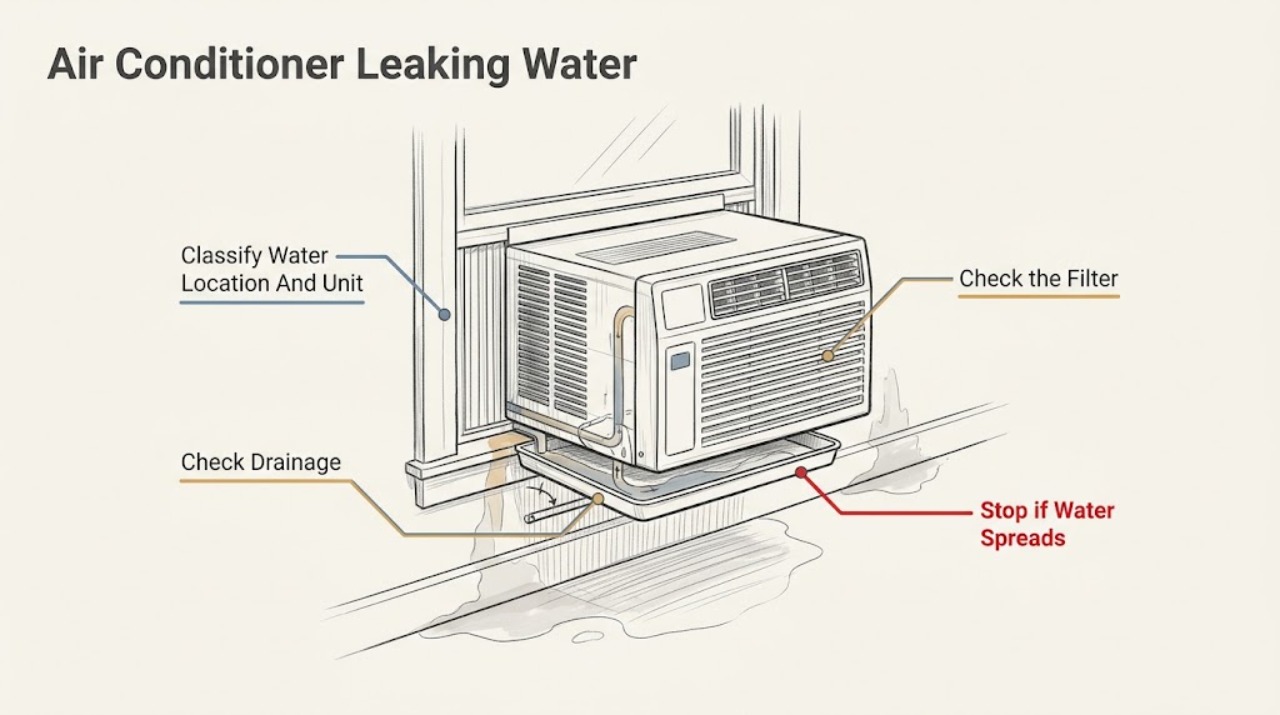
Work through in order
Diagnostic checks
Use only checks that match the exact appliance or system and its official guide.
-
Check 1
From a dry position, turn the GE air conditioner off and record the exact model and architecture. Identify whether water is outside at the rear, inside below the indoor coil or from the louvers, only being misted/spit, or near the plug, cord, or outlet. Note whether the unit is a window/room model, portable model, or a ductless/central HVAC system, and when the water appears.
Expected result: The water is outdoor-only, indoor liquid/spitting, near electrical equipment, or the unit is not a room/window model.
Next step: Follow the matching location branch only. If the unit is portable, ductless, or central, use its exact manual or contact an HVAC professional; if water is active near electricity, isolate power from a dry safe position and stop.
Stop if: Do not run the unit to reproduce the leak, reach into wet areas, move a heavy window unit, or use a countertop/portable drain procedure on a window unit.
Why this matters
Why: Outdoor water can be normal base-pan drainage, while indoor water is not normal. Water near electrical equipment is a hazard. A non-window architecture does not inherit GE's window tilt and slinger-ring guidance.
-
Check 2
For a GE window/room unit with water only on the outdoor side, inspect from outside without opening the cabinet. Note whether conditions are humid or rainy and whether the water is dripping from the rear/base-pan area rather than entering the room. Do not add a hole or remove a plug unless the exact manual expressly describes a storage or service procedure.
Expected result: Outdoor dripping occurs during humidity/rain and no indoor water is present, or water is entering the room or appears unrelated to the rear base pan.
Next step: Leave the outdoor drainage design intact when there is no indoor leak. If the water is entering indoors, proceed to filter, cleaning, and installation checks; if the rear leak is excessive, persistent in dry conditions, or the cabinet is damaged, arrange service.
Stop if: Do not drill the base pan, install an improvised drain, or routinely remove a drain/sub-base plug to solve an indoor leak.
Why this matters
Why: GE says condensation and rain can fill the base pan, and the slinger ring throws water onto the outdoor condenser coil; outdoor dripping can therefore be normal. Indoor water is a different fault path.
-
Check 3
For indoor dripping or spitting from a room/window unit, keep the appliance off and inspect the accessible air filter according to the model manual. Look for visible dust or restricted airflow and for obvious accessible dirt that the model's cleaning instructions permit you to address; keep water and cleaner away from controls, plug, outlet, and wiring.
Expected result: The filter is visibly dirty or airflow is restricted, the model authorizes accessible cleaning and debris is present, or the filter and accessible surfaces are clean.
Next step: Clean and dry the filter exactly as the model manual directs, then leave the unit off if water remains. If indoor dripping continues with a clean filter or the unit is icing, arrange service rather than opening the cabinet.
Stop if: Do not spray cleaner into the cabinet, scrape a coil, remove a cover, or operate the unit with a wet filter or water near electrical parts.
Why this matters
Why: GE lists a filter that needs cleaning and a unit that needs cleaning as possible contributors to indoor water. A clean accessible filter does not prove the condensate path, indoor coil, or internal drain is clear.
-
Check 4
For a window/room unit only, visually check from a stable, dry position whether the cabinet is level or slightly lower toward the outdoors, and whether the installation appears to have shifted. GE's general guidance uses about a 1/4-inch tilt to the outside for water disposal. Do not loosen the mount, lift the unit, or attempt to reinstall it while it is in the window.
Expected result: The unit visibly slopes into the room, appears level/slightly outward, or the support/mount is loose, damaged, or no longer secure.
Next step: If the installation is visibly shifted, stop using the unit and have a qualified installer/service technician secure or reinstall it. If it is stable and correctly oriented but leaks indoors, escalate to appliance service for the internal water path.
Stop if: Do not push, shim, remove, tilt, or lift a window unit, and do not apply the 1/4-inch rule to portable, ductless, or central systems.
Why this matters
Why: GE says an indoor leak can result when a room air conditioner is tilted slightly into the room and describes a slight outward tilt for drainage. A loose or shifted window installation adds a fall and electrical hazard, not a DIY adjustment opportunity.
-
Check 5
Record the model, water location, weather/humidity, cooling performance, filter result, installation appearance, and any visible ice, odor, smoke, cord/outlet heat, or repeated electrical protection event. Keep the air conditioner off when indoor water persists or any hazard is present.
Expected result: Water remains after safe external checks, ice is present, cooling is abnormal, the unit is a different HVAC architecture, the mount is unsafe, or electrical damage/hazard is visible.
Next step: Arrange qualified GE appliance service for a room/window unit or a licensed HVAC professional for ductless/central equipment. If there is smoke, a hot/damaged cord or outlet, sparks, or water at electrical equipment, leave it isolated and use electrical service as appropriate.
Stop if: Do not open the cabinet, handle refrigerant, test live voltage, access the fan or coil, or continue operating a unit that is leaking indoors or electrically unsafe.
Why this matters
Why: The remaining possibilities can include an inaccessible condensate path, coil/fan problem, sealed refrigeration issue, drain/pump arrangement, installation fault, or electrical fault. These cannot be identified safely from the outside and are not solved by adding a drain hole.
Use your observations
Decision map
Find the observation that best matches what you see, then follow the next safe action.
-
PATH 01Safety boundary
What you see
A GE window/room unit drips outdoors from the rear during humid or rainy conditions, with no indoor water.
Do this next
Leave the base-pan design intact and monitor only for a change to indoor leakage, structural damage, or abnormal electrical symptoms. Do not drill a drain hole.
Why this path and its safety boundary
Why it matters: This pattern matches GE's described base-pan and slinger-ring operation: condensate and rain can collect, then water can be thrown onto the outdoor condenser coil or drip from the rear.
Safety stop: Do not remove a drain plug during normal operation or treat normal outdoor drainage as proof of an indoor drain failure.
-
PATH 02Safety boundary
What you see
Water drips, spits, or sprays into the room and the filter is dirty or airflow is visibly restricted.
Do this next
Clean and dry the accessible filter using the model manual, keep liquid away from electrical parts, and arrange service if indoor water persists or ice forms.
Why this path and its safety boundary
Why it matters: GE lists a filter needing cleaning and a unit needing cleaning among possible causes of indoor water. The observation supports an airflow/cleaning branch but does not prove the internal drain is clear.
Safety stop: Do not spray into the cabinet, scrape coils, or operate with a wet filter.
-
PATH 03Safety boundary
What you see
A stable, room/window unit visibly slopes toward the room or appears to have shifted in its mount.
Do this next
Stop using it and have a qualified installer or service technician correct the installation. A portable or central unit needs its own drainage instructions instead.
Why this path and its safety boundary
Why it matters: GE says a room air conditioner tilted slightly into the room can cause indoor water; a shifted or loose mount adds a mechanical fall risk and should not be corrected by pushing the appliance.
Safety stop: Do not lift, shim, loosen, or reinstall a window unit yourself.
-
PATH 04Safety boundary
What you see
The GE product is portable, ductless, central, or another HVAC architecture rather than a room/window unit.
Do this next
Use the exact model manual and contact the installing HVAC provider or a qualified HVAC professional for a persistent leak. Keep the unit off if water is near electrical equipment.
Why this path and its safety boundary
Why it matters: The window-unit base pan, slinger ring, and outward-tilt guidance cannot be assumed. The condensate hose, pump, drain, or installation boundary may be different.
Safety stop: Do not drill a drain, alter a condensate line, open refrigerant circuits, or apply the window tilt rule.
-
PATH 05Safety boundary
What you see
Indoor water continues after the filter/visible checks, or there is ice, abnormal cooling, water near an outlet, a hot/damaged cord, smoke, or repeated electrical protection operation.
Do this next
Leave the unit isolated and arrange qualified appliance or HVAC/electrical service. Provide the model, water location, timing, weather, photos, and safe check results.
Why this path and its safety boundary
Why it matters: The problem may be an inaccessible condensate path, coil/fan or sealed-system fault, installation failure, or electrical hazard. The visible symptom does not identify a safe replacement part.
Safety stop: No operation to reproduce the leak, cabinet removal, live testing, refrigerant work, or improvised drainage.
Helpful context
Understand the symptom
The landing side changes the diagnosis
A GE window air conditioner can normally discharge water outdoors during humid or rainy conditions. That is different from liquid entering the room or being sprayed onto the room side. Before touching the unit, note whether the water is outside at the rear, inside below the indoor coil, being spit from the louvers, or coming from the plug, cord, or outlet. Water near electrical equipment is a stop condition, not a cleaning clue.
Apply the window-unit rule only to a window unit
GE's opened water guidance is for room/window air conditioners. It describes an outdoor drainage angle of about 1/4 inch and a base-pan/slinger-ring design. A portable unit, ductless system, central split system, or other GE HVAC product can have a different condensate hose, pump, drain, or installation requirement. Use its exact manual or contact an HVAC professional rather than improvising an angle or drain.
Do not turn a leak into an electrical or refrigerant repair
Turn the air conditioner off and disconnect power only from a dry, safe position. Do not reach behind a wet unit, remove the cabinet, add a drain hole, access the fan or coil, handle refrigerant, or probe wiring. A persistent indoor leak, visible ice, damaged cord, hot outlet, smoke, or water near the receptacle belongs with qualified appliance or HVAC service.
Only after diagnosis
Potential parts
- model-matched air filter
Consider only when the exact model uses a replaceable filter and the visible filter is damaged or cannot be cleaned as directed; a dirty filter alone does not identify an internal leak part.
Filter shape and access vary by GE air-conditioner model. Confirm the complete model number and the manufacturer's fit information. - window installation support or seal materials
Consider only when a qualified installer confirms a shifted, damaged, or model-specific installation component is allowing water indoors.
Window hardware, seals, and installation requirements vary by model and window; do not infer a part from a leak alone. - condensate drain or internal water-path component
Consider only after qualified service identifies an internal water-path component as the cause of persistent indoor leaking.
Internal drain, pan, fan, coil, and pump arrangements are model-dependent and may require cabinet access; confirm diagnosis and fit first.
When checks do not resolve it
Need a professional?
Safety scope: The owner may turn the unit off, isolate power from a dry position, inspect the landing location, clean or replace an accessible model-authorized filter, and visually note a window installation condition without moving the unit. Qualified appliance/HVAC service must handle cabinet removal, coils, fans, internal drains or pumps, refrigerant, wiring, live testing, and window-unit removal or reinstallation.
Common questions
FAQ
Is water dripping outside my GE window air conditioner normal?
Often, yes. GE says condensation and rain can collect in the base pan and the rear fan's slinger ring throws water toward the outdoor condenser coil, so outdoor dripping can be normal during humid or rainy conditions. Indoor dripping is a different problem.
Why is my GE air conditioner leaking water into the room?
GE says indoor dripping, spitting, or spraying is not normal. For a room/window model, start with the model-authorized filter and accessible cleaning guidance, then visually check whether the unit is level or tilted slightly into the room; GE describes about a 1/4-inch outward tilt for window drainage. Persistent leaks need service.
Should I drill a drain hole in my GE window air conditioner?
No. GE says the operating design retains water in the base pan and uses the slinger ring to handle some of it; adding a drain hole or routinely removing a drain plug can reduce efficiency. Use the model manual or service guidance instead.
Does the 1/4-inch outward tilt apply to every GE air conditioner?
No. GE's opened guidance applies that approximate outward tilt to window room air conditioners. Portable, ductless, and central systems can use different condensate arrangements, so follow the exact manual or contact an HVAC professional.
When should I stop using a leaking GE air conditioner?
Stop when water is entering the room, near the plug or outlet, or accompanied by ice, smoke, a hot/damaged cord, sparks, or repeated electrical protection. Isolate power only from a dry, safe position and arrange qualified appliance, HVAC, or electrical service.
Read the exact guide
Official sources
- Window Air Conditioner - Drain PlugGE Appliances · GE window room air-conditioner base-pan, drain-plug, and slinger-ring operating design
- Support for GE Air ConditionersGE Appliances · GE air-conditioner support routing, model-specific support, room-air-conditioner leak topics, and GE Profile Smart Air Conditioner support
- Air Conditioner - Spitting or Spraying WaterGE Appliances · GE room air-conditioner indoor water spitting, filter, installation-angle, and cleaning guidance
- Air Conditioner - Water Dripping OutsideGE Appliances · GE window/room air-conditioner outdoor base-pan drainage and normal outdoor dripping
- HVAC (Ductless, Ducted, Side Discharge) – Technical Service and SupportGE Appliances Air & Water · GE ductless, ducted, side-discharge, and other HVAC service boundary and owner support
Community feedback
Share a repair observation
Share a plain-text repair observation. Accepted observations are published automatically; this page may take a moment to update.